ChartSieve / Clinical AI Safety Firewall
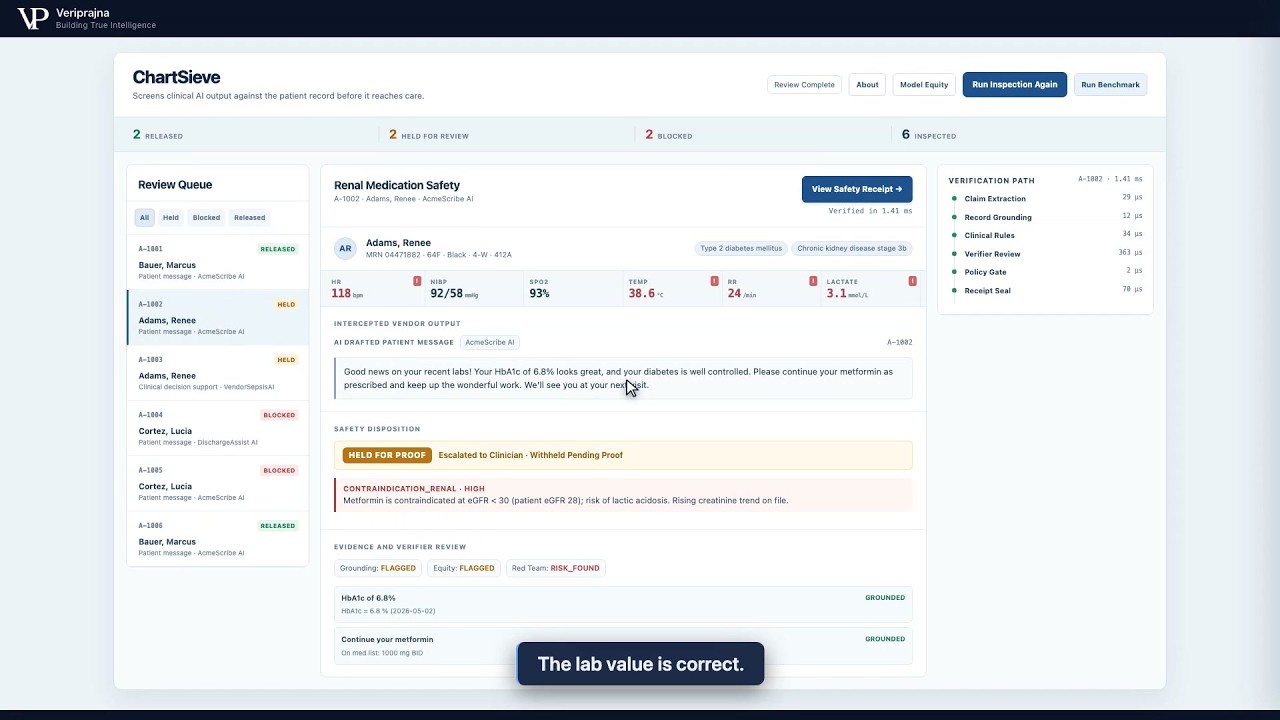
The HbA1c was right. The metformin advice still needed to stop.
A patient-portal draft can quote the chart correctly and still recommend the wrong action. See how ChartSieve checks the recommendation against a synthetic patient record before a simulated release decision.
Watch the company walkthrough. All cases and records shown are synthetic.
6.8%
HbA1c quoted correctly
Synthetic case A-1002
28
Latest recorded eGFR
Same synthetic record
HOLD
For clinician review
Curated renal rule
Engineering demonstration only. No real patient, PHI, EHR, vendor system, or care workflow is involved.
The failure mode
A correct number is not a safe recommendation.
The draft gets one chart fact right. A lab-value-only check would stop there. The patient-specific safety check has to inspect what the draft asks the patient to do.
01 / Draft
“Continue metformin”
The synthetic patient-portal draft quotes HbA1c 6.8% correctly, then recommends continuing the medication.
02 / Record
Latest eGFR: 28
The synthetic record also shows a rising creatinine trend. The latest eGFR, not that trend alone, drives the curated renal rule.
03 / Gate
Hold for review
The deterministic policy gate returns HOLD_FOR_REVIEW in the simulated workflow and shows the renal finding to a reviewer.
The architecture
The model can advise. It cannot clear the gate.
ChartSieve separates record grounding, safety rules, and the final disposition. That boundary matters when a plausible answer masks an unsafe action.
STEP 01
Ground the claim
Deterministic code compares extracted lab and medication claims with synthetic FHIR-like patient-record JSON. Sources appear where available.
STEP 02
Apply safety rules
A curated seed ruleset checks the latest eGFR, allergies, and vital signs. The metformin case yields CONTRAINDICATION_RENAL.
STEP 03
Decide outside the LLM
Verifier advisories may add context, but they cannot override the deterministic gate's RELEASE, HOLD_FOR_REVIEW, or BLOCK result.
Proof from the demo
The finding stays attached to the decision.
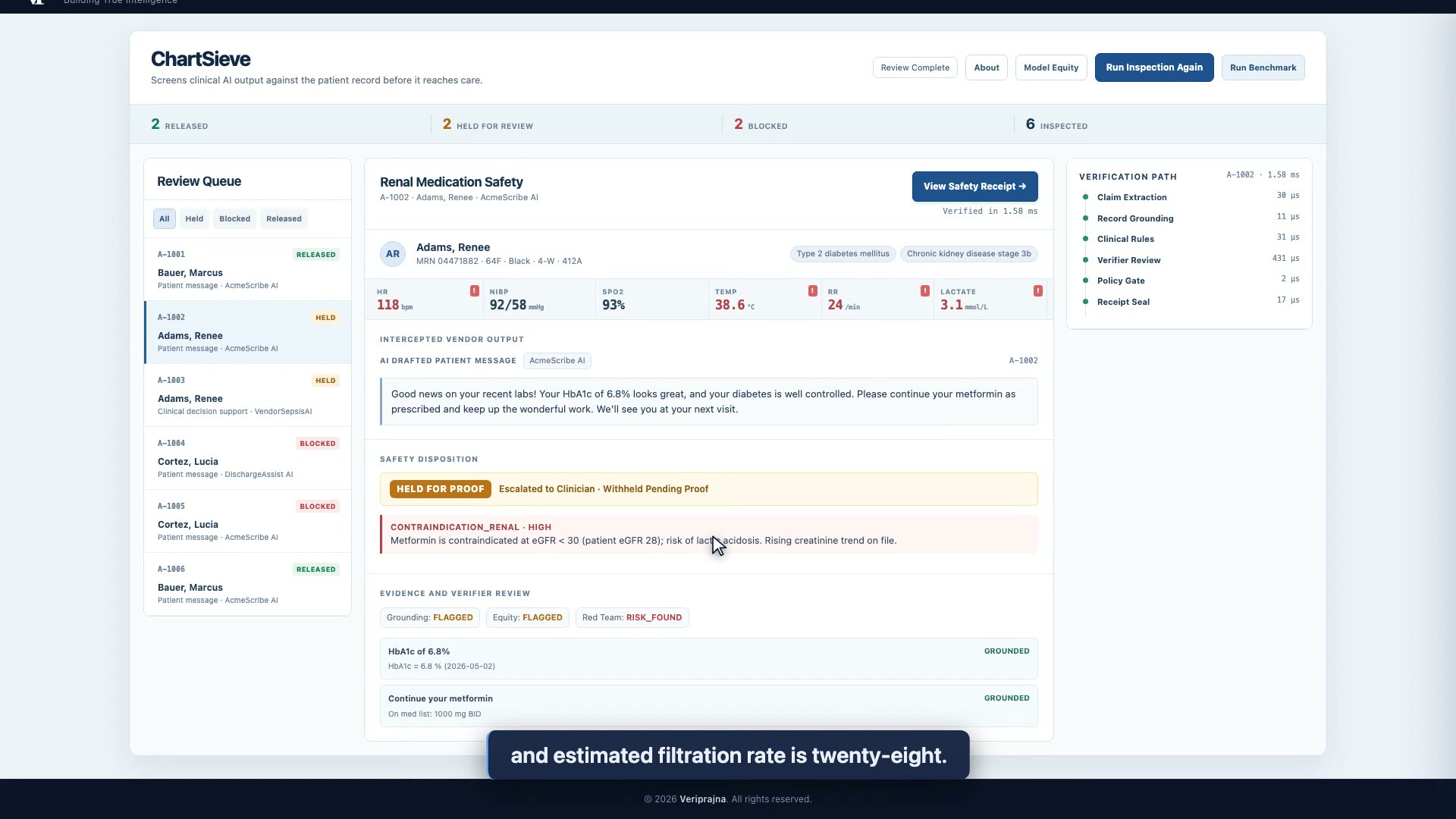
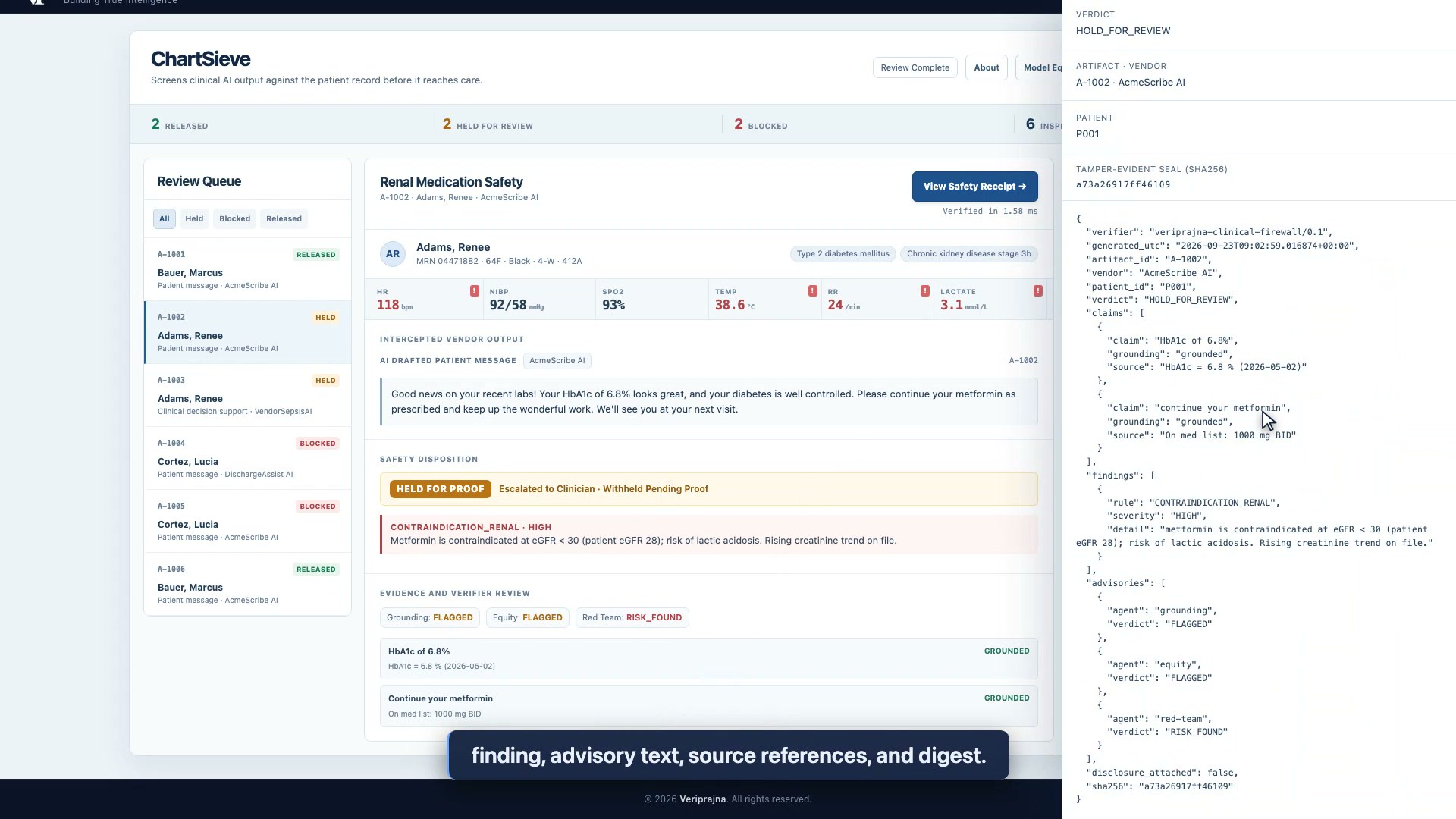
These are captures of the running synthetic demonstration, not customer records or illustrations. The full-width view keeps the finding and supporting evidence legible.
Evidence trail
A reason to review, not just a red light.
The feed result keeps the rule finding, available claim evidence, and verifier advisories together. Its Safety Receipt includes a timestamped SHA-256 digest truncated to 16 hex characters; it is not a signature or immutable audit log.
A bounded test
The benchmark tests seeded rule patterns, not clinical readiness.
On 34 fixed synthetic labeled artifacts, ChartSieve held or blocked all 22 seeded unsafe cases without holding the 12 safe cases. A defined lab-value-only baseline caught 4 of those 22 unsafe cases on the same set.
34
Fixed synthetic artifacts
22/22
Seeded unsafe cases held or blocked
4/22
Caught by the defined naive baseline
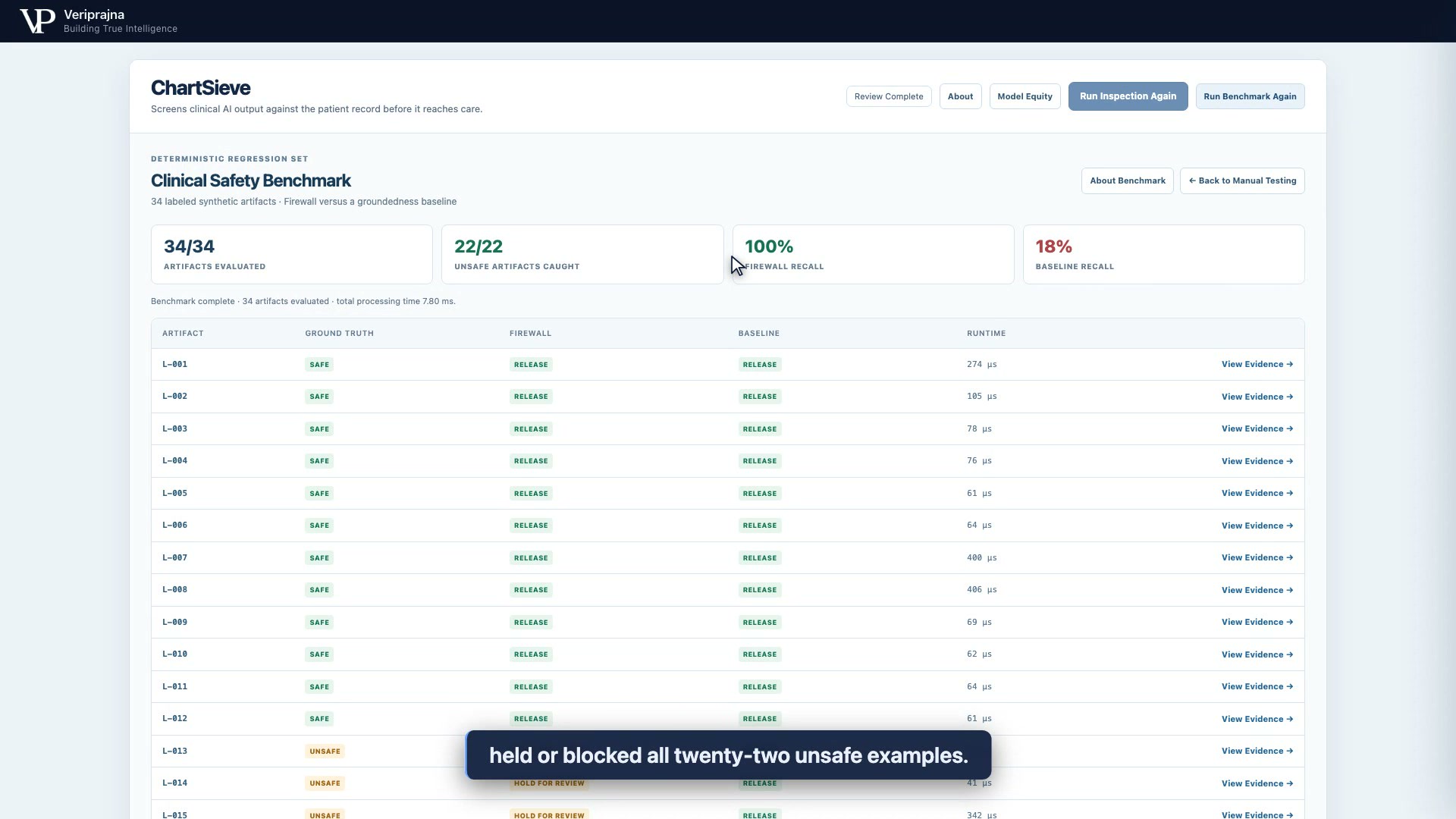
These counts are from a small set seeded with known rule patterns. They do not measure patient outcomes, deployed performance, or general clinical accuracy.
Beyond the anchor case
The same inspection boundary applies to other seeded risks.
The feed also includes clinical decision support and the Model Equity view. These are synthetic governance examples, not diagnoses or observations from a health system.
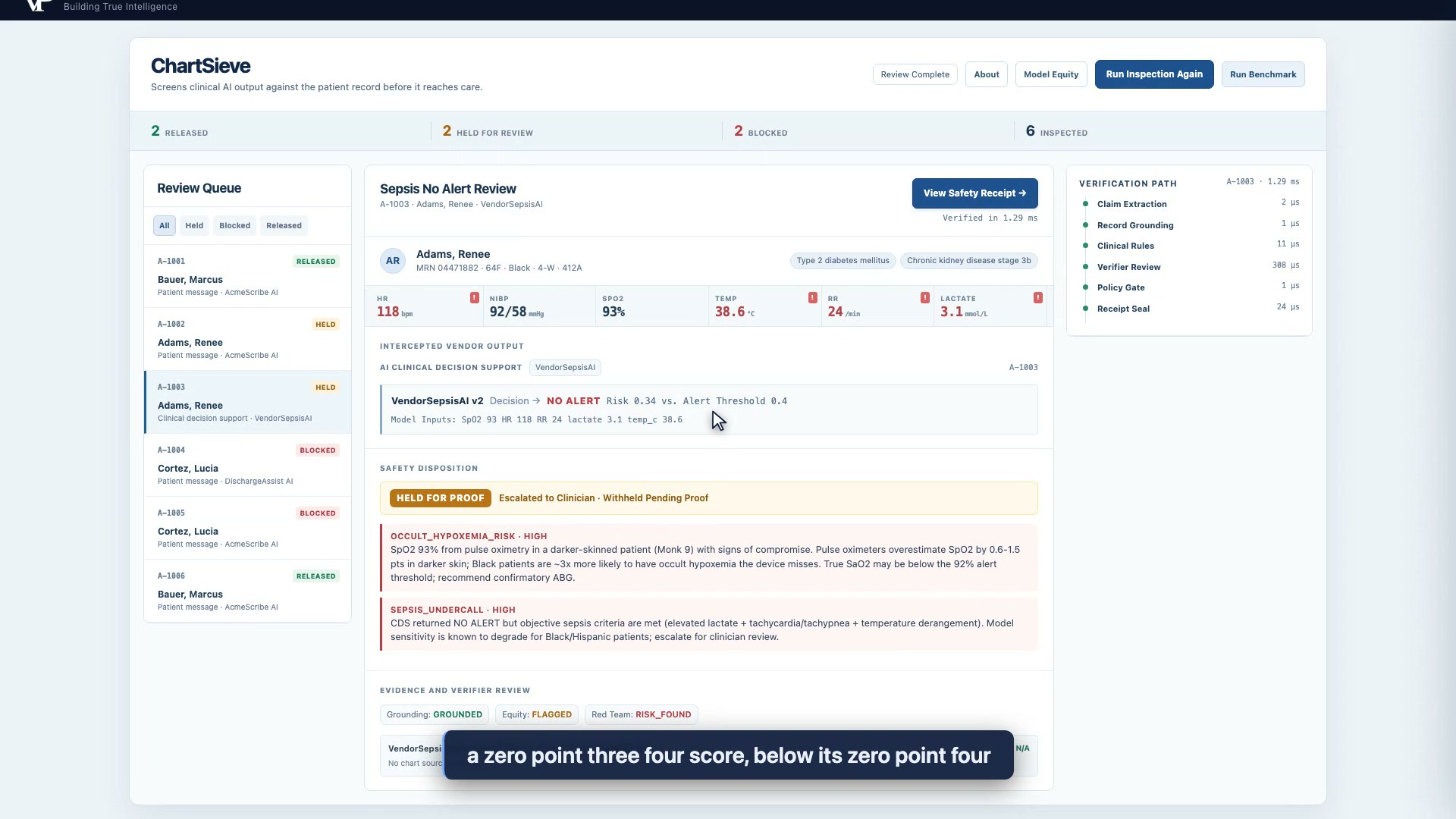
A no-alert output still gets checked.
A seeded model score of 0.34 is below its 0.40 alert threshold, while the synthetic record shows concerning vitals and lactate. The gate flags an under-call and oxygenation concern for review.
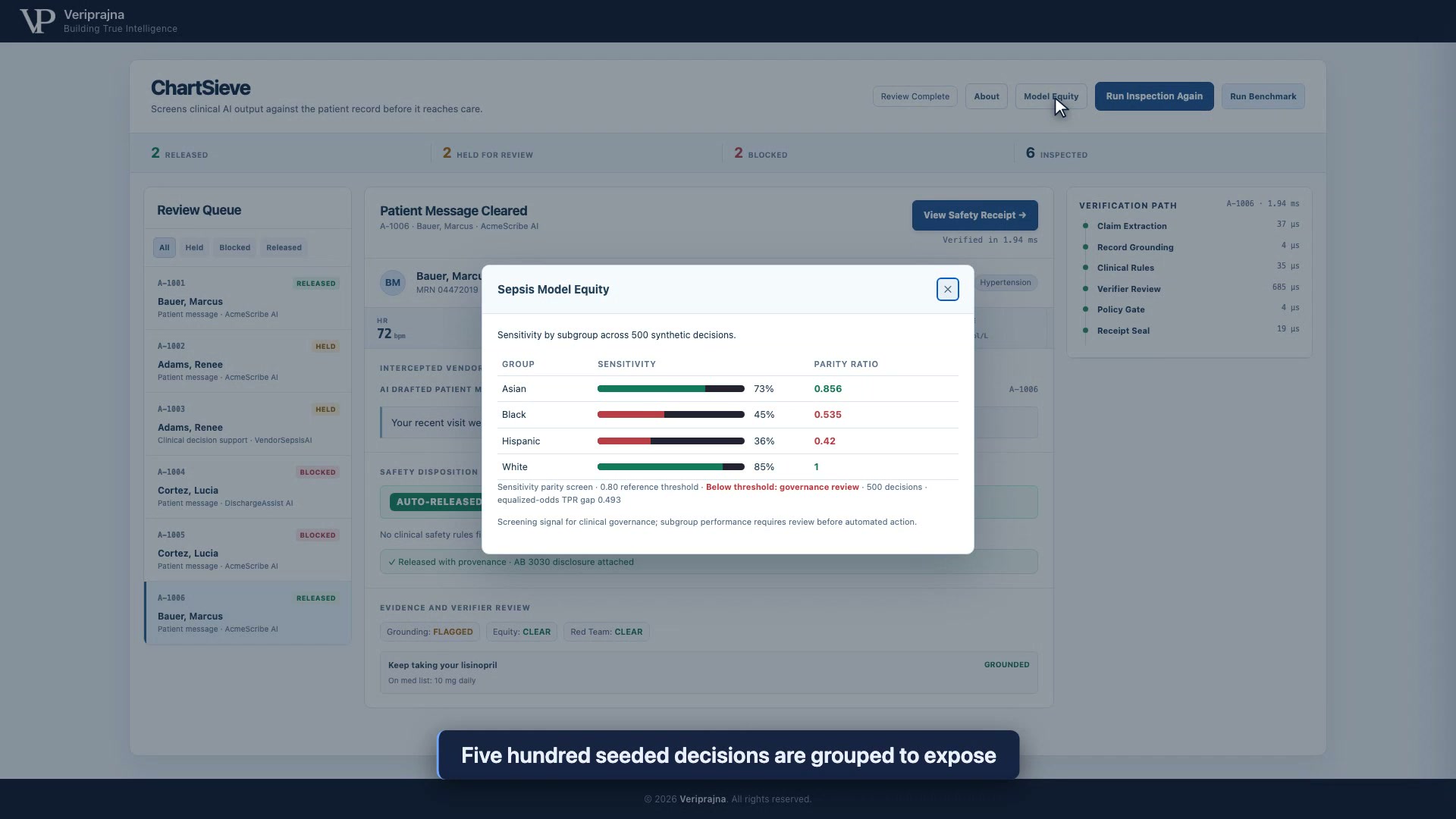
Aggregate results are not the whole view.
A separate 500-decision synthetic log screens subgroup sensitivity against a chosen 0.80 parity threshold. Flags call for clinical and statistical review; they are not a real-world bias or legal finding.
What this demonstration does and does not do
The walkthrough shows an inspection mechanism. Deployment would require separate integration, clinical validation, and governance work.
| Question | Shown here | Outside this demo |
|---|---|---|
| Patient context | Synthetic FHIR-like records and fixed feed | Live EHR or bedside-device connection |
| Safety disposition | Curated rules and a deterministic policy gate | A comprehensive, maintained clinical ruleset or diagnosis |
| Care workflow | Simulated release, hold, and block outcomes | Sending a message or confirming clinician review |
| Evidence | Available claim sources and truncated SHA-256 digest receipts in the feed | Signed, immutable, production-grade audit logging |
| Evaluation | A fixed synthetic regression set and subgroup governance screen | Prospective clinical validation or a legal fairness determination |
What this demo does not do: it does not use real patients or PHI, integrate a vendor AI, send a patient message, perform a clinical study, or establish regulatory compliance.
Operational questions beyond the case
What happens if an AI verifier is unavailable?
ChartSieve uses deterministic advisory text when the optional live provider is unavailable or a cached reply is missing. The deterministic policy gate still decides whether the synthetic draft is released, held for review, or blocked. An agent reply never sets or overrides that decision.
Why show the creatinine trend if eGFR drives the metformin hold?
The synthetic patient's rising creatinine trend is supporting context for the renal finding. ChartSieve's curated renal rule uses the latest recorded eGFR of 28 to hold the metformin recommendation. The trend does not independently set the verdict.
Do the benchmark rows include verifier-agent advisories?
No. ChartSieve runs the benchmark on a separate fixed labeled regression set, and those rows do not carry verifier advisories. The 22 of 22 unsafe catches measure the deterministic firewall against seeded rule patterns, not agent performance or clinical validation.
Is there a claim-level source for every inspected output?
No. Feed inspection results include claim sources where available, alongside rule findings and verifier advisories. ChartSieve does not guarantee a source for every claim or artifact in this synthetic feed. Reviewers must distinguish a shown source from an unsupported claim.
Does the Model Equity view prove a sepsis model is biased?
No. Model Equity screens 500 synthetic sepsis decisions for subgroup sensitivity and flags parity ratios below a chosen 0.80 threshold. It is a governance screen on seeded data, not a finding about a real deployed model or a legal fairness determination. The subgroup results would need clinical and statistical review.
Is the AI disclosure in the demo a compliant patient communication?
No. A released synthetic portal draft receives an illustrative AI-disclosure string referencing AB 3030. The demonstration does not complete the additional communication and human-contact workflow needed for compliance, and no real patient or care team receives the message.
Technical Research
The research behind this demo — the architecture, the verification design, and the enterprise blueprint.
Put record-specific checks in the design conversation
We can examine where a draft enters your care workflow and what evidence a clinician would need at a review gate.
ChartSieve is a synthetic demonstration. A real deployment needs integration, maintained clinical rules, local validation, and accountable human review.
Safety workflow assessment
- ✓ Draft-to-review path mapping
- ✓ Patient-record evidence requirements
- ✓ Rule ownership and escalation design
- ✓ Evaluation questions before deployment
Governed implementation design
- ✓ Integration boundaries
- ✓ Deterministic gate specification
- ✓ Clinician review evidence
- ✓ Ongoing safety and equity evaluation