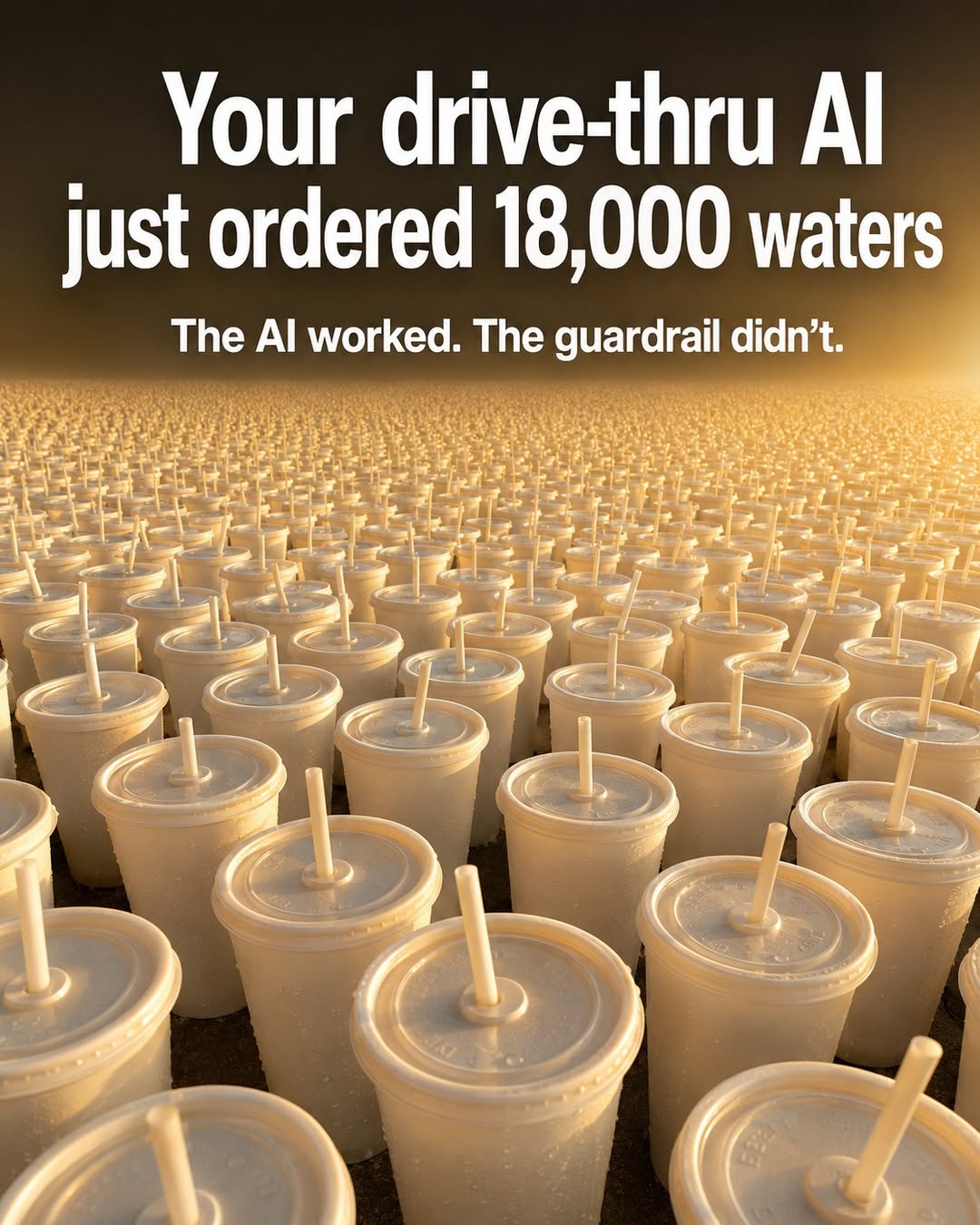
Taco Bell's drive-thru AI accepted an order for 18,000 cups of water. The AI wasn't broken. It understood the order perfectly.
The system recognized the words exactly right. What it didn't have was a single line of business logic asking: is this order physically possible? No quantity cap. No anomaly check. No rate limit per session. So a prank flowed straight to the kitchen display, racked up 21.5 million views, and paused its AI expansion.
The same gap is why McDonald's AI once added 260 Chicken McNuggets to one car and garnished an ice cream with bacon. In every case the language understanding was correct. The guardrail was just absent.
What we keep finding: the gap between 80% accuracy (McDonald's-IBM, partnership killed in 2024) and 96% (Hi Auto at Bojangles, ~500 locations) isn't a smarter model. It's three engineered layers almost nobody builds —
→ Signal processing at the speaker post, where engine rumble at 200-400Hz lands right on the male voice fundamental
→ A deterministic validation layer between the AI and the POS that takes 2-3 weeks to build and stops the 18,000-waters category of failure cold
→ Disfluency-tolerant speech handling, so the system stops cutting off the 80 million people who stutter — a growing ADA exposure
The model is rarely the problem. The architecture around it is.
If you've watched a drive-thru AI fail in the wild, what actually broke — the recognition, or the missing layer downstream of it?
#VoiceAI #QSR