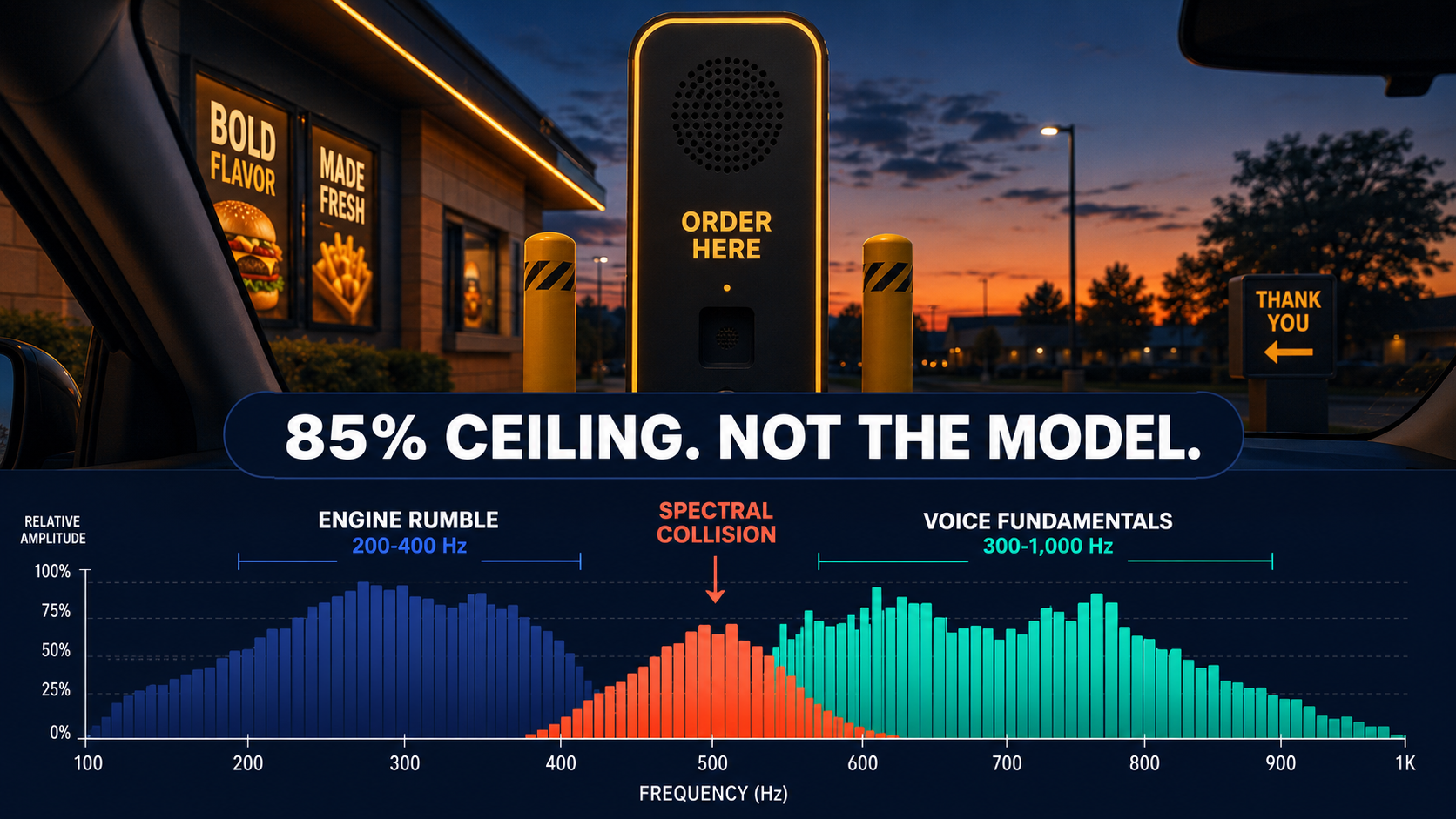
The gap between 85% and 99%+ autonomous accuracy in drive-thru AI is not a model problem. McDonald's spent three years with IBM discovering this: multiple model updates, architecture revisions, and a partnership termination in July 2024 at an accuracy rate that never cleared 80–85%. The 260-nugget incident became internet folklore. The Museum of Failure gave it a listing. But the model wasn't the ceiling. Everything the model had to operate through was.
Three engineering layers sit between a spoken order and a correct transaction at the speaker post: the acoustic signal that reaches the model, the ordering logic that validates what the model returns, and the range of speakers the system was built to understand. Every serious AI drive-thru failure in the last two years traces to one or more of these — not to the language model at its center.
Today's deployment data confirms the pattern. Wendy's FreshAI reports 86% autonomous accuracy (99% with human assist). SoundHound's "Julia" at White Castle runs at 96%+ accuracy and 90%+ order completion, claiming $58,000 in annual savings per location. Hi Auto at Bojangles processes 100 million orders annually at 93% completion, 96% accuracy, across roughly 500 locations. The spread between these deployments — all well-funded, all at scale — exists almost entirely because of how each one handles the three engineering layers, not because of model quality differences.
The Acoustic Problem That Starts Before the Model Hears a Word
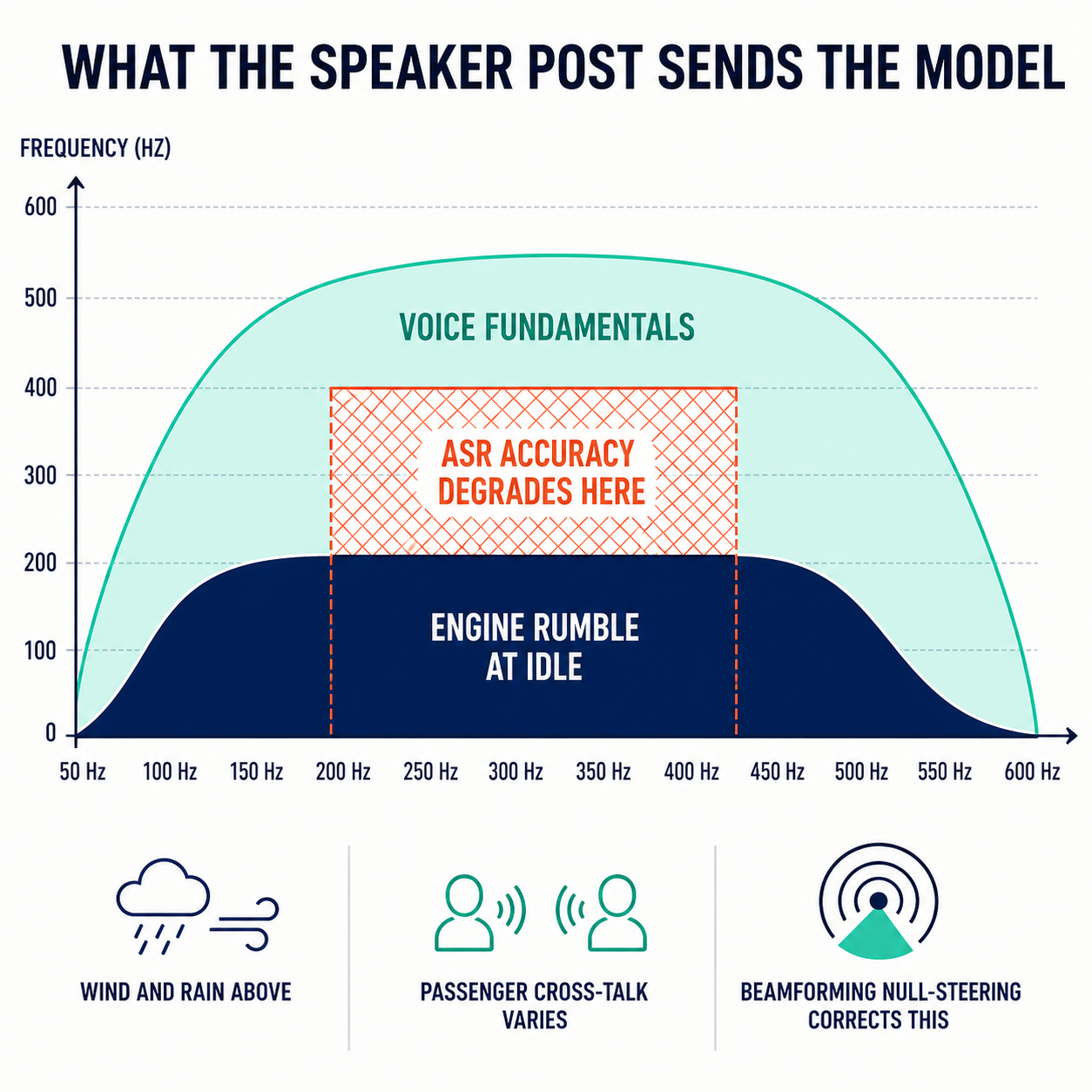
Standard automatic speech recognition was calibrated for clean speech or call-center audio. The drive-thru speaker post is neither. Idling vehicle engines generate noise primarily in the 200–400 Hz range — the same band where voice fundamentals live. That spectral overlap arrives at the microphone through the same path as the voice, not as background noise at a distance, but as interference at the source, mixed with wind, rain, and whatever a passenger is saying from the far side of the vehicle.
Off-the-shelf ASR degrades under these conditions before any order complexity is introduced. Beamforming arrays with null-steering calibrated to the speaker-post geometry — and spectral subtraction tuned to the idling-vehicle noise floor — are what close this gap. Neither Google's Vertex AI backing Wendy's FreshAI nor NVIDIA's GPU infrastructure behind Taco Bell's Byte by Yum! addresses this layer as a component. Both platforms provide powerful model infrastructure. Neither ships with speaker-post acoustic engineering.
The accuracy gap at the speaker post begins before the model hears a word.
That's why the Wendy's FreshAI complaint record includes "three attempts needed to complete an order" and "bot cuts off mid-sentence." Customer frustration with those failures is often attributed to a weak AI. The actual cause is audio reaching the model that the model wasn't designed to handle.
What the Taco Bell Incident Was Actually Telling You
In August 2025, a customer discovered that Taco Bell's AI ordering system would accept an order with an implausible quantity of near-zero-cost items and process it without challenge. The exploit generated 21.5 million social media views, forced Taco Bell to pause its AI expansion, and accelerated its shift to a hybrid human-assist model.
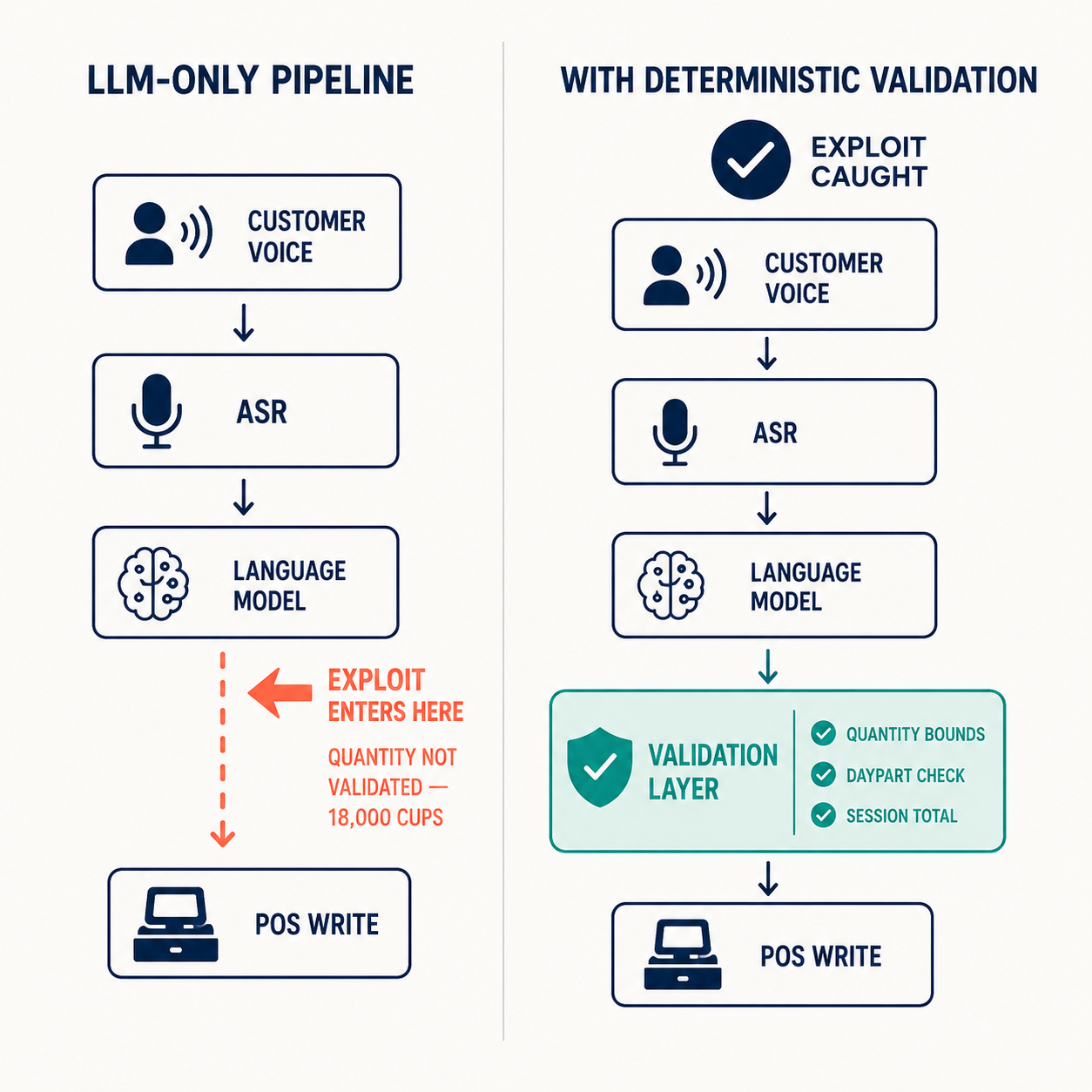
This gets framed as an AI hallucination. It was an ordering logic failure. The language model did exactly what language models do — it interpreted natural-language input and generated a transaction. What was absent was a deterministic validation layer: quantity within configurable bounds, item availability confirmed for the current daypart, session totals checked against realistic thresholds for a single vehicle. None of those checks require a smarter model. They require an architecture that doesn't treat the model as the last line of defense.
An LLM-only ordering pipeline is adversarially fragile by design. The guardrails it needs don't come from the model — they run after it.
Our QSR drive-thru engineering work — the full architecture is at https://veriprajna.com/solutions/qsr-drive-thru-voice-ai — treats the validation layer as a separate engineering concern from the language model. Quantity bounds, daypart logic, multi-lane session isolation, and modifier conflict resolution are deterministic rules that execute after the model interprets the order and before the transaction writes to POS. They're not designed to be reasoned around.
The POS Integration Where Deployments Go Quiet
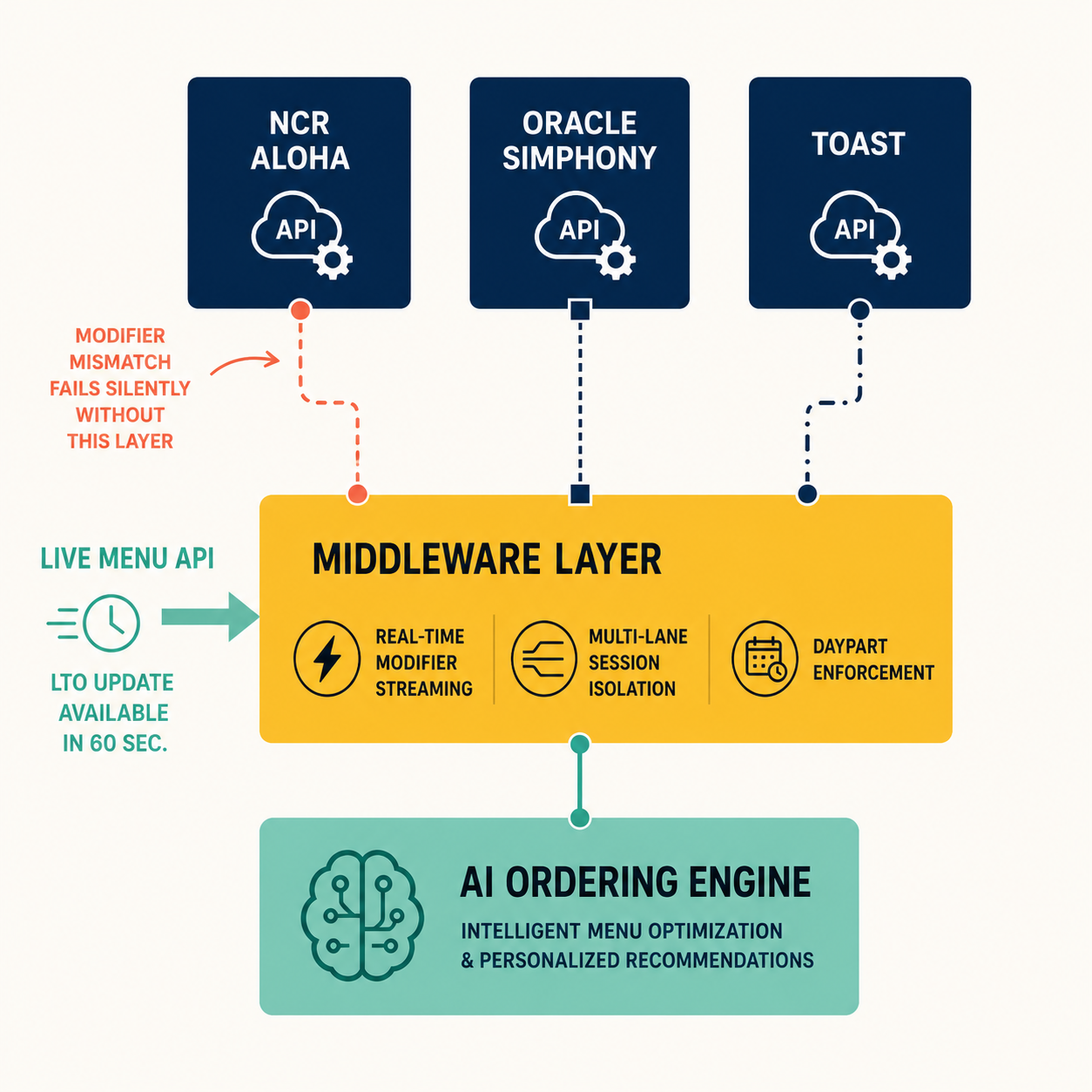
Menu middleware is where most QSR voice AI deployments encounter their first extended pause. NCR Aloha, Toast, and Oracle Simphony each expose different APIs with different limitations around real-time modifier streaming, multi-lane session isolation, and daypart enforcement. A chain running limited-time offers, regional items, and dayparting makes two to four menu changes per week. A system that requires model retraining to accommodate each change is effectively offline for hours between updates.
The NCR Aloha API error log for a chain running LTOs tells the story concisely: when the modifier "ghost pepper ranch" exists in the digital menu but hasn't propagated to the POS modifier tree, every order including it either fails silently or requires manual crew intervention. At 17–18 cars per hour per lane, most of those failures go uncaught until the customer at the pickup window says something.
Dynamic NLU grounding via live menu API solves this structurally — the model reasons against current menu state, not a training snapshot, so a 5:00 AM item addition in Simphony is immediately available at the speaker post at 5:01 AM without a model update cycle. That's not a capability most off-the-shelf platforms provide. It's engineering at the integration layer.
The Accessibility Exposure Accumulating on the Court Docket
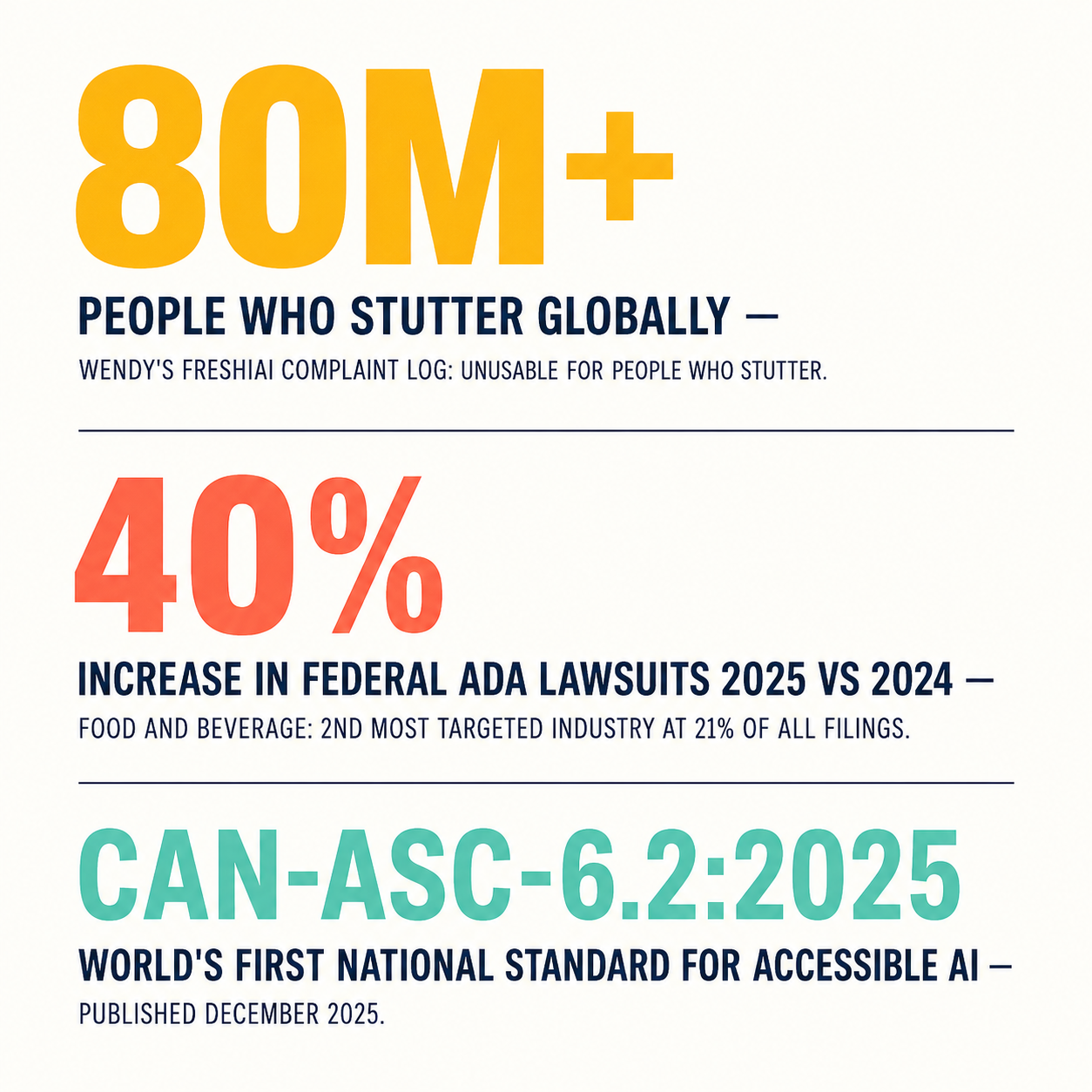
Food and beverage companies are the second-most-targeted industry for ADA lawsuits — 21% of all filings — with federal cases up 40% in 2025 versus 2024. No case has yet named a QSR voice AI system specifically. The regulatory trajectory suggests that window is closing.
Stuttering affects more than 80 million people globally. Wendy's FreshAI's complaint record already includes "unusable for people who stutter" — not from an accessibility audit, but from customer reviews. A drive-thru AI that consistently fails on disfluent speech, and routes those customers to a manual window as its only response, is creating an unequal service condition for a protected class.
Canada's CAN-ASC-6.2:2025, published December 2025 and the world's first national standard for accessible AI systems, requires equitable access across disability status, meaningful ability to decline AI for a human alternative, and transparency in AI decisions. The EU AI Act adds transparency obligations effective August 2026: customer-facing voice AI must inform speakers they're interacting with AI. Neither of these frameworks requires solving the hard acoustic problems — they require documenting that you tried and that alternatives exist.
The BIPA question is more precise than most legal teams realize. The Carpenter v. McDonald's class action was dismissed because the court accepted that the NLP system didn't constitute biometric speaker recognition. Any voice AI architecture that maintains speaker-identifying features across sessions — for personalization, repeat-order suggestions, or disfluency profiling — moves into a different legal analysis than the one that produced that dismissal. The dismissed case isn't a compliance clearance; it's a fact-specific ruling on one specific architecture.
The Throughput Constraint That Makes All Other Tradeoffs Real
QSR operations measure drive-thru performance in CPHPL — cars per hour per lane. The 2025 industry data puts AI-powered lanes at 17–18 CPHPL versus 16 without AI. That gain is real and measurable. So is the risk in the other direction: any validation logic, escalation round-trip, or API call that pushes response latency above 300ms pulls CPHPL below baseline, and a deployment that degrades throughput gets pulled regardless of its accuracy numbers.
Cloud-hosted ASR adds 100–500ms of network latency depending on region and load. Edge deployment with NVIDIA Orin hardware reduces that to 5–10ms, but carries $500–$1,500 in hardware cost per location — a $250,000–$750,000 capital commitment at 500 locations before a single order is processed. Both approaches are defensible depending on the chain's latency tolerance and capital structure. Neither is obviously correct without operational data.
Human escalation engineering is equally load-bearing, and equally invisible in the accuracy figures vendors publish. A system escalating 10% of orders to a crew member needs escalation that doesn't drop the car from the queue — how the hand-off surfaces the model's best interpretation alongside the audio, how the session resumes after crew resolution, and how escalation rate trends signal which acoustic or logic layer is degrading are operational engineering problems. They don't appear on any vendor scorecard.
What the Architecture Looks Like at 96%+
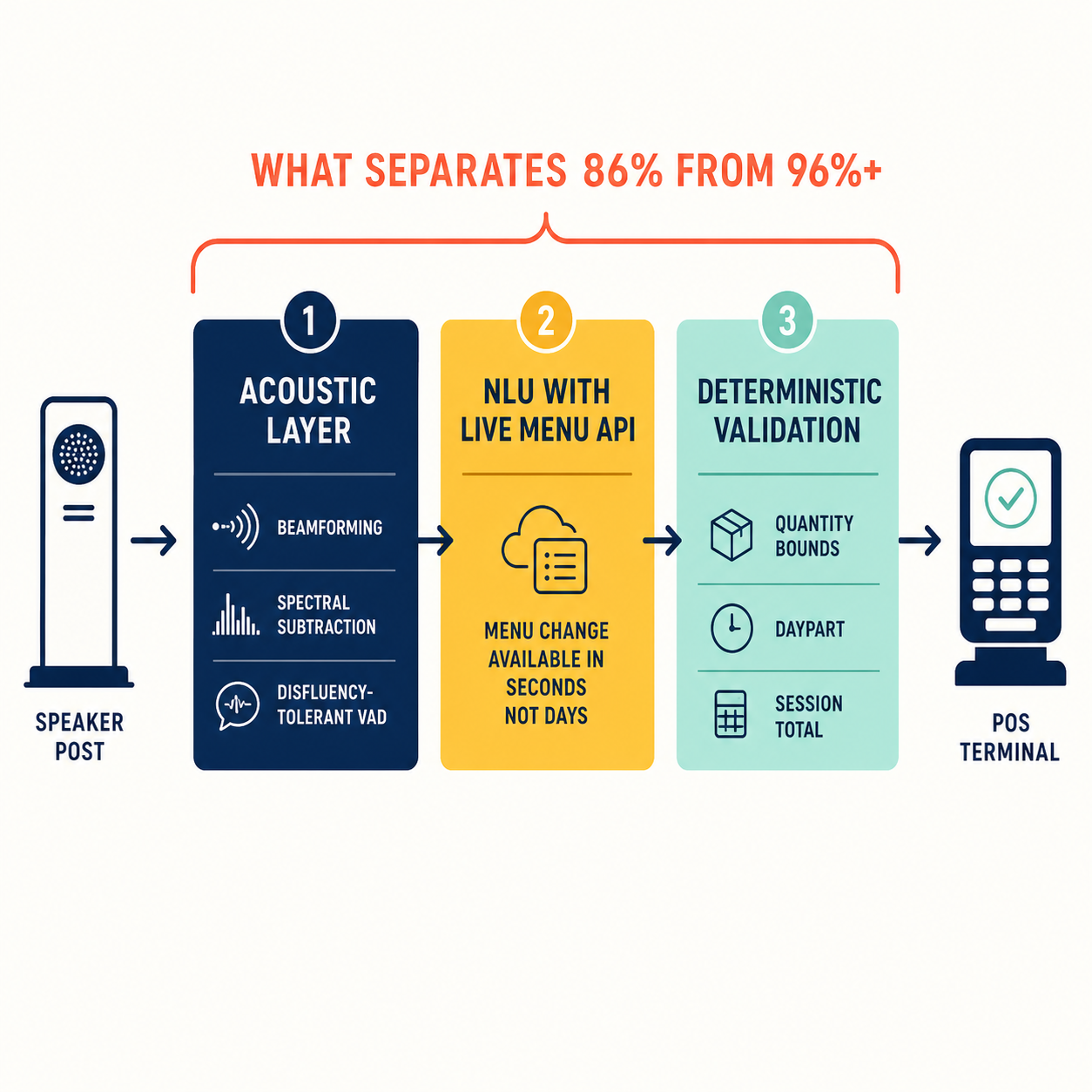
The deployments clearing 96%+ autonomous accuracy consistently are running the three engineering layers as a designed sequence rather than a vendor stack assembled from independent components. Acoustic preprocessing starts at the speaker post: beamforming calibrated to the post geometry, spectral subtraction tuned to the vehicle noise floor, and voice activity detection that handles disfluent speech without cutting off mid-word. What reaches the ASR model is audio it was actually designed to process.
From there, the NLU layer reasons against a live menu API rather than a training snapshot — a menu change pushed to Simphony at 5:00 AM is available at the speaker post at 5:01 AM without a retraining cycle. The deterministic validation layer executes after the model returns its interpretation: quantity bounds, daypart availability, modifier conflict resolution, session totals. By the time a transaction writes to POS, three independent engineering layers have reviewed it.
The vendor-neutral integration posture matters more than it appears in the abstract. Google Cloud and NVIDIA both have QSR partnerships — Wendy's, McDonald's, Taco Bell — that create platform dependency. When an upstream API changes rate limits, when the cloud provider updates the underlying model version without notice, chains on single-vendor architectures absorb the change without negotiating leverage. Custom middleware that sits between the POS and the AI layer, and can be retargeted to a different upstream vendor without rebuilding the integration, is what creates optionality at renewal. More detail on how that's structured in practice is at https://veriprajna.com/solutions/qsr-drive-thru-voice-ai.
Where the Field Actually Is in 2026
The "Prove It Era" framing that's appeared in industry coverage since Presto's $10 million raise in January 2026 — and its hiring of the FreshAI founder — captures something real: pilot-stage deployments are now being asked to demonstrate consistent performance at hundreds of locations, across adversarial conditions, through every menu daypart. The chains that are asking those questions are discovering that the proof points they need don't come from the model vendor's accuracy claim. They come from the acoustic log, the POS error rate, and the escalation trend line.
McDonald's Google Cloud partnership is architecting at infrastructure scale — accuracy scales across thousands of locations, a Virtual AI Manager on Google Distributed Cloud edge, voice AI drive-thru planned for 2026, national deployment by 2027. What a chain at that scale will find is that infrastructure doesn't solve the speaker-post acoustics, the POS middleware complexity, or the accessibility exposure. Those three engineering layers precede the platform.
The question worth asking before the next QSR voice AI deployment isn't which vendor to choose. It's which of the three engineering layers — acoustic, logic, or access — your current stack is weakest on, and whether you know that from operational data or from the accuracy number on the vendor's sales deck.