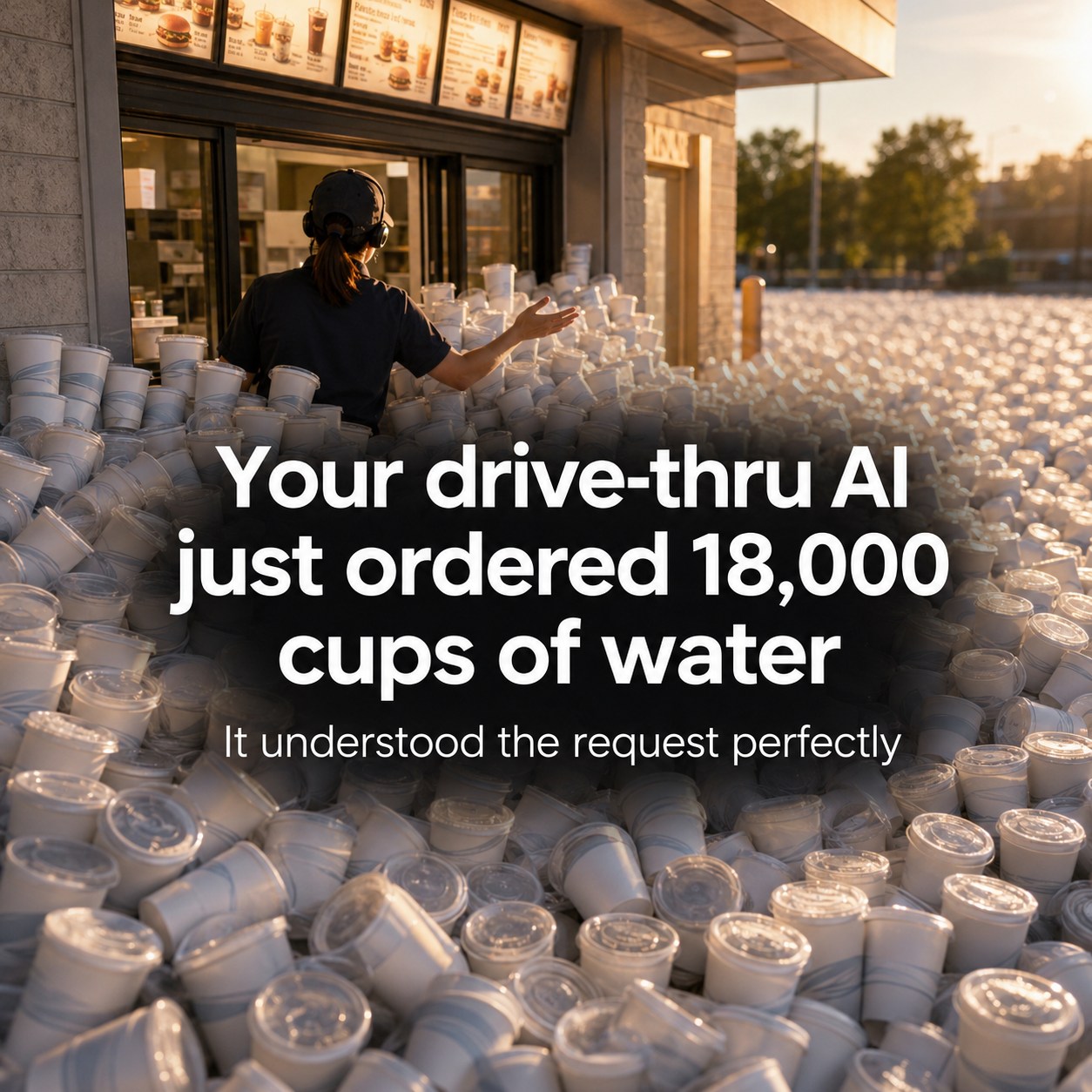
Taco Bell's drive-thru AI took an order for 18,000 cups of water. The clip racked up 21.5 million views. The bot understood the request perfectly — that was never the problem.
That's the part most people get wrong about QSR voice AI. The language model wasn't broken. There was simply no layer between the AI and the POS asking one question: is this order physically possible?
The same gap added 260 Chicken McNuggets to one car at McDonald's and garnished vanilla ice cream with bacon. In every case the speech recognition was correct. The business logic was absent.
A deterministic validation engine fixes it — and it isn't AI. It's rule-based middleware we build to enforce quantity caps drawn from real order distributions (the 99.9th percentile for water at most locations is around 8 cups), block item combinations with effectively zero historical probability, and escalate anything past those bounds to a human. Two to three weeks per chain. The cheapest fix available, and it kills the category of failure that goes viral.
It's why the chains that engineered the architecture — not just the model — clear 96% accuracy (Hi Auto at Bojangles, ~500 locations) while McDonald's killed a three-year IBM partnership stuck at 80%.
The model is rarely the thing that breaks a drive-thru. The missing layers around it are — signal processing at the speaker post (engine rumble sits at 200-400Hz, right on top of a male voice's fundamentals), deterministic validation before the POS, accessibility for the 80M people who stutter.
Save this for your next vendor evaluation, and ask the demo team how their system caps an 18,000-water order before it reaches the kitchen.
#VoiceAI #DriveThruAI #QSRTech #RestaurantTechnology #ConversationalAI