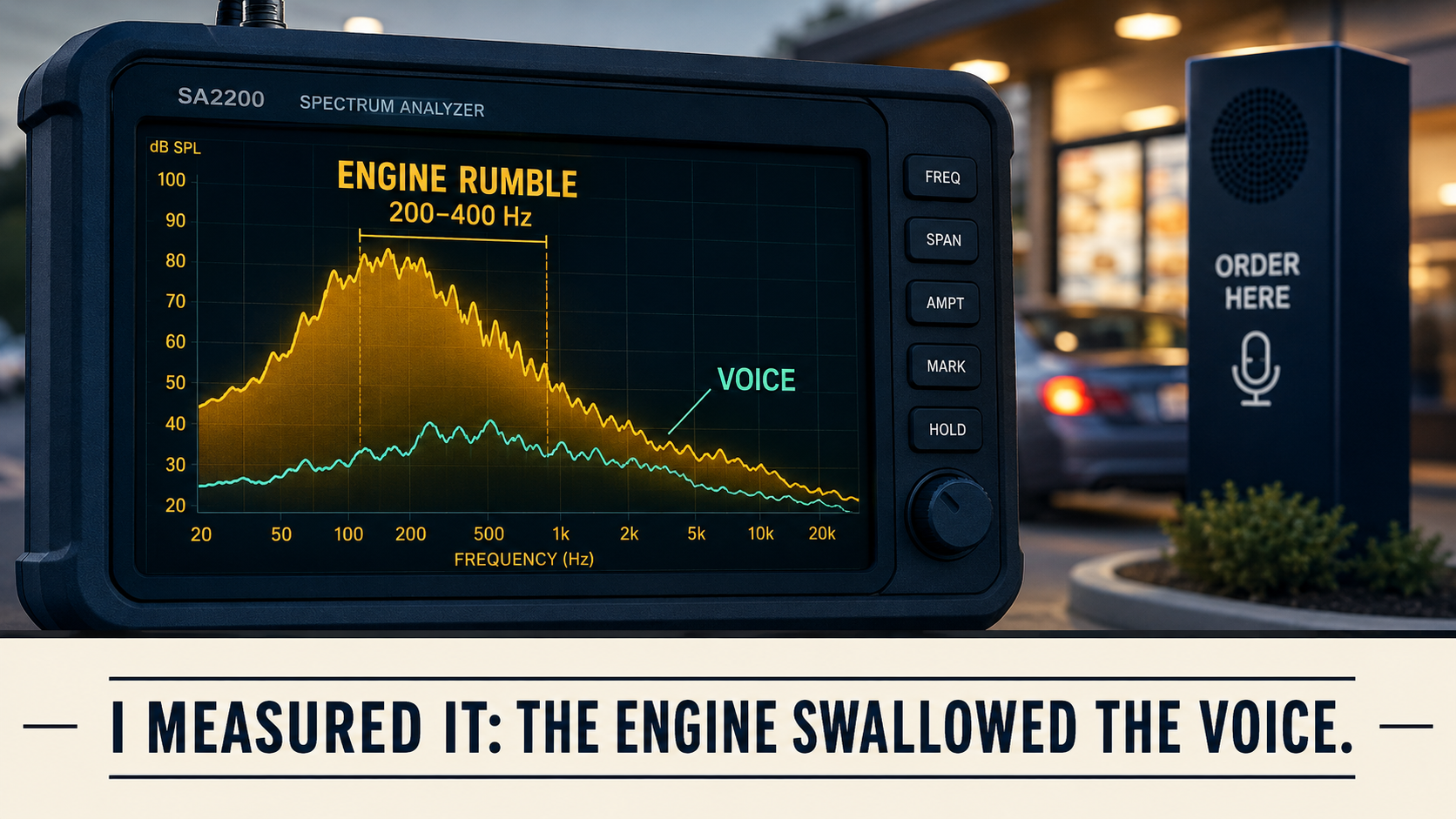
My first reaction to the Taco Bell 18,000-water-cups story was that someone had found a clever exploit. My second reaction — the one that actually mattered — was that we'd been thinking about drive-thru AI failure completely wrong.
The coverage framed it as an AI hallucination. It wasn't. The language model did exactly what language models do: it parsed a natural-language order and returned a transaction. What was missing was a deterministic validation layer that never got built, because the team designing the system assumed the model's judgment was sufficient. That assumption is widespread across every serious drive-thru AI deployment I've seen or studied, and it's why the industry has a documented accuracy ceiling it can't seem to clear.
The ceiling is real. McDonald's and IBM worked on their system for three years, through multiple model updates and architecture revisions, before the partnership terminated in July 2024 at 80–85% autonomous accuracy. Wendy's FreshAI publicly reports 86%. SoundHound's "Julia" at White Castle runs at 96%+ with 90%+ order completion and claims $58,000 in annual savings per location; Hi Auto at Bojangles processes 100 million orders annually at 96% accuracy across roughly 500 locations. The spread between 80% and 96% across all of these — all serious, all well-funded — exists almost entirely because of how well each one handles the engineering layers below the AI, not because of model quality differences. These aren't weak AI systems. They're strong AI systems operating through engineering gaps that the model can't compensate for on its own.
What I Found Standing at the Speaker Post
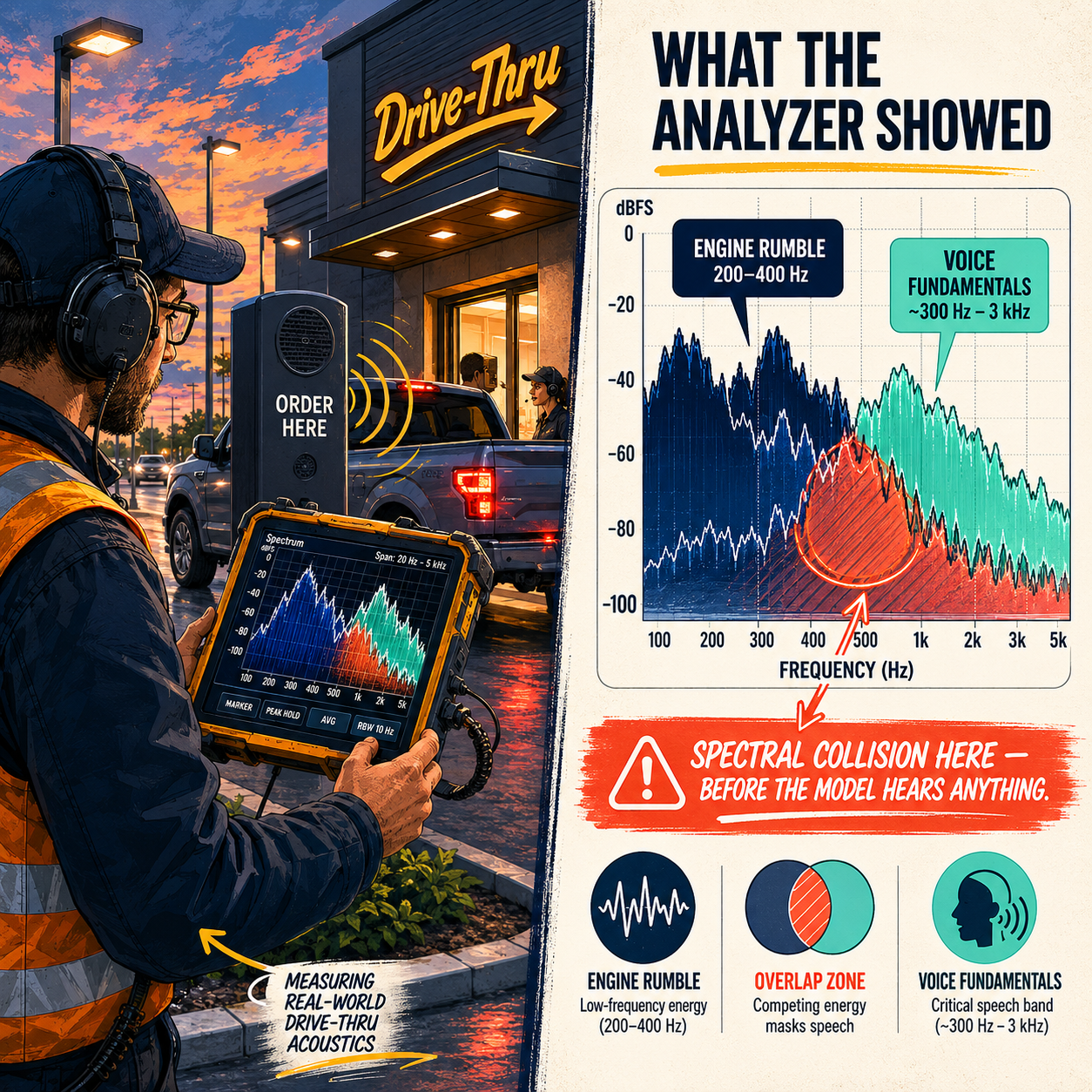
I've spent time with a portable spectrum analyzer at actual drive-thru speaker posts, and what struck me wasn't the wind or the precipitation — it was the idling engine. Vehicle engines at idle generate noise concentrated in the 200–400 Hz band. That's the same band where voice fundamentals live. By the time a male voice reaches the microphone from the driver's window, it's competing with a noise source that overlaps its fundamental frequency from below, not from above.
Standard ASR — the kind that ships with every general-purpose voice AI platform — was trained on call-center audio, podcast recordings, mobile voice assistants. Clean speech with a noise floor that looks nothing like an idling F-150 at two feet. When I looked at what Google's Vertex AI was being asked to process in the Wendy's FreshAI deployment, I kept thinking: the model isn't weak, but it's receiving audio it was never designed to handle.
Beamforming arrays with null-steering calibrated to speaker-post geometry, and spectral subtraction tuned to the vehicle noise floor, are what close this gap. Neither Google nor NVIDIA's infrastructure — which backs Taco Bell's Byte by Yum! — addresses this as a component. Both platforms provide powerful model infrastructure. The acoustic engineering that precedes the model has to be built separately, and most deployments don't build it.
The accuracy gap at the speaker post begins before the model hears a word. The question is whether the deployment was designed to close it before asking the model to compensate.
The Wendy's FreshAI complaint record makes sense through this lens. "Three attempts needed to complete an order," "bot cuts off mid-sentence," "suggests wrong items when you ask for tea" — these read as language model problems. They're acoustic delivery problems. The model was receiving degraded audio and doing its best with it.
The Moment the 18,000 Cups Reframed Everything
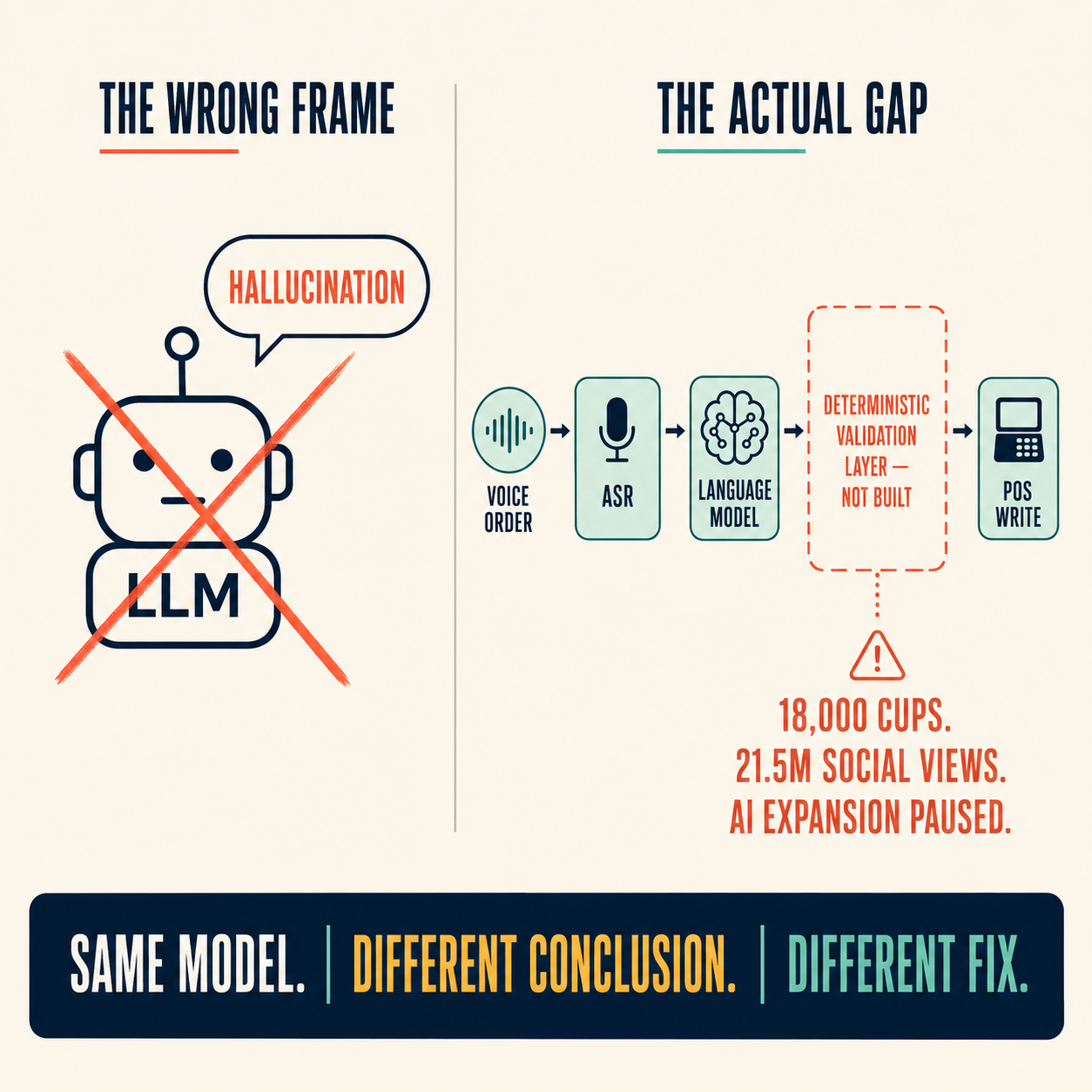
When the Taco Bell incident broke, my team spent time with the press coverage before saying much. What landed, when we talked about it, was that the framing of "AI hallucination" was pointing at the wrong layer — the model had interpreted the order correctly, as a language model would; what was absent was the deterministic validation layer that should have run after it. That reframing mattered because it pointed at a completely different engineering response.
If the problem is hallucination, you fix the model. If the problem is a missing guardrail, you build the guardrail. The guardrail the Taco Bell system lacked was deterministic quantity validation — a check that runs after the language model interprets the order and before the transaction writes to POS, verifying that the quantity requested is within configurable bounds, that the items are available for the current daypart, and that the session total falls within realistic thresholds for a single vehicle pull-through.
None of that requires a smarter model. It requires an architecture that doesn't treat the model as the last line of defense.
I've built ordering validation layers into the drive-thru engineering work we do at Veriprajna — the architecture is documented at https://veriprajna.com/solutions/qsr-drive-thru-voice-ai — and the design decision that shaped all of them was: assume the model's interpretation is probabilistically correct but make none of the downstream logic contingent on it being infallible. The guardrail layer doesn't second-guess the language model. It checks the result against invariants the model can't reason around.
The Taco Bell incident generated 21.5 million social media views and forced a pause on AI expansion. It also clarified something the field needed clarifying: the adversarial surface of a public-facing AI ordering system is much larger than anyone designing it in a controlled pilot environment expects.
The POS Middleware Nobody Talks About
What surprises me most in conversations with QSR operators isn't how complex the AI layer is — it's how much of the deployment problem has nothing to do with AI. It's in the POS integration.
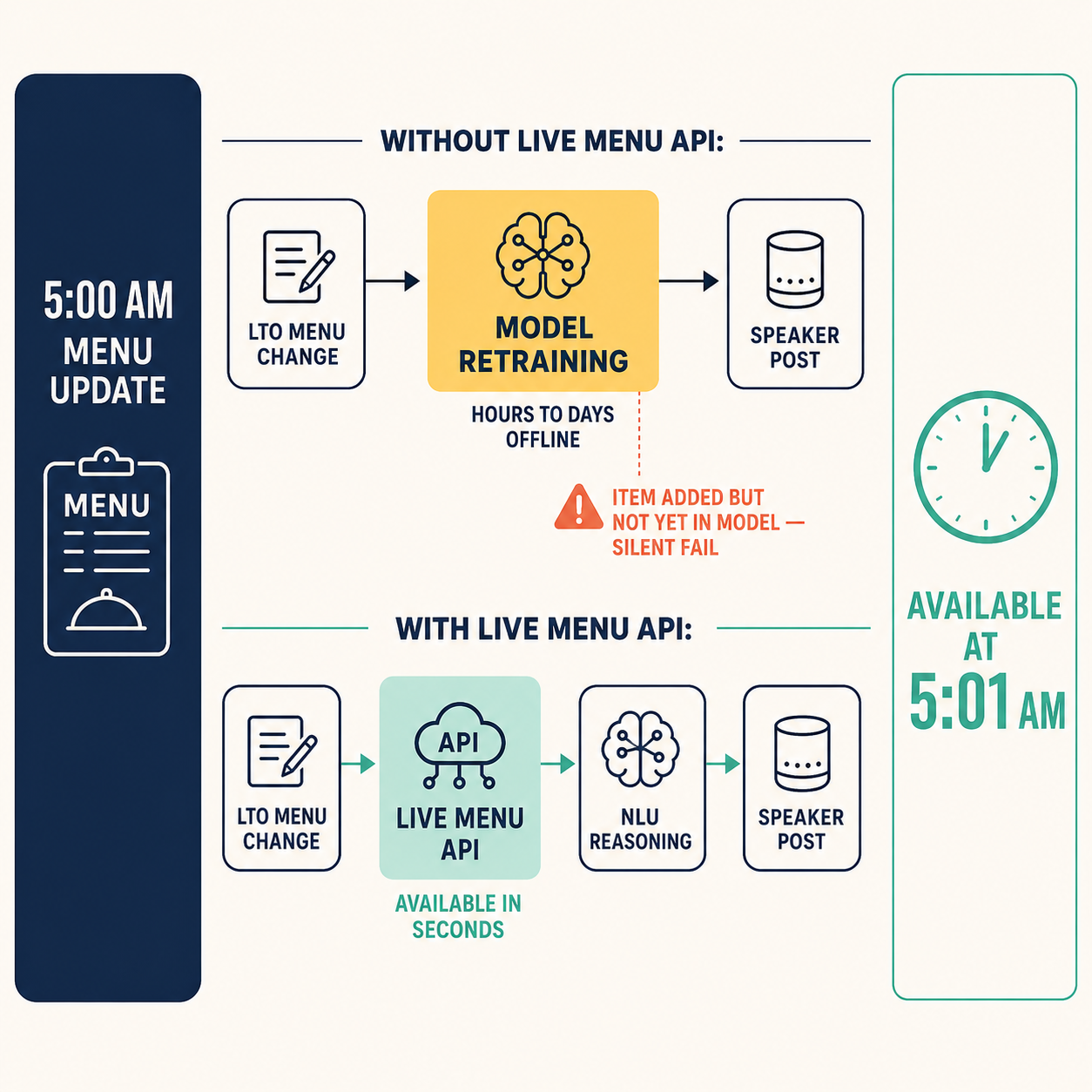
NCR Aloha, Toast, and Oracle Simphony each expose different APIs with different limitations around real-time modifier streaming, multi-lane session isolation, and daypart enforcement. A chain running limited-time offers, regional items, and dayparting makes two to four menu changes a week. A voice AI system that requires model retraining to handle each change is operationally impossible at that pace — it's effectively offline for hours between menu updates.
The NCR Aloha API error log for a chain running LTOs is one of the most informative artifacts I know in this space. When the modifier "ghost pepper ranch" exists in the digital menu but hasn't propagated to the POS modifier tree, every order including it either fails silently or throws an error the crew has to catch manually. At 17–18 cars per hour per lane, crew doesn't catch most of them. The customer at the pickup window catches them.
Dynamic NLU grounding via live menu API — where the model reasons against current menu state rather than a training snapshot — is the architectural response that actually works. A menu change pushed to Simphony at 5:00 AM is available at the speaker post at 5:01 AM without a model update cycle. This isn't complicated in concept; it's just engineering that most off-the-shelf platform deployments don't do.
The Accessibility Complaint That Reordered My Engineering Priorities
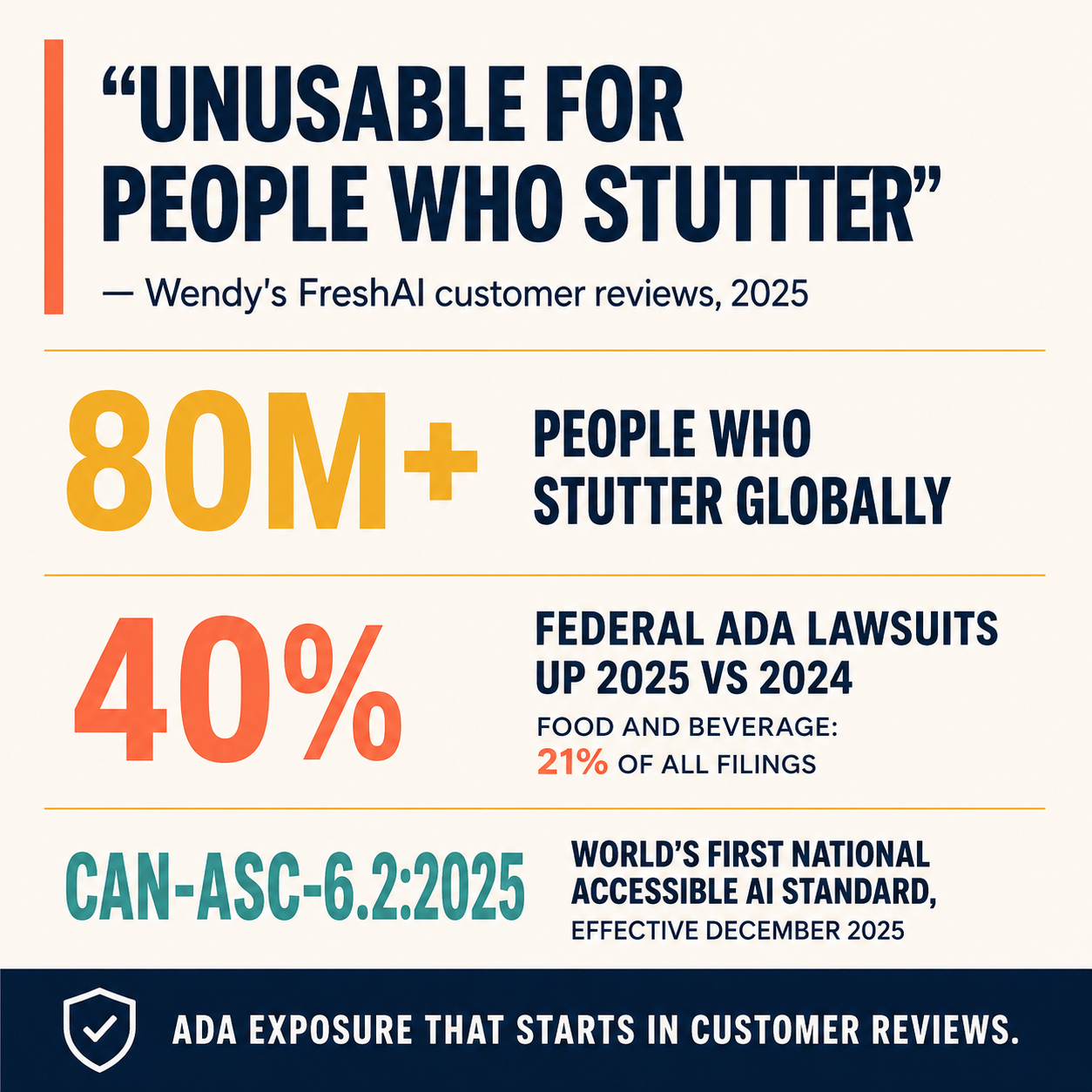
The moment I went back and read the Wendy's FreshAI complaint thread carefully — not the company's official communications, but the actual customer reviews — I found something that reordered my priorities.
"Unusable for people who stutter." That phrase appears in public reviews, not in any accessibility audit. It means the system was deployed, it was publicly operating, and it was already failing a protected class before anyone ran a conformity assessment.
Stuttering affects more than 80 million people globally. A drive-thru AI that consistently routes disfluent speakers to a manual window is offering unequal service to a large fraction of the driving public. The ADA exposure is real — food and beverage companies are the second-most-targeted industry at 21% of all filings, with federal cases up 40% in 2025 versus 2024. No case has yet named a QSR voice AI system specifically. That gap will close.
Canada's CAN-ASC-6.2:2025, published December 2025, is the world's first national standard for accessible AI systems. It requires equitable access across disability status and meaningful ability to decline AI for a human. The EU AI Act adds transparency obligations effective August 2026. These frameworks aren't asking systems to solve the hard acoustic problems — they're asking for documentation that you tried and that alternatives exist.
The BIPA question is subtler. The Carpenter v. McDonald's class action was dismissed because the court accepted that the NLP system didn't constitute biometric speaker recognition. But the ruling is fact-specific. Any architecture that maintains speaker-identifying features across sessions — for repeat-order suggestions, personalization, or disfluency profiling — is reasoning from a different set of facts than the ones that produced the dismissal.
Accessibility engineering isn't a compliance checkbox. It's what separates a system from the complaint record that's already accumulating in public reviews.
The disfluency-tolerant ASR configuration — voice activity detection that doesn't cut off mid-word when a speaker repeats a syllable, extended timeout thresholds for speakers processing their order, graceful escalation that doesn't expose the speaker's difficulty to the crew — are specific engineering choices, not afterthoughts. They go in at the signal-processing layer, not as a UI accommodation.
The Throughput Math That Keeps Every Other Tradeoff Honest
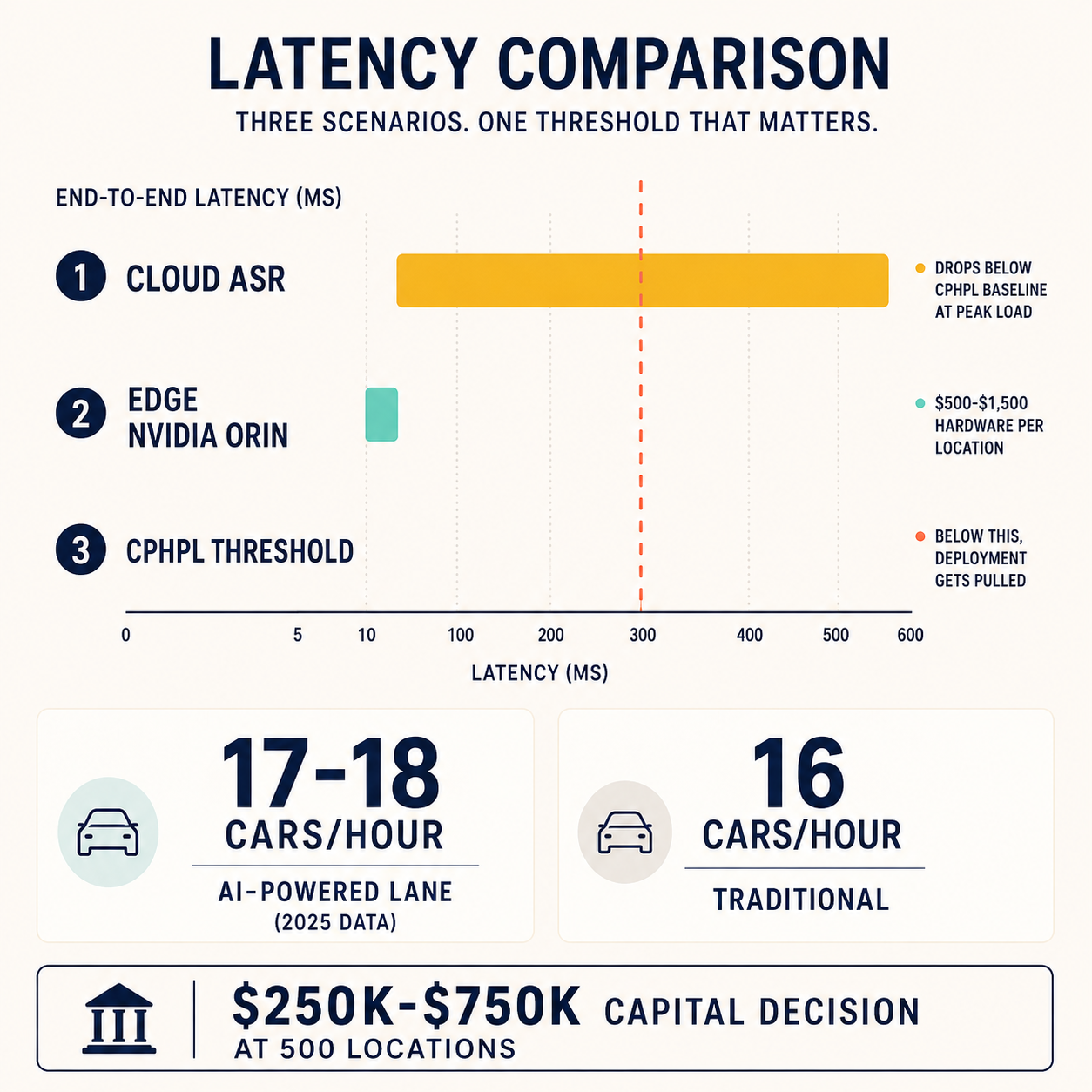
I've had this conversation enough times to know that the throughput number ends every architecture debate: CPHPL, cars per hour per lane. The 2025 industry data puts AI-powered lanes at 17–18 CPHPL versus 16 without AI. Any validation logic, escalation round-trip, or API call that adds latency above 300ms pulls that number below baseline, and a deployment that degrades throughput gets pulled regardless of its accuracy.
That constraint is what makes every other tradeoff real. Cloud-hosted ASR adds 100–500ms of network latency. Edge deployment with NVIDIA Orin reduces that to 5–10ms but adds $500–$1,500 in hardware cost per location — a capital commitment that becomes meaningful at 500+ locations. Neither approach is obviously correct without operational data on the specific deployment's latency tolerance.
Human escalation engineering sits inside the same tradeoff, and it's almost always underspecified in the design. A system that escalates 10% of orders to a crew member needs escalation that doesn't drop the car from the queue. How the hand-off surfaces the model's best interpretation alongside the audio, how the session resumes after crew resolution — these operational decisions are where the throughput math actually gets made. They don't appear on the vendor accuracy scorecard.
What I Tell Teams Building This Now
When I look at where the field is in 2026, I keep coming back to Presto's $10 million raise in January 2026 — and particularly its hiring of the FreshAI founder — as a signal that the market is entering a prove-it phase. Pilot deployments are being asked to demonstrate consistent performance across hundreds of locations, through adversarial conditions, over every menu daypart. The proof points that matter in that evaluation don't come from the model vendor's accuracy claim. They come from the acoustic log, the POS error rate, and the escalation trend line.
McDonald's Google Cloud partnership is building at infrastructure scale — accuracy scales across thousands of locations, a Virtual AI Manager on Google Distributed Cloud edge, voice AI drive-thru planned for 2026. What a chain at that scale will find is that infrastructure doesn't solve the speaker-post acoustics, the POS middleware complexity, or the accessibility exposure. Those three engineering layers precede the platform.
The architecture behind how we've approached these layers for QSR chains is at https://veriprajna.com/solutions/qsr-drive-thru-voice-ai — including the ordering validation design, the POS integration approach, and what accessible ASR configuration actually looks like in practice.
What I keep coming back to is that the complaint record is already in public reviews. "Unusable for people who stutter." "Three attempts needed." "Bot cuts off mid-sentence." The accuracy number a chain is evaluating against doesn't include any of those customers. The 86% that's publicly celebrated at Wendy's FreshAI is the percentage of orders that completed without human intervention — it doesn't capture the fraction of speakers who gave up, drove to another window, or decided not to come back. That's a different number, and chains that want to know it should be asking for it.