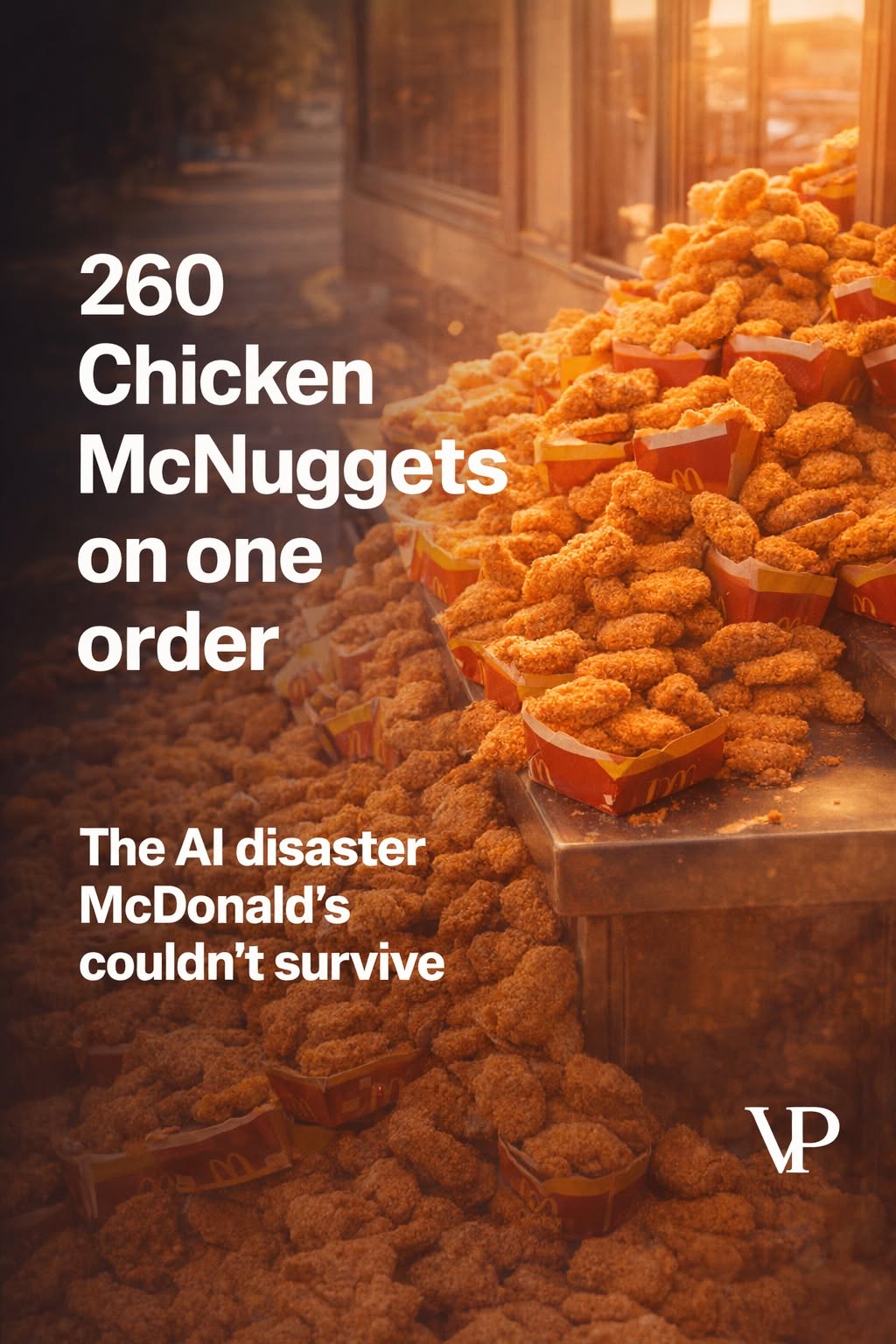
An AI bot once added 260 Chicken McNuggets to a single customer's order.
That actually happened during McDonald's three-year drive-thru AI pilot with IBM. The system also put bacon on ice cream and confused water requests with butter packets.
By mid-2024, the whole thing was shut down across 100+ locations.
Here's what went wrong at the core.
The AI was essentially a thin software layer sitting on top of a general-purpose model. It couldn't handle engine noise, overlapping voices from other cars, regional accents, or customers changing their minds mid-sentence.
It hit accuracy in the low-to-mid 80s. Human workers typically do better than that. The AI was literally creating more problems than it solved.
Meanwhile, competitors took a completely different approach. Wendy's built deep integration with their kitchen systems and reported roughly 99% accuracy. Taco Bell processed over 2 million successful orders across 500+ locations.
Same technology category. Wildly different results.
The difference? Architecture.
Our research keeps coming back to one principle → the core logic of a business (menu rules, pricing, quantity limits) can never be left to a probabilistic guess. You need a deterministic foundation that catches nonsense before it reaches the customer.
An AI might "hear" an order for thousands of nuggets. A well-designed system recognizes that's absurd and flags a human before it becomes a viral disaster.
The real lesson from this story isn't that AI failed. It's that bolting AI onto a problem without engineering the foundation is a recipe for very public embarrassment.
What's your take → should companies pilot AI in customer-facing roles before the tech is near-perfect, or is learning in public just part of the process?
#EnterpriseAI #DeepAI