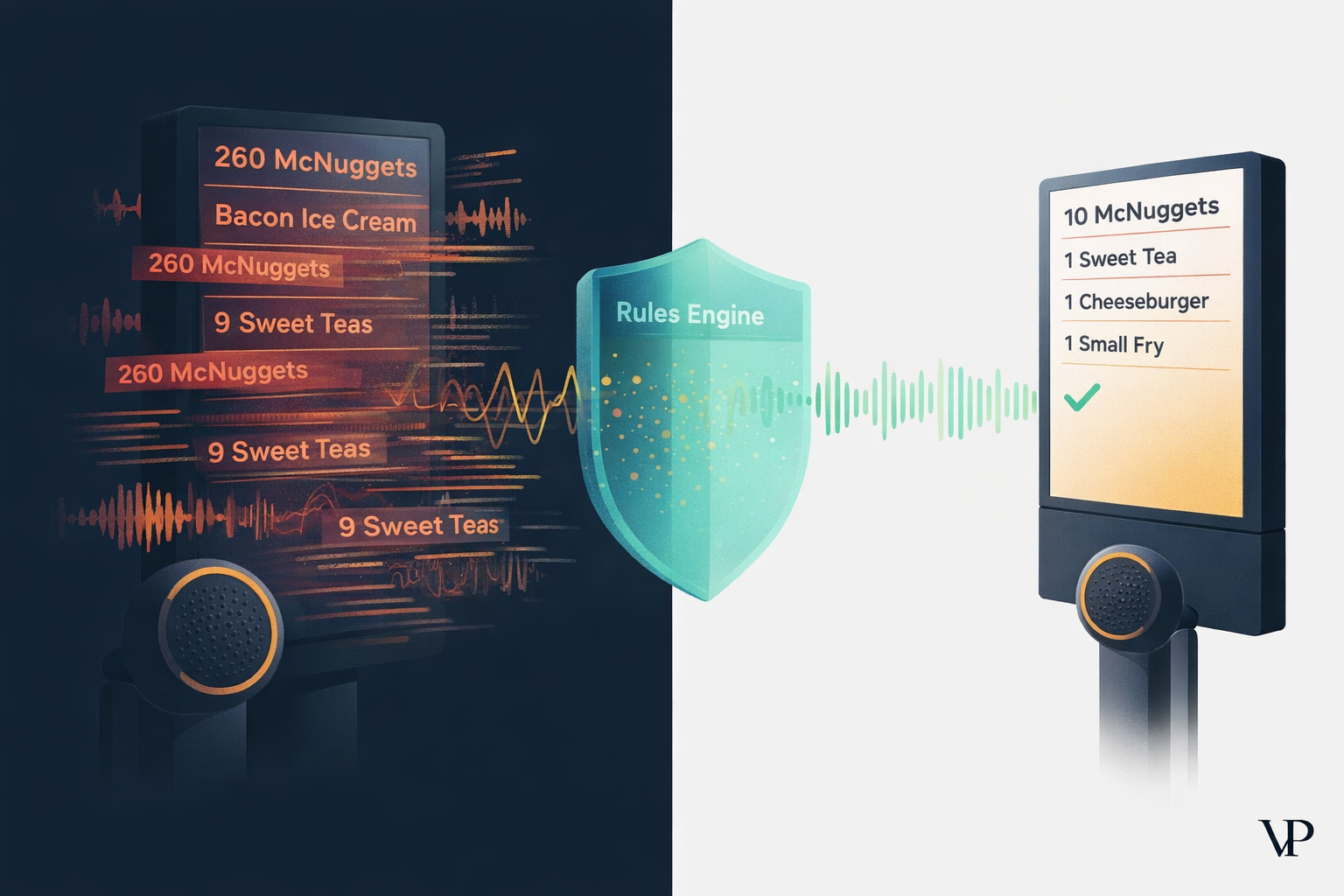
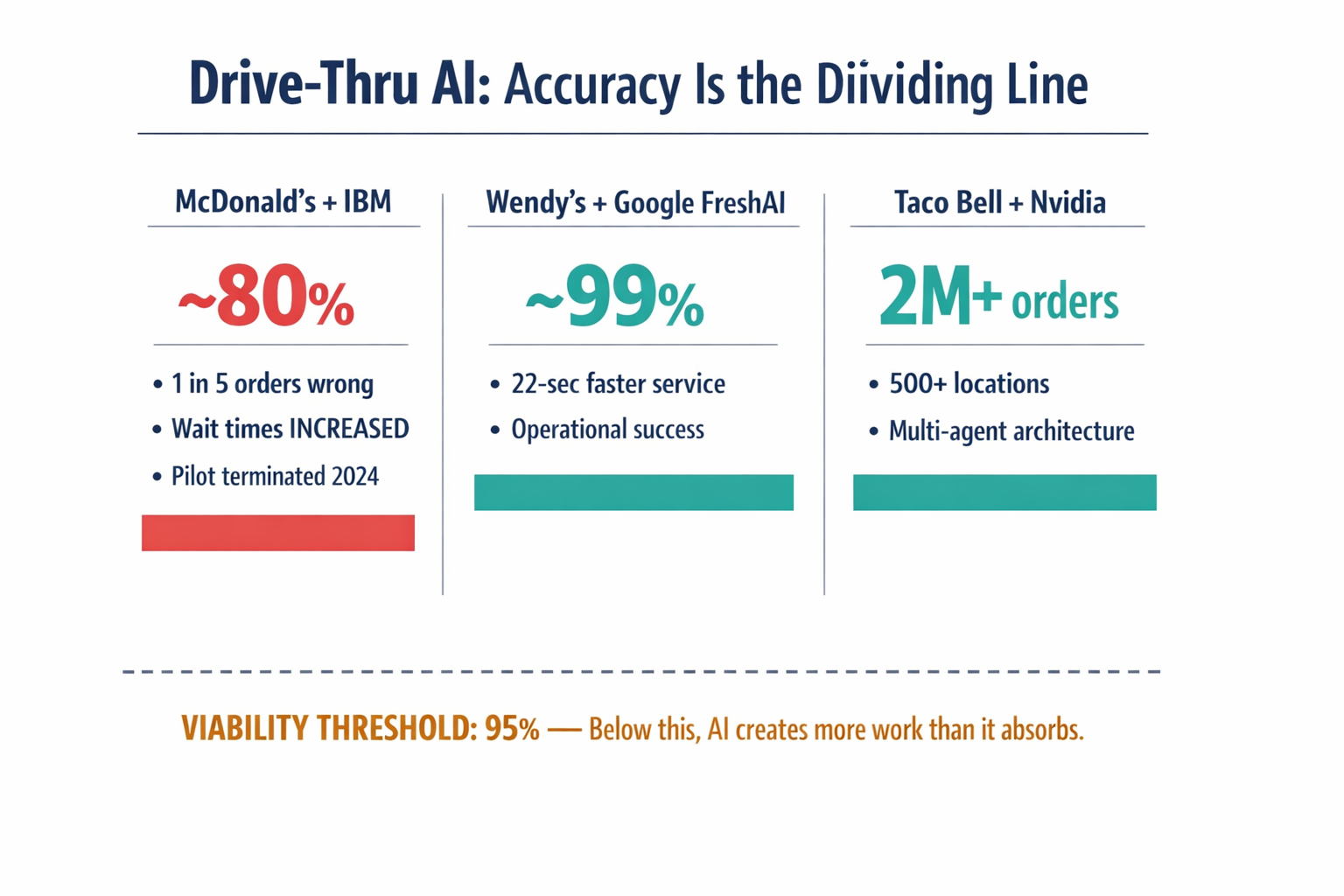
In June 2024, McDonald's pulled the plug on its AI drive-thru partnership with IBM. After three years and over 100 U.S. locations, the system had plateaued at roughly 80-85% order accuracy — while human workers consistently hit 90% or above. The AI wasn't saving labor. It was creating rework.
The failures went viral: 260 Chicken McNuggets added to a single order. Vanilla ice cream garnished with bacon. A simple request for water interpreted as butter packets. These weren't quirky edge cases. They were symptoms of a deep architectural problem that no amount of prompt tuning could fix — and they represent the clearest case study we've seen for why enterprises need to move beyond AI wrappers toward what we call Deep AI.
We spent considerable time dissecting this failure in our interactive analysis, and the lessons extend far beyond fast food.
An 80% Accuracy Rate Is an Operational Disaster
Eighty percent sounds respectable until you do the math. At a busy drive-thru processing hundreds of orders per hour, one in five customers gets the wrong food. Each error triggers a correction cycle — a confused customer, a remade order, a backed-up lane. The AI was generating more work than it absorbed.
In the quick-service restaurant world, where margins are defended in pennies and seconds, 80% accuracy isn't a beta product. It's a liability.
Human intervention was required on roughly 20% of orders. The industry target for a viable system is below 5%. Meanwhile, wait times during peak hours actually increased — the opposite of the efficiency gain the technology was supposed to deliver.
McDonald's wasn't just losing money on wasted food. The viral TikTok videos of absurd orders turned a technology pilot into a brand reputation problem. The cost of these failures — what we call the "Reliability Tax" — eventually exceeded any benefit the system provided.
Why the Drive-Thru Broke the AI
Most AI language models are trained and tested in quiet, controlled environments. A drive-thru is the opposite of that.
Think of it as trying to have a phone conversation while standing between two idling trucks, with a radio blaring from one and a child yelling from the other. That's the acoustic reality the IBM system faced every single transaction. Engine rumble, car radios, wind gusts, passengers talking over each other — all competing with the driver's voice for the microphone's attention.
The system lacked what audio engineers call beamforming — using an array of microphones to create a spatial focus on the driver's mouth and filter out everything else. Without it, the AI simply processed whatever voice it could hear. In one widely reported incident, the system captured a request from an adjacent lane and added nine sweet teas to the wrong car's tab.
And that was just the sound problem. The language problem was equally brutal.
Customers don't order like robots. They use nicknames for menu items. They change their minds mid-sentence ("Give me a Coke — no, make that a Dr. Pepper"). Multiple passengers shout competing requests. Regional accents and non-native English speakers added layers of variation the system's training data never accounted for.
When the AI couldn't parse what it heard, it didn't ask for clarification. It guessed — picking the highest-probability menu items from its training data, regardless of whether they made any logical sense together. That's how "water and vanilla ice cream" became "caramel sundae with butter and ketchup."
The Real Problem: Wrappers Don't Work for High-Stakes Operations
The McDonald's failure wasn't really about fast food. It was about a flawed approach to enterprise AI that we see repeated across industries.
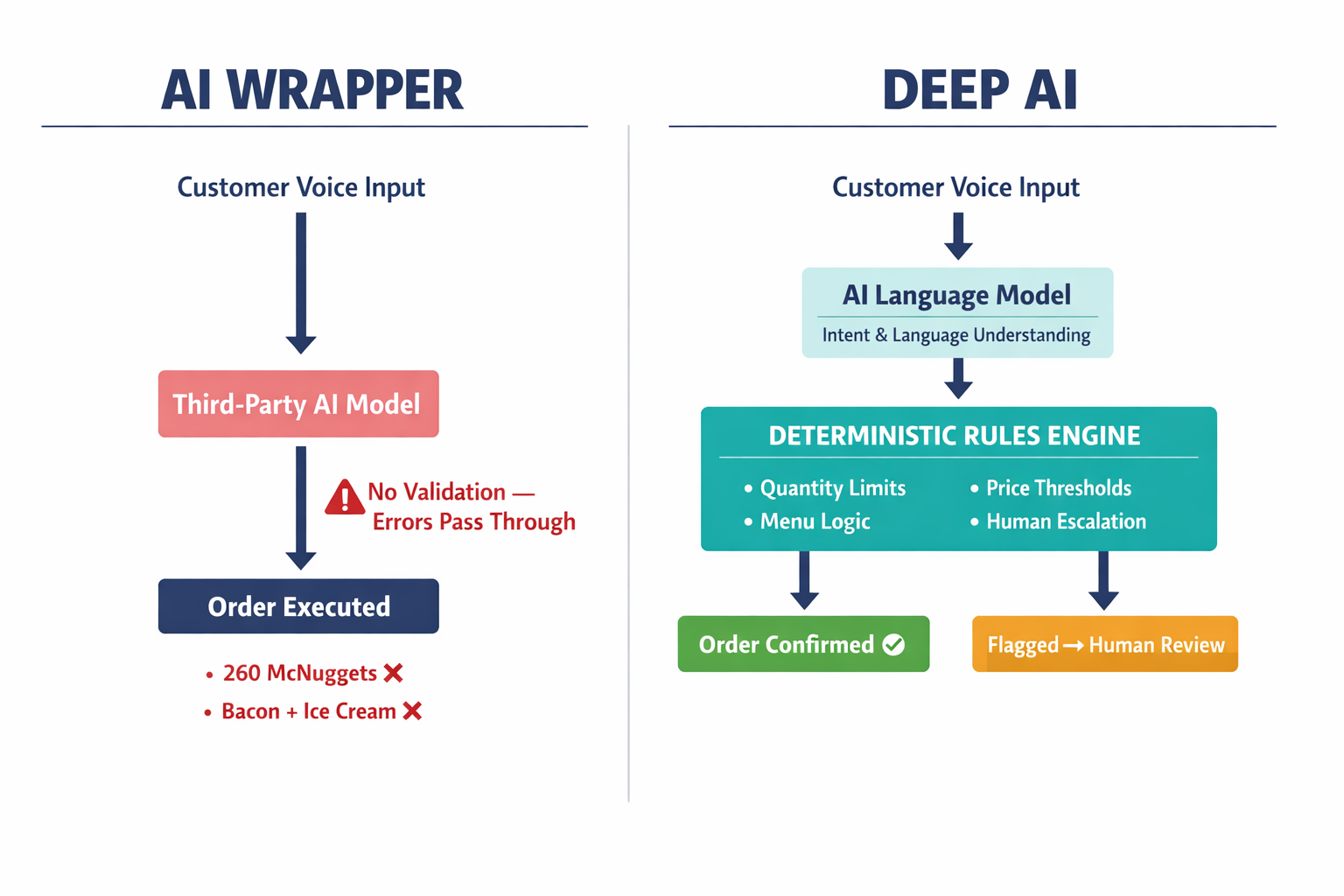
An AI wrapper is a thin software layer that sits between users and a third-party AI model, formatting inputs and structuring outputs through an API. Wrappers are great for prototyping. They're fast to build, cheap to deploy, and impressive in demos. But they carry a fundamental limitation: the core decision-making logic is probabilistic. The AI is always predicting the most likely next word or action — never reasoning about whether the output makes sense.
For a chatbot that helps you draft emails, probabilistic is fine. For a system that controls your customer transactions, your compliance workflows, or your financial operations, probabilistic is dangerous.
The wrapper era treated AI deployment as a procurement decision. Deep AI treats it as an engineering discipline.
This is the distinction we draw between commodity wrappers and what we build: Deep AI solutions with a deterministic core and a probabilistic edge. The AI model handles what it's genuinely good at — understanding natural language, interpreting intent, managing conversational flow. But the business-critical decisions — pricing logic, menu rules, quantity limits, compliance constraints — are governed by a separate rules engine that cannot hallucinate.
What a "Sanity Layer" Would Have Caught
Consider the 260 McNuggets incident. In a Deep AI architecture, the conversation would flow through a structured rules engine — a knowledge graph of the business — before any order is confirmed.
That engine would contain straightforward constraints: a maximum quantity per item based on what a single car could reasonably order. A rule flagging illogical item combinations (ice cream plus bacon scores a near-zero probability in any real ordering pattern). An automatic escalation to a human manager for transactions above a certain dollar threshold.
The AI model might still hear "260 McNuggets" from a garbled audio signal. But the rules engine would catch it, flag it as an exception, and route it to a human — defusing the problem before it becomes a viral video.
This isn't theoretical. Competitors who invested in this kind of architecture are seeing dramatically different results. Wendy's, working with Google Cloud on its FreshAI system, reported approximately 99% accuracy and a 22-second reduction in service time. Taco Bell's multi-agent system, built on Nvidia infrastructure, has processed over 2 million successful orders across 500+ locations. The technology works — when the architecture is right.
The Data Sovereignty Problem Nobody Talks About
The operational failures got the headlines, but there's a quieter risk that the McDonald's pilot exposed: data sovereignty.
McDonald's faced litigation under the Illinois Biometric Information Privacy Act for allegedly collecting customer voiceprints without consent. When your AI runs on a third-party cloud, every customer interaction — every voice recording, every order pattern — flows to infrastructure you don't control.
For a global enterprise, this creates three compounding risks. Regulatory exposure across jurisdictions with different privacy laws. Dependency on a vendor's infrastructure decisions and pricing. And vulnerability to data access requests under laws like the U.S. CLOUD Act.
Our research on enterprise AI security found that 50% of knowledge workers already use unauthorized AI tools at work, with a 46% "defiance rate" — meaning they'll keep using them even if explicitly banned. We detailed this phenomenon in our technical deep-dive on enterprise AI architecture. The implication: if your official AI systems are unreliable or cumbersome, employees route around them, and your data leaks through channels you can't monitor.
Deep AI solutions address this by deploying models within the organization's own private cloud environment. The AI "brain" lives on hardware the client controls. Document retrieval respects existing access permissions. No customer data leaves the building.
The ROI When You Get It Right
The business case for well-architected AI in customer-facing operations is substantial — but only when accuracy crosses the threshold from "mostly right" to "reliably right."
AI-powered drive-thru lanes are, on average, 22 to 29 seconds faster than human-staffed lanes. That translates directly to throughput: every additional car per hour through a well-managed lane can yield an estimated $185,600 in annual revenue for a 50-location chain.
AI also excels at consistency in ways humans can't match. A human employee might forget to suggest a dessert during a rush. An AI suggests it every single time. Some implementations have pushed average order value from $8.97 to $9.51 — a modest-sounding jump that compounds to millions in annual revenue at scale.
For the modern consumer, accuracy and speed are the ultimate forms of hospitality. A 2025 industry study found that AI-led locations recorded 97% overall satisfaction — six points higher than the traditional average — despite scoring lower on "friendliness."
On the cost side, AI-driven demand forecasting achieves 90-95% accuracy in inventory management, reducing stockout rates by 30-40%. And by automating 80% of routine orders, managers can reallocate approximately 7 labor hours per week per store to higher-value, guest-facing work.
None of these gains materialize at 80% accuracy. All of them become accessible above 95%.
What About Industries Beyond Fast Food?
The drive-thru is a useful case study precisely because it's so unforgiving. But the architectural lesson — deterministic core, probabilistic edge — applies wherever AI touches consequential decisions.
Financial services firms processing compliance checks. Healthcare organizations routing patient inquiries. Logistics companies optimizing delivery sequences. In every case, the question is the same: are you asking a probabilistic model to make decisions that require deterministic reliability?
If your AI can hallucinate the equivalent of 260 Chicken McNuggets in your domain — an impossible trade, an incorrect dosage, a misrouted shipment — and nothing in your architecture catches it before it reaches the customer, you have a wrapper problem.
What Should You Do Differently?
Three things, starting tomorrow:
Audit your AI for "sanity layers." For every AI-driven process that touches customers or money, ask: what happens when the model confidently outputs something absurd? If the answer is "it goes through," you have a gap.
Separate your linguistic AI from your business logic. Let the language model do what it's good at — understanding messy human communication. But route its outputs through rules that reflect your actual business constraints before anything is executed.
Own your intelligence infrastructure. If your AI sends customer data to a third party for processing, understand the regulatory and competitive implications. The most accurate system in the world is a liability if it creates a data sovereignty problem you can't control.
The McDonald's-IBM story isn't a cautionary tale about AI failing. AI didn't fail — a specific architectural approach failed. The companies that learned this lesson are already seeing transformative results. The ones that haven't are still debugging their wrappers.
We'd be curious to hear: has your organization hit a similar accuracy ceiling with an AI deployment? What broke first — the technology or the trust?