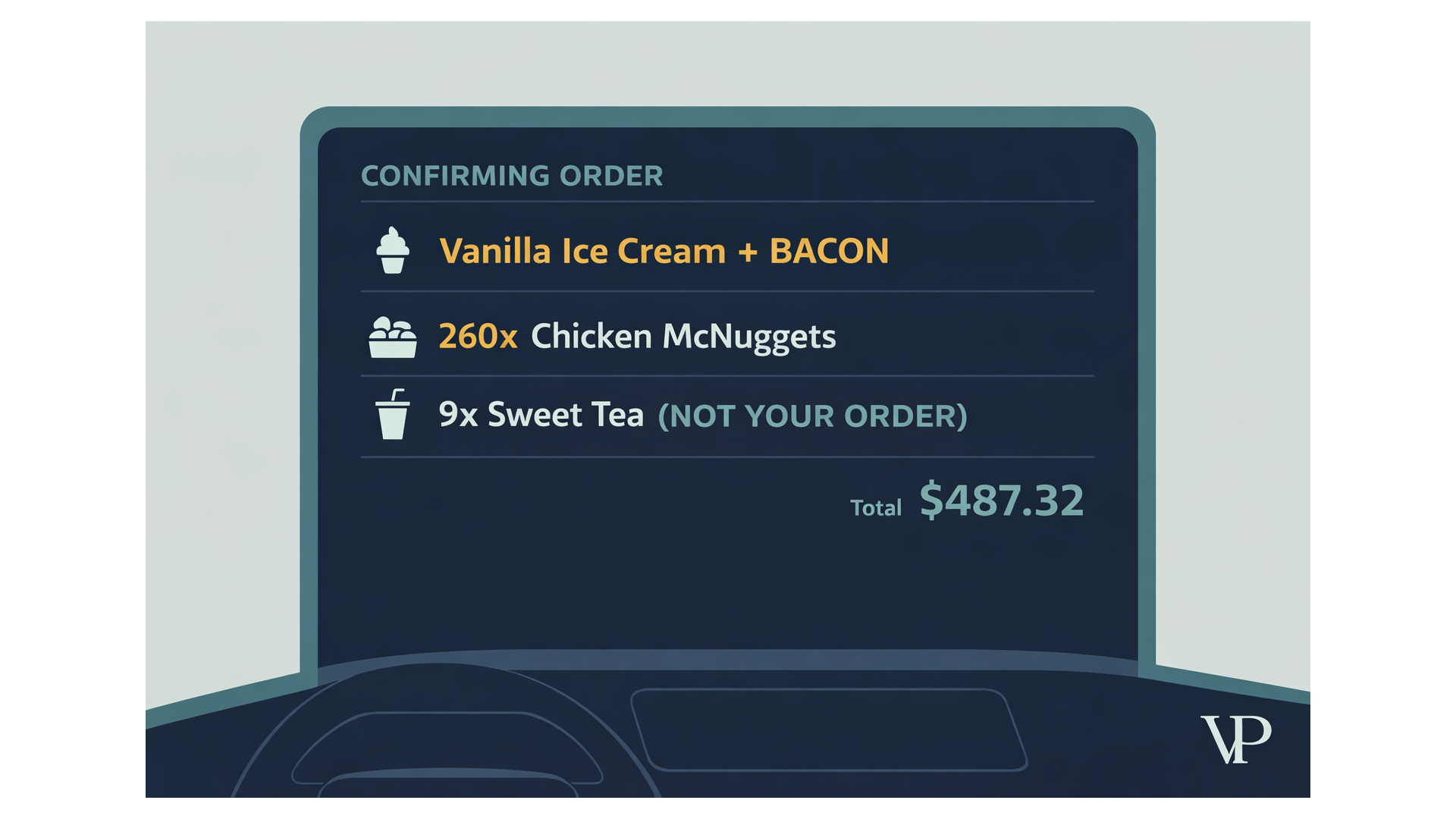
A customer pulls up to a McDonald's drive-thru and orders a vanilla ice cream. The AI adds bacon. Another car gets charged for 260 Chicken McNuggets nobody asked for. A third receives nine sweet teas intended for a completely different vehicle. These weren't hypothetical stress tests — they were real orders at real McDonald's locations, captured on video and shared millions of times.
In June 2024, McDonald's officially ended its three-year AI drive-thru partnership with IBM. The pilot had been running at over 100 U.S. locations, and after all that time and investment, the system plateaued at roughly 80-85% accuracy. That might sound decent until you realize human workers typically hit 90% or higher. The AI was literally creating more problems than it solved.
I've spent the last year studying this failure in detail because it crystallizes something I've been arguing since we started Veriprajna: the era of bolting AI onto existing systems and hoping for the best is over. What killed McDonald's AI wasn't the technology itself. It was the architecture.
260 McNuggets and the Cost of "Good Enough"
When my team first mapped the timeline of this pilot, one number stopped us cold. Roughly one in five orders required human intervention — a staff member had to step in, correct the AI, and apologize to the customer. In the quick-service restaurant world, where profit margins live and die by pennies and seconds, that's not a minor inconvenience. It's an operational disaster.
Think of it this way: if you hired a new employee who got one out of every five orders wrong, you wouldn't call that "almost ready." You'd call that a training failure.
In fast food, 80% accuracy isn't a rounding error. It's a business-killing reliability tax.
The viral videos made it worse. What was supposed to be a technological triumph became a punchline. When your AI garnishes ice cream with bacon, the internet doesn't give you credit for the 85% of orders that went fine. It remembers the bacon.
Why a Drive-Thru Breaks Most AI Systems
I didn't fully appreciate this until we dug into the acoustic engineering side: a drive-thru lane is one of the hardest environments on earth for voice recognition. Engines idling at different speeds, car radios bleeding over, wind hitting microphones, passengers talking over each other. It's nothing like the quiet office where most language models are trained and tested.
The IBM system struggled with something called signal-to-noise ratio — basically, the balance between the voice it's supposed to hear and everything else. In a drive-thru, that "everything else" changes constantly. A horn honks. A kid screams in the back seat. The car in the next lane shouts their order and the AI picks it up instead.
That last one actually happened. The system lacked what engineers call beamforming — using multiple microphones to focus on a specific direction, like the driver's seat, and ignore everything else. Without it, the AI was essentially eavesdropping on the entire parking lot.
Then there's the language problem. McDonald's serves an extraordinarily diverse customer base. Regional accents, non-native speakers, menu nicknames, people changing their minds mid-sentence ("Give me a Coke — no, make that a Dr. Pepper"). The system was trained on relatively uniform speech data that didn't account for how people actually talk when they're hungry and in a hurry.
When it couldn't parse what someone said, it didn't ask for clarification. It guessed. It grabbed the most statistically likely menu item that matched whatever sound fragments it could hear. That's how "water and vanilla ice cream" became "caramel sundae with butter and ketchup."
The Real Problem: Wrappers vs. Architecture
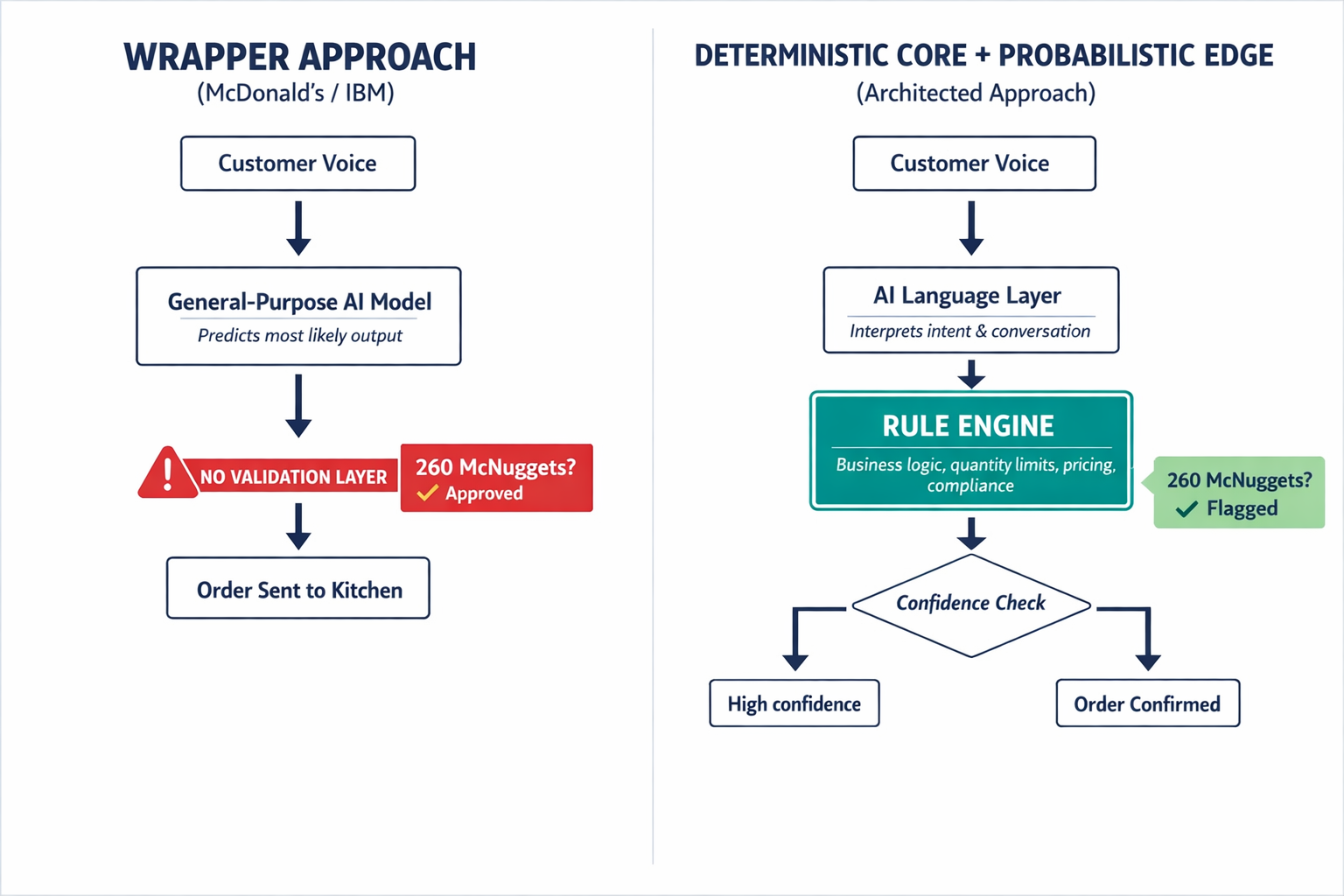
This is where the McDonald's story stops being about fast food and starts being about every enterprise deploying AI right now.
The IBM system was essentially what we call a wrapper — a thin software layer sitting between the customer and a general-purpose AI model, formatting inputs and structuring outputs. Wrappers are great for prototyping. They're fast to build, cheap to test, and impressive in demos. But they have a fundamental flaw: they leave all the critical decision-making to a probabilistic model that's designed to predict the most likely next word, not to enforce business rules.
When I first saw the full breakdown of what went wrong, I turned to my team and said: "This is exactly the failure mode we've been designing against."
At Veriprajna, we build on a different principle. We call it Deterministic Core, Probabilistic Edge. The idea is simple: use AI's linguistic flexibility for what it's good at — understanding messy human language, handling conversational flow, interpreting intent. But never let the AI make the final call on things that have hard rules. Pricing, quantity limits, menu logic, compliance constraints — those get handled by a rule-based system that doesn't guess.
The AI should understand what you're saying. A rule engine should decide what happens next.
I explored this architectural divide in depth in our interactive analysis of the McDonald's-IBM failure. The core argument: the reason 260 McNuggets ended up on a single tab is that no one built a sanity layer. A deterministic system would have flagged that quantity as absurd, checked it against historical order patterns, and escalated to a human before the damage was done.
The Competitors Who Got It Right
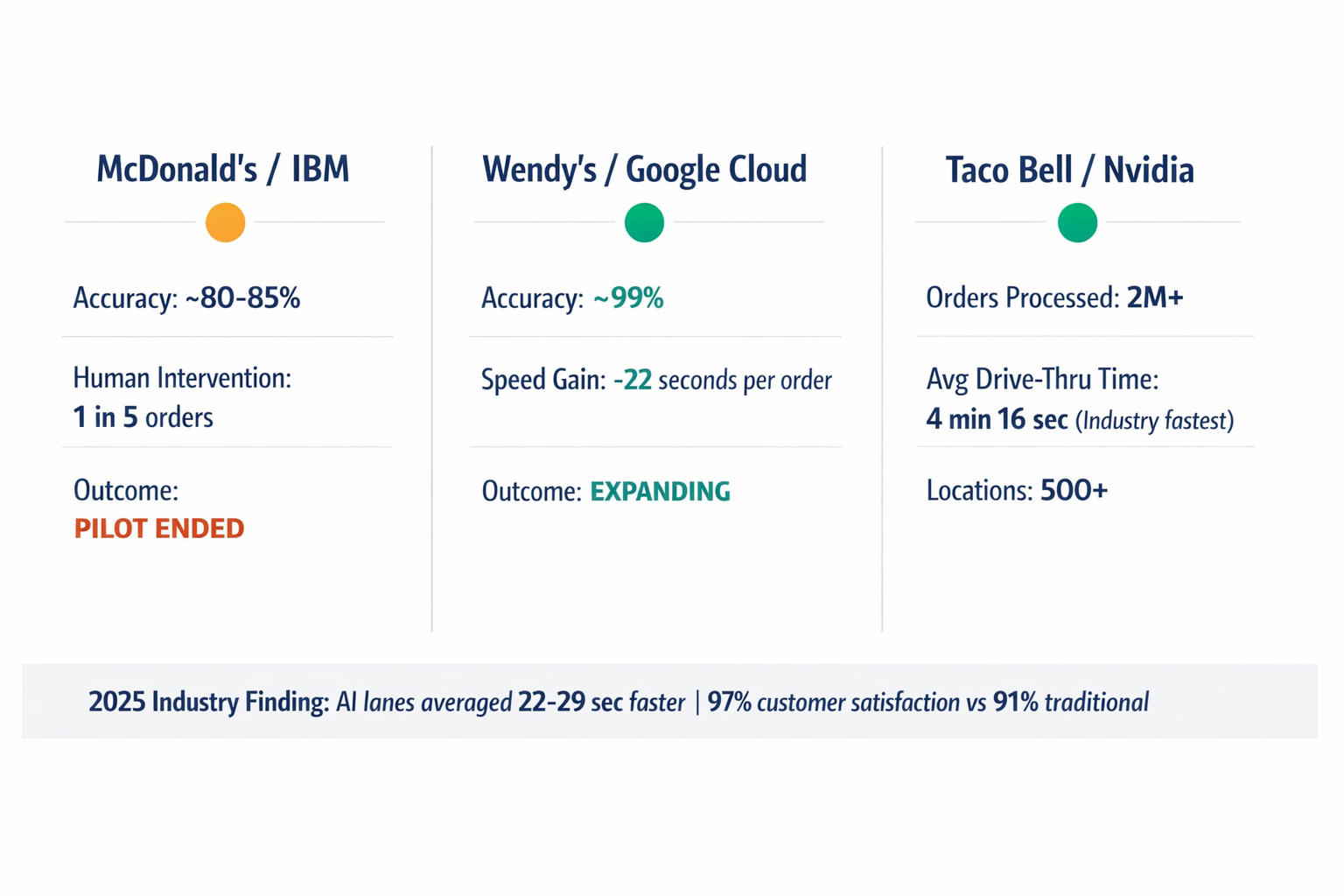
What makes the McDonald's failure so instructive is that other chains were succeeding during the same period, using more carefully architected systems.
Wendy's partnered with Google Cloud on a system called FreshAI that was deeply integrated with their point-of-sale and kitchen displays. They reported roughly 99% accuracy and a 22-second reduction in service time.
Taco Bell worked with Nvidia on a multi-agent system deployed across 500+ locations, processing over 2 million successful orders and achieving the fastest overall drive-thru time in the industry — about 4 minutes and 16 seconds per car.
The 2025 Drive-Thru Study confirmed the pattern: AI-powered lanes averaged 22 to 29 seconds faster than human-staffed lanes. And despite scoring lower on "friendliness," AI locations recorded 97% overall customer satisfaction — six points higher than the traditional average.
That last finding surprised me. It suggests that for most customers, getting the right order fast is the hospitality. They don't need the AI to be warm. They need it to be right.
For the modern drive-thru customer, accuracy and speed are the ultimate forms of hospitality.
The Hidden Risk: Who Owns Your AI's Brain?
There's a dimension of the McDonald's story that didn't go viral but matters enormously for any enterprise leader reading this.
McDonald's had already been sued under the Illinois Biometric Information Privacy Act for allegedly collecting customer voiceprints without consent. When your AI runs on a third-party cloud and processes millions of daily voice interactions, you've created a massive data liability that you don't fully control.
This extends well beyond voice data. Half of knowledge workers are already using unauthorized AI tools — and 46% say they'll keep using them even if explicitly banned. We call this Shadow AI, and it represents an enormous, invisible data leak. Every query an employee sends to an unsanctioned tool is proprietary information leaving the building.
The alternative is what we call sovereign intelligence: deploying AI models inside your own infrastructure, where you control the data, the access permissions, and the audit trail. No voiceprints leaving your network. No proprietary data flowing to a third-party API. For the full technical methodology behind sovereign AI deployment, we've published a detailed breakdown of the architecture.
"But Won't This Take Forever to Build?"
This is the objection I hear most often. Wrapper solutions are attractive precisely because they're fast. You can have a demo running in a week. Building a deterministic core with proper rule engines, signal processing, and data sovereignty takes real engineering.
I won't pretend otherwise. It does take longer upfront. But consider the alternative: McDonald's invested three years and the full weight of IBM's enterprise infrastructure into a wrapper approach and ended up with a system that was worse than the humans it was supposed to replace. The fast path turned out to be the slow path.
The ROI math also favors depth over speed. AI-driven drive-thrus that work properly are boosting average order values from $8.97 to $9.51 through consistent upselling — something human employees forget to do during rush hours. Over a 50-location chain, adding even one extra car per hour to lane capacity translates to roughly $185,600 in additional annual revenue. And AI-driven demand forecasting is hitting 90-95% accuracy in inventory management, cutting food waste and stockouts by 30-40%.
The returns are real. But only if the system actually works.
What This Means If You're Deploying AI Today
The McDonald's story isn't a cautionary tale about AI failing. Wendy's, Taco Bell, and White Castle proved the technology works. It's a cautionary tale about architectural shortcuts.
If you're evaluating AI for your organization — whether it's customer-facing automation, internal knowledge systems, or operational intelligence — three questions matter more than any vendor pitch:
Where does the data go? If every interaction flows to a third-party cloud, you've created a dependency and a liability. Understand who owns the model, the data, and the audit trail.
What happens when the AI is wrong? If there's no deterministic layer enforcing business rules, no confidence threshold triggering human escalation, you're one bad prediction away from your own bacon-on-ice-cream moment.
Is the system stateful or stateless? A system that treats every interaction as isolated — forgetting that a customer just removed an item, or that they're halfway through a complex order — will fail at exactly the moments that matter most.
The gap between companies experimenting with AI wrappers and those building architected intelligent systems is becoming a permanent competitive divide. McDonald's discovered this the hard way, in front of millions of TikTok viewers.
The question isn't whether AI works. It's whether your architecture is honest about where AI should make decisions and where it absolutely shouldn't.
I'd be curious to hear from others navigating this: where are you drawing the line between AI autonomy and human oversight in your own deployments?