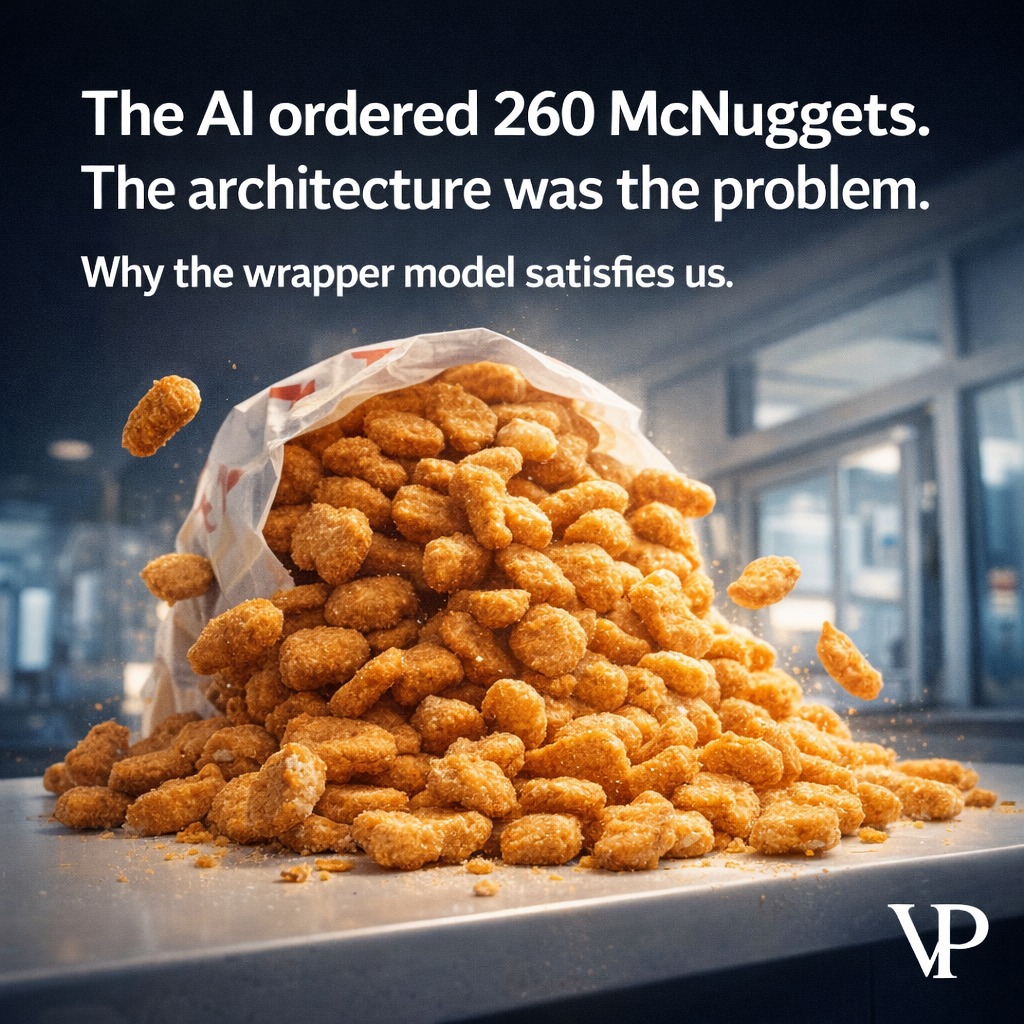
McDonald's AI added 260 McNuggets to one order. Here's why that satisfies us.
Not because we enjoy chaos. Because it proves exactly what our research has been saying for years.
The problem was never AI itself. It was the architecture underneath.
For three years, one of the world's biggest brands tried to automate drive-thru ordering by layering a generic voice model on top of existing systems. The result? Bacon on ice cream. Butter packets instead of water. A pilot stuck at roughly 80% accuracy while human workers consistently hit 90%+.
Meanwhile, competitors who built deeper took a different path entirely — and started seeing service times drop by 22+ seconds per order with satisfaction ratings near 97%.
The difference comes down to one principle:
Deterministic core. Probabilistic edge.
Translation: let AI handle the flexible, conversational part of an interaction. But never let a neural network decide business logic alone. Menu rules, quantity limits, pricing constraints — those need hard boundaries that no hallucination can override.
When a system lacks that foundation, you get 2,500 nuggets on a tab and a TikTok moment that erodes years of brand trust.
When you build it right, the AI knows to escalate instead of guess. It respects the physics of the problem, not just the probability of the next word.
Our latest whitepaper breaks down exactly how the wrapper model collapsed, what the successful implementations got right, and the four-pillar framework enterprises need to scale AI without becoming the next cautionary tale.
Save this if you're building AI systems that need to work in the real world — not just the demo room 🔖
What's the worst AI fail you've seen in a customer-facing product?
#EnterpriseAI #AIArchitecture #DeepAIStrategy #VoiceAI #AIReliability