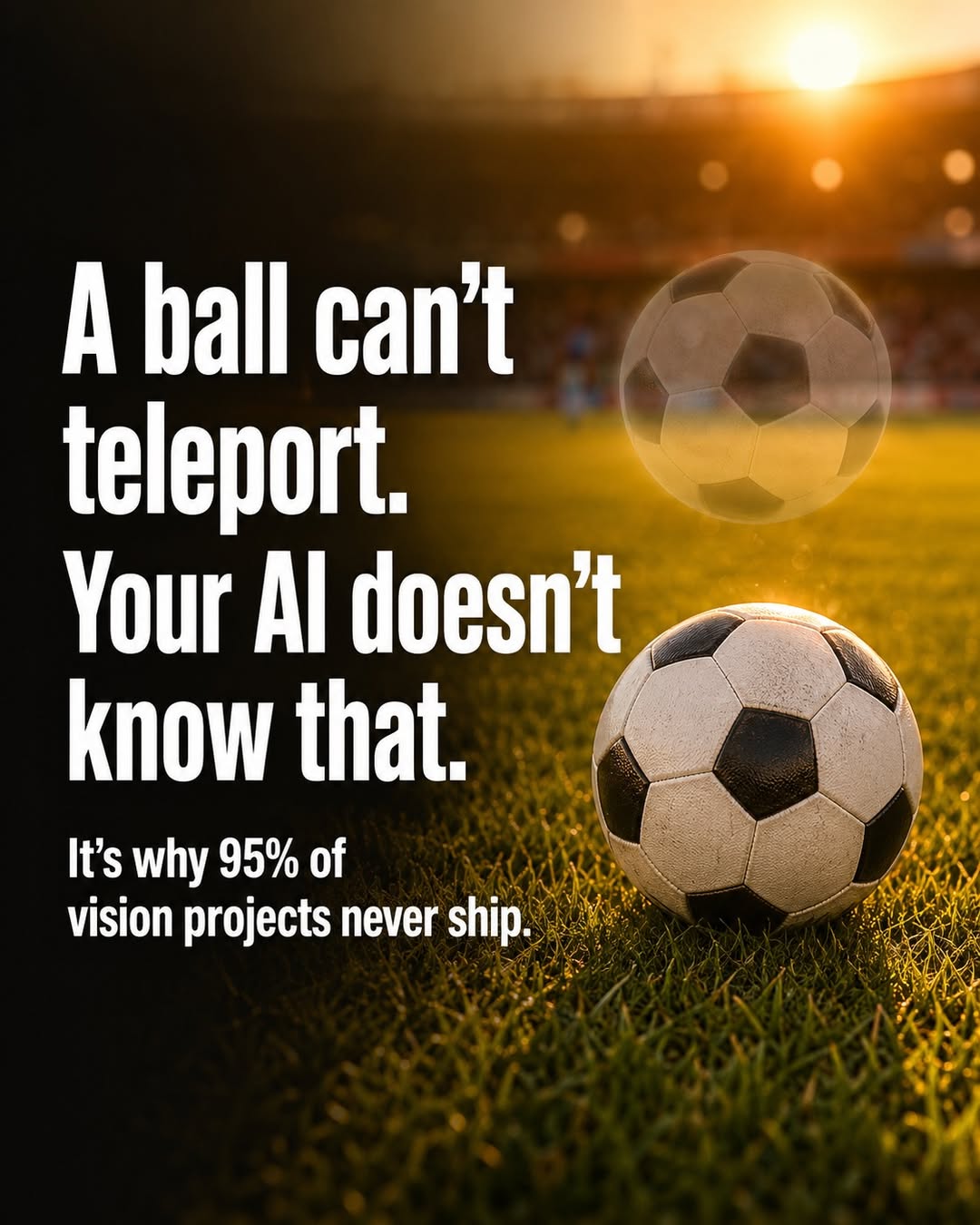
An AI sports camera once spent an entire football match tracking a linesman's bald head instead of the ball.
This really happened — Scotland, October 2020. Under the floodlights, his head threw specular highlights with pixel gradients nearly identical to a white soccer ball. The detector gave the head 98% confidence. The real ball — fast, blurring through shadows — scored 80%. So the camera followed the head.
Here's what no training data fixes: that "ball" was moving at 3 mph, holding a steady 1.7-meter height on a vertical cylinder. It broke every kinematic law a soccer ball obeys. The detector judged each frame in isolation. It saw a shape, never asking whether that shape was physically possible.
We see the same failure everywhere. In semiconductor fabs, classifiers flag dust particles as kill defects because they don't model how light scatters off a pit versus a stain — and a 1% yield loss can run into millions. On production lines, shadows trigger phantom rejects. The pattern is identical: detection without physics.
The fix isn't a bigger model. It's embedding the constraints the world already obeys — a ball can't teleport, a defect has parallax, a shadow has no depth — into the pipeline, so the system rejects the impossible before it gets expensive.
Around 95% of computer vision projects never reach production. Edge cases are where they die.
What's the most physically impossible thing your vision system has ever flagged as real?
#ComputerVision #ManufacturingAI