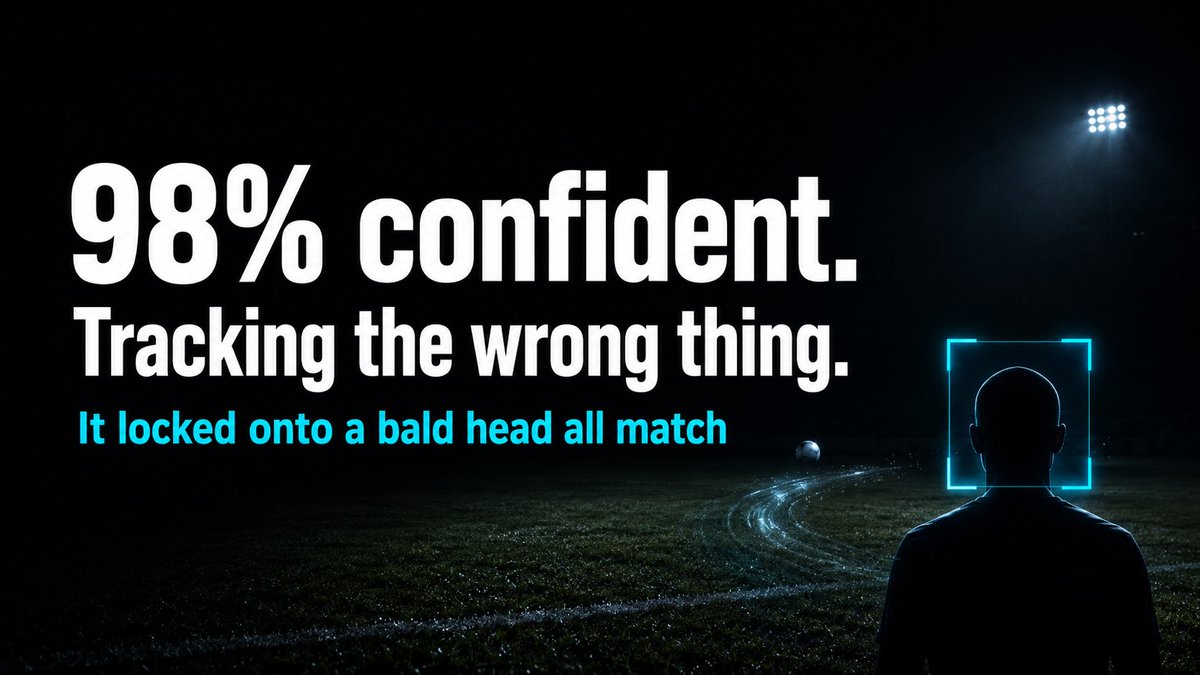
- In October 2020, an AI camera at a Scottish football match tracked a linesman's bald head instead of the ball. For the whole match. The detector was 98% sure the head was the ball. It had no way to know a ball can't sit still at 1.7m on a man's neck. 🧵
- Standard CNNs read each frame on its own. Under stadium floodlights, the bald head threw specular highlights with pixel gradients statistically identical to a white ball. 98% confidence on the head, 80% on the real ball. The system just followed the bigger number.
- This is the core flaw in generic computer vision: it finds patterns, but it doesn't understand physics. A ball can't teleport. A defect has parallax. A shadow has no depth. The model knows none of that — so it confidently flags the impossible.
- Same failure, different industry. In semiconductor fabs, KLA's tools detect features down to 10nm. But one scan flags thousands of anomalies per wafer — mostly dust and noise. The classifier has no model of how light hits a pit vs a stain vs process residue.
- The cost is real. A 1% yield loss at advanced nodes runs into millions — a single wafer can cost tens of thousands. Move to a new process node and the training data goes stale, so the nuisance rate spikes. Detection was never the bottleneck. Judgment is.
- On the production line, the failure is silent. A lighting angle shifts after maintenance. A lens hazes over weeks. False rejects climb, or defects escape — and you find out at the recall. Cost of poor quality already runs ~20% of sales for the average manufacturer.
- The instinct is to throw more training data at it. But more data only trains for the failures you've already seen — never the one edge case that recalls the product. And edge cases aren't 5% of the problem: they're 80% of your engineering time and 100% of your liability.
- Look at what ships. Pixellot's Kalman filter is post-hoc smoothing, not a constraint. NVIDIA's Omniverse uses physics only to make training data. Cognex is purely data-driven. Even SoccerNet's tracking benchmark integrates no physics-aware tracking. The gap is industry-wide.
- We build the opposite. Physics constraints live inside the pipeline: Kalman motion models, optical-flow gates, physics-informed architectures that reject the impossible before it gets expensive. A correct part's geometry doesn't shift when the lighting does — so we anchor to it.
- It's not theory. Physics-constrained trackers like Phys-3D enforce plausible 3D motion through pinhole geometry — holding 2.97% counting error through dense occlusion and camera shake, where naive detectors lose the plot.
- Honest question for CV teams: when your model throws a false positive, do you reach for more training data, or for a hard constraint that rejects the physically impossible? We think the industry over-indexes on data. #ComputerVision #MachineVision
- We wrote up how physics-constrained vision cuts false positives in sports tracking, semiconductor inspection, and manufacturing QA: https://veriprajna.com/solutions/physics-constrained-computer-vision