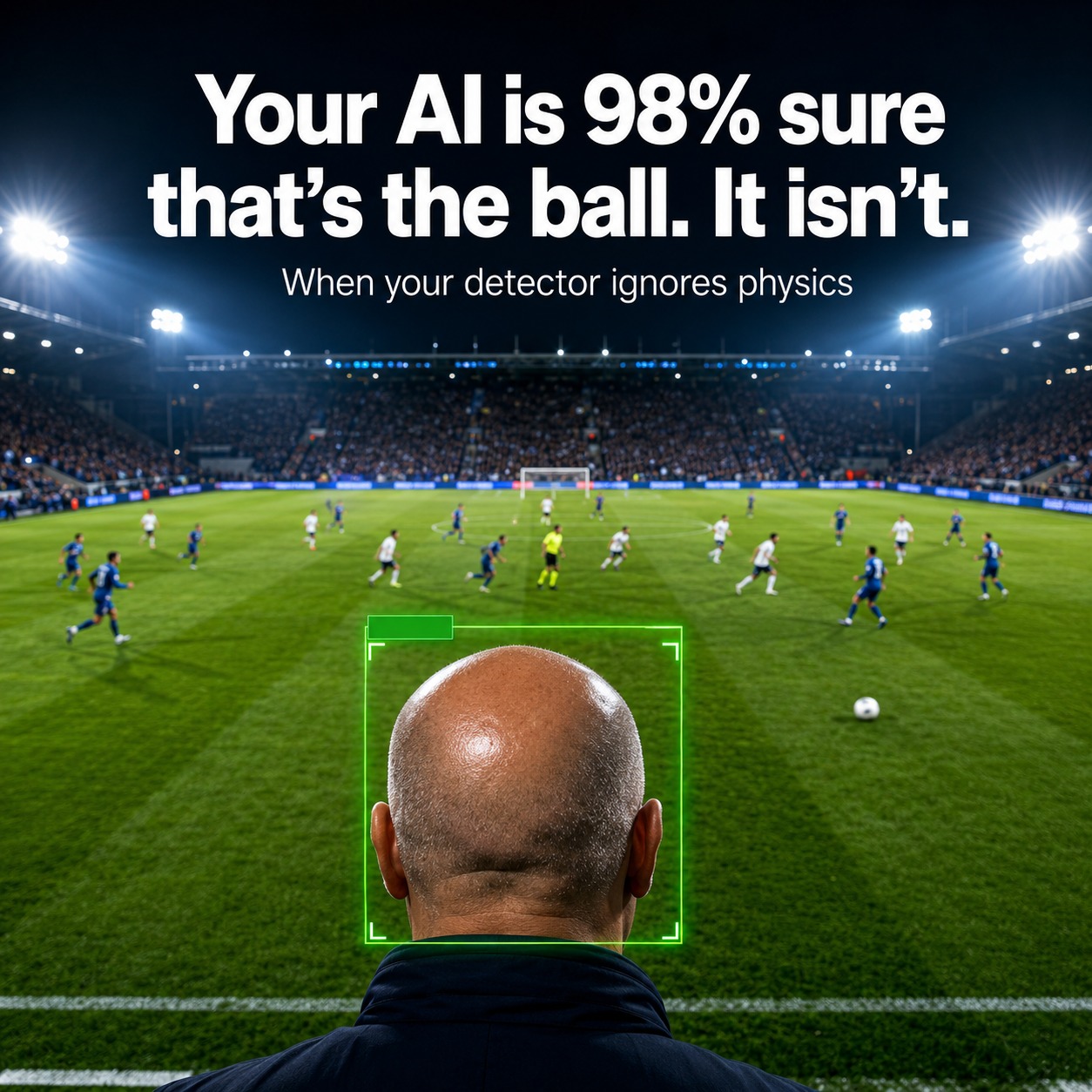
An AI camera once spent an entire soccer match tracking a linesman's bald head, convinced it was the ball.
This actually happened — Inverness Caledonian Thistle, October 2020, a Pixellot automated system. Under stadium floodlights, the bald head threw specular highlights with pixel gradients statistically indistinguishable from a white ball. The detector scored 98% confidence on the head; the real ball, blurring through shadows, scored 80%. The system followed the highest-confidence signal.
What it couldn't know is that a "ball" hovering at a constant 1.7 meters, drifting at walking pace, attached to a vertical cylinder, violates every kinematic constraint of a soccer ball in play.
The fix was never more training data. It's physics. A ball can't teleport. A defect has parallax. A shadow has no depth.
We see the exact same failure outside sport — in semiconductor inspection and manufacturing QA. In the fab, classifiers flag dust as kill defects because they have no model of how light scatters off a pit versus a stain — and every new process node (a 2nm gate-all-around transition, say) makes the training data obsolete overnight and spikes the nuisance rate, where a 1% yield loss runs into millions. On production lines, models drift silently as a lens hazes or a fixture wears, until a quality escape forces containment — cost of poor quality already averages ~20% of sales.
Generic computer vision finds patterns; it doesn't understand physics. That gap is why an estimated 95% of CV projects never reach production and edge cases swallow ~80% of engineering time.
So we build the constraint into the pipeline — Kalman-filter motion models, optical-flow gates, physics-informed architectures — so it rejects the impossible before it gets expensive.
Save this if your detector keeps confidently calling shadows defects. What's the strangest false positive your vision system has ever insisted on?
#ComputerVision #PhysicsInformedAI #MachineVision #DefectDetection #EdgeAI