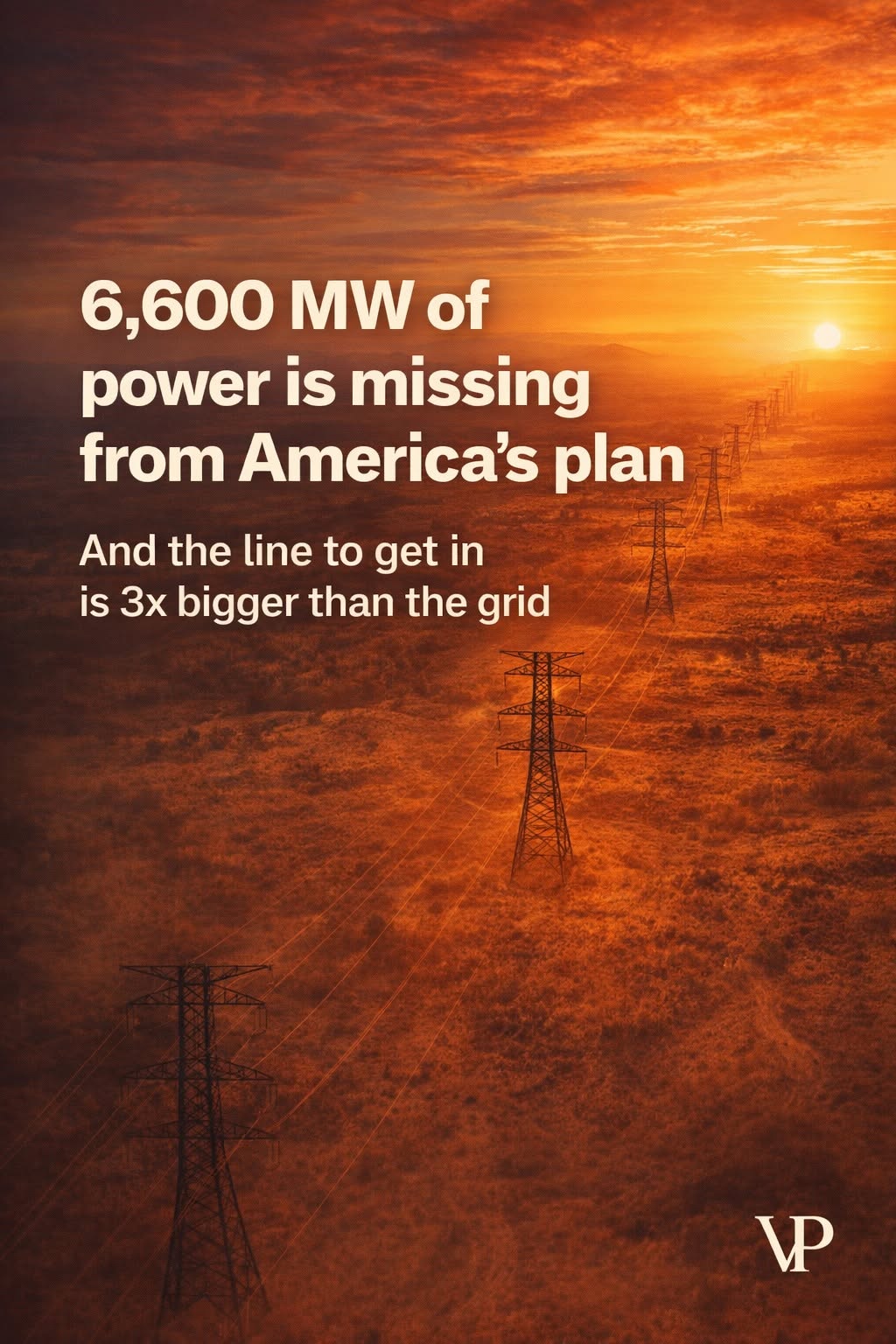
The largest grid operator in America just failed its own reliability auction for the first time ever.
Let that satisfy for a second.
PJM couldn't secure enough power to meet its safety target for 2027/2028. The gap? Over 6,600 MW. That's roughly enough electricity to power millions of homes just... missing from the plan.
Meanwhile in Texas, ERCOT's queue of large customers waiting to connect has ballooned to 233 GW. Their entire grid peaks around 85 GW. So the line of people wanting in is nearly three times bigger than the system itself.
The root cause is a collision we've been tracking closely.
Old power plants are shutting down faster than new ones come online. And at the same time, data centers are driving demand through the roof. PJM saw a 5,250 MW jump in its demand forecast, mostly from data centers alone.
Here's what caught our attention in the research: existing transmission lines often carry only 60-80% of what they safely could, because ratings are based on worst-case weather assumptions from decades ago. One utility used real-time monitoring to unlock 61% more capacity on major lines for a fraction of the cost of building new ones.
That's the kind of solution our team gets excited about. Not just building more, but making what already exists dramatically smarter.
We put together a deep technical breakdown of both crises and the AI approaches that could actually close these gaps.
Honest question for anyone in energy, tech, or policy: do you think we can engineer our way out of this, or does the grid need a fundamental redesign from scratch?
#EnergyGrid #AIEngineering #GridReliability