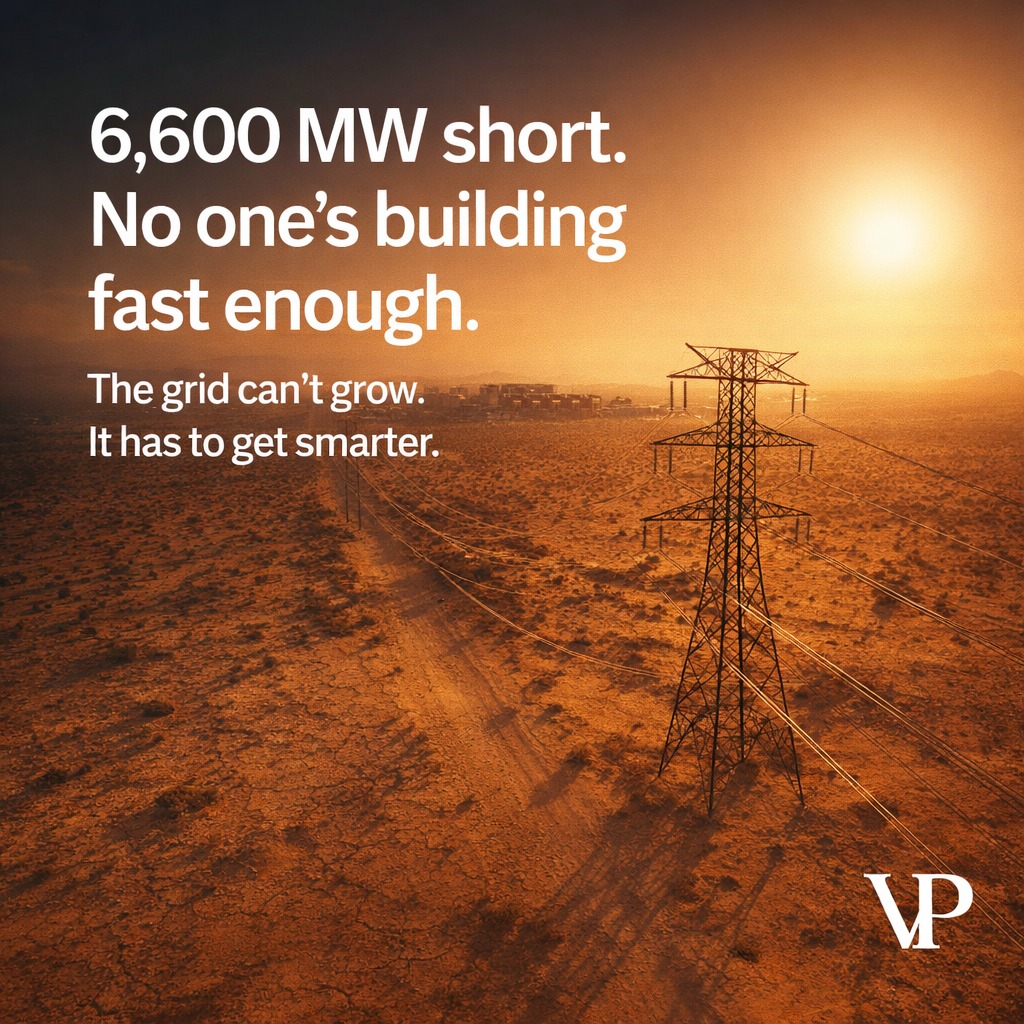
The US power grid is short 6,600 MW and nobody's building fast enough to fix it.
Here's what's actually happening — and why brute-force construction won't save us.
PJM, the largest grid operator in America, just failed to secure enough capacity for the first time ever. Their reserve margin dropped to 14.8% against a 20% target. Capacity prices hit the regulatory ceiling across all 13 states.
Meanwhile in Texas, ERCOT's large-load interconnection queue hit 233 GW. That's nearly 3x the entire state's peak demand. Most of those requests are from data centers. And new generation coming online? Only 23 GW — mostly solar and battery.
The math doesn't work.
Replacing 1 MW of retiring coal or gas requires roughly 5 MW of solar to deliver the same reliability. Over 54 GW of thermal generation has already retired in PJM since 2011, with up to 58 GW more at risk by 2030.
So what's the path forward?
Our team builds what we call Deep AI for energy infrastructure. Not chatbots. Not dashboards.
We're talking physics-informed neural networks that solve grid stability equations 87x faster than traditional methods. Graph neural networks that map power flow across thousands of substations in milliseconds. Reinforcement learning agents that balance load in real time under hard physical constraints.
One example: dynamic line rating powered by AI and sensor data unlocked 61% more transfer capacity on existing 345 kV lines — at a fraction of the cost of building new ones.
The grid can't grow fast enough to match the AI boom. It has to get smarter.
Save this if you work in energy, infrastructure, or tech strategy. We broke down the full technical blueprint in our latest analysis.
What's the bigger bottleneck right now — generation capacity or interconnection speed? Drop your take below 👇
#GridReliability #EnergyAI #PowerSystemEngineering #DeepLearningEnergy #ERCOTGrid