
For the first time in its history, the largest power grid operator in the United States failed to secure enough electricity to keep the lights on. In December 2025, PJM Interconnection — the grid operator serving 65 million people across 13 states — came up 6,623 megawatts short of its reliability target for 2027/2028. That's roughly the output of six nuclear power plants that simply don't exist. Meanwhile, in Texas, the grid operator ERCOT is drowning in 233 GW of new connection requests — nearly three times the state's entire peak electricity demand — mostly from data centers hungry to power AI.
These aren't isolated incidents. They're symptoms of a structural collision: the technology revolution is outrunning the physical infrastructure that powers it. And the conventional playbook — build more power plants, string more transmission lines — can't move fast enough.
Our team has spent months analyzing these twin crises, and we've reached a conclusion that might surprise people outside the energy sector: the most important near-term solution isn't more steel in the ground. It's smarter software in the control room. Not chatbots. Not dashboards. We're talking about AI that understands physics.
The Grid Is Retiring Faster Than It's Rebuilding
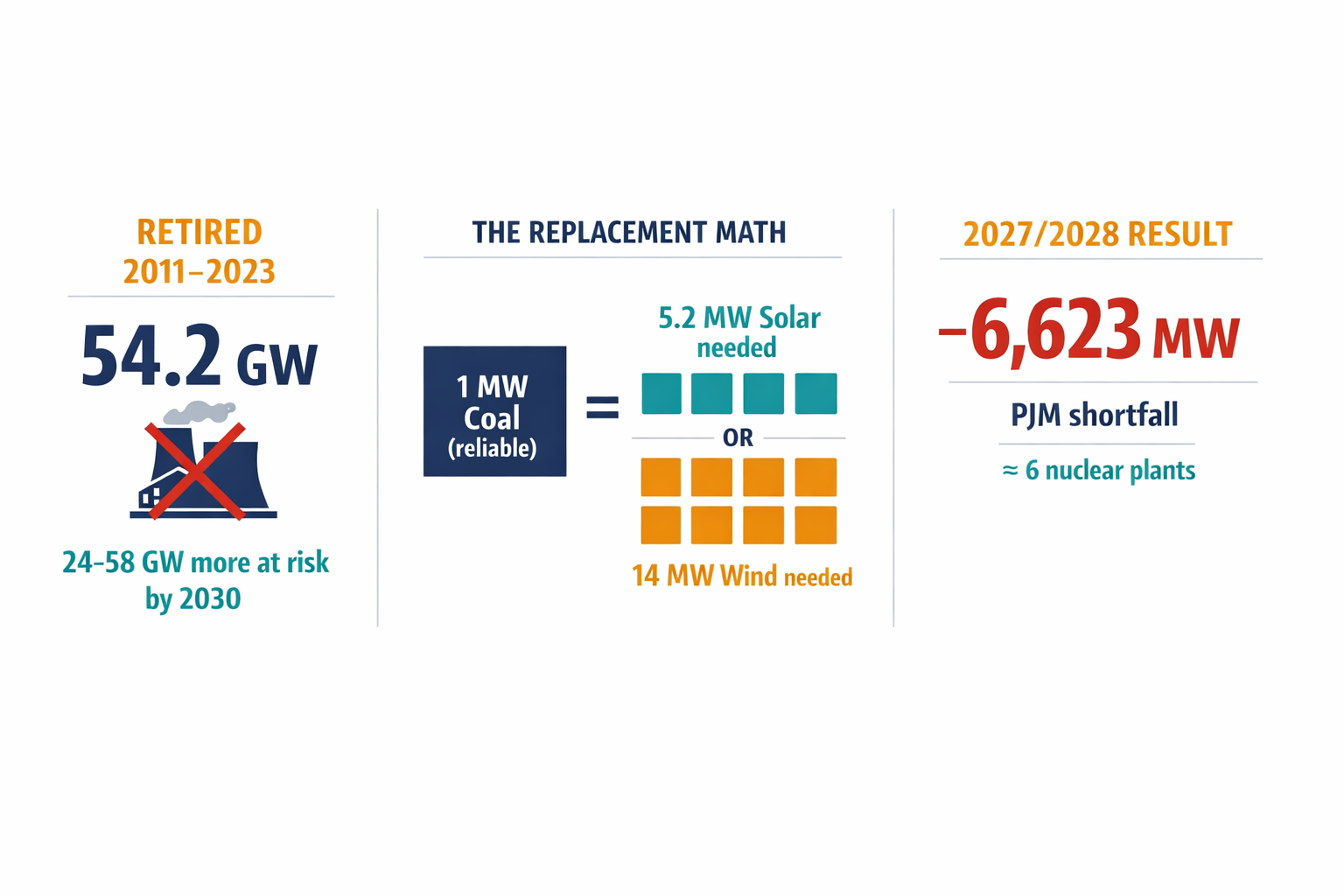
The PJM shortfall didn't appear overnight. Between 2011 and 2023, the region retired 54.2 GW of coal and gas plants — reliable, "always-on" generation that could ramp up whenever demand spiked. An additional 24 to 58 GW is at risk of retirement by 2030, representing up to 30% of installed capacity.
What's replacing them? Mostly solar and wind. Both are critical for decarbonization, but they introduce a math problem that many people outside the energy industry don't appreciate: replacing 1 MW of retiring coal requires roughly 5.2 MW of solar or 14 MW of wind to deliver the same level of reliability. The sun doesn't always shine during peak demand. The wind doesn't blow on command.
The grid isn't short on energy. It's short on energy you can count on at 6 PM on the hottest day of the year.
This gap between nameplate capacity and dependable capacity is what drove PJM's auction to hit its price ceiling of $333.44 per megawatt-day across the entire region — a regulatory cap designed to protect consumers that may now be discouraging the very investment needed to close the deficit.
We explored these dynamics in depth in our interactive analysis of the PJM shortfall and ERCOT crisis.
Texas Has a Different Problem: Too Many Requests, Not Enough Reality
ERCOT's crisis looks different on the surface but shares the same root cause. The Texas grid operator's large-load interconnection queue — essentially a waiting list for new facilities wanting to plug into the grid — exploded by 269% in a single year to reach 233 GW. Data centers account for 77% of those requests.
But most of those requests will never materialize. The industry calls them "phantom loads" — speculative applications from hyperscalers who submit requests at dozens of sites simultaneously, hedging their bets on which location will deliver the fastest connection. The result is that real engineering teams spend months running complex reliability studies on projects that may never break ground.
Meanwhile, on the supply side, ERCOT synchronized only 23 GW of new generation in 2025. The generation queue is dominated by solar (158 GW) and battery storage (175 GW), with natural gas at just 47 GW. Texas created a $9 billion fund to incentivize new gas plants, but roughly 35% of proposed projects have already withdrawn, citing global turbine shortages and permitting delays.
When 233 GW is waiting in line and only 23 GW showed up last year, you don't have a queue — you have a traffic jam with no off-ramp.
The state legislature passed Senate Bill 6 to standardize interconnection rules and improve forecasting, but legislation alone can't untangle a queue this large. Something has to sort the real projects from the speculative ones — fast.
Why Generic AI Won't Solve This
The energy industry has been adopting "AI" for years. Most of it falls into what we'd call shallow implementations: basic load forecasting with regression models, chatbots for customer service, simple anomaly alerts on equipment sensors. These tools have value, but they're fundamentally inadequate for the crisis at hand.
A power grid is not a spreadsheet. It's a synchronized machine spanning thousands of miles, governed by the laws of physics. Electricity moves at near light speed. A failure at one substation can cascade across an entire region in seconds. Frequency deviations of less than 1% can damage industrial equipment.
Any AI system that's going to help manage a 6.6 GW deficit or sort through 233 GW of connection requests needs to understand these physical realities — not just correlations in historical data.
This is the distinction we draw between shallow AI and what we call Deep AI: models that embed the actual physics and network structure of the grid into their core architecture.
Teaching Neural Networks the Laws of Physics
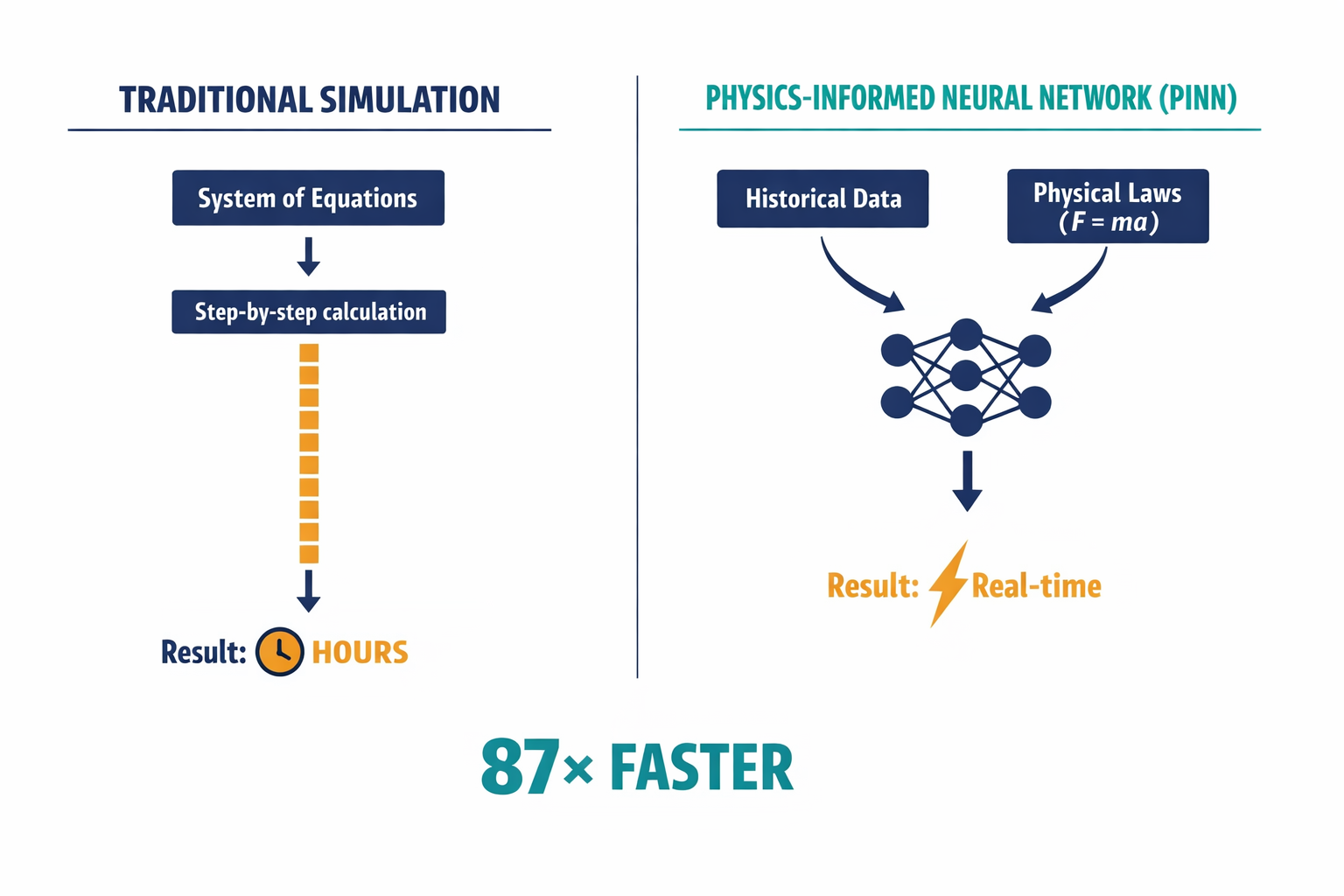
One of the most promising approaches is something called a Physics-Informed Neural Network, or PINN. Traditional grid stability analysis works by solving enormous systems of equations that describe how generators, transmission lines, and loads interact. For a grid as large as PJM, a single simulation can take hours. That's fine for planning. It's useless during an emergency.
A PINN takes a different approach. Instead of learning patterns purely from historical data — the way a standard AI model works — it's trained with the physical laws of the system baked directly into its learning process. Think of it like the difference between teaching someone to drive by showing them thousands of dashcam videos versus teaching them how engines, brakes, and friction actually work. The physics-trained driver handles situations they've never seen before.
The results are striking. PINNs can determine grid stability states up to 87 times faster than conventional numerical solvers. More importantly, they can "look ahead" — calculating the system's state at any future point without laboriously stepping through every millisecond in between. During a potential blackout event, that speed is the difference between automated intervention and cascading failure.
Seeing the Grid as a Network, Not a Spreadsheet
The second pillar of Deep AI for power systems is the Graph Neural Network, or GNN. A power grid is inherently a network: substations are nodes, transmission lines are edges connecting them. Standard machine learning treats all this data as a flat list of numbers, throwing away the spatial relationships that matter most.
A GNN preserves the grid's topology. It can learn which transmission corridors are critical bottlenecks, which substations are most vulnerable to cascading failures, and how a disruption at one point will ripple through the network. When PJM experienced a substation event in Baltimore that threatened a 1,200 MW load loss, the propagation of voltage drops and frequency swings across the network was exactly the kind of problem a GNN is built to predict — in milliseconds rather than minutes.
For predictive maintenance, multilayer GNNs have demonstrated an F1 score of 0.89 (on a scale where 1.0 is perfect) for identifying substations at risk of failure within 30 days. That's the difference between a planned repair and an emergency blackout.
For the full technical methodology behind these approaches, including the mathematical frameworks for PINNs and GNNs, see our detailed research.
The Fastest Win: Unlocking Capacity That Already Exists
Not every solution requires years of development. One of the most immediate applications of Deep AI is something called Dynamic Line Rating, or DLR — and it illustrates why smarter software can sometimes beat new hardware.
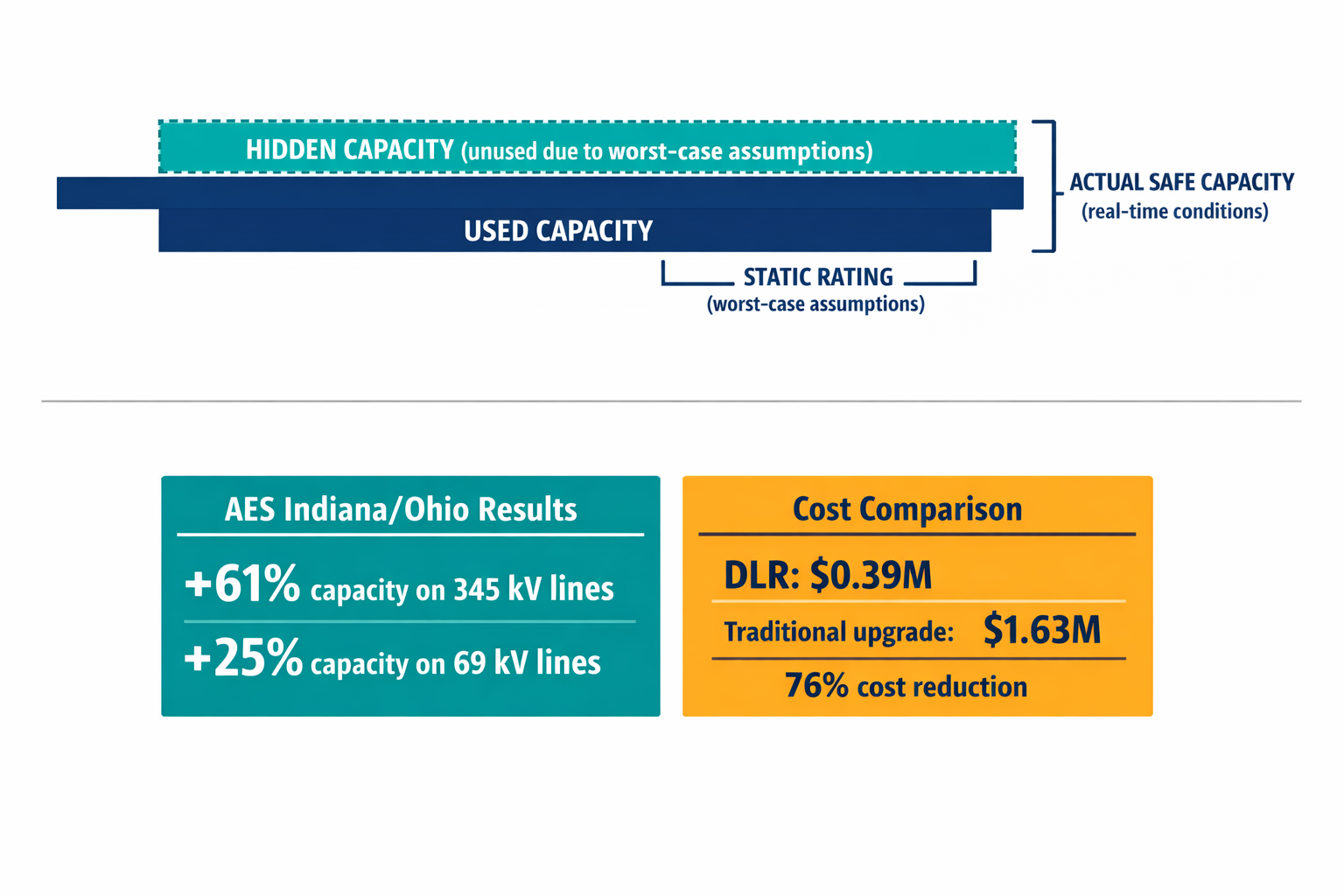
Every transmission line has a rated capacity: the maximum power it can carry safely. Traditionally, these ratings are calculated using worst-case assumptions — the hottest day, no wind, maximum sun exposure on the conductor. The problem is that these conditions rarely all occur simultaneously. On most days, 20-40% of a line's actual capacity goes unused because the rating assumes conditions that aren't happening.
DLR uses real-time weather data and IoT sensors to calculate what a line can actually carry right now. When AES deployed this approach on lines in Indiana and Ohio, they increased transfer capacity by 61% on high-voltage 345 kV lines and 25% on 69 kV lines. The cost? $0.39 million — compared to $1.63 million for traditional physical upgrades. Deployment time dropped from years to months.
For a grid operator staring at a 6,623 MW shortfall, the cheapest new megawatt is the one already flowing through a wire you own.
For PJM, scaling DLR across its 13-state footprint could unlock enormous transmission capacity without a single new line being built. It's not a complete solution, but it buys critical time while new generation comes online.
Sorting the Real From the Speculative in ERCOT's Queue
For ERCOT's interconnection backlog, the opportunity lies in intelligent automation. Today, every connection request triggers a manual engineering study — a complex reliability analysis that can take months. When 233 GW of requests are waiting, that process breaks down.
We've been developing what we call agentic AI for this problem: AI systems that don't just analyze data but take structured actions. When an interconnection request comes in, these agents can automatically screen it for regulatory compliance, group projects into optimal clusters based on where they'd actually connect to the grid (not just when they applied), and — critically — assign a probability score for whether the project will actually reach completion.
That last capability directly addresses the phantom load problem. By analyzing patterns in project financing, developer track records, site characteristics, and commercial readiness, machine learning can help planners distinguish between a data center that will break ground in 18 months and one that's holding a spot in line "just in case."
The goal is to shift from a "first-come, first-served" queue to a "first-ready, first-served" model — potentially reducing the $14 billion in estimated transmission improvements currently under review by focusing investment where it will actually be needed.
What About the Cost of Doing Nothing?
The economic stakes make the case for urgency. A recent analysis by the Natural Resources Defense Council found that data center growth in the PJM region could drive $163 billion in cumulative capacity costs from 2028 through 2033. In Northern Illinois alone, that translates to a $70-per-month increase for the average residential household.
These costs don't just affect utility bills. For industrial consumers and the tech companies driving demand, unreliable power means production risk, stranded capital investment, and potential relocation. For the communities hosting data centers, it means bearing the cost of infrastructure upgrades they didn't ask for.
Deep AI doesn't eliminate these costs, but it reshapes them. By accurately identifying how much capacity existing infrastructure can safely deliver, by predicting which power plants are at risk of early retirement (our models achieve a 1.07% error rate on retirement age prediction), and by accelerating the interconnection process for projects that are genuinely ready to build, AI converts a brute-force infrastructure problem into an optimization problem.
Capital efficiency improves. Timelines compress. Risk becomes visible before it becomes a crisis.
Can AI Be Trusted in a Control Room?
This is the question we hear most often from utility executives, and it's the right one. A power grid is critical infrastructure. An AI model that makes a wrong call during a peak demand event doesn't just produce a bad quarterly report — it causes a blackout.
Our approach is built on a principle we call stability-aware inference. AI never operates as an autonomous black box in the control room. When a GNN identifies a cascading failure risk, it generates a visual explanation highlighting the specific lines and substations contributing to the danger. Human operators verify the reasoning before any action is taken.
This isn't a limitation — it's a design requirement. The AI handles the computational work that humans physically cannot do in real time (scanning thousands of contingencies per second), while humans retain decision authority over actions that affect millions of people. The architecture connects to existing control systems without replacing the safety-critical structures that utilities have spent decades refining.
The goal isn't to replace grid operators with AI. It's to give them the ability to see around corners.
What This Means for Your Organization
Whether you're a utility planning for 2027, a data center developer waiting in an interconnection queue, or an industrial consumer worried about reliability and rates, the implications are concrete:
Utilities: Dynamic Line Rating and physics-informed stability tools can unlock existing capacity while new generation is built. GNN-based predictive maintenance catches substation failures before they cascade. These aren't five-year research projects — pilot deployments can begin within months.
Data center developers: AI-accelerated interconnection screening can move credible projects to the front of the queue. Understanding which grid locations have genuine available capacity — versus locations where your request will trigger billions in upgrades — saves years and millions in development costs.
Large industrial consumers: The $163 billion in projected PJM capacity costs will flow through to ratepayers. Investing in demand flexibility programs — managed by AI that can guarantee high availability without disrupting operations — is both a cost hedge and a reliability contribution.
Policymakers: Price caps that mask scarcity signals and interconnection processes designed for a slower era need updating. AI tools can provide the analytical foundation for smarter market design and more efficient permitting.
The power grid was built for a world of predictable demand and controllable supply. That world is over. The AI revolution is simultaneously the grid's greatest stressor and its most powerful potential tool. The question isn't whether Deep AI will transform grid operations — it's whether that transformation happens fast enough to prevent the reliability failures that are now, for the first time, showing up in the numbers.
We'd welcome hearing from anyone navigating these challenges — whether you're on the utility side, the demand side, or somewhere in between. The 2027 deadline isn't abstract. It's 18 months away.