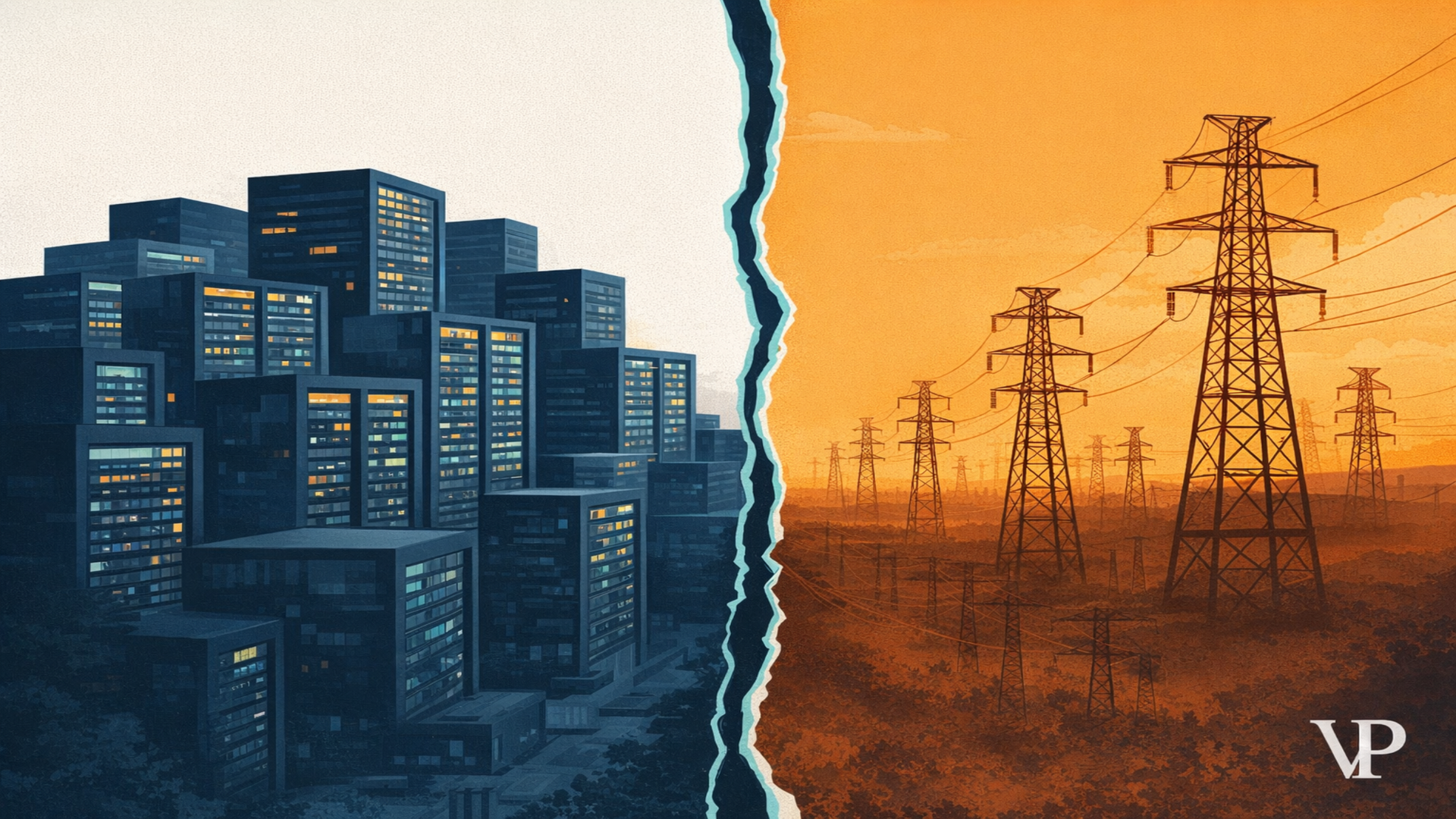
For the first time in its history, the largest grid operator in the United States failed to secure enough power to keep the lights on. In December 2025, PJM Interconnection — which serves 65 million people across 13 states — came up 6,623 megawatts short of its reliability target for the 2027/2028 delivery year. That's roughly the output of six nuclear power plants that simply don't exist.
Meanwhile, in Texas, the grid operator ERCOT is staring at an interconnection queue of 233 gigawatts — nearly three times the state's entire peak demand — with most of that coming from data centers that need power around the clock. The generation being built to serve them? Mostly solar and batteries. The mismatch is staggering.
I've spent the last several months studying these twin crises with my team at Veriprajna, and what we found shook a belief I'd held for years: that AI could be deployed incrementally into energy systems, one use case at a time, like adding features to a software product. It can't. The grid is a physics problem masquerading as an infrastructure problem, and the AI most companies are selling for it is laughably shallow.
The Retirement Cliff Nobody Planned For
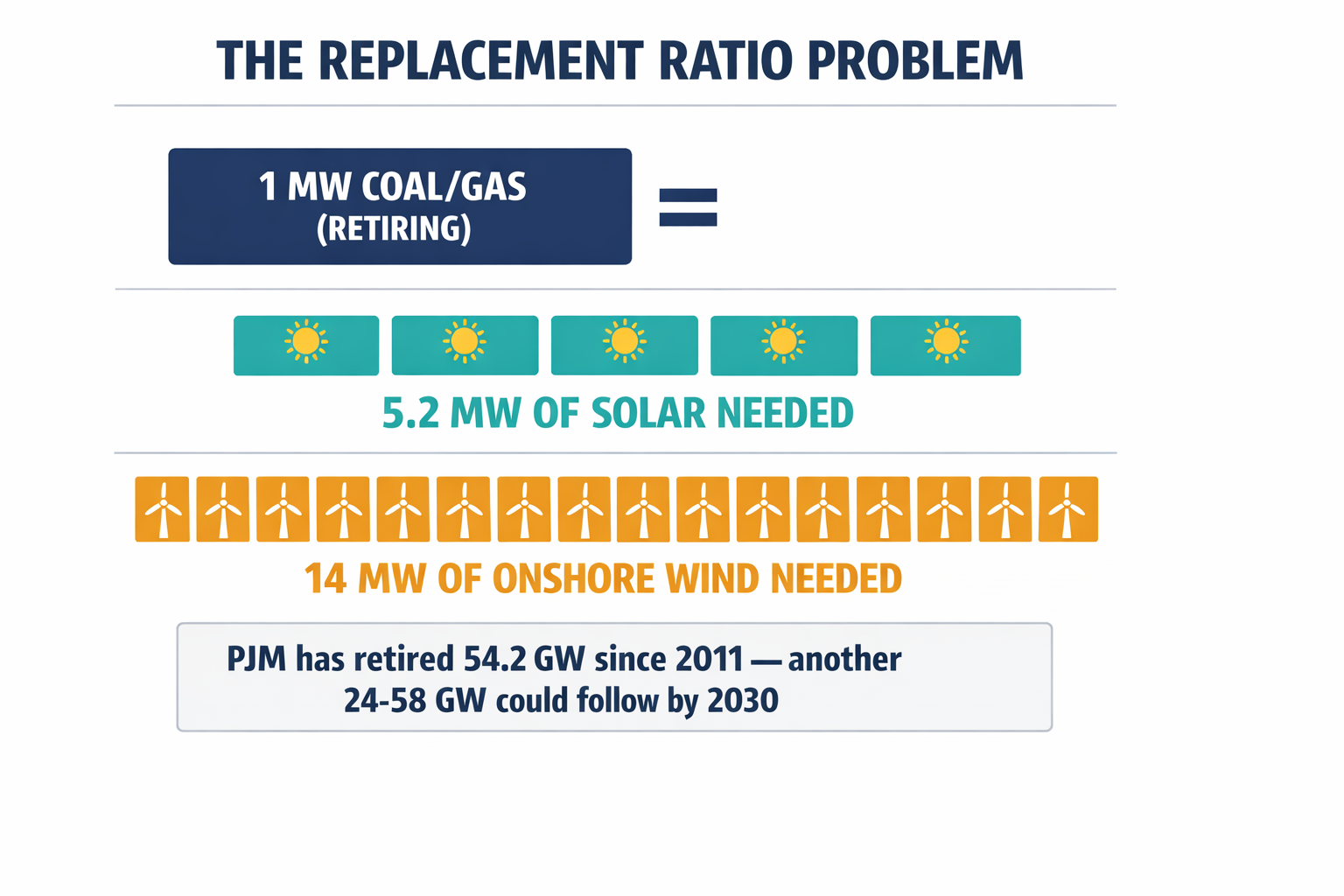
Between 2011 and 2023, PJM retired 54.2 gigawatts of coal and gas plants. That's not a trend — it's a controlled demolition of the generation fleet. And another 24 to 58 GW could follow by 2030, representing up to 30% of installed capacity.
The assumption was always that renewables would fill the gap. They haven't, and the math explains why. PJM's own analysis shows that replacing 1 MW of retiring coal or gas requires about 5.2 MW of solar or 14 MW of onshore wind to deliver the same reliability. A megawatt of solar doesn't show up at 7 PM on a January evening when everyone turns on their heaters.
The grid isn't short on energy. It's short on energy that shows up when you need it.
This is the core of the PJM shortfall. The capacity auction — where power plants bid to be available during peak demand — hit its price cap of $333.44 per MW-day across the entire region. That cap was supposed to protect consumers from price spikes. Instead, it masked the true cost of scarcity and may have discouraged the very investment needed to close the gap. Total auction cost: $16.4 billion. Megawatts still missing: 6,623.
I explored this dynamic in detail in our interactive analysis of the crisis, which maps how the retirement cliff, data center demand, and market design failures compound each other.
Texas Has a Different Problem — And It's Even Stranger
ERCOT's crisis isn't a capacity shortfall yet. It's a traffic jam.
That 233 GW interconnection queue represents a 269% increase from the end of 2024. Data centers account for 77% of the large-load requests. But here's the twist: many of these requests are speculative. Hyperscalers submit multiple applications across different sites, hedging their bets on which utility will connect them fastest. The industry calls these "phantom loads" — requests that clog the engineering pipeline but may never reach financial close.
ERCOT synchronized only 23 GW of new generation in 2025. The queue is ten times that. Engineers are running complex reliability studies on projects that might never get built, while real projects wait in line behind phantoms.
Texas lawmakers responded with Senate Bill 6, which standardizes interconnection rules and requires data centers with backup generators to make them available during grid emergencies. The state also created a $9 billion fund to incentivize new gas plants. But roughly 35% of proposed gas projects have already withdrawn, citing global turbine shortages and permitting delays.
When financial incentives can't build power plants fast enough, the grid has to get smarter — because it can't grow physically at the speed of the AI revolution.
Why Most "AI for Energy" Is a Waste of Money
I need to be blunt about something. Most of what's being sold as "AI for the grid" is superficial — chatbots for customer service, basic regression models for load forecasting, dashboards that look impressive but don't respect the physics of how electricity actually moves.
The power grid is not a spreadsheet. It's a synchronized dynamical system where electricity travels at near the speed of light, where a fault at one substation can cascade across a thousand miles in seconds, and where the laws of physics are non-negotiable. Kirchhoff's Laws don't care about your machine learning model's training data.
When my team started working on grid problems, we quickly realized that general-purpose AI — the kind built to predict ad clicks or recommend movies — fails catastrophically when applied to power systems. A neural network that doesn't understand that voltage and current are related by impedance will confidently produce answers that would trip a breaker in the real world.
This is the distinction I keep coming back to: shallow AI treats the grid as a collection of data points. Deep AI treats it as the physical system it actually is.
Making AI Respect Physics
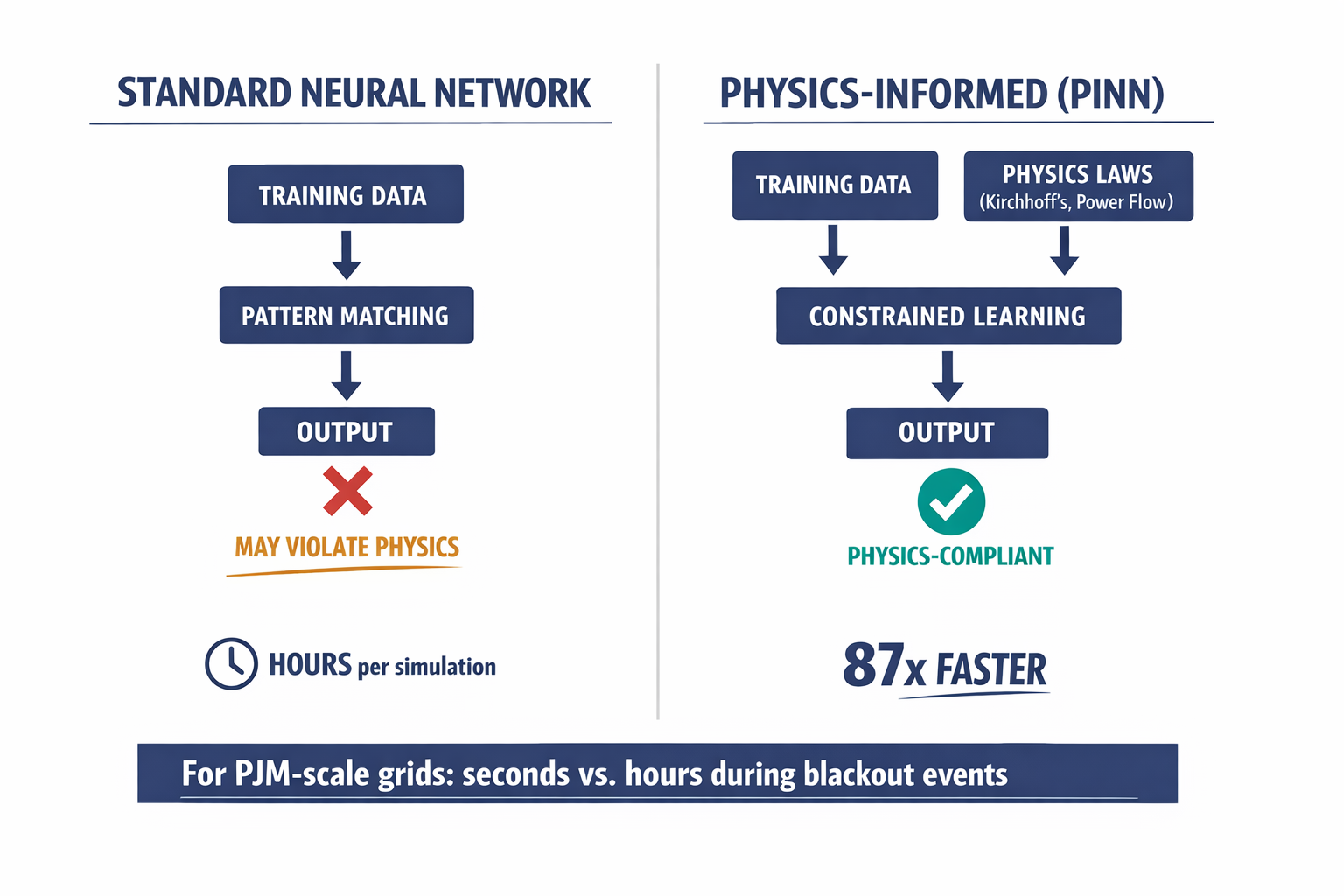
The breakthrough that changed our approach was a class of models called Physics-Informed Neural Networks, or PINNs. Think of a standard neural network as a student who learns entirely from examples — show it enough data, and it finds patterns. A PINN is a student who also has to obey the textbook. The laws of physics are baked directly into how the model learns, so it can't produce answers that violate them.
For power grids, this matters enormously. Traditional stability simulations — the kind grid operators run to check whether the system can handle the loss of a major plant — solve massive systems of equations. For a grid as large as PJM, a single simulation can take hours. PINNs can produce equivalent results 87 times faster because they don't need to step through time sequentially. They can jump straight to the answer at any point, like looking up a page in a book instead of reading from the beginning.
That speed difference isn't academic. During a potential blackout event, the difference between hours and seconds is the difference between preventing a cascade and managing a disaster.
The second piece is treating the grid as what it actually is: a network. Substations are nodes. Transmission lines are edges. We use Graph Neural Networks — models specifically designed for networked data — to capture how disturbances propagate through the system's actual topology. When we tested multilayer GNNs on substation failure prediction, they achieved an F1 score of 0.8935 for identifying at-risk substations within a 30-day window. That's accurate enough to schedule preventive maintenance before a reliability event occurs.
A neural network that doesn't understand the topology of the grid is like a GPS that doesn't know about one-way streets. It'll give you directions — they'll just be wrong.
The Fastest Win: Unlocking Capacity That Already Exists
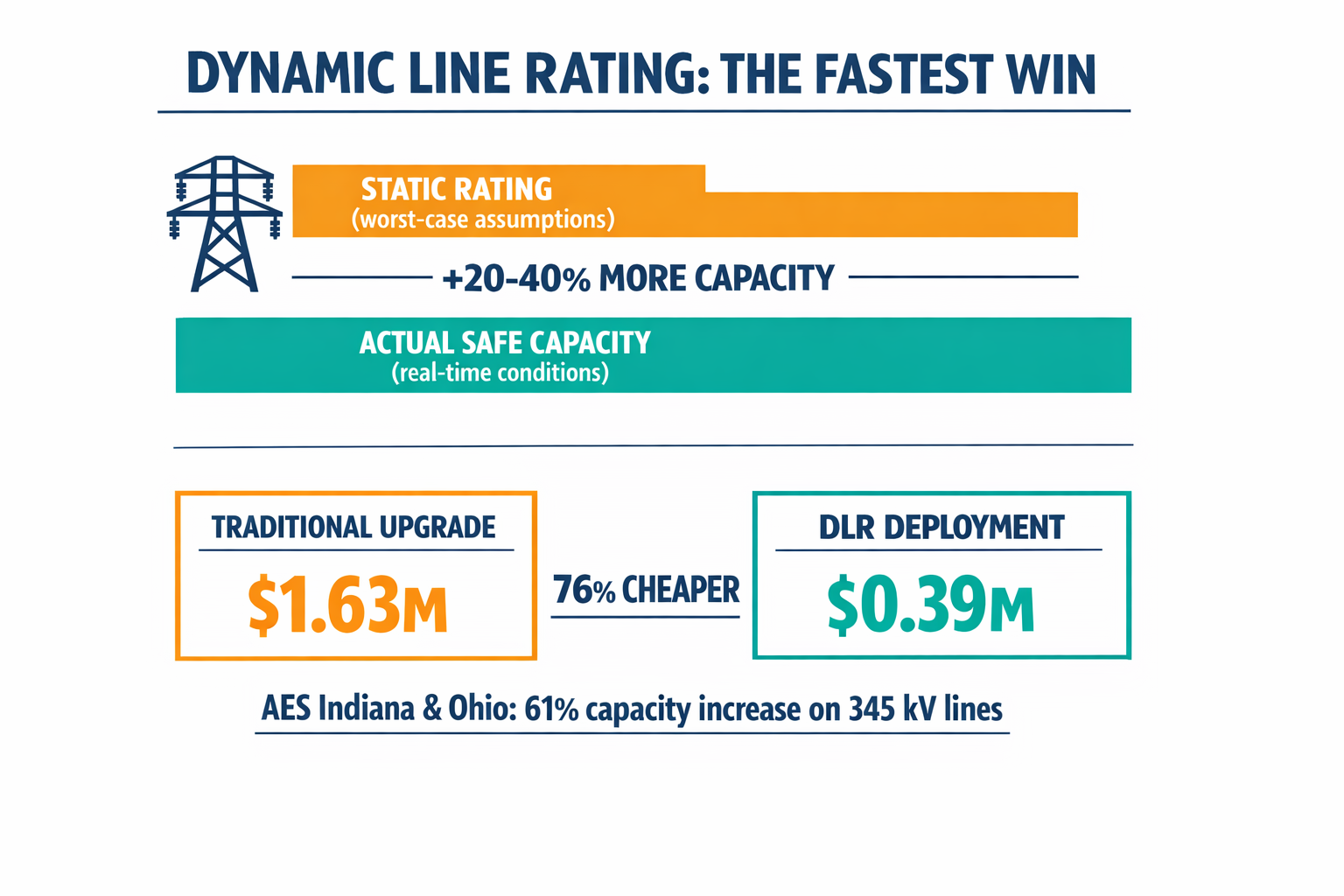
Not everything requires years of R&D. One of the most immediate solutions to both the PJM and ERCOT crises is something called Dynamic Line Rating, or DLR.
Every transmission line has a rated capacity — the maximum power it can safely carry. But those ratings are based on worst-case assumptions: hottest day, no wind, full sun beating on the conductor. On most days, the actual safe capacity is 20-40% higher than the rating says.
DLR uses real-time weather data and sensors mounted on the lines to calculate what the conductor can actually handle right now, today, in current conditions. It's the difference between a speed limit set for the worst blizzard of the decade and one that adjusts for clear roads.
The results are striking. In Indiana and Ohio, AES used DLR and sensor technology to increase transfer capacity by 61% on high-voltage 345 kV lines — at a cost of $0.39 million, compared to $1.63 million for traditional line upgrades. That's 76% cheaper and deployable in months instead of years.
For PJM, facing a 6,623 MW gap by 2027, deploying DLR across the most congested corridors could unlock enormous amounts of transmission capacity without building a single new line.
What a 233 GW Queue Needs: Digital Engineers, Not More Paperwork
The ERCOT queue problem is fundamentally a bottleneck of human engineering hours. Every interconnection request triggers a complex reliability study. With 233 GW in the queue, there aren't enough engineers on the planet to process them all using traditional methods.
This is where we've been building what I think of as "digital engineers" — AI agents that don't just chat, but reason over technical documentation and regulatory filings. When an interconnection request comes in, these agents can automatically screen it against NERC and FERC standards, group projects into optimal clusters based on where the grid actually has capacity, and — critically — assign a probability score to whether the project will actually get built.
That last capability is the key to solving the phantom load problem. Instead of processing requests first-come, first-served, ERCOT could shift to first-ready, first-served — prioritizing projects with real financing, real site control, and real engineering feasibility. The estimated $14 billion in transmission improvements currently under review could shrink dramatically if the queue were filtered for credibility first.
For the full technical methodology behind our approach — including the PINN architectures, GNN frameworks, and reinforcement learning control layers — see our detailed research.
The $163 Billion Question
A recent analysis by the NRDC found that data center growth in PJM could drive $163 billion in cumulative capacity costs from 2028 through 2033. In Northern Illinois alone, that translates to roughly $70 more per month on the average residential electricity bill.
That number stopped me cold when I first saw it. We're talking about ordinary households subsidizing the power needs of the AI industry — not because anyone chose that outcome, but because the grid's market mechanisms weren't designed for this kind of demand shock.
The companies building data centers know this is unsustainable. Several hyperscalers are already exploring co-located generation, on-site nuclear, and direct power purchase agreements that bypass the grid entirely. But for the next five years, the existing grid has to absorb the hit.
But Can You Trust AI in a Control Room?
This is the objection I hear most from utility executives, and it's the right one. The power grid is critical infrastructure. A bad recommendation from an AI model isn't a wrong movie suggestion — it's a potential blackout affecting millions of people.
My answer is that we never deploy AI as a black box in operational settings. Every recommendation from our models comes with an explanation — specifically, a graph-based visualization showing which substations, which transmission lines, and which physical constraints are driving the recommendation. A human operator can verify the reasoning before acting on it. The AI proposes; the engineer disposes.
We also don't let AI models touch the safety-critical control layer directly. Our architecture connects to existing control systems without replacing the proven safety structures that have kept the grid running for decades. Think of it as adding a very smart advisor to the control room, not replacing the operators.
What Should You Actually Do?
If you're a utility executive, a grid planner, or a large energy consumer reading this, here's what I'd prioritize:
In the next 12 months: Deploy Dynamic Line Rating on your most congested corridors. It's the highest-ROI, lowest-risk intervention available. Simultaneously, get your data infrastructure ready — most utilities can't even aggregate their SCADA, weather, and IoT data into a single queryable system.
In years one through three: Replace traditional stability simulations with physics-informed models. Integrate graph neural networks into your fault prediction and state estimation workflows. If you're a data center developer in the ERCOT queue, push for automated screening processes that reward project readiness over filing date.
In years three through five: Build toward what I call the "sentient grid" — systems that can detect, diagnose, and begin responding to disturbances autonomously, with human oversight at the decision boundary. This isn't science fiction. The algorithms exist. The challenge is integration, trust, and organizational change.
The Grid Is the Bottleneck Now
I started this work believing that AI's biggest challenge in energy was technical — better models, faster inference, more data. I was wrong. The biggest challenge is that the most complex machine humanity has ever built is being asked to power the next most complex thing humanity is building, and the two are on a collision course.
The 6,623 MW gap in PJM isn't just a number on a capacity auction report. It's a signal that the era of passive grid management — build plants, connect them, hope demand doesn't outpace supply — is over. The 233 GW queue in ERCOT isn't just a traffic jam. It's proof that the AI revolution is arriving faster than the physical infrastructure can accommodate it.
We don't have a generation problem or a transmission problem. We have an intelligence problem — and it's the one kind of problem AI might actually be suited to solve.
The question I keep asking myself: are we going to treat the grid as a physics problem that deserves physics-aware AI, or are we going to keep throwing chatbots at it and hoping for the best?
I'd genuinely like to hear from anyone wrestling with these challenges — whether you're on the utility side, the data center side, or somewhere in between. What's the bottleneck you're hitting that nobody's talking about?