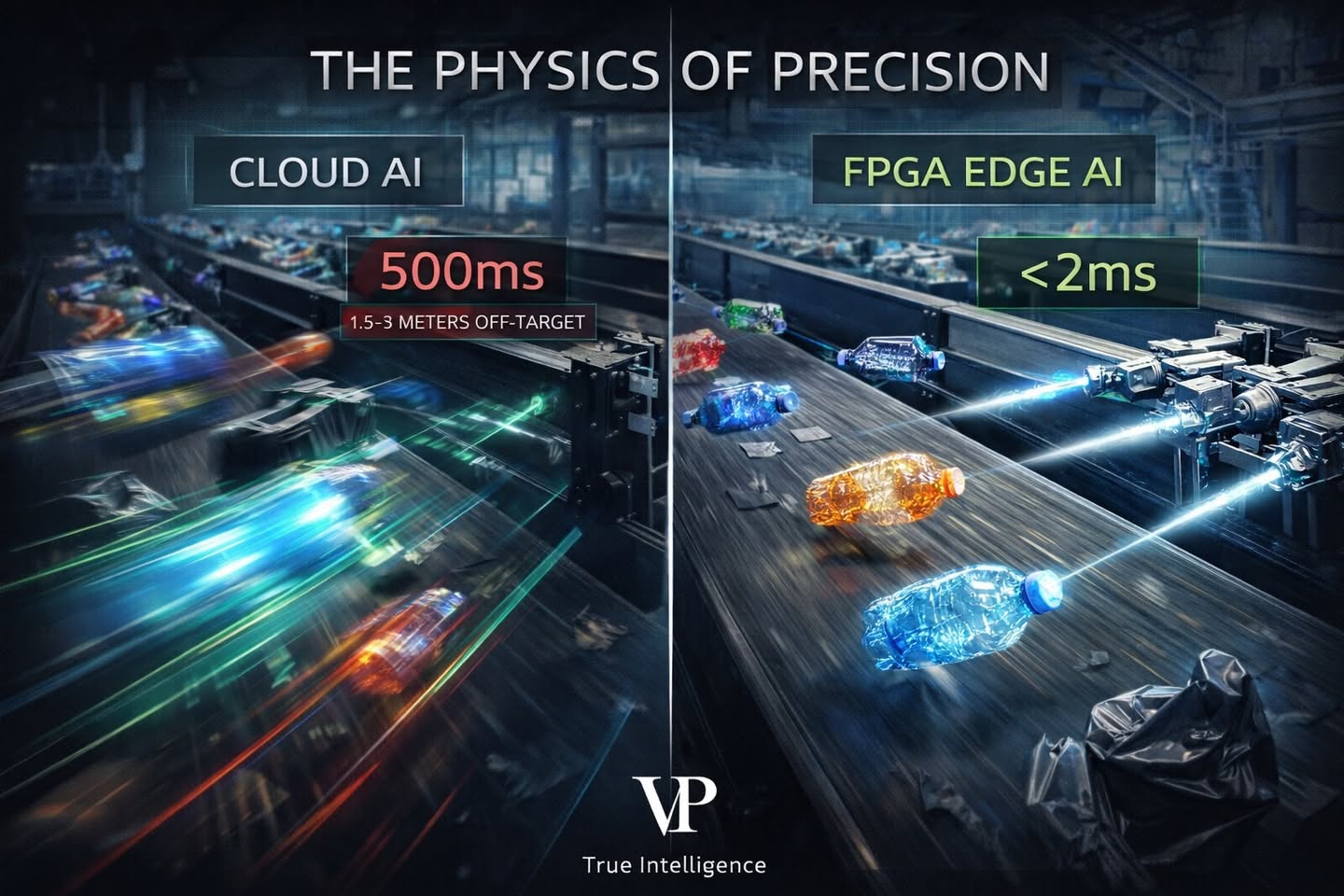
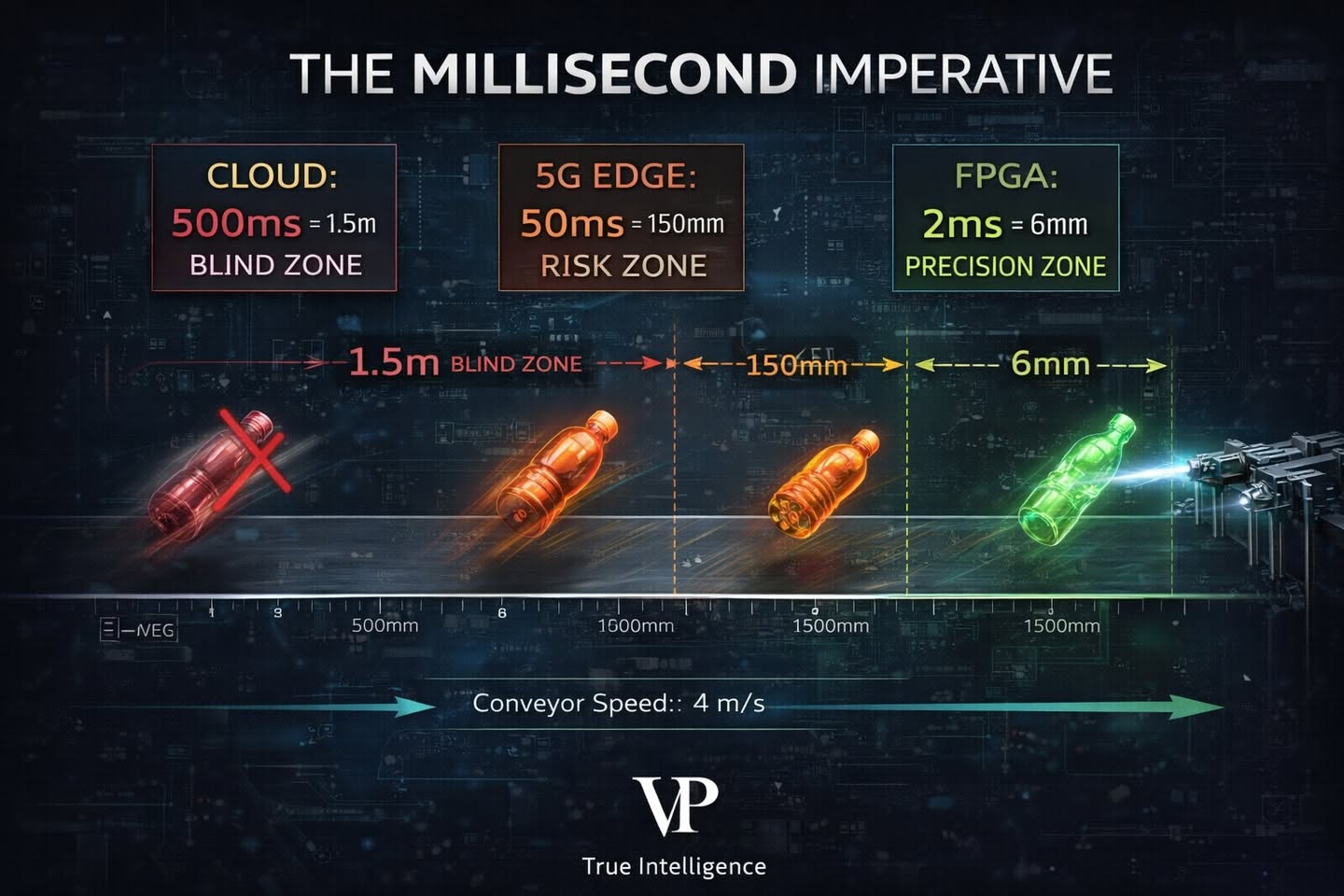
What if your AI is already too slow—before it even makes a decision?
In high-velocity material recovery, milliseconds aren’t a performance metric. They’re a profit lever.
Yet most AI-driven sorting systems today are built on cloud architectures that physically cannot keep up with conveyor belts moving at 3–6 m/s.
Our latest whitepaper reveals a hard truth the industry can no longer ignore:
🔴 A typical 500 ms cloud AI round-trip creates a “blind displacement” of 1.5–3.0 meters on the belt.
🔴 That latency forces slower belt speeds, larger footprints, lower purity, higher air consumption—and ultimately destroys unit economics.
🔴 Even a 1% purity drop can downgrade bales, costing hundreds of kilograms per hour in lost value in a modern MRF. 
At VeriPrajna, we prove that this is not an AI problem—it’s an architecture problem.
Our analysis shows how quantized edge AI on FPGAs, operating with deterministic sub-2 ms latency, fundamentally changes what’s possible:
• Up to 300% throughput increase without expanding plant footprint
• Sub-millimeter synchronization between vision and pneumatic ejection
• Near-zero jitter, even in harsh industrial environments
• Massive OpEx savings by eliminating cloud inference and bandwidth costs
• Higher purity and yield—without slowing the line 
This whitepaper is not a marketing overview.
It’s a technical and economic manifesto for operators, OEMs, and system architects building the next generation of circular economy infrastructure.
📘 Read the full whitepaper (link in comments) to understand why deterministic edge intelligence is now a non-negotiable requirement for high-speed sorting.
👉 Ready to rethink your architecture?
Talk to our Deep AI engineering team:
📧 [email protected]
📱 WhatsApp: +91 92170 59957
Because in real factories, AI doesn’t just need to be smart. It needs to be fast enough to obey physics.
#EdgeAI #IndustrialAI #RecyclingTechnology #FPGA #CircularEconomy