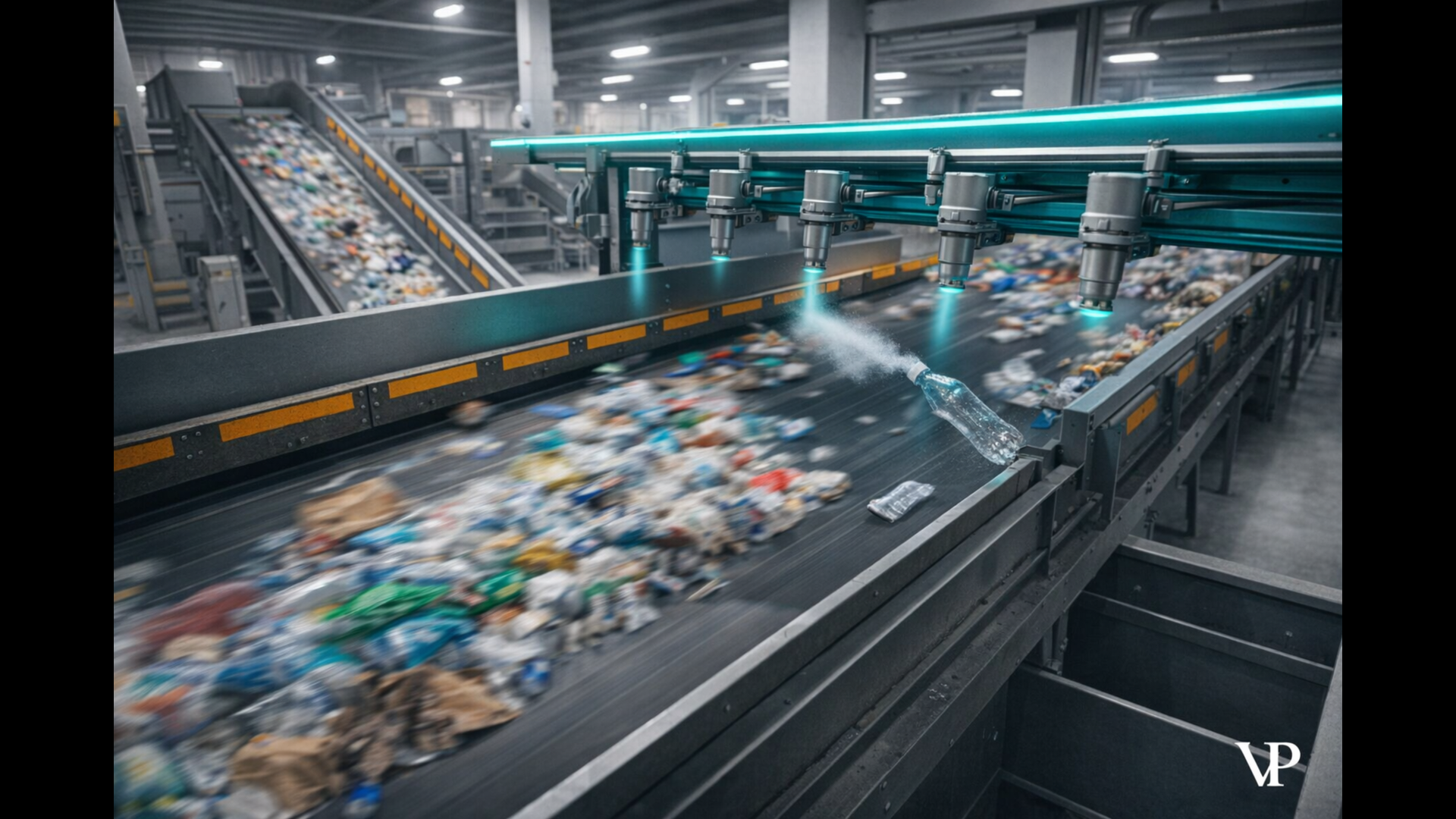
A plastic bottle on a recycling conveyor belt moving at 6 meters per second travels 3 full meters in the time it takes a cloud AI system to decide what it is. By the time the answer comes back, the bottle is long gone — unsorted, unrecovered, headed for landfill. This isn't a hypothetical. It's the basic physics that most AI-for-recycling pitches ignore.
The recycling industry is betting heavily on artificial intelligence to solve its sorting crisis: tightening purity standards, labor shortages, and waste streams that grow more complex every year. But there's a fundamental mismatch between how most AI gets deployed — through cloud servers hundreds of miles away — and what high-speed sorting actually demands. Our research into this gap reveals that the problem isn't the AI models themselves. It's where they run and how fast they respond.
The sorting crisis isn't an AI problem. It's a physics problem disguised as an AI problem.
What Happens in 500 Milliseconds
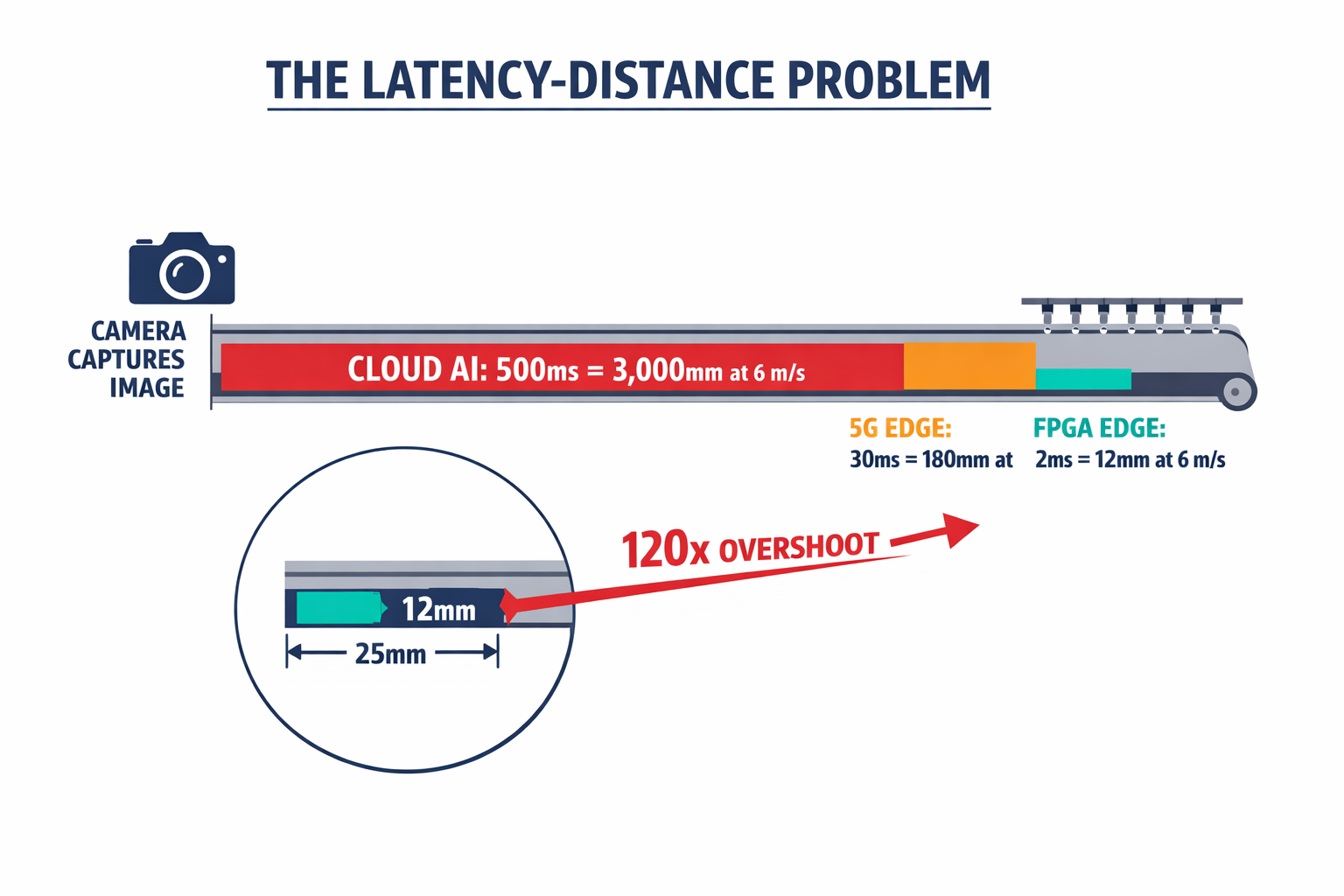
To understand why cloud AI breaks down in recycling, you need one simple equation: distance equals speed multiplied by time.
Modern sorting conveyors in Material Recovery Facilities (MRFs) — the plants where your curbside recycling actually gets separated — run at 3 to 6 meters per second. That speed is non-negotiable. It's what makes a facility profitable, processing dozens of tons per hour across narrow belts.
A standard cloud AI round trip — capturing an image, compressing it, sending it to a remote server, waiting in a processing queue, running the model, and sending back the answer — takes roughly 500 milliseconds. At 3 m/s, the object has moved 1.5 meters. At 6 m/s, it's moved 3 meters.
The ejection system that's supposed to separate a PET bottle from an aluminum can uses a row of tiny pneumatic nozzles spaced just 12.5 to 31 millimeters apart. Each nozzle fires a precise blast of air to knock the target off its path. To hit a single bottle without disturbing its neighbors, the timing error needs to be smaller than the object itself.
A 3-meter blind spot versus a 25-millimeter target. That's not a close call — it's a physical impossibility.
The Hidden Costs of "Just Looking Ahead"
Cloud AI vendors have a standard answer to the latency problem: place the camera further upstream on the conveyor. Detect the object early, then fire the air jet when it arrives at the ejection point 1.5 meters later.
In theory, this works. In practice, it creates a cascade of expensive problems.
First, there's the space problem. Many recycling plants are retrofits — built into existing warehouses where every meter of floor space is already allocated. Extending a sorting line by several meters means re-engineering the entire plant layout: moving gantries, altering feed angles, pouring new foundations. For a facility already operating on thin margins per ton, this capital expenditure can kill the business case for AI entirely.
Then there's the tracking problem. Conveyor belts aren't precision instruments. They vibrate from motor oscillations. They wear unevenly. And the objects riding on them aren't sitting still. Lightweight plastic films flutter and lift off the surface at high speeds — operators call this the "flying carpet" effect. Heavy glass bottles roll into plastic trays, knocking both off course.
Over a 1.5-meter travel distance, all of these forces compound. A simple tracking algorithm can account for constant belt speed, but it can't predict a gust of air lifting a chip bag or a bottle cap bouncing off a can. The spatial uncertainty grows with every centimeter of travel, and it grows unpredictably.
The longer you wait to act, the less you know about where the object actually is.
The third cost is the most devastating: throughput collapse. When tracking becomes unreliable, the only option is to slow the belt down. Reducing speed from 4 m/s to 1 m/s cuts processing capacity by 75%. For a facility that needs to move 50 tons per hour to stay profitable, that's not an optimization tradeoff — it's an economic death sentence.
Why Jitter Matters More Than Average Latency
Most discussions about cloud versus edge computing focus on average latency. But in high-speed sorting, the real killer is jitter — the unpredictable variation in how long each response takes.
A cloud system might average 500ms, but any given request could take 450ms or 550ms depending on network congestion, server load, and routing changes happening across the internet in real time. That ±50ms variation translates to a 300-millimeter uncertainty window at 3 m/s. To compensate, the system would need to fire a 30-centimeter-wide blast of air — ejecting everything in that zone, whether it's the target or not.
This is how purity collapses. We explored this problem in depth in our interactive analysis of edge AI for material recovery, where we break down exactly how tail latency — the worst 1% of response times — does more damage than average latency ever could. If just 1% of sorting decisions arrive late at a facility processing 50 tons per hour, that's 500 kilograms of contaminants per hour slipping through. Enough to downgrade a bale from premium pricing to rejection.
And then there's the connectivity question nobody wants to talk about. Recycling plants are electrically hostile environments — full of heavy motors, variable frequency drives, and metal structures that act like signal-blocking cages. A cloud-dependent sorting line has a single point of failure: the internet connection. When it drops, the AI goes blind. The line either stops or reverts to dumb mode, sorting nothing.
The 2-Millisecond Alternative
The solution isn't better cloud infrastructure. It's moving intelligence to the machine itself — specifically, onto a type of chip called an FPGA (Field-Programmable Gate Array).
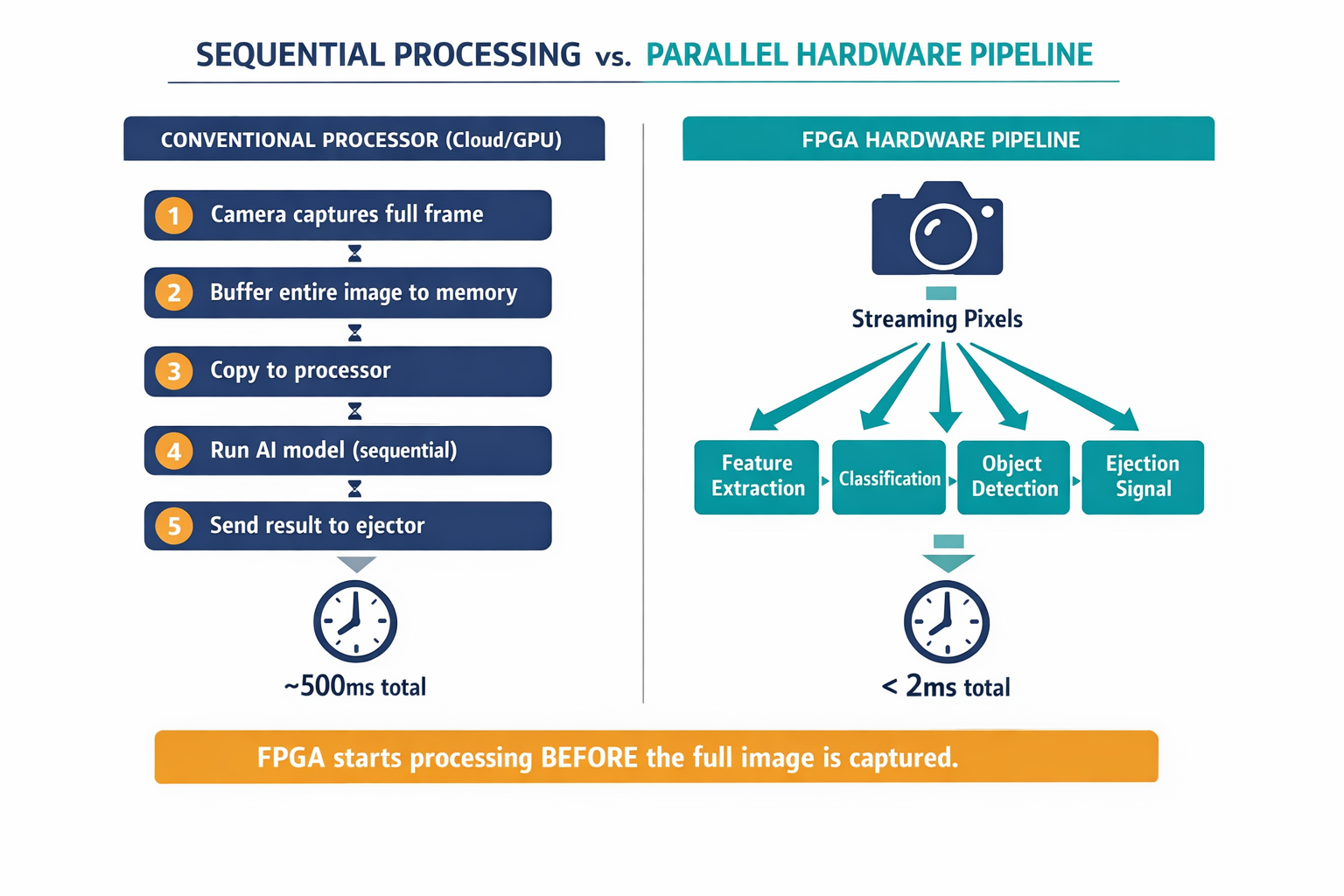
FPGAs are fundamentally different from the processors in your laptop or in a cloud data center. A normal processor reads instructions one at a time from memory, executes them, stores the result, and moves on. Think of it like a chef reading a recipe step by step — fast, but sequential. An FPGA, by contrast, is like a kitchen where every step of the recipe happens simultaneously on dedicated equipment. The chopping, the sautéing, the plating all happen in parallel because each task has its own physical workspace wired into the chip.
This distinction matters enormously for sorting. When a camera captures an image, a conventional system must buffer the entire frame, copy it to the processor's memory, and then start analyzing it. An FPGA begins processing pixels the instant they arrive from the camera sensor — before the full image is even captured. The result for the top of the image can be ready before the camera finishes reading the bottom.
An FPGA doesn't wait for the picture. It starts thinking while the picture is still being taken.
The outcome: deterministic latency under 2 milliseconds. At 6 m/s, that's 12 millimeters of object displacement — comfortably within the precision range of pneumatic ejection nozzles. And because the processing time is locked to hardware clock cycles, it doesn't vary. No jitter. No tail latency spikes. If the inference takes 1,450 clock cycles, it takes exactly 1,450 clock cycles every single time, whether it's 2 AM on a Tuesday or peak processing on a Monday morning.
Making Big AI Models Fit on Small Chips
The obvious objection: FPGAs have far less memory than cloud GPUs. How do you run a sophisticated neural network on a chip with limited resources?
The answer is quantization — a technique for compressing AI models without meaningfully degrading their accuracy. During training, neural networks use 32-bit floating-point numbers (imagine a number with 7 decimal places of precision). But for the task of distinguishing a milk jug from a soda bottle on a conveyor belt, that level of precision is massive overkill.
By converting model parameters to 8-bit integers (INT8), the memory footprint shrinks by 4x. Push further to 4-bit integers (INT4), and our benchmarks show a 77% performance boost over INT8 on compatible hardware, with memory requirements dropping by 8x compared to the original model. This compression is dramatic enough that even large object-detection networks fit entirely within the FPGA's on-chip memory — eliminating the need to fetch data from slower external memory and removing yet another source of delay.
The critical question is whether this compression costs accuracy. When done naively, it can. But a technique called Quantization-Aware Training (QAT) simulates the effects of lower precision during the training process itself, so the model learns to be robust to the rounding. For object detection tasks — the kind used to identify recyclables — INT8 models maintain over 99% of the accuracy of their full-precision counterparts.
The visual features that distinguish recyclable materials — shape, opacity, label texture, color — are macroscopic. You don't need seven decimal places of precision to tell the difference between a clear PET bottle and an opaque HDPE jug. For the full technical methodology behind our quantization and deployment approach, see our detailed research on waste sorting AI at the edge.
Bare Metal: Eliminating the Last Source of Unpredictability
Even with an FPGA handling the AI, there's one more layer of non-determinism to eliminate: the operating system.
Linux — even "real-time" Linux — is a time-sharing system. It constantly juggles tasks: handling network packets, writing log files, managing SSH connections, running background updates. Every time it switches tasks, it pauses what it was doing, saves its state, and loads the next job. These interruptions are invisible to a human user, but they create microsecond-level delays that accumulate and vary unpredictably.
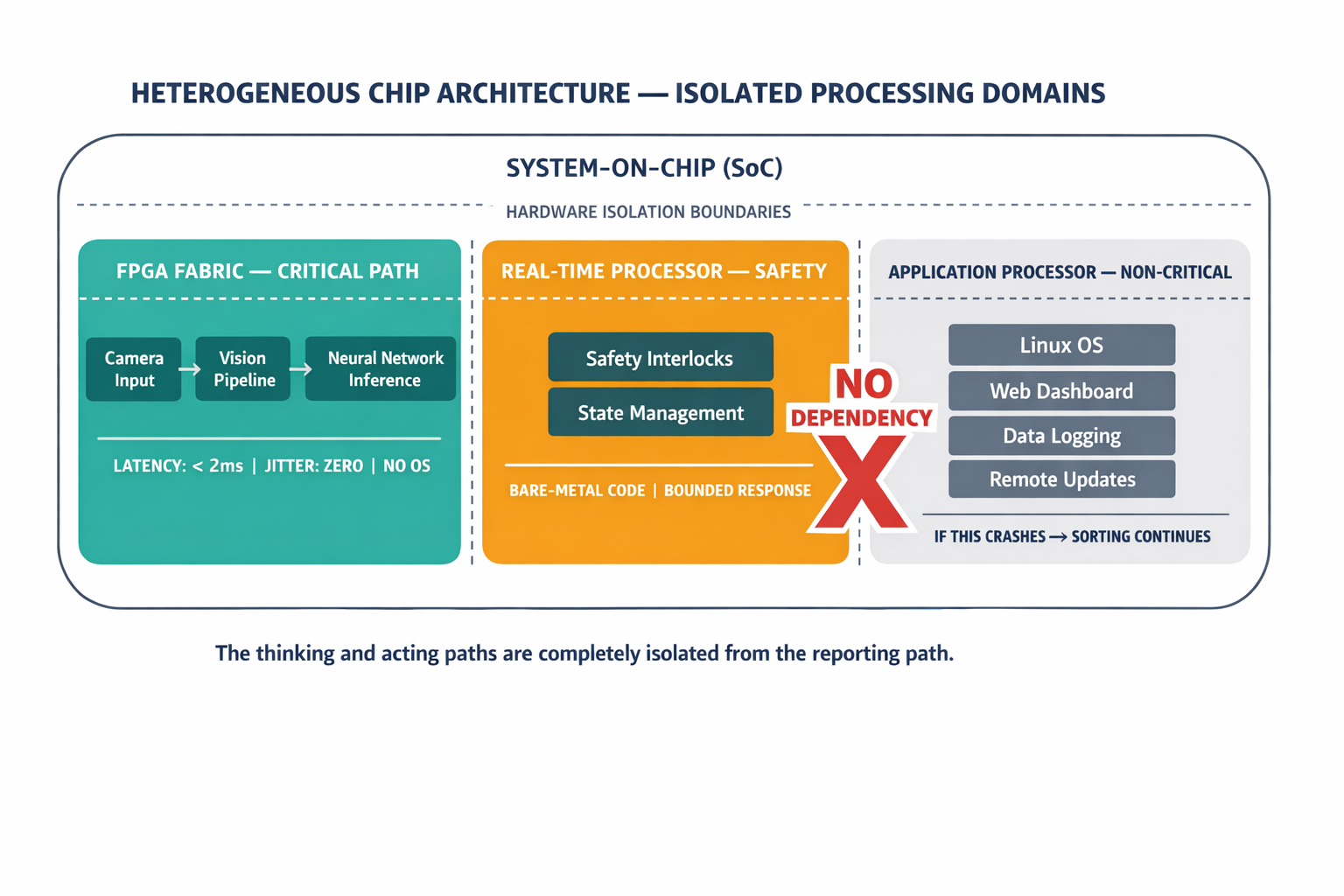
Our architecture uses heterogeneous chips that combine FPGA fabric with traditional processors on a single piece of silicon. We split responsibilities ruthlessly:
The FPGA fabric handles the vision pipeline, neural network inference, and valve control signals. Pure hardware logic. Zero jitter.
A dedicated real-time processor runs lightweight bare-metal code for safety interlocks and state management. Strictly bounded response times.
A separate application processor runs Linux for the non-critical stuff: logging data, serving the web dashboard, managing remote updates.
The thinking and acting paths are completely isolated from the reporting path. If the Linux partition crashes, the FPGA keeps sorting at full speed. The sorting machine operates autonomously — no network required, no operating system in the critical loop.
What This Means for Facility Economics
The shift from cloud to edge FPGA isn't a marginal technical improvement. It changes the unit economics of an entire facility.
With 2ms latency, belt speeds can increase from a cloud-constrained 2 m/s to 6 m/s — a 300% increase in processing capacity from the same physical footprint. For a facility running two shifts, that's potentially 160 additional tons processed daily. With recycled PET prices ranging from $400 to $800 per ton, the revenue implications reach into the millions annually.
Precision improves on both sides of the sorting equation. Purity goes up because precise ejection stops contaminants from accidentally landing in the wrong output stream — higher-purity bales command premium pricing. Yield goes up because the air blast hits center-mass on the target instead of clipping its edge or missing entirely, recovering material that would otherwise go to landfill.
And the operational costs drop. No cloud bandwidth fees for streaming high-definition video from dozens of cameras around the clock. No per-inference API charges. And a 10x improvement in energy efficiency — an FPGA processing a video stream consumes 10 to 20 watts versus 100 to 200 watts for a comparable GPU setup.
But What About 5G and Edge Cloud?
Fair question. 5G edge computing promises latencies of 20 to 50 milliseconds — a dramatic improvement over standard cloud. At 3 m/s, that's 60 to 150 millimeters of displacement. Better, but still 5 to 12 times the nozzle pitch of a precision ejection system. And 5G still carries jitter risk — variable enough to create the same purity problems at lower magnitude.
More fundamentally, any architecture that depends on a wireless connection inherits a single point of failure. The sorting line's intelligence should live on the sorting line.
Does This Apply Beyond Recycling?
The physics we've described — the relationship between processing latency, object velocity, and actuation precision — applies anywhere AI must trigger a physical response on a fast-moving line. Food inspection. Pharmaceutical packaging. Electronics assembly. Any process where objects move at meters per second and decisions must translate to millimeter-accurate physical actions.
The pattern is the same: cloud AI works beautifully for analysis that can wait. It fails for control that cannot.
The Millisecond Imperative
The recycling industry doesn't have an AI problem. It has a deployment problem. The models exist. The training data exists. What's missing is the ability to run those models fast enough, reliably enough, and close enough to the action to actually sort material at industrial speed.
A sorting system that thinks in half-seconds cannot act in milliseconds. The intelligence must be as fast as the physics it's trying to control.
Quantized edge models on FPGAs aren't a niche technical curiosity. They're the minimum viable architecture for AI-driven sorting at the speeds the circular economy demands. The gap between "AI that can identify a bottle" and "AI that can eject a bottle at 6 meters per second" is the gap between a demo and a deployed system.
We'd be curious to hear from anyone running AI in high-speed industrial environments — what latency thresholds have you hit, and how did you work around them?