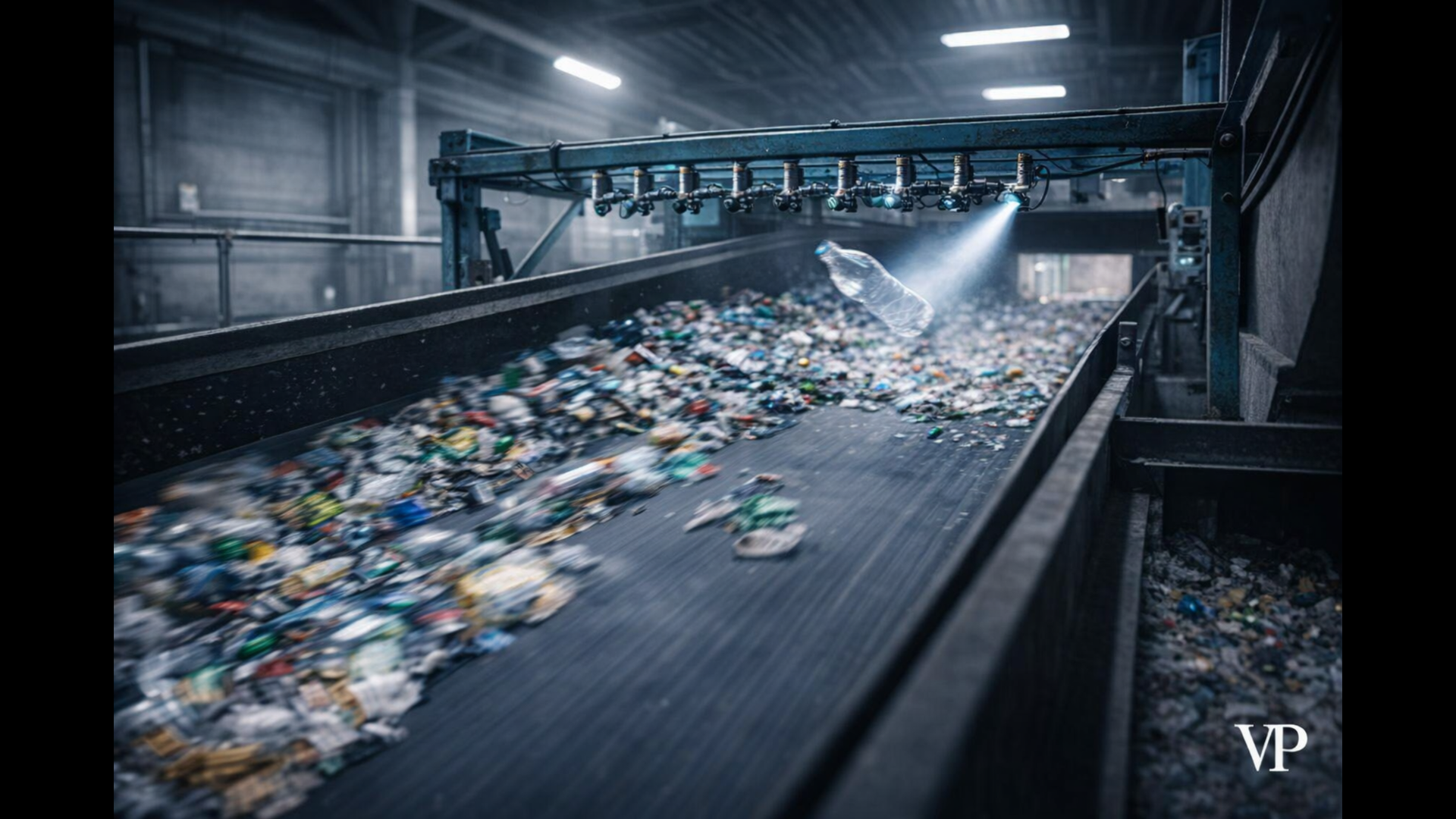
A plastic bottle moving at 6 meters per second travels 3 meters before a cloud AI system can decide what it is. By then, it's already in the wrong pile — or buried in landfill.
That single number — 3 meters of blind displacement — is why I believe the recycling industry's current approach to AI is fundamentally broken. Not slightly suboptimal. Not "needs improvement." Broken at the level of physics.
My team at Veriprajna has spent the last year working at the intersection of machine learning and industrial hardware, specifically in material recovery — the facilities that sort your recyclables into clean streams of plastic, aluminum, paper, and glass. What we found shocked us: the AI systems being sold to these facilities literally cannot keep up with the conveyor belts they're supposed to monitor.
The 500-Millisecond Problem Nobody Talks About
Modern recycling facilities — called Material Recovery Facilities, or MRFs — run conveyor belts at speeds between 3 and 6 meters per second. That's fast. A crushed soda can crosses your field of vision in a blink.
To sort this chaos, AI vision systems identify each object and trigger a blast of compressed air from a row of tiny nozzles to knock the target item off the belt and into the right bin. Those nozzles are spaced about 12 to 31 millimeters apart. The timing has to be surgical.
Now consider what happens when you send a camera image to a cloud server for analysis. The image gets compressed, uploaded, queued, processed by a GPU, and the answer travels back. That round trip takes roughly 500 milliseconds on a standard cloud inference setup.
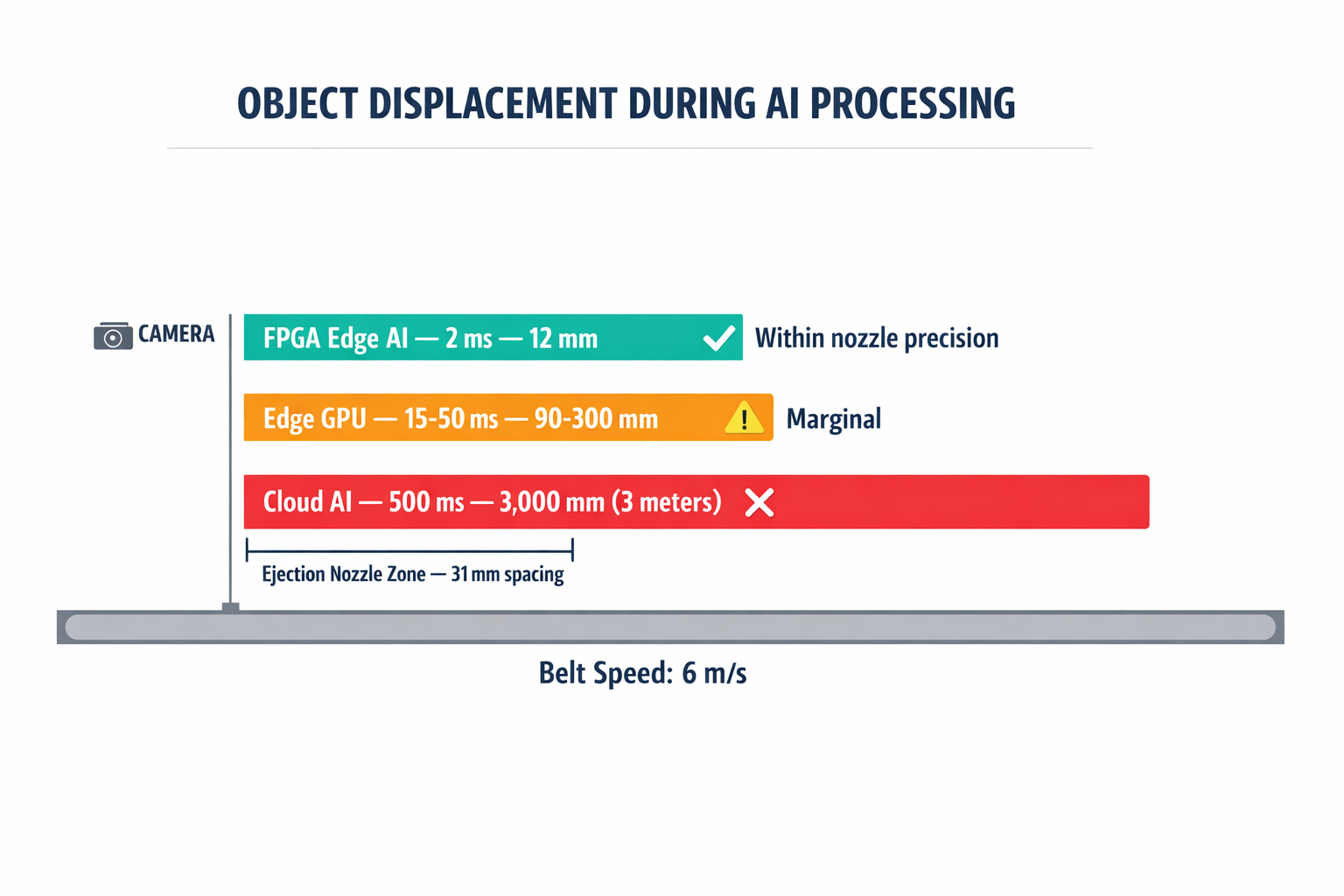
In that half-second, an object on a belt moving at 3 m/s has traveled 1.5 meters. At 6 m/s, it's moved 3 full meters.
You're asking a system with 31-millimeter precision to compensate for 3 meters of uncertainty. That's like threading a needle from across a football field.
The object isn't even in the ejection zone anymore. The AI's answer arrives after the moment has passed.
"Just Look Further Upstream"
This is the first objection I hear from cloud AI vendors: move the camera further back on the belt, so the system has time to process before the object reaches the air jets.
It sounds reasonable. It isn't.
When we modeled this in our interactive analysis of the problem, three things became clear.
First, space is expensive. Most recycling facilities are retrofitted warehouses. Extending a sorting line by several meters means re-engineering the entire plant layout — moving gantries, altering feed angles, sometimes knocking out walls. For a brownfield facility, it can be structurally impossible.
Second, objects don't sit still on moving belts. Conveyor belts vibrate. Motors shake them. At high speeds, lightweight plastic films actually lift off the surface — operators call it the "flying carpet" effect. A heavy glass bottle can roll into a plastic tray, changing both their trajectories. Over 1.5 meters of travel, a lightweight object can drift several centimeters laterally. No linear tracking algorithm can predict these random collisions and aerodynamic effects.
Third — and this is the one that kills the economics — facility operators end up slowing the belt down. If your AI can't keep up at 4 m/s, you run at 1 m/s. You've just cut your facility's processing capacity by 75%. In an industry running on thin margins per ton, that's not a compromise. That's a death sentence for your unit economics.
The Real Enemy Isn't Latency — It's Jitter
I'll admit: when we started this research, I assumed the core problem was raw speed. Make the cloud faster, problem solved. I was wrong.
The deeper problem is jitter — the unpredictable variation in how long each request takes. A cloud system might average 500ms, but any individual request could take 450ms or 550ms. That ±50ms swing sounds small. It isn't.
At 3 m/s, a 100-millisecond uncertainty window means the system doesn't know where the object is within a 300-millimeter zone. To compensate, it has to fire a wide burst of air covering that entire zone. This wastes enormous amounts of compressed air and blasts everything in that 300mm stretch off the belt — good material and bad alike.
Jitter doesn't just reduce accuracy. It makes precision physically impossible.
Why does jitter exist? Because the internet is a shared resource. Routing paths change. Router buffers fill up. Packets get dropped and retransmitted. Even inside the data center, your inference request sits in a queue waiting to be batched with other requests to maximize GPU utilization. That queuing delay varies from request to request.
For a recycling facility processing 50 tons per hour, even a 1% purity drop from jitter-induced misfires means 500 kilograms of contaminants per hour sneaking into clean bales. That's enough to downgrade a bale from premium pricing to rejection by the buyer.
What 2 Milliseconds Changes
Our approach at Veriprajna uses a fundamentally different kind of computing hardware: FPGAs — Field-Programmable Gate Arrays. If a GPU is a factory floor full of general-purpose workers who can be assigned any task, an FPGA is a custom-built machine where the assembly line itself is the algorithm.
The difference matters because of how data moves through each system.
A GPU works like this: capture a full image frame, store it in memory, copy it to the GPU's memory, process it, copy the result back. Each step adds time, and the operating system running the GPU constantly interrupts the work to handle other tasks — network packets, log files, background updates.
An FPGA processes data the way water flows through a pipe. Pixels stream directly from the camera sensor into the processing circuit. The system starts analyzing the top of the image before the camera has even finished capturing the bottom. There's no waiting for a full frame. No copying between memory banks. No operating system stealing clock cycles.
The result: deterministic latency under 2 milliseconds. Not "2ms on average." Exactly the same processing time, every single time. If the circuit takes 1,450 clock cycles, it takes 1,450 clock cycles whether it's Tuesday morning or Saturday at midnight.
At 6 m/s belt speed, 2ms of latency means the object has moved just 12 millimeters — well within the precision range of the ejection nozzles.
System Latency Displacement at 6 m/s Can It Sort? FPGA Edge AI 2 ms 12 mm Yes — precision ejection Edge GPU 15-50 ms 90-300 mm Marginal, needs compensation Cloud AI 500 ms 3,000 mm (3 m) No
But Can You Fit a Real AI Model on an FPGA?
This was my own skepticism when we started. FPGAs have limited on-chip memory compared to GPUs with gigabytes of dedicated RAM. How do you run a serious neural network on constrained hardware?
The answer is quantization — compressing the AI model's numerical precision without meaningfully hurting its accuracy. Think of it like the difference between a RAW photograph and a well-compressed JPEG. The file is dramatically smaller, but your eyes can't tell the difference.
Standard AI models train with 32-bit floating-point numbers (FP32). For inference — the "looking at things and deciding what they are" phase — you don't need that precision. We compress models down to 8-bit integers (INT8) and even 4-bit integers (INT4). That's an 8x reduction in memory requirements at INT4, which means models that would normally need gigabytes of GPU memory fit entirely inside the FPGA's on-chip storage.
The accuracy tradeoff? Negligible. The visual features that distinguish a milk jug (HDPE plastic) from a soda bottle (PET plastic) are macroscopic — shape, opacity, label texture. These features survive quantization easily. INT8 models retain over 99% of the accuracy of their full-precision counterparts for object detection tasks. INT4 delivers up to a 77% performance boost over INT8 on compatible hardware, at accuracy levels that remain operationally indistinguishable.
We don't just shrink off-the-shelf models, though. We use frameworks like FINN and hls4ml to map specific neural network layers to specific hardware resources on the FPGA, tuning precision layer by layer. For the full technical methodology behind our quantization and hardware co-design approach, see our detailed research.
The "Zero-OS" Architecture
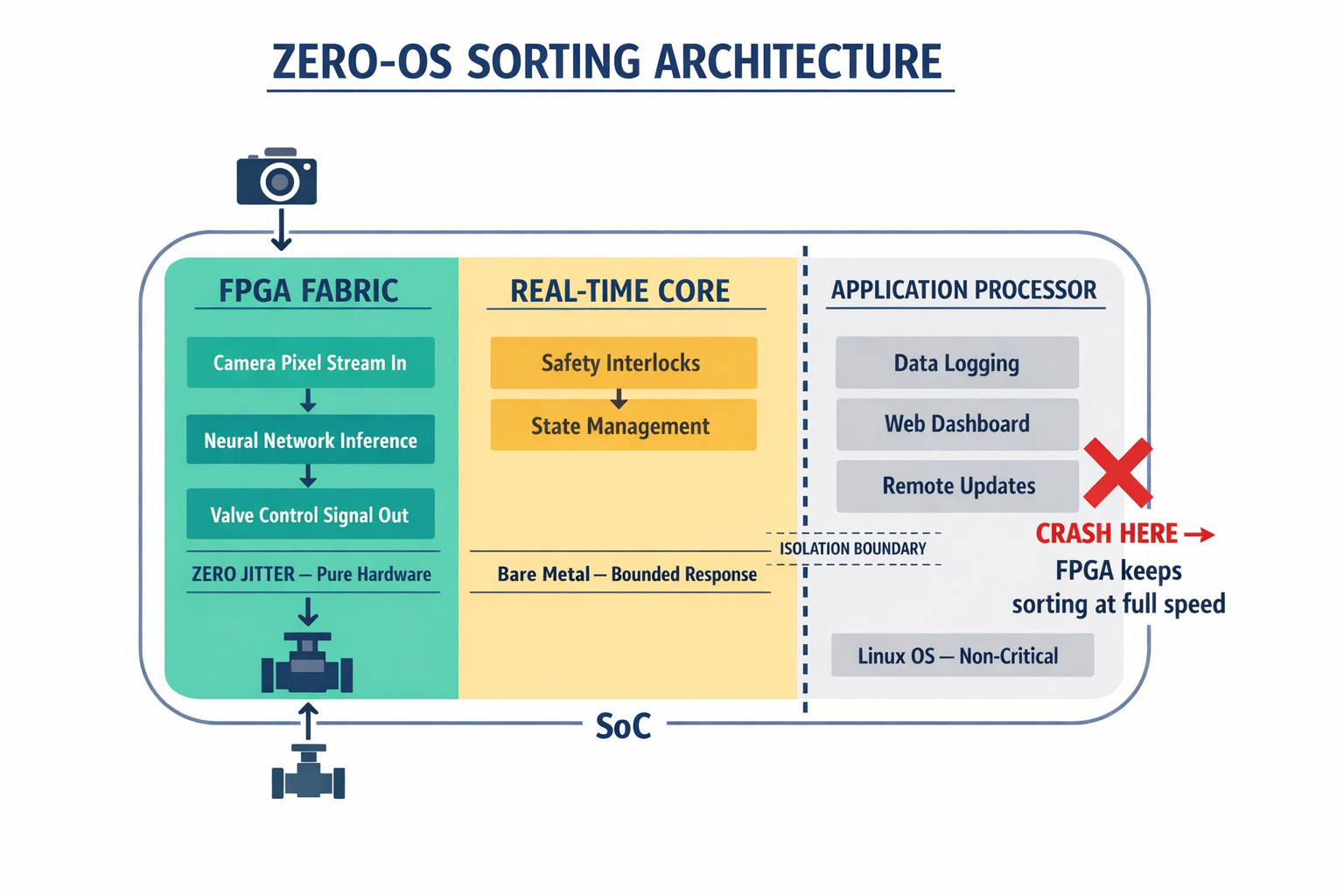
One decision we made early on still surprises people: the critical sorting path in our system runs on no operating system at all.
Even "real-time" Linux is fundamentally a time-sharing system. The kernel divides processor time among hundreds of processes — your AI inference, the network driver, the SSH daemon, log file management. Every time it switches tasks, it flushes caches and burns microseconds. When a camera triggers an interrupt, the kernel has to pause whatever it's doing, handle the interrupt, and wake up the right driver. How long that takes depends on what the kernel was doing at that exact moment.
We use chips that combine FPGA circuitry and ARM processor cores on a single piece of silicon. The architecture splits responsibilities cleanly:
The FPGA fabric handles vision processing, neural network inference, and valve control signals. Pure hardware. Zero jitter.
A real-time processor core runs bare-metal code for safety interlocks and state management. Strictly bounded response times.
A separate application processor runs Linux for the non-critical stuff: logging data, serving the web dashboard, handling remote updates.
If the Linux partition crashes, the FPGA keeps sorting at full speed. The "thinking" and "acting" paths are completely isolated from the "reporting" path.
This is the architectural choice that makes the whole system industrial-grade. A sorting machine that stops working when its internet connection hiccups isn't a sorting machine. It's a liability.
What This Means for the Bottom Line
The math is stark. A facility running at 2 m/s because its cloud AI can't keep up processes roughly 5 tons per hour per meter of belt width. The same facility running at 6 m/s with edge FPGA inference processes 15 tons per hour — a 3x throughput increase from the same physical footprint.
For a two-shift operation (16 hours), that's 160 additional tons processed daily. With recycled PET prices ranging from $400 to $800 per ton, the revenue implications run into millions annually — without building a single new square foot of facility.
Then there's the precision dividend. Tighter ejection timing means fewer contaminants in clean bales (higher purity, premium pricing) and fewer good recyclables accidentally sent to landfill (higher recovery, less waste). Even a 1-2% improvement in recovery rates meaningfully reduces lost revenue and rising landfill tipping fees.
And the operational savings compound: no cloud API fees for streaming high-definition video 24/7, no massive bandwidth costs, and FPGA power consumption of 10-20 watts versus 100-200 watts for a comparable GPU setup.
What About 5G Edge Computing?
Fair question. 5G edge cloud promises 20-50ms latency, which is dramatically better than standard cloud. At 3 m/s, that's 60-150mm of displacement — approaching workable territory for some applications.
But the jitter problem doesn't disappear. 5G networks still route through shared infrastructure, and latency spikes still occur. At the 99th percentile — the tail latency that determines your worst 1% of sorting decisions — 5G edge can't guarantee the determinism that pneumatic valve timing demands. For facilities where a single percentage point of purity determines whether a bale gets accepted or rejected, "usually fast enough" isn't a specification. It's a gamble.
Why I Think "AI" Is the Wrong Conversation
The recycling industry doesn't have an AI problem. Plenty of neural networks can identify a crushed aluminum can in a photograph. The industry has a physics problem: getting the right answer to the right actuator at the right millisecond.
Any developer can call an API to classify a bottle in a static image. Identifying and ejecting that bottle at 6 meters per second, in a chaotic stream of mixed waste, at 99% purity, 24 hours a day — that requires thinking about silicon, clock cycles, airflow dynamics, and encoder pulses. It requires building the AI and the hardware as one integrated system.
That's what my team does. Not wrapping cloud APIs. Not fine-tuning someone else's model and calling it a product. Designing the inference pipeline from the FPGA fabric up — selecting silicon, writing hardware description code, building custom quantization schemes, integrating sensor drivers.
The future of recycling isn't smarter AI. It's faster physics.
The circular economy everyone talks about building? It depends on facilities that can sort more material, more accurately, at higher speeds. That means intelligence that lives at the edge — deterministic, autonomous, and synchronized to the millisecond with the machinery it controls.
If you're working on industrial automation where latency isn't just a performance metric but a physical constraint, I'd genuinely like to hear how you're approaching the problem. The gap between "AI that works in a demo" and "AI that works at line speed" is where most of the interesting engineering lives.