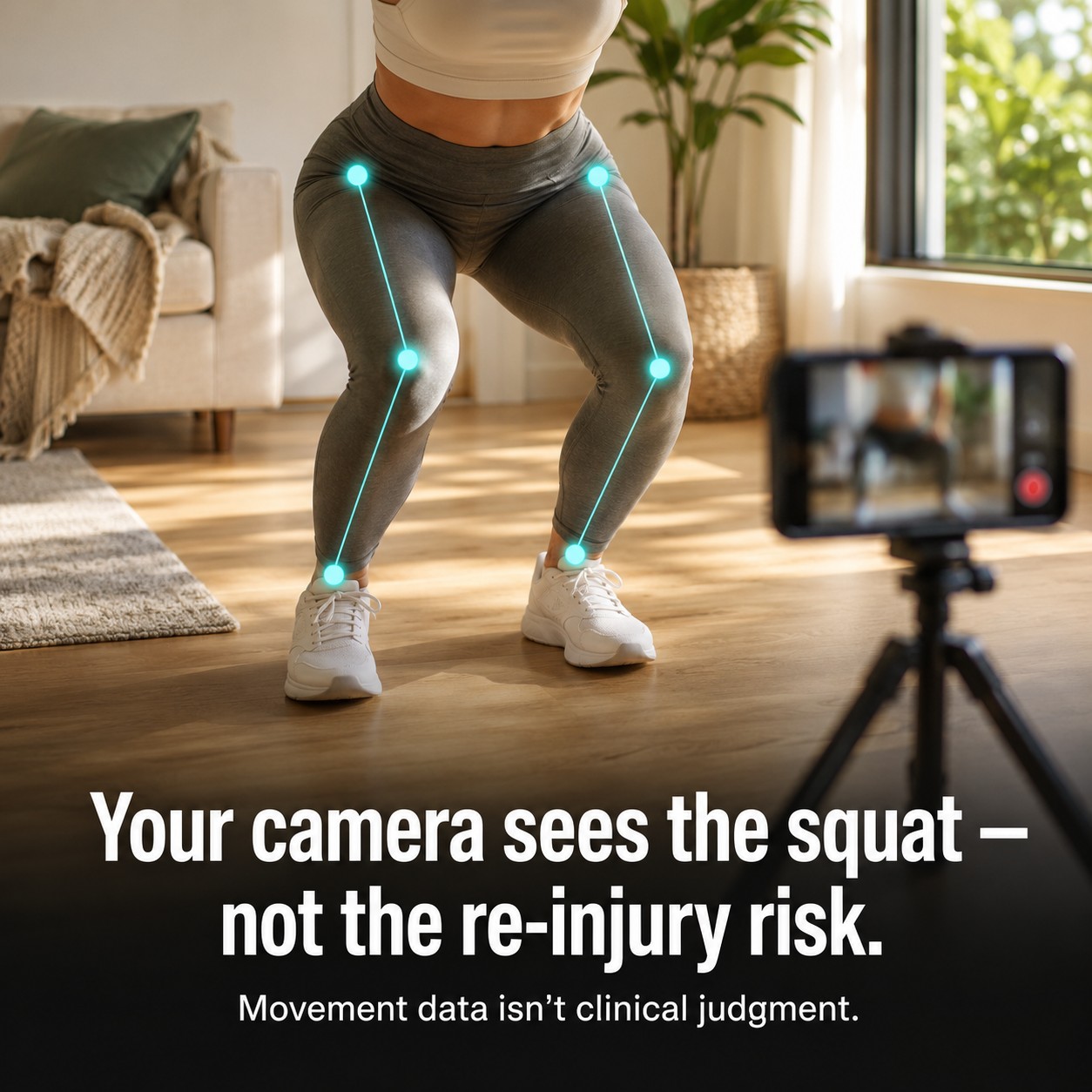
Pose estimation is free. The intelligence that knows a 78° knee bend is a re-injury risk for a post-ACL patient is not.
Here's the gap. A patient 8 weeks post-ACL does prescribed squats at home. BlazePose extracts 33 keypoints at 30 FPS. The raw data: the left knee shifts 4.2cm medially on the descent, flexion reaches 78° against a 90° target, and the ascent takes twice as long as the descent.
A pose library returns those numbers. It does not know the 4.2cm medial shift is knee valgus — a re-injury risk specific to post-ACL patients. It does not know 78° might be fine at week 8 if the patient was at 60° two weeks ago. It does not know the slow, lopsided ascent signals compensation.
That layer — exercise-specific, population-aware biomechanical thresholds — is what nobody sells as a standalone capability. BlazePose, MoveNet and MediaPipe are commoditized. The rule engine above them is the actual work.
CMS's 2026 rule cut remote therapeutic monitoring (RTM) thresholds to as few as 2 monitoring days and 10 minutes, so verified exercise data finally becomes billable for far more patients. Yet only 35% of PT patients fully adhere to their home exercise program, and self-reports are unreliable.
For corporate wellness, MSK issues cost about $486 direct plus $3,105 in lost productivity per employee a year. With 36% of MSK surgeries unnecessary — a $90B workforce drag — employers want verification, not Fitbit-shaking. The honest constraint: monocular cameras carry 9–22° of error on knee angle, so the design has to be edge-first and on-device, transmitting aggregate compliance — not video, not skeletal keypoints, which courts may treat as biometric data under BIPA.
Camera in, clinically meaningful, RTM-ready data out. That's the build.
Save this if you're putting exercise verification on a PT or wellness platform — what's the hardest exercise for your model to score?
#PhysicalTherapy #DigitalHealth #ComputerVision #CorporateWellness #RemoteTherapeuticMonitoring