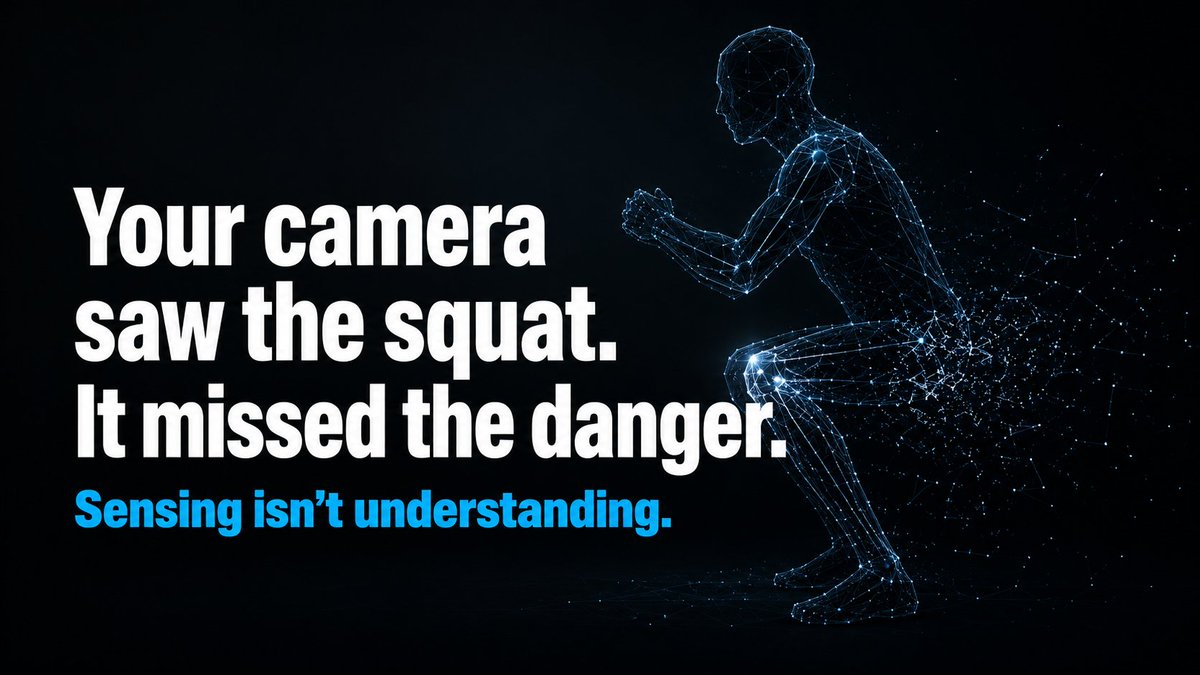
- Pose estimation is free. BlazePose, MoveNet, MediaPipe run on any phone, extracting 33 body keypoints at 30fps.
That's the easy part.
The hard part: knowing a 4.2cm knee shift is re-injury risk for a post-ACL patient — and a "good rep" for everyone else. 🧵 - The gap, concretely. A 62-year-old, 8 weeks post-ACL, does prescribed squats at home. BlazePose returns the numbers:
knee drifts 4.2cm medial on the descent. Depth hits 78°, not the 90° target. Descent takes 1.1s, ascent 2.3s. - A pose library returns those numbers. It does NOT know:
— 4.2cm medial = knee valgus, a re-injury risk for post-ACL patients
— 78° may be fine for week 8 if they were at 60° two weeks ago
— 2:1 ascent ratio = compensation, using momentum
That interpretation IS the product. - The sensor is commoditized. The brain is not.
Every fitness app runs the same open-source pose estimation. What happens AFTER the keypoints — the per-exercise, per-patient, per-population rule engine — is where the real work lives. Nobody sells that as a standalone layer. - Why it matters now: only 35% of PT patients fully adhere to home exercise. 65% abandon in the first month. Self-reported compliance is fiction — patients overreport.
Clinicians want verified data. Current tools give a binary "did/didn't," not quality. - And the money moved. The 2026 CMS Final Rule added CPT 98979 and 98985, dropping the RTM billing threshold from 16 days to as few as 2, and from 20 minutes to 10.
Far more patients are now billable. But CMS still demands device data tied to treatment decisions. - The incumbents verify — and lock you out.
Hinge Health ($732M 2026 revenue, 73% fewer knee replacements): TrueMotion CV — closed platform.
Sword bought Kaia for $285M (Jan 2026): great tech, same lock-in plus an M-band hardware dependency.
Neither embeds in YOUR product. - Accuracy honesty most vendors skip: monocular knee-angle error runs 9.3–21.9° in 2D vs lab motion capture. MediaPipe correlates 0.80 on the lower limb.
Not clinical-grade for every use. The fix is clinician-set thresholds per patient — not one fixed global rule. - Corporate wellness, same gap. 36% of MSK surgeries are unnecessary — $90B wasted. Yet only 25% of employees use them, and 50%+ won't share health data after years of Fitbit-shaking fraud.
The fix isn't surveillance — it's on-device processing: aggregate compliance, never video. - One more: skeletal keypoints can be biometric data under BIPA — gait alone can re-identify a person. 107 BIPA class actions were filed in Illinois in 2025.
"Just store the keypoints" is a liability, not an architecture. Privacy has to be designed in from frame one. - If you run a PT platform or wellness program: would you trust a "good rep" score that uses ONE fixed threshold for a 25-year-old athlete and a 70-year-old post-op patient?
That single assumption is where most exercise AI quietly breaks. #DigitalHealth #PhysicalTherapy - We wrote up the full camera-to-RTM-documentation architecture — the intelligence layer above pose estimation:
https://veriprajna.com/solutions/ai-biomechanics-exercise-verification