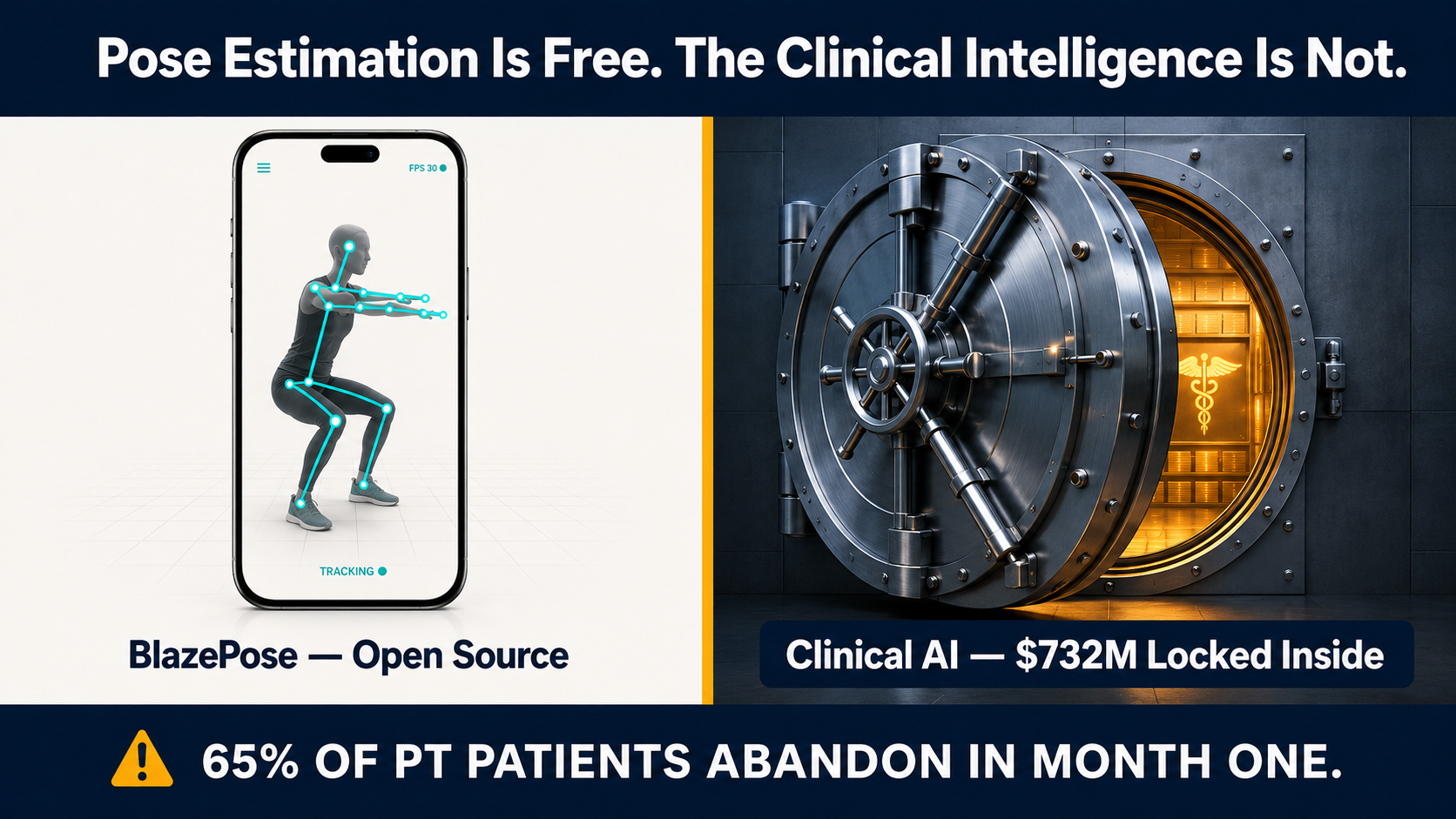
BlazePose runs on any phone. MoveNet is open-source. MediaPipe is a Google library you can download today. The AI biomechanics and exercise verification layer above those tools — the intelligence that determines whether the squat is biomechanically correct, whether the deviation pattern is clinically significant for this patient at this stage of recovery, whether the rep qualifies for an RTM billing export or triggers a clinician alert — doesn't exist as a product. Every company that has solved it built it for themselves.
We've been studying this gap across both PT platform and corporate wellness deployments, and the pattern is consistent: the companies doing serious exercise verification at clinical grade have locked it inside their own care models. The companies exposing APIs stop short of the clinical interpretation that RTM billing actually requires. The companies running the billing workflow trust the data they receive without verifying how it was generated. Each piece exists; the pipeline from camera to RTM-compliant compliance data does not.
Why Exercise Verification Has No Off-the-Shelf Equivalent
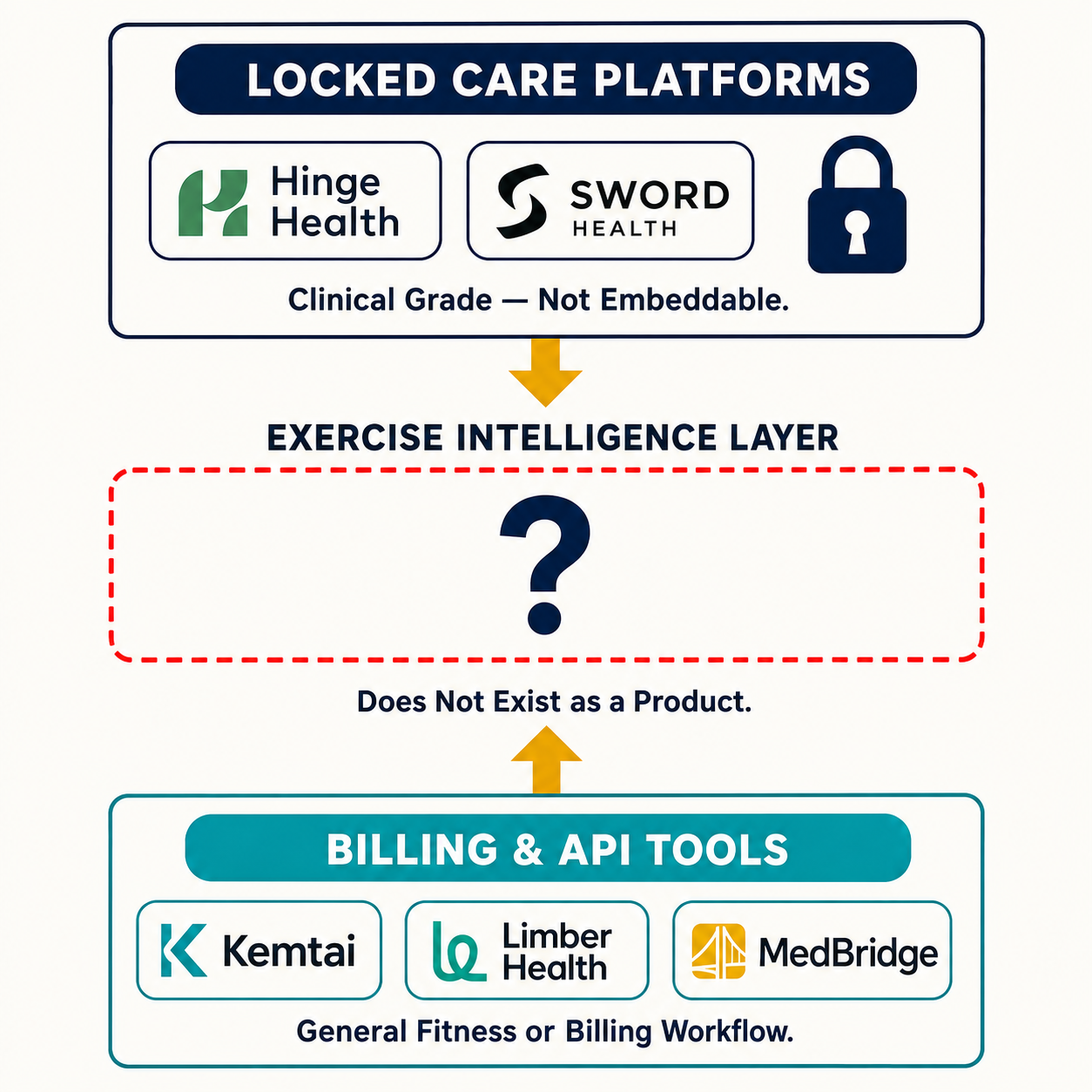
Hinge Health is the revenue reference point for digital MSK care — projecting $732M for 2026, with published clinical outcomes showing 56% fewer spinal fusions and 73% fewer knee replacements among their patients versus traditional care. Their TrueMotion computer vision and Robin AI care assistant represent genuine clinical-grade exercise verification. But TrueMotion is inside Hinge Health's care delivery model. It is not embeddable in your product. Hinge Health is a care company that solved the verification problem as a competitive moat, not a verification company selling to the broader market.
Sword Health's January 2026 acquisition of Kaia Health for $285M has a similar shape, at larger scale. Kaia was the world's most clinically validated digital MSK solution, with a Validation Institute Program Validation showing 33% pain reduction at three months and 80% reduction in inpatient costs. Sword combined Kaia's Motion Coach computer vision with its M-band wearable sensor biofeedback and is now planning a $500M funding round. The combined platform is the most validated verification capability that exists — and it's transitioning Kaia customers onto a new product stack while being built for Sword's own care delivery, not for PT platforms to embed.
On the B2B API side, Kemtai offers browser-based computer vision via WebGPU, tracking 44 body landmarks with real-time corrective guidance — no native app install required. QuickPose offers an iOS SDK with AI exercise counters, timers, and form checks for fitness app developers. Both fill the real-time feedback layer for general fitness. Neither configures biomechanical thresholds per patient population, produces RTM-compliant documentation output, or handles the clinical interpretation logic that makes verification legally meaningful for billing.
Limber Health, MedBridge, and Force Therapeutics run the billing workflow side — RTM billing specialist platforms, exercise prescription libraries, EHR-integrated patient engagement. Limber Health's patent-pending risk stratification and Athletico PT's reported 30%+ improvement in outcomes represent real innovation in the billing and compliance management layer. The gap is that these platforms accept the exercise data they receive and manage billing around it. They are built on the assumption that verified exercise data exists upstream. It frequently does not.
The verification capability exists inside Hinge and Sword's care models. The billing workflow exists inside Limber's and MedBridge's platforms. Neither company has any incentive to fill the gap between them.
What the CMS 2026 Expansion Actually Unlocked
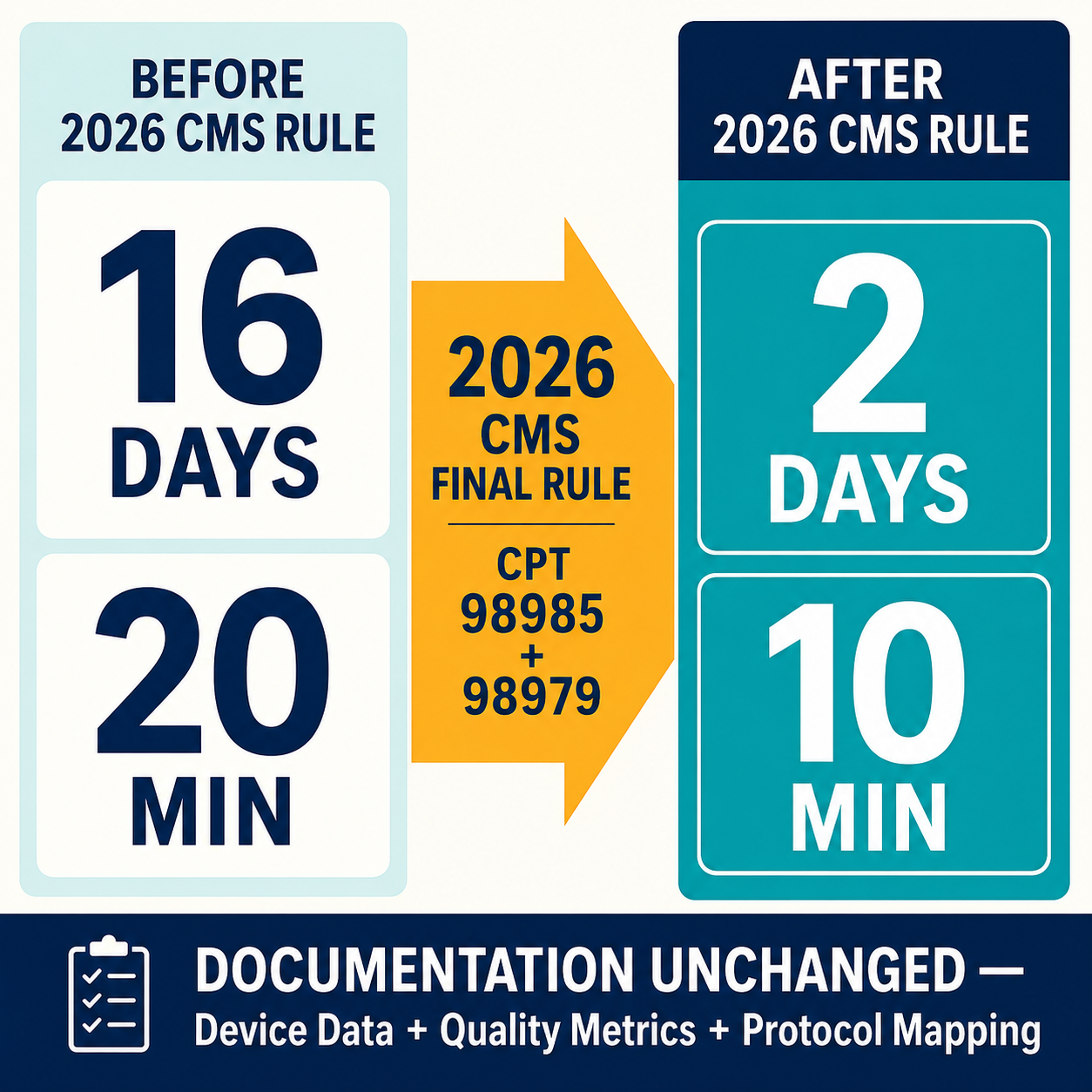
The 2026 CMS Final Rule added two new RTM codes — CPT 98985 (device supply for MSK monitoring, 2–15 days in a 30-day period) and CPT 98979 (treatment management, first 10 minutes) — lowering the monitoring threshold from 16 days to as few as 2 days, and the management time threshold from 20 minutes to 10 minutes. A materially larger patient population is now RTM-billable than was true twelve months ago.
What didn't change is the documentation standard. RTM billing under CPT codes 98975–98985 requires device-gathered data tied to specific treatment decisions — timestamps, rep counts, quality metrics, and protocol mapping that demonstrates the monitoring data influenced the care plan. The 2026 expansion lowered the bar for duration; it did not change what the bar requires.
This creates a specific revenue architecture problem for PT platforms. Only 35% of PT patients fully adhere to home exercise programs (Physiopedia/Sprypt, 2025) — meaning 65% have partial or no adherence, and clinicians currently have no way to distinguish between patients who are genuinely non-adherent and patients who are adherent but didn't do the exercise correctly. Self-reported compliance doesn't satisfy RTM documentation. The new codes open billing to more patients and shorter monitoring windows, but the documentation requirement remains device data with quality metrics.
The pipeline we built at AI Biomechanics for PT Platforms & Corporate Wellness specifically addresses this documentation gap — camera input to RTM-compliant compliance data output, with exercise-specific biomechanical thresholds configurable per patient population and per exercise protocol.
Corporate Wellness: The Same Gap, a Different Privacy Constraint
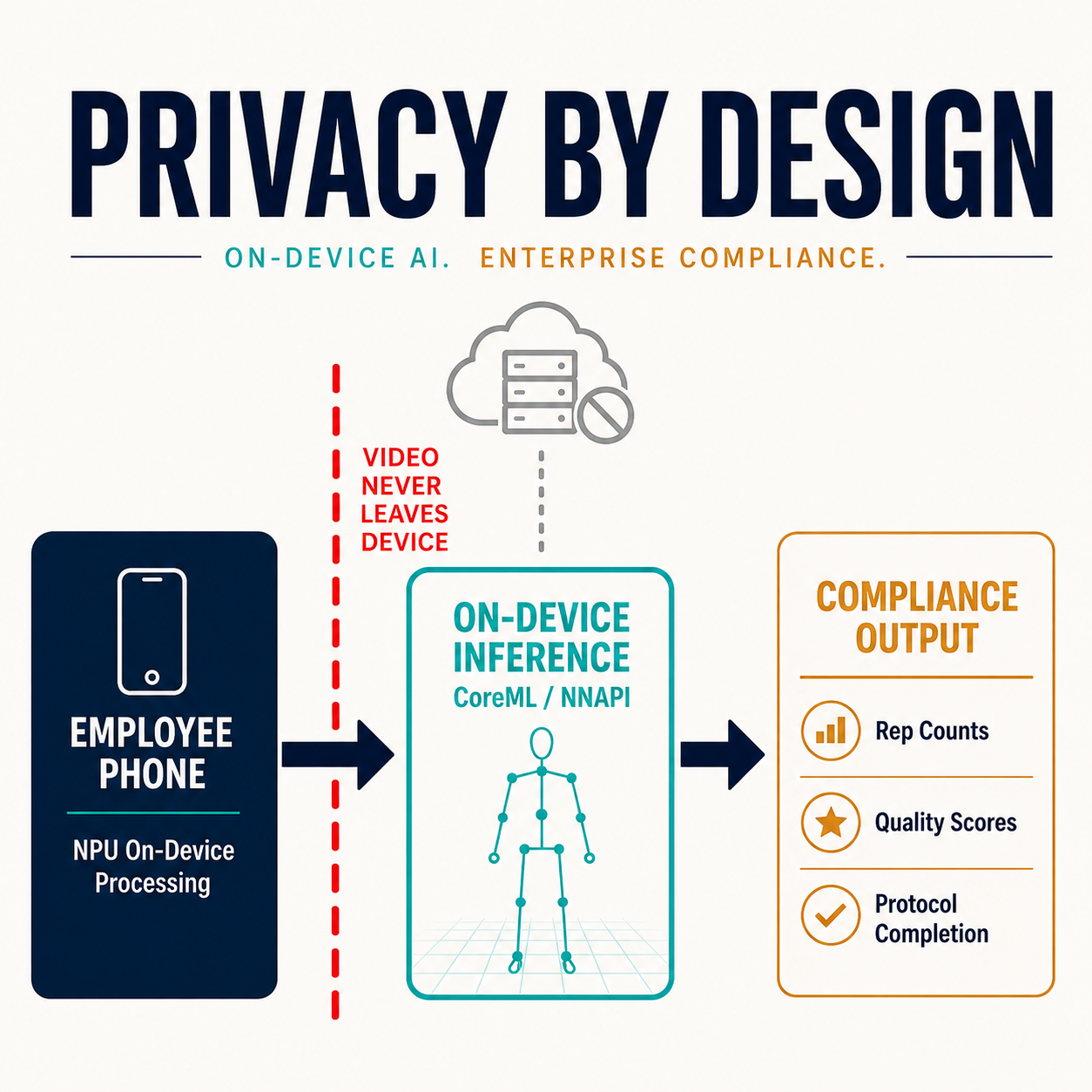
The corporate wellness version of this problem comes with a constraint that PT platforms don't face: the employees whose movement you need to verify are the ones most likely to abandon the program if they think they're being watched.
MSK disorders cost employers $40.51 per member per month in direct costs (UnitedHealthcare) plus $3,105 per employee annually in productivity losses (BioFunctional Health) — and Employee Benefit News estimates 36% of MSK surgeries are unnecessary, driving $90B in avoidable workforce costs. Business Group on Health projects that 96% of employers will offer virtual MSK care by 2027. The cost of the problem is documented. The adoption failure is documented alongside it.
The adoption problem is equally real. Only 25% of employees actually use available wellness programs. Over half express reluctance to share health data with their employer. Multiple Fitbit-shaking scandals — employees gaming step-count-based incentives — have pushed employers toward verification, but verification through continuous video surveillance creates the kind of optics that drive adoption lower, not higher.
The architecture that threads this needle is on-device inference: NPU-accelerated processing on the phone (CoreML on iOS, NNAPI on Android) that produces aggregate compliance data — rep counts, quality scores, protocol completion percentages — without transmitting video frames or raw keypoint coordinates to any server. The employee's movement data never leaves their device; only the structured compliance output does. This directly addresses the data-reluctance problem while producing the verification data employers need.
The biometric privacy exposure here is substantive. Illinois saw 107 new BIPA class action lawsuits in 2025 alone. The April 2026 Seventh Circuit ruling capped BIPA damages at one recovery per person, which reduces class-action exposure without eliminating it. Gait analysis research has established that body movement patterns can enable re-identification — the legal theory for treating skeletal keypoint data as biometric data under BIPA and GDPR Article 9 is established, even without fitness-specific case law yet. On-device processing eliminates the biometric data transmission before it creates liability exposure.
The positioning decision for corporate wellness programs also intersects with FDA classification. The FDA's January 2026 guidance reduced oversight of general wellness products — exercise monitoring positioned for wellness use, without disease or diagnostic claims, can stay below SaMD (software as a medical device) classification. Any clinical claims, including RTM billing documentation, push back toward SaMD territory. PT platforms accept that classification trade-off as part of the RTM billing value proposition. Corporate wellness programs can avoid it entirely with the right framing.
AI Biomechanics Accuracy Is a Threshold Configuration Problem, Not a Model Problem
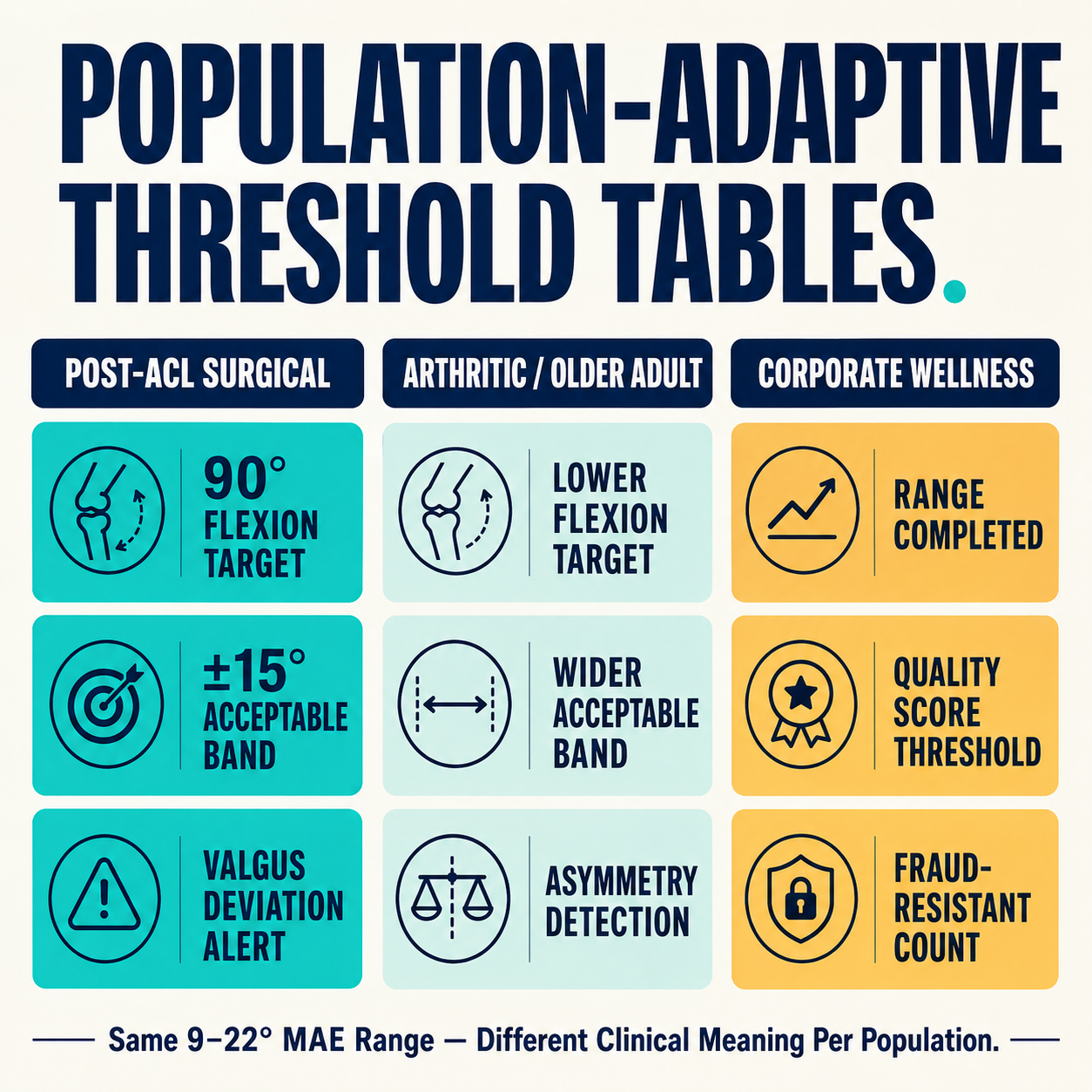
Monocular camera pose estimation carries a knee flexion angle MAE of 9–22 degrees depending on conditions — lighting, body habitus, patterned clothing, equipment in frame (Nature Scientific Reports, 2025). That range sounds alarming for clinical use. The frame for understanding it is that the clinical significance depends on what you're measuring against.
For late-phase ACL rehabilitation, the target angle is 90 degrees. A 15-degree MAE means actual angle measurements ranging from 75 to 105 degrees around a 90-degree target. Whether that level of measurement precision is acceptable depends on the clinical protocol — what the acceptable range around target is, and whether the exercise monitoring purpose is threshold detection (did the patient reach depth?) or deviation detection (did the valgus pattern emerge?). Population-adaptive threshold configuration makes monocular camera data clinically useful without requiring gold-standard measurement accuracy.
On the model performance side, MSA-TCN (Multi-Scale Attention Temporal Convolutional Network) published at IEEE in 2025 achieved 98.7% accuracy for human activity recognition at 0.08 MB model size and 1.8ms inference time on a mid-range smartphone. That's practical edge deployment — no cloud round-trip, sub-frame latency, with the model small enough for on-device NPU optimization. The accuracy benchmark is on standard HAR datasets, not clinical populations, but the latency and size characteristics make the edge deployment architecture tractable.
The engineering gap that this doesn't solve is the exercise-specific interpretation layer: the biomechanical rule engine that knows what patterns are clinically significant for which exercises in which populations, with configurable thresholds that clinicians can set per patient per protocol. That's not a better model problem. It's a domain knowledge engineering problem.
The measurement accuracy question is the wrong starting question. The right question is: what does a clinically actionable threshold look like for this exercise, this patient, and this stage of care?
The Build-vs-Buy Decision for Platform Operators
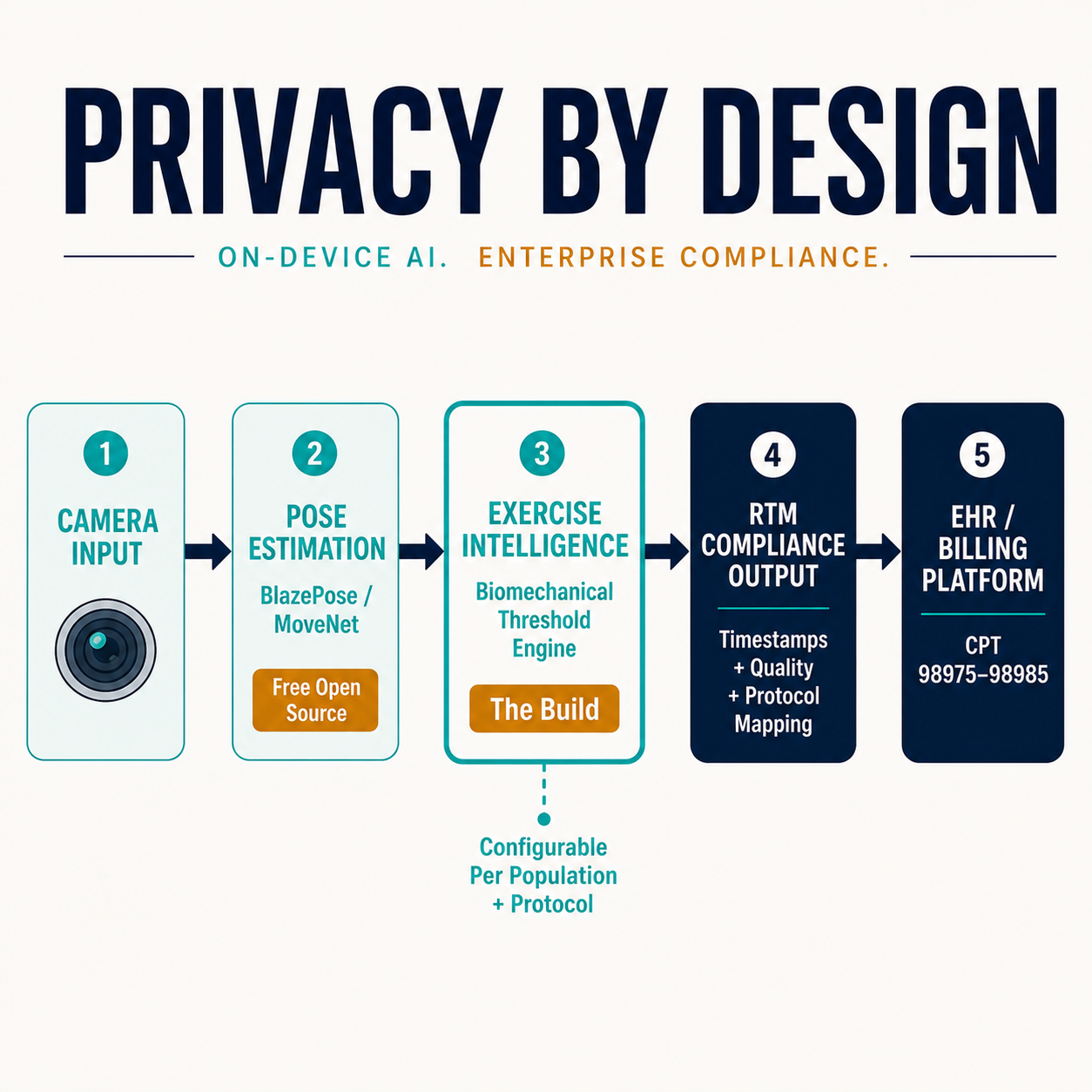
For PT platform operators, the relevant comparison isn't Hinge Health — it's whether to build the exercise intelligence layer themselves or to partner with a specialist who has built it. Building from scratch means assembling pose estimation pipeline, biomechanical threshold logic, RTM documentation output, and EHR integration in sequence. The first of those four components is genuinely open-source and fast. The second through fourth are not.
The corporate wellness equivalent decision is whether current wellness platform vendors — those whose exercise tracking relies on wearable steps and self-report — will add camera-based verification, or whether the verification layer needs to be added as a separate component. Agentic AI in healthcare is moving toward autonomous exercise monitoring that adjusts programming based on performance data; BCG and ARPA-H's ADVOCATE program are both framing 2026 as the year agentic health stewardship moves from pilot to deployment. Platform operators making architecture decisions now are building the foundation for that agentic layer.
What we've observed consistently is that the integration constraint is where the real architecture decisions live — not the AI component, but the data shape at the EHR interface, the consent flow for employee health data, the protocol mapping for specific RTM codes. The architecture we built for AI Biomechanics for PT Platforms & Corporate Wellness is designed to plug into existing platforms rather than replace them — but the relevant questions are always specific to what your platform currently produces and what your billing workflow expects to receive. If you're evaluating what the verified exercise intelligence layer looks like in your stack, that's the conversation worth having.