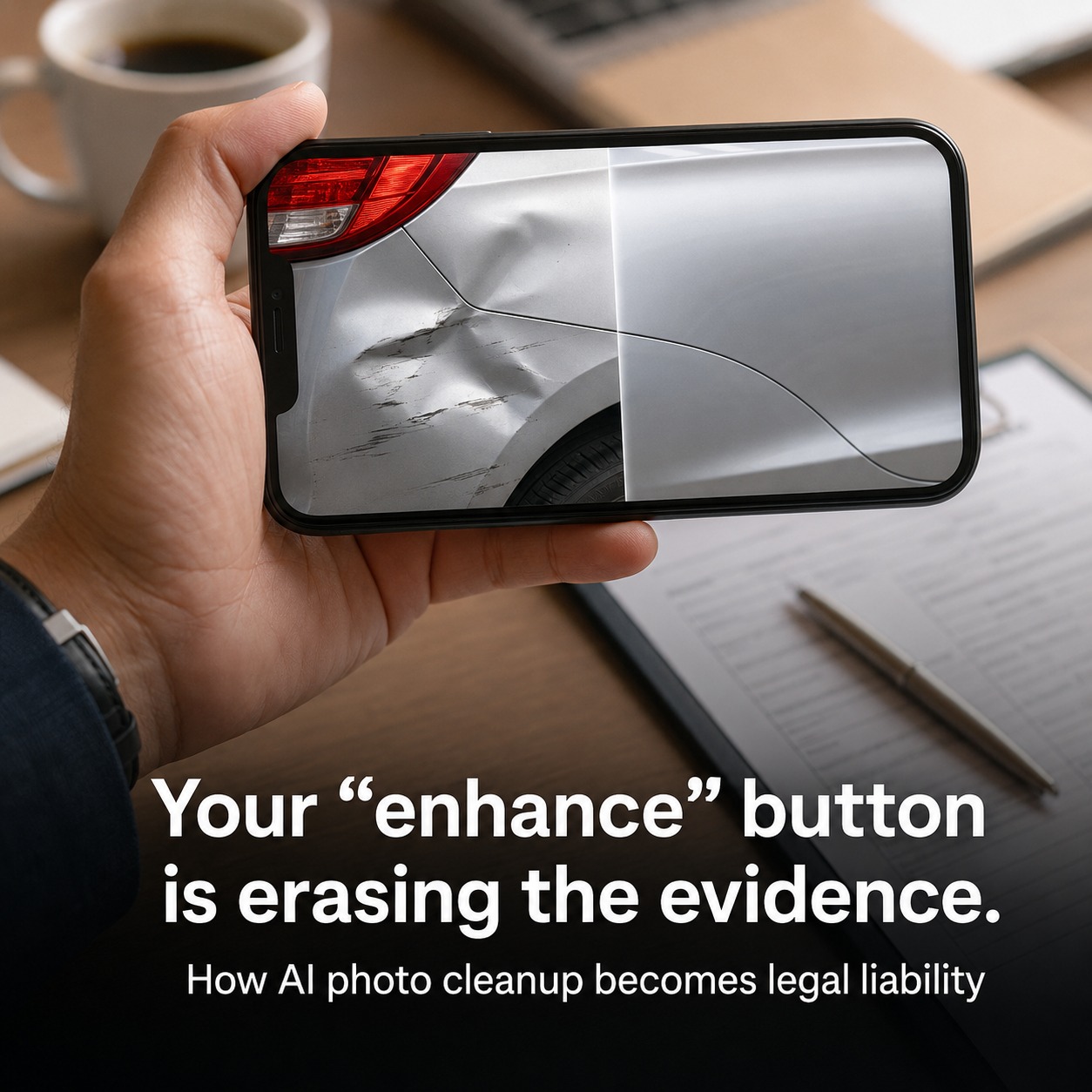
The biggest deepfake threat to auto insurers in 2026 isn't a fraudster. It's the "enhance" button inside your own claims app.
Here's the failure mode almost no one has audited: a policyholder uploads a photo of a dented quarter panel. Your image pipeline runs a GenAI upscaler to "clean it up." The model, trained to maximize image quality, reads the dent as noise and smooths it away. The adjuster sees a tidier photo with less visible damage.
Under US law, that's spoliation. Altering evidence relevant to a legal proceeding — even with good intent — introduces synthetic pixels the camera sensor never captured. If a denied claim goes to litigation and your workflow overwrote the original, you're facing adverse inference instructions, sanctions, or summary judgment.
And that's only half of it. On the fraud side, UK motor carriers disclosed in 2025 that fraudsters used diffusion models to inject scratches and cracks into benign photos — inflating average payouts by roughly GBP 13,000 per claim. Verisk found 36% of consumers would alter a claim image, and 55% of Gen Z would consider it. Yet only 32% of insurers feel confident detecting deepfakes. Most damage-assessment AI scores what the damage looks like, not whether it was physically present when the shutter clicked.
Now layer on compliance: the NAIC Model Bulletin is live in 24 states, and the EU AI Act classifies insurance AI as high-risk with penalties up to EUR 35M or 7% of global turnover.
The fix isn't a better severity score. It's forensic computer vision that authenticates, measures, and preserves every pixel — the kind of evidence-integrity system we build, with a chain of custody that holds up in court.
Save this if you're scoping a claims-AI vendor this year. What is your stack doing to the original image before an adjuster ever sees it?
#InsuranceAI #DeepfakeDetection #ComputerVision #ClaimsAutomation #InsurTech