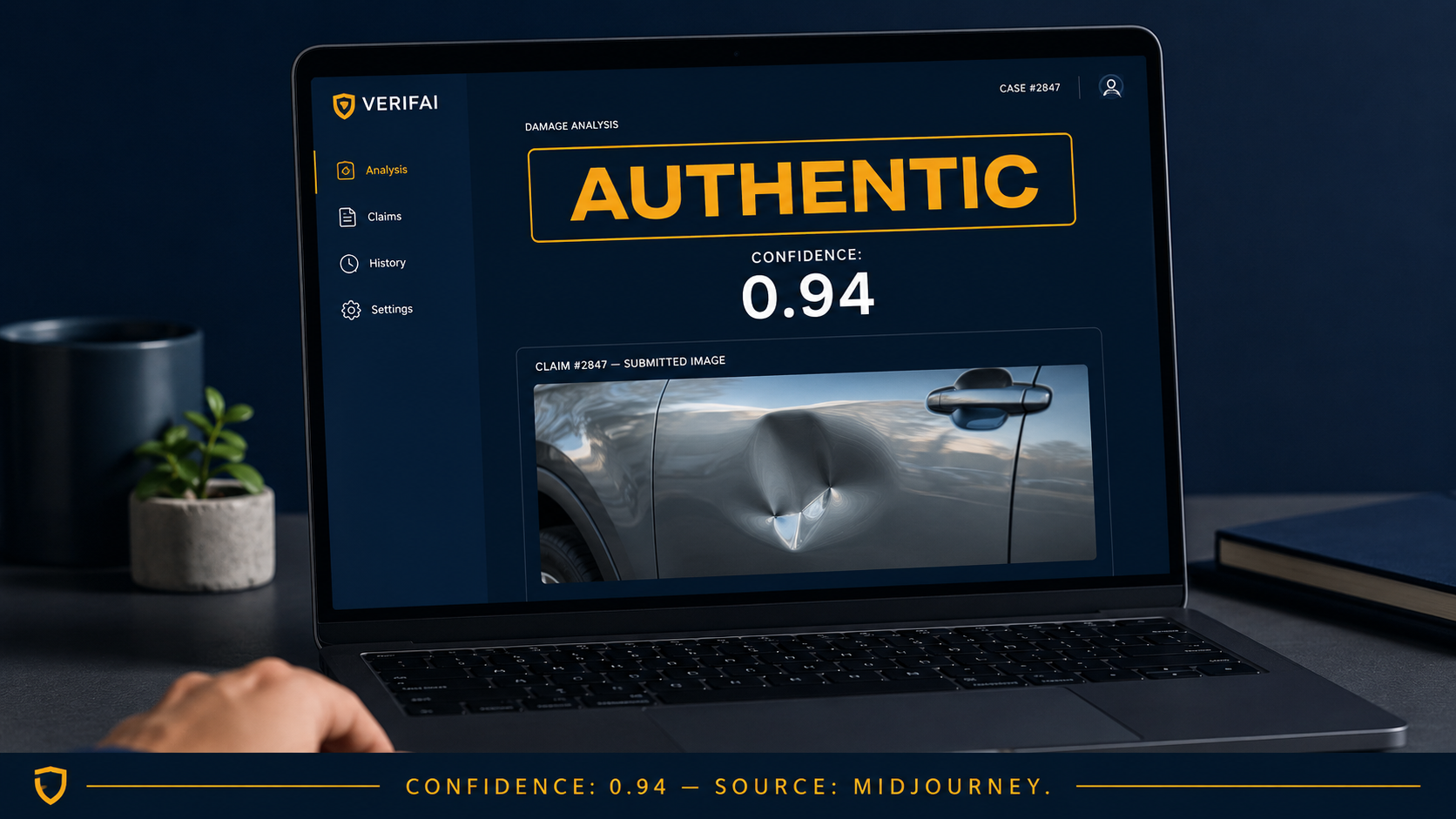
I ran a test last year that I wasn't expecting to fail the way it did. We'd built a PRNU-based detection stack for an auto carrier — Photo Response Non-Uniformity, the sensor-noise fingerprinting method that's been the standard in digital forensics for over a decade. We were evaluating it against a sample of synthetic damage images. The first one I fed through was Midjourney output, a convincing vehicle quarter-panel dent. The confidence score came back 0.94. High confidence: authentic image.
The image had never touched a physical camera sensor. There was no noise fingerprint to find. The tool was doing exactly what it was designed to do. The threat had moved, and the detection hadn't.
That test was the moment the project scope changed.
What I'd Missed About the Direction of the Problem
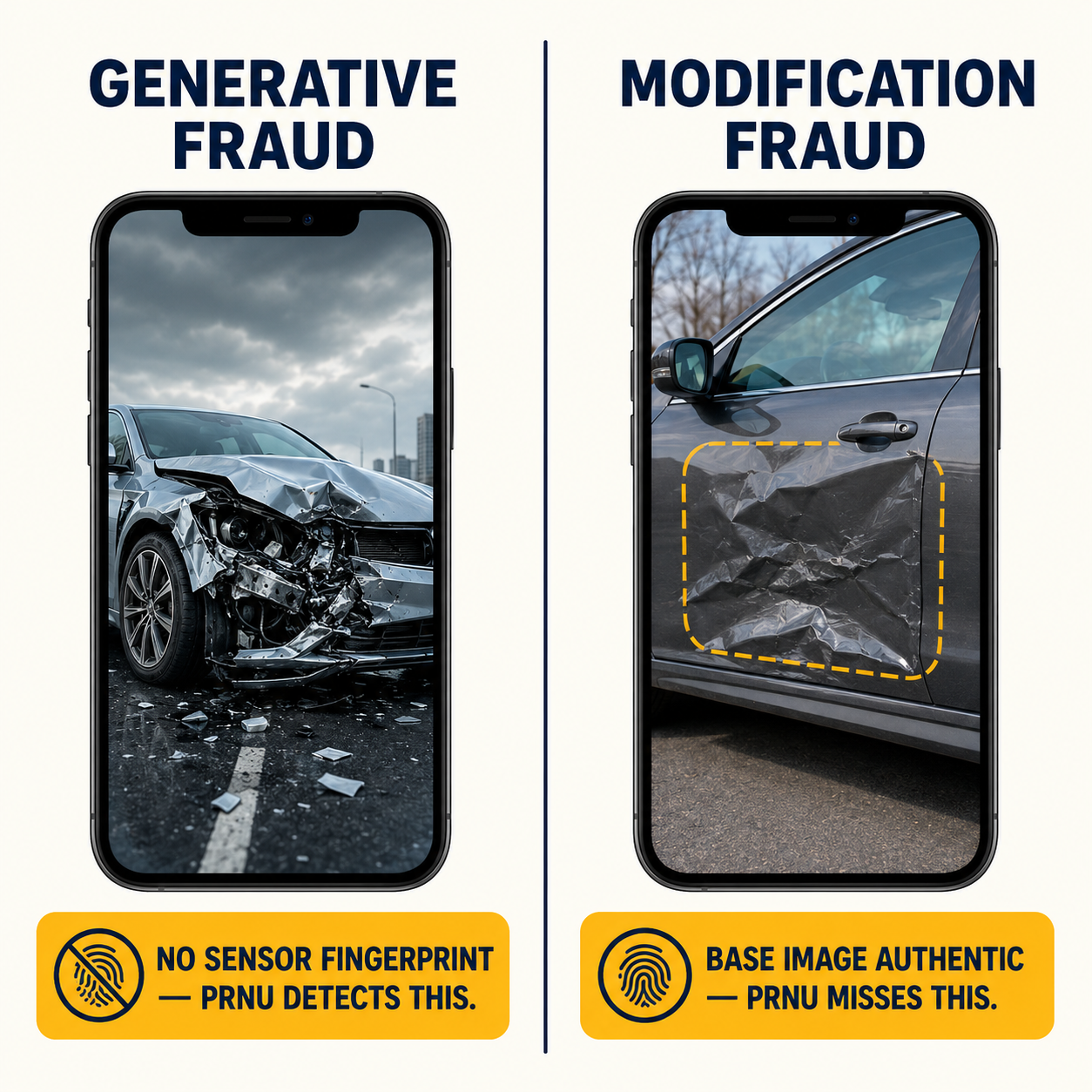
Before that test, I'd been thinking about AI claim fraud the way most of the industry frames it: generative. Someone creates a fake accident and submits it. That is real — AI-enhanced insurance fraud in the US went from under 20,000 cases in 2022 to more than 80,000 by 2025 (FraudOps.ai). But the Verisk 2026 State of Insurance Fraud Study reframed the problem for me when I read it: 36% of US consumers would consider altering a claim image, and among Gen Z that number reaches 55%.
Modification fraud — real photos enhanced to show more damage — turns out to be harder to detect than pure generation, because the base image is authentic. PRNU analysis sees the sensor fingerprint. The manipulation is in what was painted over afterward, not in the absence of a fingerprint. The Guardian documented a 300% increase in AI-manipulated vehicle images at one UK insurer in a single year. Milliman has been writing about this category under the label "accidents that never happened" for long enough that I should have been more prepared for the test result.
The $29 billion per year in US auto-specific fraud, driving roughly $900 annually onto every honest policyholder's premium, is weighted toward the cases where the image is real but the damage is not. That's where the current detection gap is sharpest — and where PRNU-based detection has nothing to offer.
The Vendor Call I'd Been Avoiding
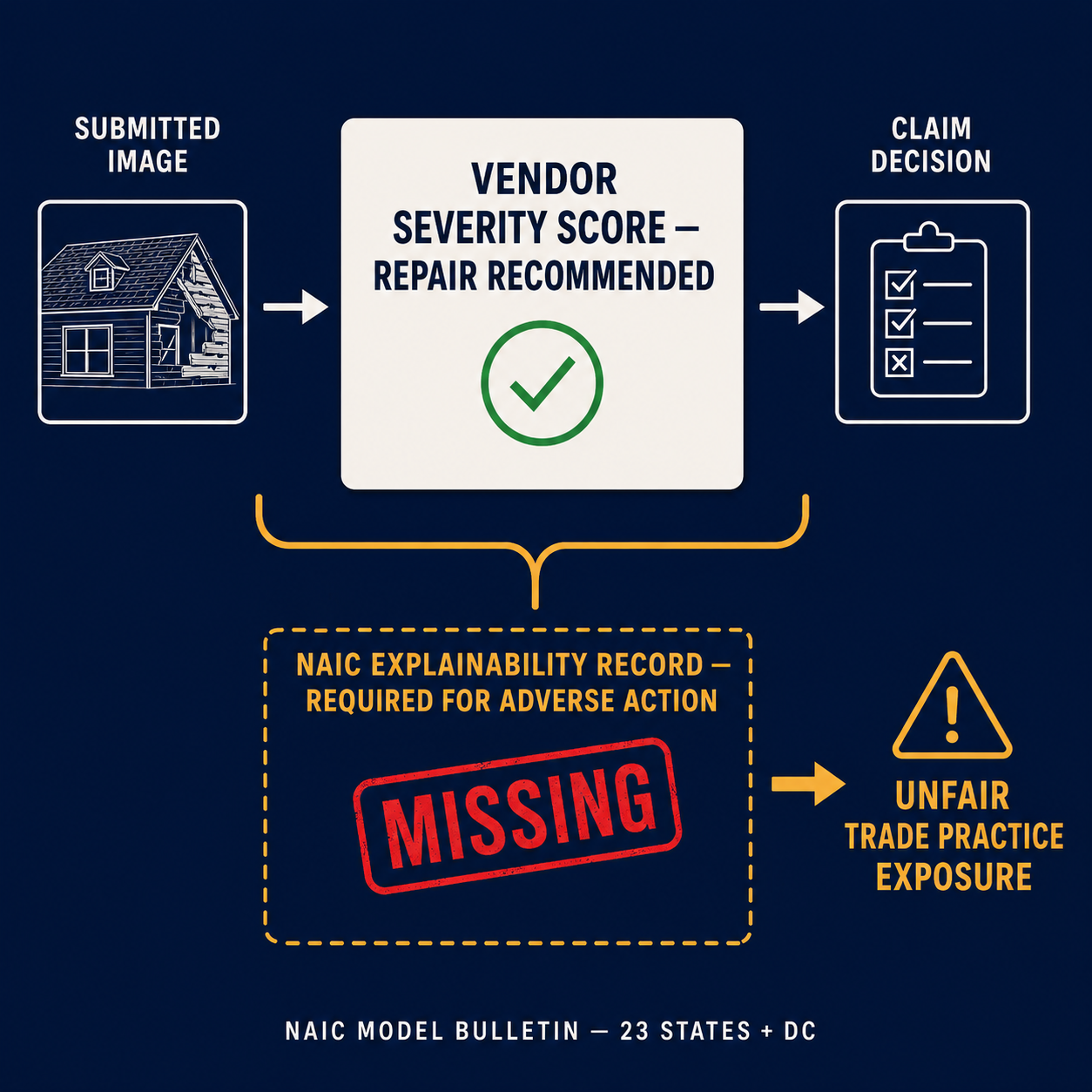
The PRNU test happened during a broader NAIC Model Bulletin compliance review I was running for the same carrier. The bulletin — now adopted by 23 states plus DC — requires auditable records for every AI decision used in claim adjudication. In practice, if you use a severity score in an adverse action, you need to show your work. The record has to exist, and it has to be attached to the decision.
When I went through the carrier's workflow, I found that the third-party severity scores they were using in claim adjudication had no attached explainability record. They had a confidence score from Tractable — a strong platform that processes over $1 billion in claims annually for carriers including Tokio Marine and The Hartford, and whose accuracy is real. But the NAIC's guidance is specific about what "auditable" means, and a confidence score without an explanation of what drove it doesn't satisfy the requirement.
I had to call the vendor and explain that the contract structure needed to change. The platform wasn't architected to produce the documentation. That's not a criticism of the model — it's a capability the platform wasn't built for. But the carrier was using it in a way that exposed them under the unfair trade practice doctrine.
When a carrier puts a vendor model in the adjudication workflow, the NAIC makes no distinction between the two. The liability for that decision belongs to the carrier who deployed it — regardless of who trained the weights.
That call was long. And it was the moment I realized the documentation problem wasn't going to be solved by a better vendor relationship. It required a different architecture.
What Colorado Did to My Next Quarter
I'd been tracking the regulatory pipeline before Colorado's AI Act arrived, but it changed my planning in a specific way. The CAIA takes effect June 30, 2026, classifying AI-driven claim denials as high-risk decisions subject to bias audit, with violations treated as unfair trade practices. The EU AI Act adds a parallel August 2, 2026 deadline with penalties reaching 35 million euros or 7% of global turnover.
What changed for me wasn't the existence of the regulation — I'd expected something like it. What changed was the timeline. Both deadlines land before year-end, and a carrier deploying an undocumented damage-assessment model against Colorado policies is potentially exposed starting in weeks, not quarters.
I went back through my project backlog and reprioritized anything that touched the FNOL-to-decision pipeline for carriers with Colorado exposure. The STP rates leading carriers are targeting — 70-90% automation for basic personal auto claims — mean more adjudication decisions are made without human review. IDC projects a 65% STP rate across auto, homeowners, and commercial auto by 2026. The faster the automation, the faster compliance exposure compounds when the documentation isn't there.
How the Pipeline Came Together
My frustration with the detection landscape was that it was segmented in a way that didn't match the fraud workflow. The platform vendors — CCC Intelligent Solutions (125+ insurers, $1B+ in revenue), Solera's Audatex (4.5 billion image database, 88% vehicle model coverage, five-second total-loss triage) — are excellent at damage assessment. Neither was designed to authenticate upstream. The major consulting firms were building insurance AI practices around LLM copilots and governance frameworks. Nobody was connecting the authentication problem to the FNOL intake point.
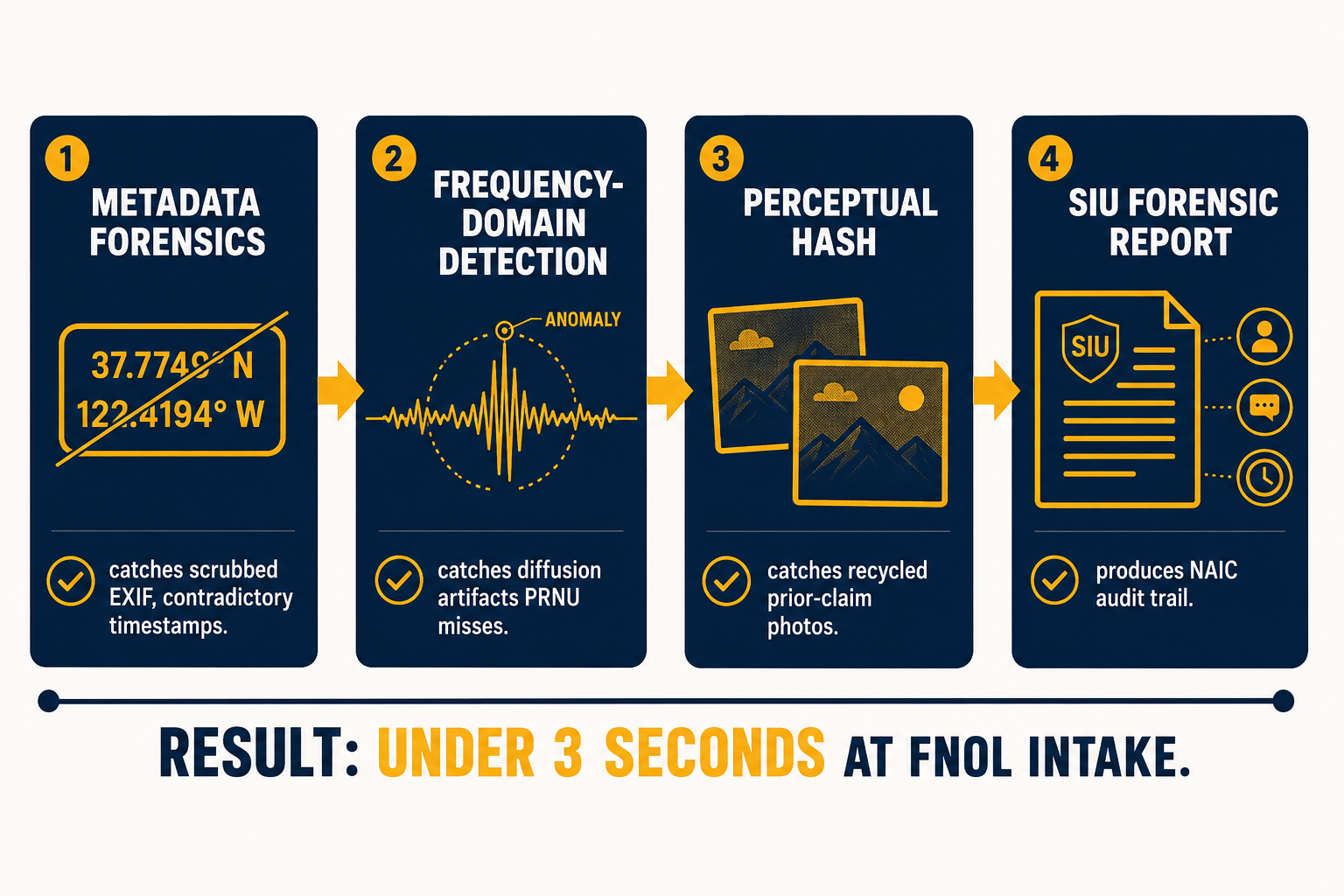
What I built starts with metadata forensics — EXIF data, GPS coordinates, timestamps cross-checked against the claim record. AI-generated images are often submitted with scrubbed or contradictory metadata, and this layer is cheap enough to run before any pixel analysis. Frequency-domain artifact detection comes next for what metadata misses: diffusion models leave structural signatures that PRNU is blind to, and models trained specifically on insurance image types — vehicle damage, property damage — catch patterns that social-media deepfake detectors were never built to find.
Running alongside both is a perceptual hash comparison against the carrier's claim history. Recycled damage photos from prior claims, resubmitted under a new claim number, produce a near-instant flag. The piece that satisfies NAIC is a forensic report: probability scores, annotated anomaly regions, a human-readable explanation suitable for SIU referral. That is the audit trail.
The full architecture is at Insurance Claims AI & Deepfake Detection — including the FNOL integration pattern and the specific structure the forensic report takes to meet NAIC documentation requirements. The design decisions came directly from what the PRNU test broke and what the compliance review demanded.
The Six-Second Pause
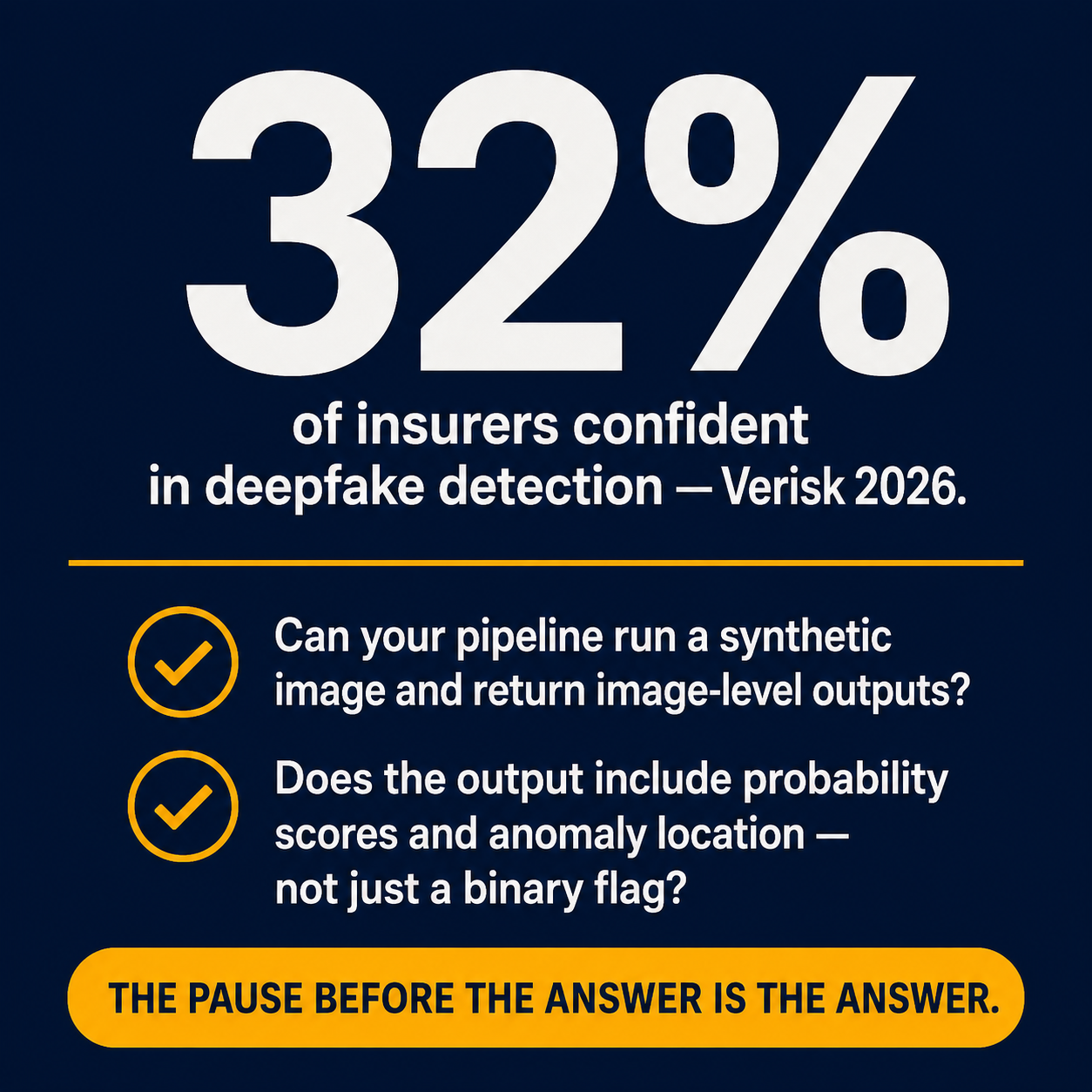
About a month into the architecture work, I was on a discovery call with a carrier that had a different detection stack — not PRNU, a third-party tool I hadn't evaluated directly. I asked whether they could run a sample of synthetic damage images through their pipeline and share the image-level outputs. Not just a pass/fail flag. I wanted to see what the tool reported at the image level.
The pause before the answer was longer than a yes would have been.
The carrier came back a few weeks later with the vendor's answer: the tool returned a binary flag — "suspicious" or "clear" — without intermediate outputs. No probability score, no anomaly location, no forensic report. Just the flag.
That output structure is the detection equivalent of a severity score without explainability. It might catch some fraud. It produces nothing that satisfies the NAIC audit requirement, and nothing you can hand to a SIU investigator with a contested claim. A carrier using it to gate FNOL decisions is doing detection theater, not detection.
The pause told me the carrier's team had already thought about this and already knew the answer. Sometimes the diagnostic question isn't about getting information from the person you're talking to. It's about confirming you're both looking at the same problem.
Only 32% of insurers feel "very confident" detecting deepfakes, according to Verisk 2026. I think the other 68% have all had a version of that pause at some point. The question now is whether the regulatory timeline changes what they do with it.