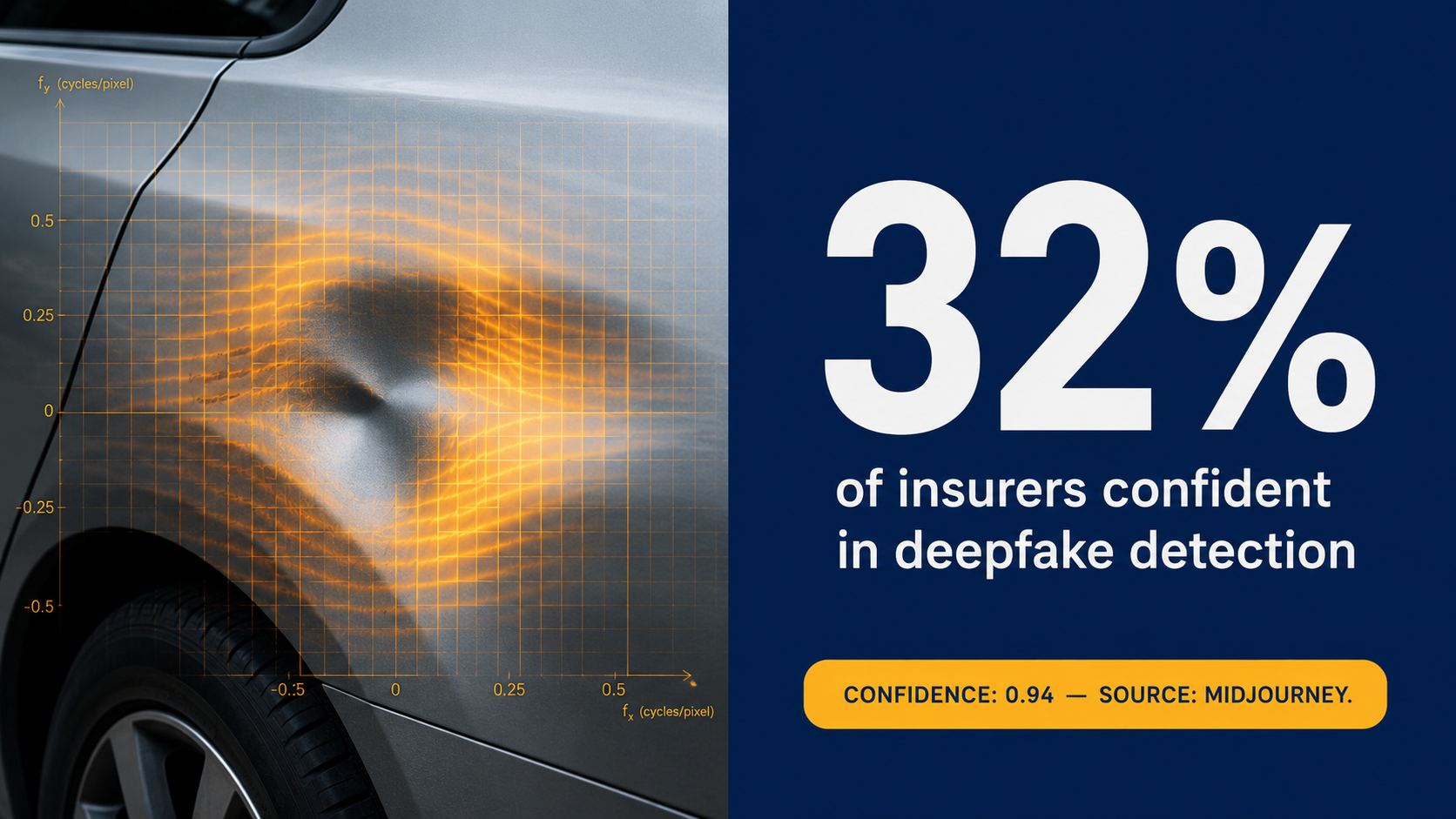
The fraud detection most auto carriers have deployed was designed for a different threat. When AI-generated and AI-enhanced claim images entered the market at scale, they arrived through tools that legacy detection was structurally unable to catch — not because the detection vendors weren't paying attention, but because the foundational method, sensor-noise analysis, depends on a property that synthetic images simply don't have.
That's the architecture gap at the center of a problem that auto insurers are finding harder to explain to their boards than to their adjusters.
The Threat Runs in Both Directions
Most carriers think about AI claim fraud as generative: someone creates a fake accident scene and submits it. That's real — AI-enhanced insurance fraud cases in the US grew from under 20,000 in 2022 to more than 80,000 by 2025 (FraudOps.ai). But the harder category is modification fraud: a real accident image, enhanced or altered to show more severe damage than exists. The Guardian documented a 300% increase in AI-manipulated vehicle images at one UK insurer in a single year. Milliman has been analyzing this category under the label "accidents that never happened."
The Verisk 2026 State of Insurance Fraud Study quantifies the consumer side: 36% of US consumers would consider altering a claim image; among Gen Z, that number reaches 55%. At average auto claim values around $13,000 (AM Best, 2026), with $29 billion in auto-specific fraud annually driving roughly $900 per year onto every honest policyholder's premium, this is not an edge case category.
Why the Standard Detection Method Is Now the Wrong One
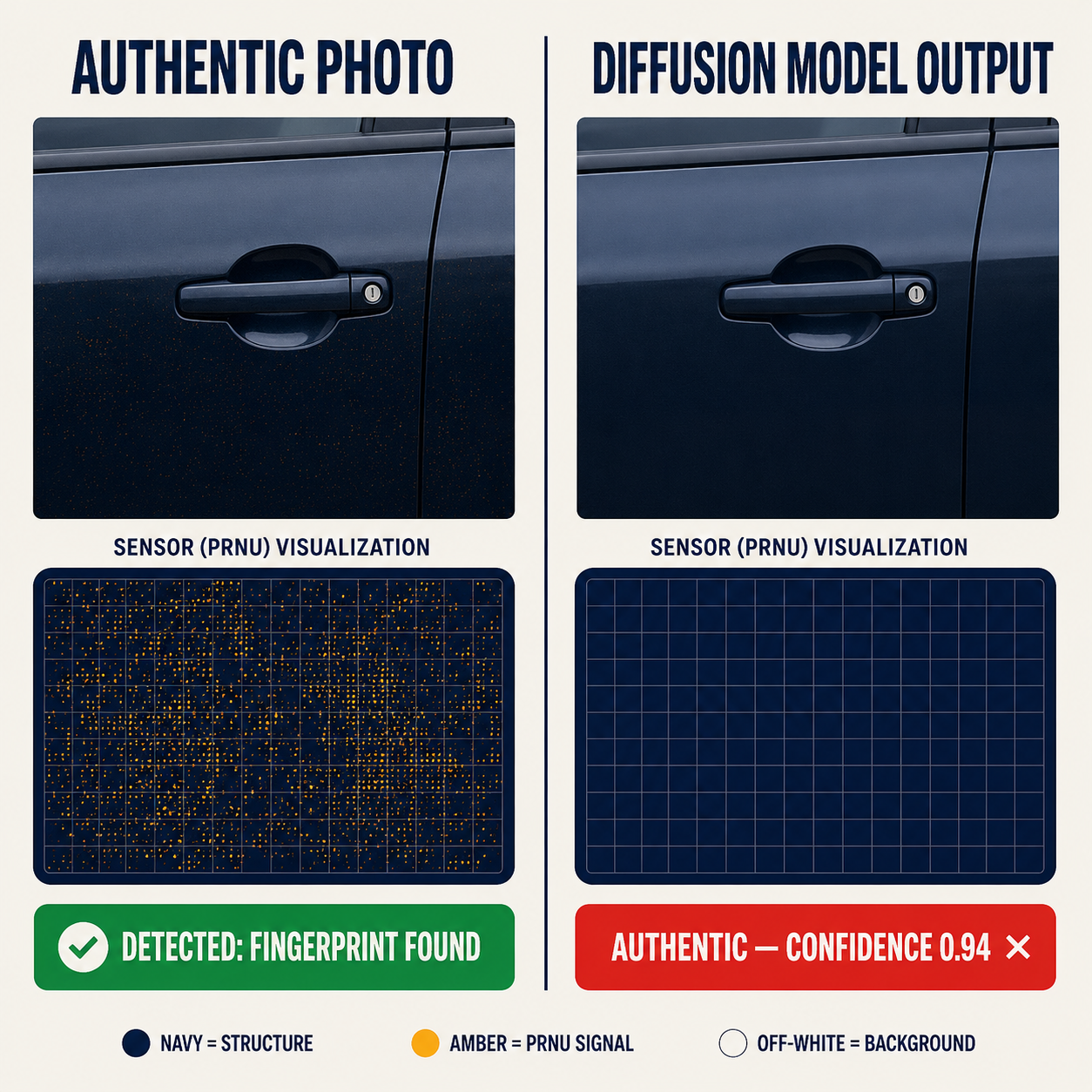
PRNU — Photo Response Non-Uniformity — has been the detection technique of choice for digital forensics for over a decade. Every camera sensor has a unique noise fingerprint, similar to a ballistic signature on a bullet, and forensic analysis can check whether the noise in a submitted image matches the device it claims to come from.
The problem with PRNU against modern diffusion-model fakes is definitional: the image was never captured by a physical sensor. There is no noise fingerprint to find.
A GAN-generated or Stable Diffusion image of vehicle damage leaves PRNU analysis with nothing to detect. The detection method looks for a signal that was never embedded. According to the Verisk 2026 study, only 32% of insurers feel "very confident" in their deepfake detection capability, and 76% report that manipulated submissions have grown more sophisticated. The limitation isn't a configuration problem — it's a physics problem. The tools that return low-confidence readings on diffusion-model images are doing exactly what they were designed to do. The threat moved.
The STP Paradox
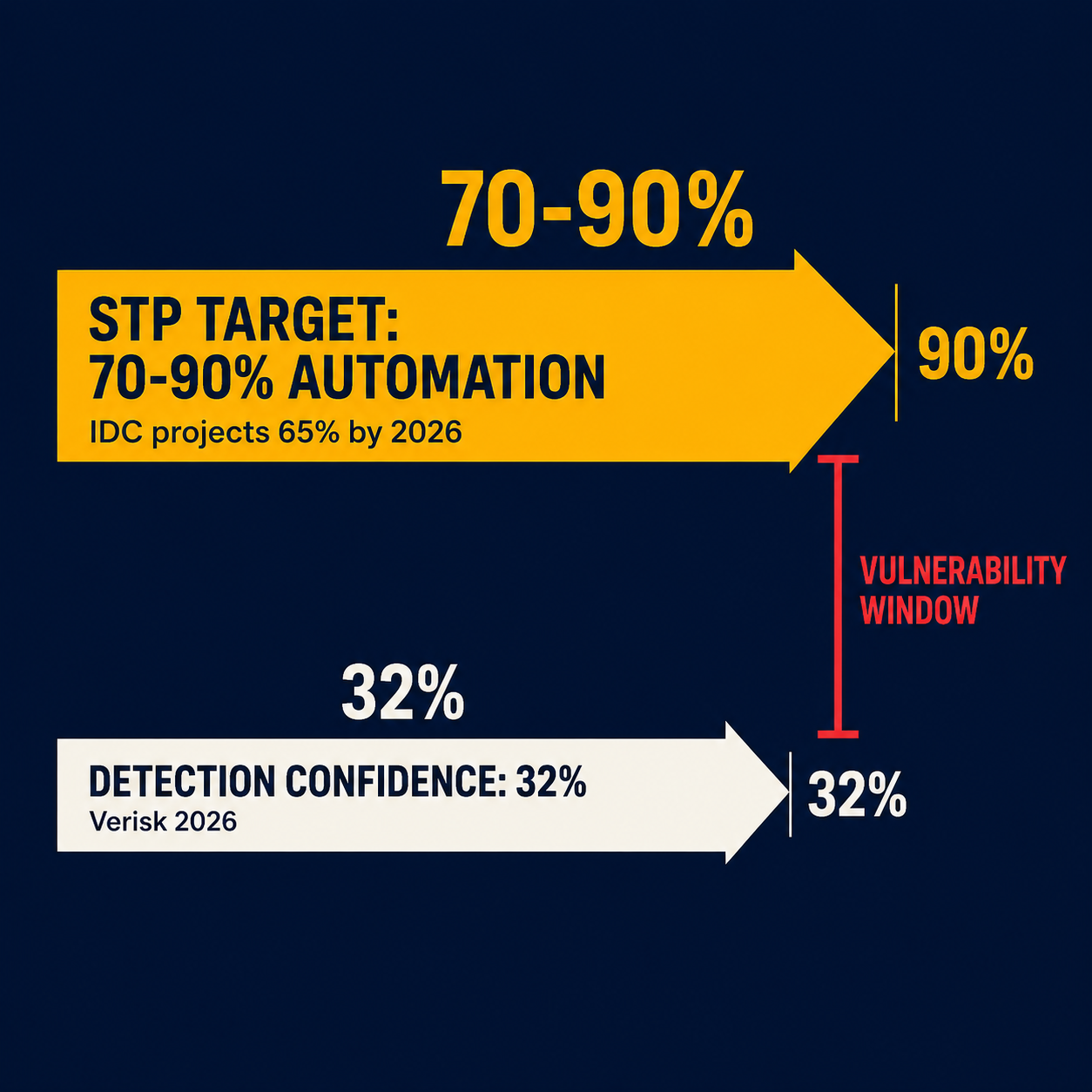
Leading auto insurers are targeting 70-90% straight-through processing rates for basic personal auto claims. IDC projects a 65% STP rate across auto, homeowners, and commercial auto by 2026. The efficiency case is real: claims processing times dropped 18.6% with AI adoption, and computer vision is projected to reduce claim processing costs by $12 billion annually.
The vulnerability window opens where STP and detection architecture intersect. When automated processing means fewer human eyes on submitted images, a detection layer that misses diffusion-model forgeries moves from a capability gap to an operational liability. Tractable processes over $1 billion in claims annually for carriers including Tokio Marine and The Hartford. CCC Intelligent Solutions serves 125+ insurers and crossed $1 billion in revenue. Solera's Audatex platform holds 4.5 billion images covering 88% of vehicle models and processes total-loss triage in under five seconds. These are damage assessment tools — among the strongest in the market — but none includes deepfake authentication upstream of the assessment pipeline. That's not a gap in their design. It's a separate problem that most carriers haven't yet assigned ownership.
Regulatory Exposure That Landed Simultaneously
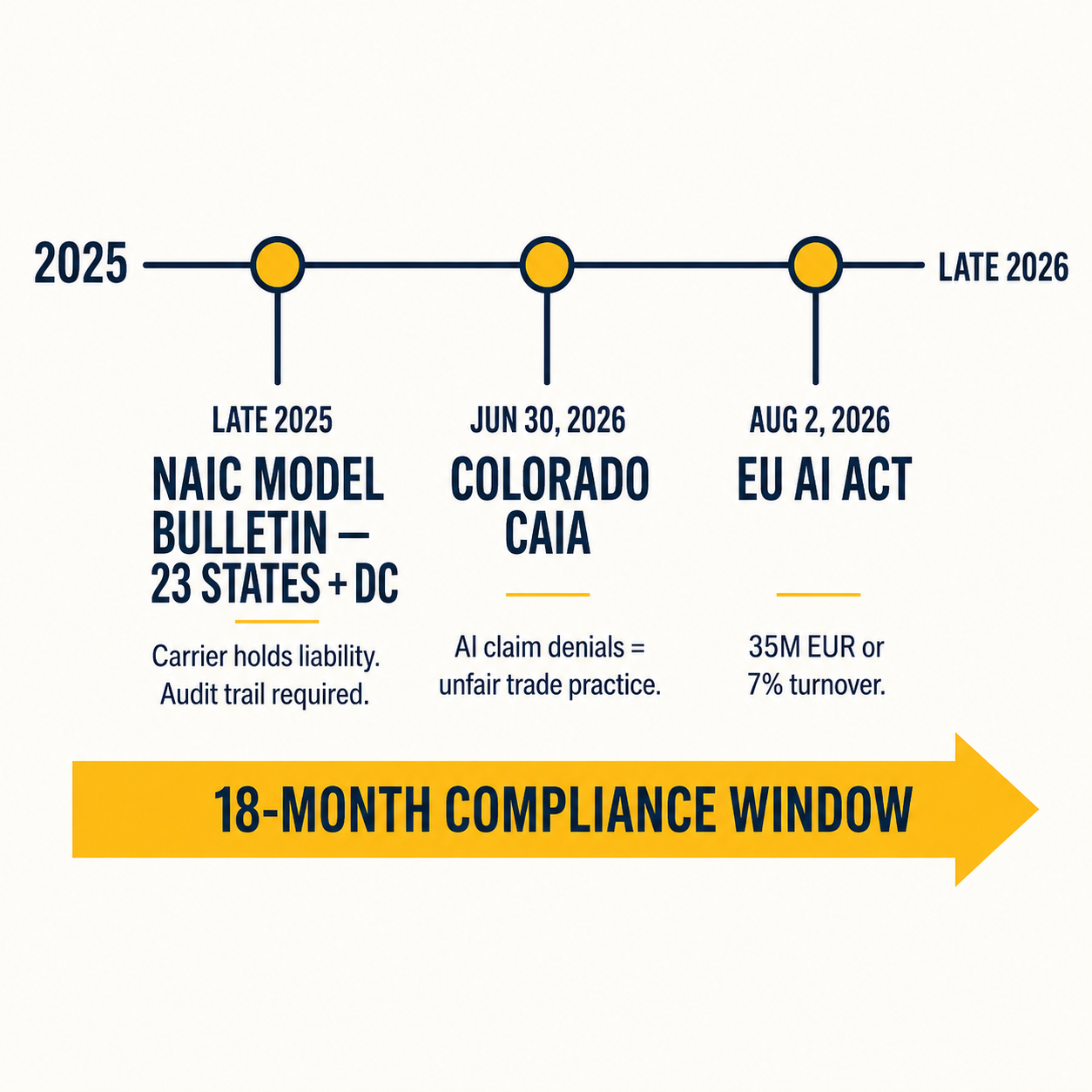
Three regulatory developments arrived in the same 18-month window, all pointing at the same documentation gap.
The NAIC Model Bulletin, now adopted by 23 states plus the District of Columbia, requires auditable records for every AI decision used in claim adjudication. A carrier using a third-party severity score in an adverse action — a denial, a reduced settlement — without an attached explainability record is exposed under the unfair trade practice doctrine. Critically, the NAIC's guidance leaves no room for the vendor excuse: if the model denies a claim, the carrier who deployed it holds the liability.
When a carrier puts a vendor model in the adjudication workflow, the NAIC makes no distinction between the two. The liability for that decision belongs to the carrier who deployed it — regardless of who wrote the training loop.
Colorado's AI Act adds enforcement teeth — effective June 30, 2026, classifying AI-driven claim denials as high-risk decisions subject to bias audit, with violations treated as unfair trade practices. The EU AI Act sets a parallel deadline of August 2, 2026, classifying insurance AI as high-risk and attaching penalties reaching 35 million euros or 7% of global turnover. The compliance ask in all three cases is the same: documented, explainable, auditable AI decisions. That standard cannot be met by a detection pipeline that returns a binary flag without showing its work.
What Forensic CV for Claims Actually Requires
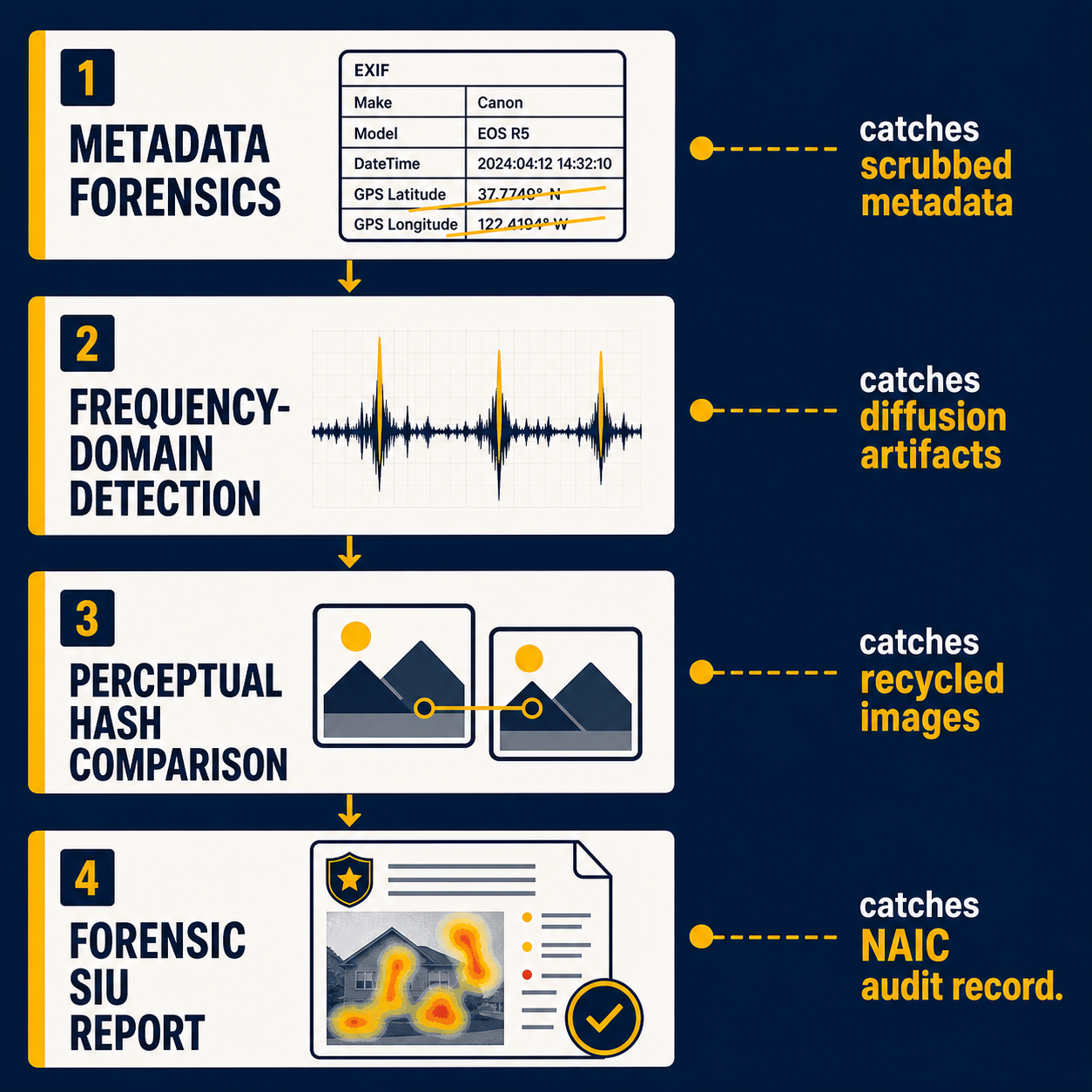
The authentication layer that works against modern diffusion-model forgeries isn't one technique. It's a pipeline, and the order matters.
Metadata forensics runs first — EXIF data, GPS coordinates, timestamps checked against the claim record. AI-generated images are often submitted with scrubbed or internally contradictory metadata. This layer is computationally cheap enough to run before any pixel analysis, and it catches a meaningful share of fraud before the more expensive layers engage.
What catches the rest is frequency-domain artifact detection. Diffusion models leave structural signatures that PRNU is blind to: frequency-domain anomalies, inconsistent noise distributions across color channels, geometric inconsistencies in reflections. Detection models need to be trained specifically on insurance-relevant image types — vehicle damage, property damage, medical documentation — not on the face-swap videos that most general-purpose deepfake detectors were built against.
A perceptual hash comparison against the carrier's claims database runs in parallel. Recycled images — real damage photos from prior claims, resubmitted months or years later — account for a portion of fraud that has nothing to do with generation. A hash index makes that pattern a near-instant flag.
The fourth element is what produces the compliance record: a forensic report with probability scores, annotated anomaly regions, and a human-readable explanation suitable for SIU referral. The pipeline has to produce something a claims adjuster can act on and a regulator can audit — not just a flag that something looked wrong.
Our work on this problem, at Insurance Claims AI & Deepfake Detection, runs end-to-end in under three seconds per image and integrates into the FNOL workflow so flagged claims are held before they enter any damage assessment pipeline. The authentication decision and the severity assessment stay separated by design — because the liability attached to each is different.
The Consulting Gap Worth Naming
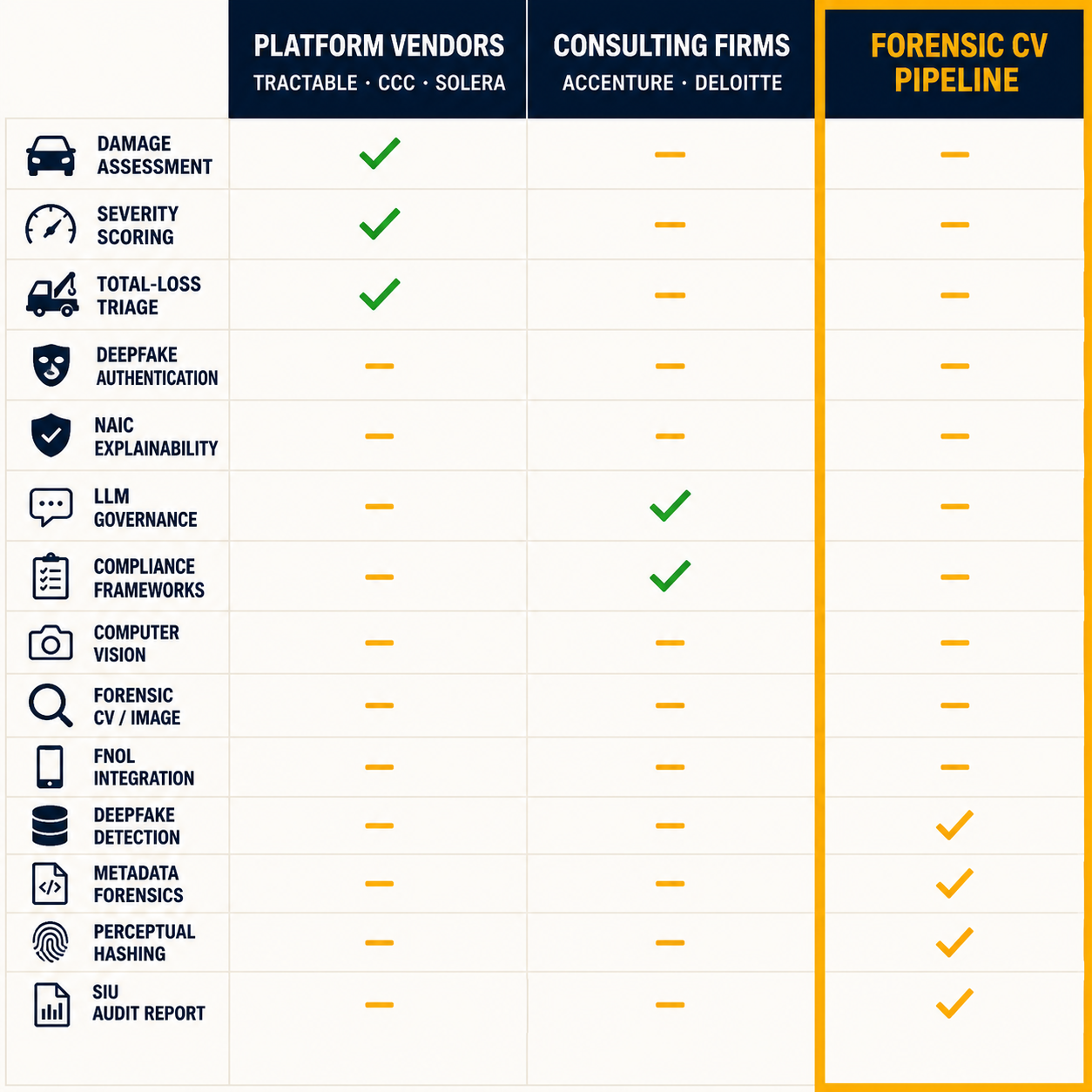
The major professional services firms — Accenture, Deloitte — have built their insurance AI practices around LLM-centric workflows: agentic claims triage, regulatory reporting copilots, governance frameworks. Neither has a custom computer vision capability for damage assessment or deepfake detection. Their insurance AI work is valuable, and it doesn't solve a pixel-level forensic problem.
This places forensic CV in a gap between the platform vendors (excellent at what they were built for, but not selling authentication infrastructure) and the consulting firms (strong at governance and LLM deployment, not at building detection pipelines). Carriers navigating this gap often end up either building bespoke detection in-house with a team that lacks insurance-image training data, or deploying social-media deepfake detectors that weren't designed for the FNOL workflow. Both paths leave the NAIC documentation requirement unmet.
A Single Diagnostic Before Year-End
One check matters more than any vendor briefing or pilot shortlist: take a sample of known synthetic damage images — current-generation Midjourney or Stable Diffusion outputs — and run them through your existing detection pipeline. Observe the false-negative rate.
If that test is difficult to run because the pipeline doesn't produce image-level outputs that the team can inspect, that finding is its own answer.
The STP targets are rising, the regulatory deadlines are fixed, and the fraud tooling available to claimants is now accessible to anyone with a browser and a subscription. The question for most carriers isn't whether to build the authentication layer. It's whether to build it before or after the first contested claim reaches litigation — and what that timeline implies for who holds the documentation when it does.
The architecture we use for that work is documented at Insurance Claims AI & Deepfake Detection, including the FNOL integration pattern and the forensic report structure the NAIC standard requires.
If your team is working through what FNOL-integrated authentication requires, what the NAIC documentation standard demands at each decision point, or where the EU high-risk classification changes the architecture — we'd genuinely find that conversation useful. The patterns repeat across carriers, and the solutions that hold up tend to look similar once the compliance requirements are concrete.