The question for media companies stopped being "is generative audio legal." That argument collapsed in a six-week window in late 2025.
Oct 30: UMG settles with Udio. Nov 25: WMG partners with Suno. Both pivot to licensed, opt-in platforms — but most tiers won't let you download or export what you make. The asset stays locked on-service.
So the urgent question changed. Three harder ones replaced it:
Portability — can the asset actually ship across broadcast, streaming, social, cinema, and in-game? Walled-garden outputs can't. Most commercial use cases break before they start.
Registrability — the US Copyright Office position is that prompt-only outputs aren't copyrightable. A competitor can free-ride on your AI jingle with impunity.
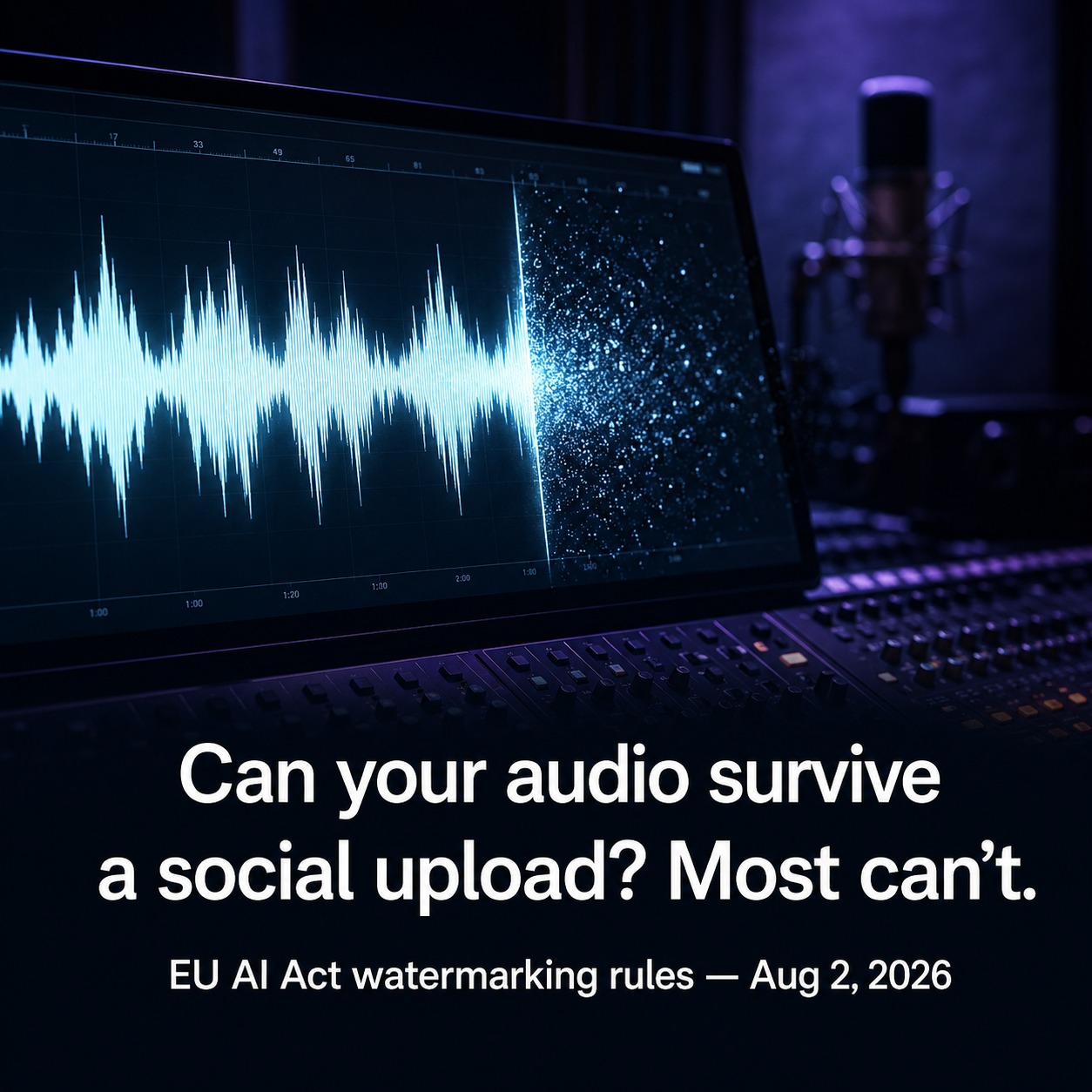
Detectability — EU AI Act Article 50 takes effect August 2, 2026, and Article 99 puts non-compliance at up to €15M or 3% of global turnover. Your audio needs machine-readable marking that survives transcoding, social upload, and the analog gap. The draft Code of Practice is explicit: metadata alone isn't enough, you need imperceptible watermarking too. And most social platforms strip C2PA metadata on upload by default.
Here's the part nobody sells you: no single vendor solves this end to end. SynthID detects only Google-generated audio. AudioSeal is open-source but speech-first. C2PA dies when metadata gets stripped. DDEX AI-disclosure fields are still in draft. The compliant pipeline is the glue between disconnected systems — watermark, manifest, disclosure, detector, takedown runbook, audit package.
Eight weeks out, that integration is the whole job.
Save this if you own rights tech, trust & safety, or AI sync compliance — the Aug 2 clock doesn't reset. Which of your assets can you prove survives a transcode and a social upload today?
#AudioWatermarking #EUAIAct #ContentProvenance #MusicTech #RightsTech