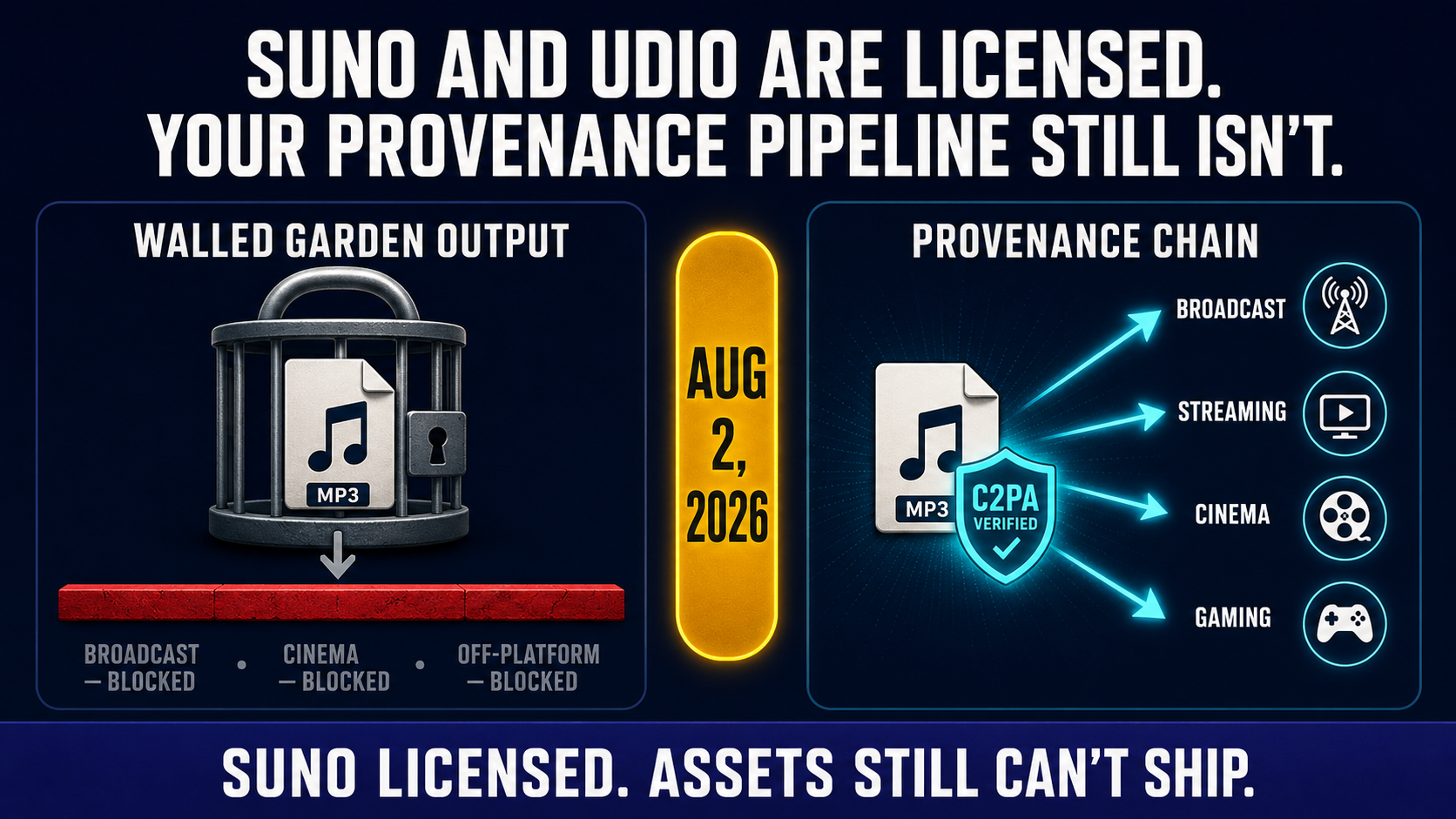
The UMG-Udio and WMG-Suno settlements, completed in October and November 2025 respectively, resolved the question the music industry spent 2024 arguing about: can you license AI-generated music at scale? The answer is yes. Licensed platforms, opt-in artist frameworks, walled-garden outputs with fingerprinting and filtering — the legality question has an answer. What it doesn't have is an architecture. Portability, registrability, and detectability remain unsolved, and EU AI Act Article 50, effective August 2, 2026, turns all three into a compliance deadline.
What a Walled Garden Actually Restricts
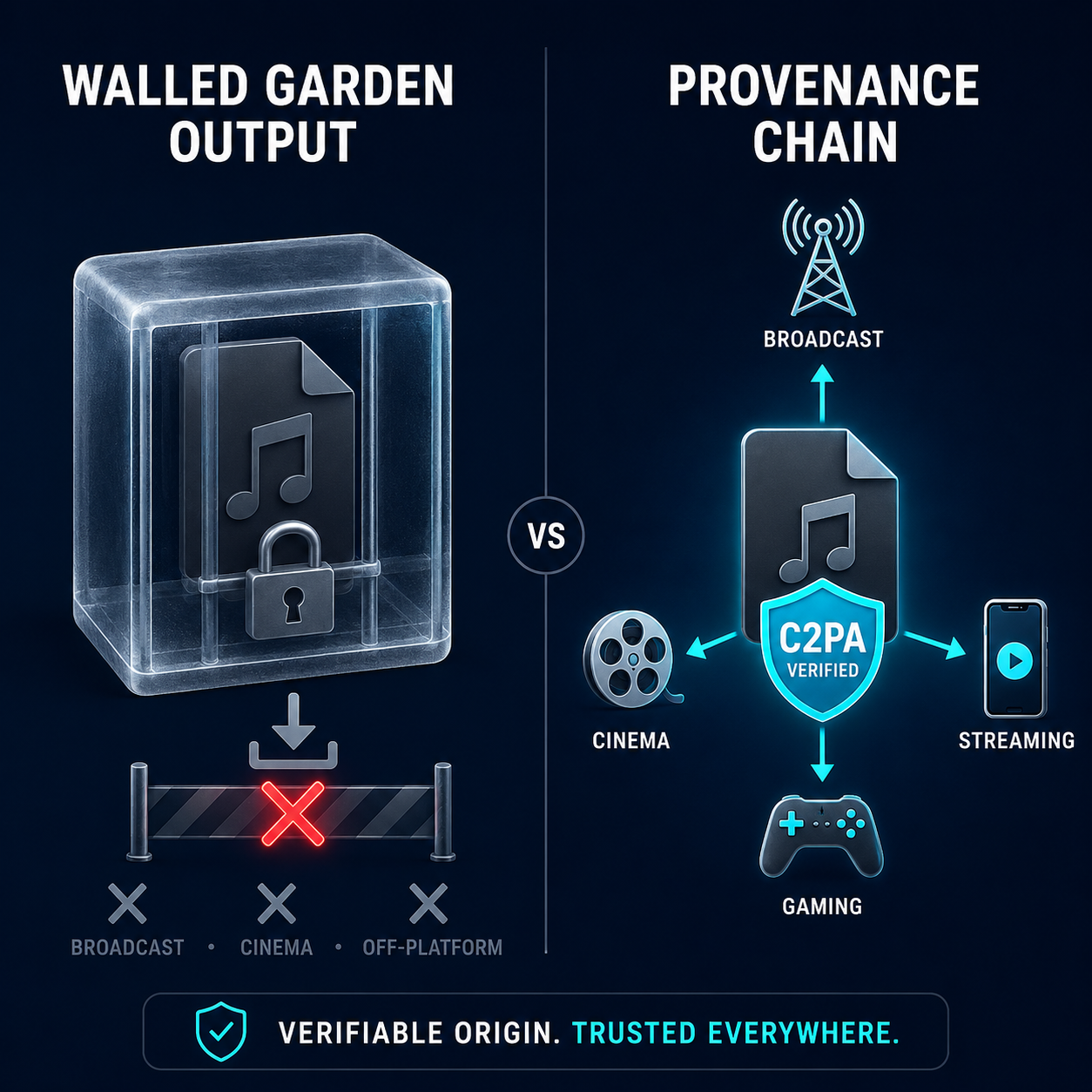
The commercial restriction buried in both settlement agreements is the one that matters most for professional media production. Under both the Udio and Suno transition terms, users cannot freely download or export creations for off-platform commercial use. Paid tiers have download caps. The platforms are licensing the music factory, not the music.
An advertising agency needs a jingle that ships across broadcast, streaming, social, cinema, and in-game licensing. A walled-garden platform that fingerprints and filters its outputs for off-platform use breaks every one of those downstream use cases before rights clearance even begins. The settlement terms that resolved the legality question simultaneously made the assets commercially unusable for the buyers who most need them.
The settlements established that AI music can be licensed. They did not establish that it can be shipped.
The copyright problem compounds this. The US Copyright Office's January 2025 position is that prompt-only outputs are not copyrightable. An AI jingle created on a licensed Suno platform may be protected from an infringement claim against the creator — but a competitor can sample and re-release it without consequence, because neither party has copyright. Building brand audio identity on AI outputs with no human-authorship documentation means IP protection is theoretical. Copyright registration requires documented human creative decisions in the chain, which means provenance work has to begin before the track is finalized, not after the campaign goes live.
The Article 50 Obligation Isn't a Footer Exercise
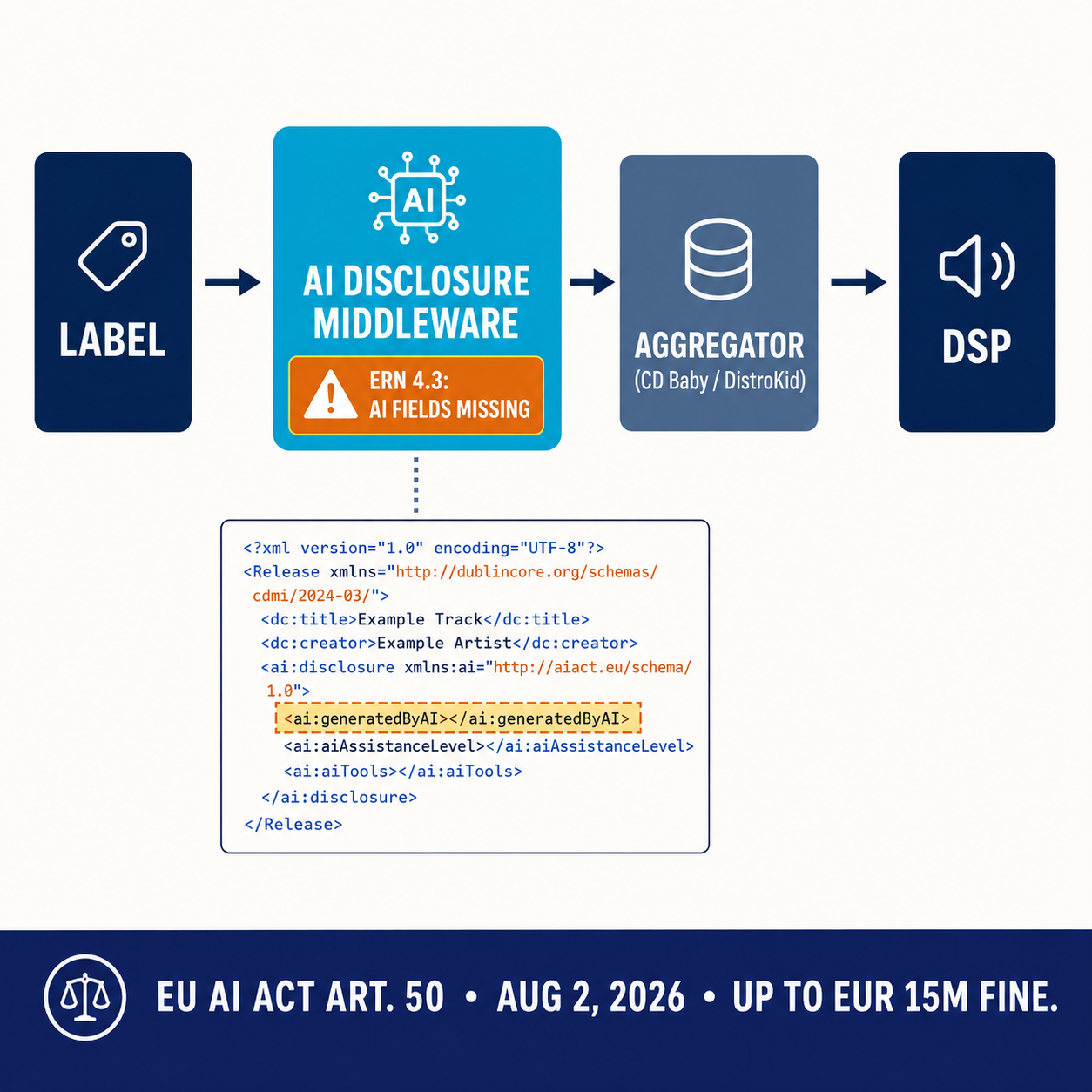
The EU AI Act Article 50 requirement for generative audio is not a disclosure notice on a platform FAQ. The European Commission's January 2026 draft Code of Practice on Marking and Labelling of AI-Generated Content specifies a multi-layer obligation: machine-readable metadata (C2PA manifests, digital signatures) and imperceptible watermarking embedded at the generation, inference, or output stage. Metadata alone is explicitly insufficient under the Code.
The Commission has stated that this draft — once finalized in June 2026 — will be the compliance benchmark used by regulators and courts from day one of enforcement. Penalties under Article 99 run up to EUR 15 million or 3% of global annual turnover for Article 50 violations, whichever is higher.
The DDEX consequence is what most audio teams haven't mapped yet. DDEX ERN 4.3 — the delivery format used by CD Baby, DistroKid, and most major aggregators — has no native AI disclosure fields. The extension is still in draft as of mid-2026. Most aggregators are not passing granular AI disclosure metadata to DSPs. A label distributing through standard aggregator pipelines, without building custom middleware to inject those fields before submission, will fail Spotify's September 2025 AI disclosure policy and the EU AI Act obligation simultaneously. Both the label and the provider (Spotify, in an audit) can face Article 50 exposure. The Commission's compliance scenario modeling makes this cascade explicit.
Watermarks Don't Survive Every Chain
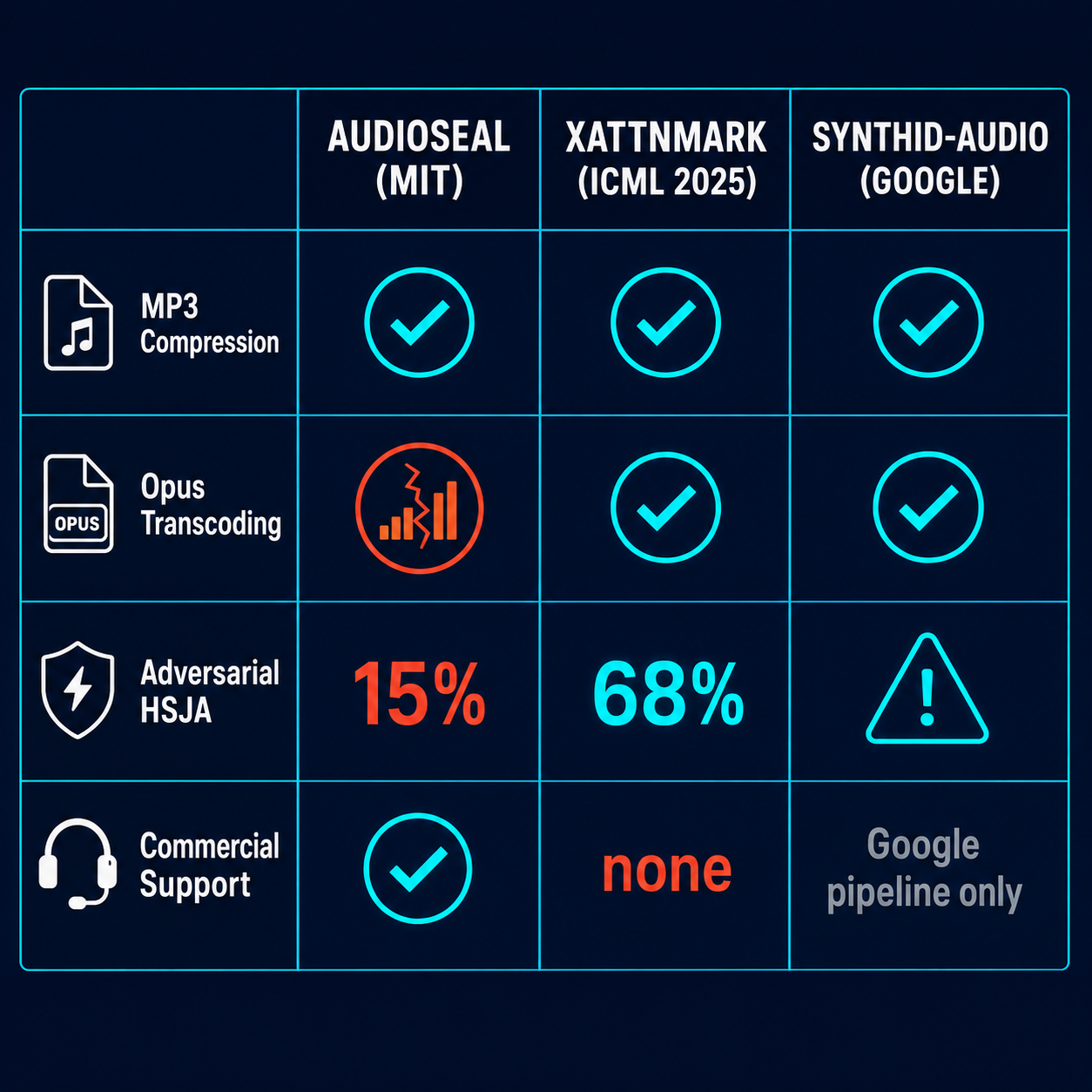
The watermarking landscape is more fragmented than vendor comparisons suggest, and the robustness differences are large enough to change architectural decisions.
Google SynthID-Audio is the most widely deployed: over 10 billion assets watermarked across modalities since the November 2025 global rollout, with a publicly available detector portal. But it is a closed system — detection works only for Google-generated content, the audio implementation is not open-sourced, and there are no integration services available. If your pipeline doesn't route through Lyria or NotebookLM, SynthID-Audio provides no compliance coverage.
Meta's AudioSeal, released under MIT license, is the most deployable open-source option. It supports sample-level localized detection at 24, 44.5, and 48 kHz, with a streaming variant added in December 2024. AudioSeal survives MP3 compression and room reverb — relevant for broadcast contexts. But its music robustness drops significantly under adversarial conditions: 15% detection rate under waveform HSJA attacks, compared to 68% for XAttnMark (Liu et al., ICML 2025). XAttnMark's cross-attention architecture maintains 91–94% detection after Stable Audio generative re-edits. It ships, however, with no commercial support and no production integration tooling.
The practical issue is not which algorithm wins a benchmark paper. A watermark that survives MP3 compression may die in Opus transcoding. AudioSeal's autocorrelation approach survives analog-gap capture — a microphone recording a broadcast signal — while most LSB-style watermarks do not, which matters for any content distributed through broadcast or social upload pipelines. Picking a watermark stack means running a survival matrix against the specific transcode sequence your content travels, not against a vendor datasheet.
What survives a lab benchmark and what survives your ingest chain are two different tests. Most teams are doing one of them.
C2PA content credentials add the metadata provenance layer. The RIAA, Roland, and Avid are all C2PA members; audio-specific standards are actively developing. But C2PA metadata is stripped by most social platforms on upload. The practical approach is soft binding: a UUID embedded via watermark points to a cloud manifest store, so that even when the metadata layer is stripped, the watermark still resolves to the provenance chain. Implementation wrinkles include GDPR implications for manifest store queries between EU-based clients and US-hosted stores, and C2PA 2.0's requirement for privacy redaction of creator identity fields — both manageable, but neither is a default.
Ad Agencies Have a Different Liability Structure
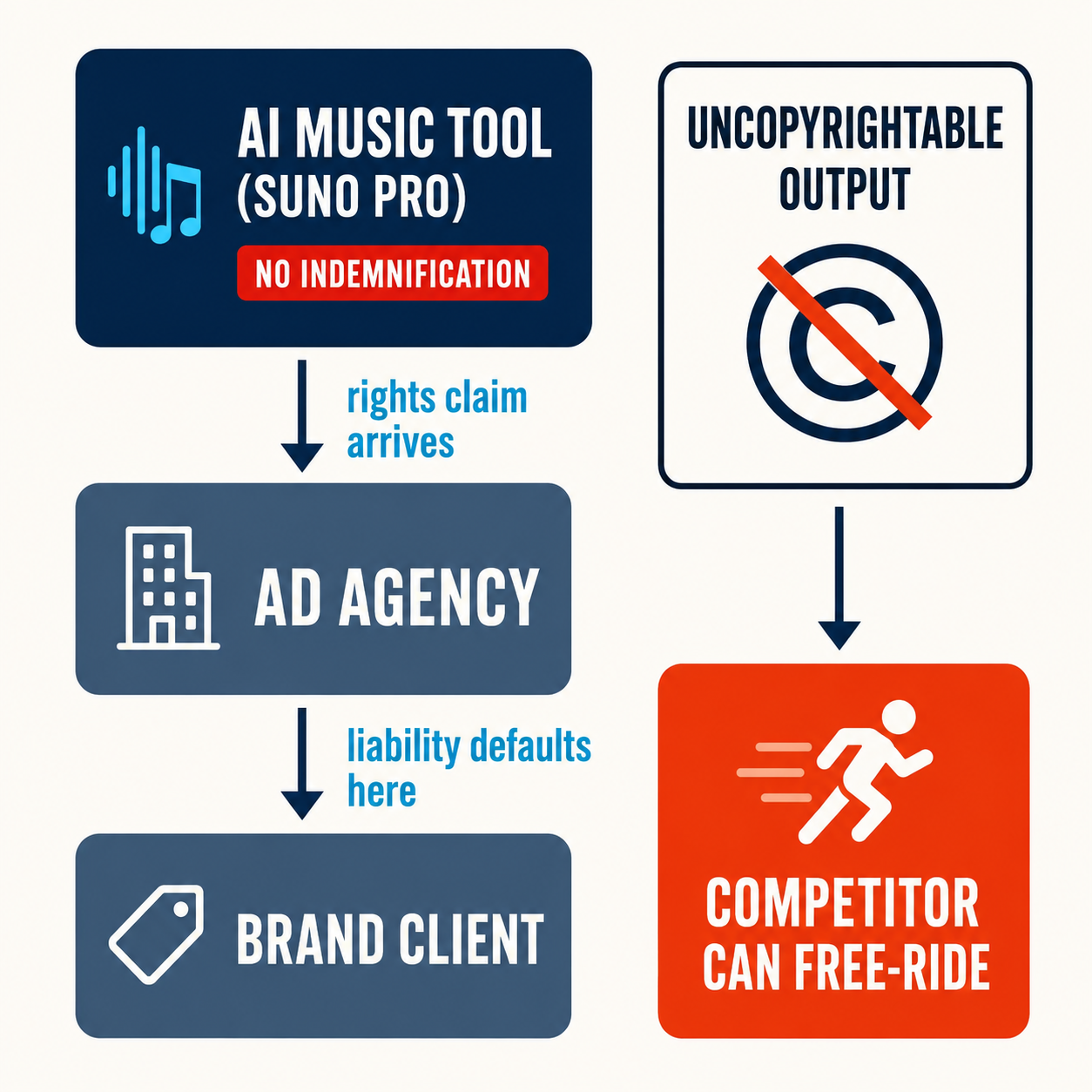
Ad agencies face a liability configuration that neither DSPs nor labels share — and it's the least-discussed gap in most Article 50 planning conversations. Suno's Pro and Premier commercial plans explicitly exclude indemnification. The 4A's Master Service Agreement guidance now pushes agencies to negotiate AI-specific indemnity clauses into client contracts — but the majority of active agreements predate AI music and haven't been renegotiated. A national campaign that uses an AI-generated jingle carries rights-claim exposure that defaults to the agency if the indemnification chain wasn't built into the production agreement before the shoot wrapped.
The bipartisan NO FAKES Act (S.1367 / H.R.2794, 119th Congress) would create a federal property right in digital replicas of voice and likeness, with notice-and-takedown obligations for platforms. Tennessee's ELVIS Act (effective July 2024) already makes unauthorized AI voice cloning a criminal offense. The scale of the surrounding ecosystem — Deezer's September 2025 data showing 28% of daily uploads fully AI-generated, with 70% of plays on those tracks identified as fraudulent; Beatdapp and Beatport estimating $2–3 billion in fraudulent royalty diversion annually; Spotify removing over 75 million spam tracks in a 12-month window — tells you how platform enforcement posture is trending. DSPs are treating AI-generated content without provenance documentation as a compliance problem, not a content category.
For agencies, the most actionable near-term work is chain-of-title documentation for every AI-generated asset currently in production: human authorship decisions recorded, voice contracts with explicit buy-out scope covering relevant statutes, C2PA stamping at every transformation, and indemnification language negotiated before a campaign goes live. The uncopyrightable output problem means a brand's AI jingle can be legally free-ridden by a competitor — which is a legal exposure distinct from the rights-claim exposure, and it requires the same chain-of-title documentation to address.
What No Single Vendor Covers
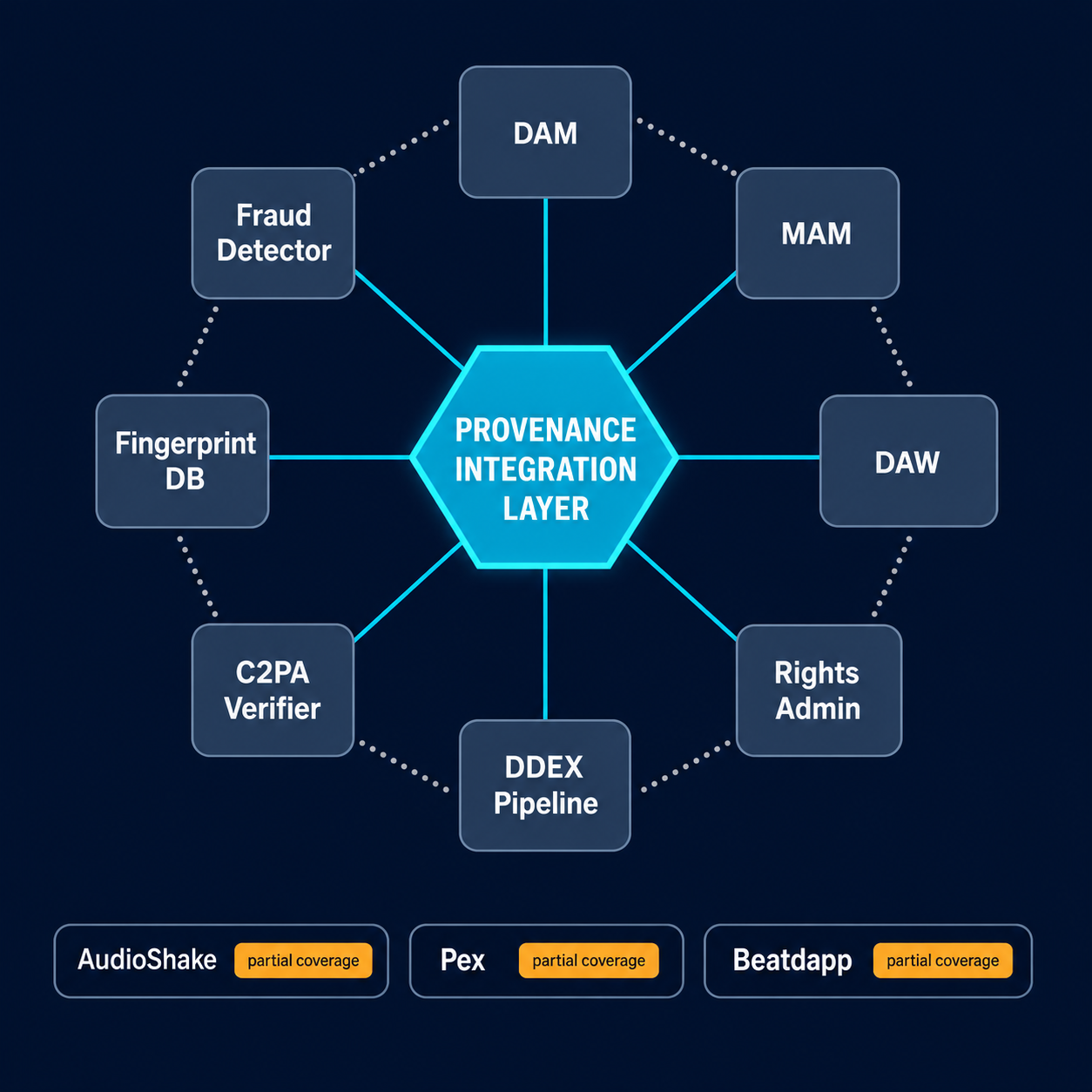
No single vendor closes the audio provenance problem end-to-end, and that's not a temporary market gap — it's an architectural one. AudioShake — Series A $14M, clients including all three major labels plus Hipgnosis, Primary Wave, Concord, CD Baby, and Disney Music Group — is the enterprise stem-separation leader, running approximately 2 dB SDR above open-source Demucs. But AudioShake is a stem-separation company, not a watermarking or provenance company; every client still needs the rest of the chain. Pex Attribution Engine does real-time fingerprint matching and can identify the AI platform of origin at high confidence for content that exists in a reference database — but fingerprinting has no reach against AI outputs never heard before. Behavioral fraud detection (Beatdapp) and DSP-side AI stream flagging (Deezer's patented detector, now licensed to rival platforms since January 2026) address adjacent problems, but neither provides the content-level provenance labeling that Article 50 requires.
A label or DSP's provenance problem spans eight to twelve disconnected systems: DAM, MAM, DAW, rights-admin, aggregator DDEX pipeline, C2PA verifier, fingerprint database, fraud detector, and internal review workflow. The end-to-end integration work — embedding architecture, DDEX middleware, multi-standard detection, takedown runbook, regulator documentation — is what we build at AI Audio Licensing, Watermarking & Provenance for Media.
One architectural question that gets deferred until it causes problems: multi-watermark coexistence. If a licensed platform embeds SynthID-Audio at generation, a label's ingest pipeline embeds a second watermark, and the DSP adds a third at ingress, the three signals may interfere — signal-to-noise degradation on later embeds reduces detection reliability on earlier ones. There's no published benchmarking on this coexistence problem yet. Designating which watermark signals are authoritative at which pipeline stages, and documenting that architecture before an Article 50 audit, is a design decision that has to be made before August, not revisited after an inquiry opens.
The Voice Bank Question Has Different Economics
For organizations running voice transformation work — podcast localization, radio imaging, audiobook narration, YouTube dubbing, accessibility adaptations — the provenance architecture has an additional economic layer. Commissioned voice recordings run $8K–$18K per actor for 45 minutes of clean material across genre styles, depending on union status and buy-out scope. Minimum viable coverage across age, gender, and accent dimensions requires 45–75 actors — $360K–$1.35M in direct capex before any client revenue reaches the project.
California AB 2602 and the SAG-AFTRA 2023 strike terms require explicit consent and separate compensation for AI voice replica use commercially. Tennessee's ELVIS Act makes unauthorized voice cloning a criminal offense. The economics force buyers toward narrow, per-use-case voice libraries — 20 actors across 4 languages for a specific podcast localization workflow — with C2PA stamping and opt-in documentation for every artist, rather than general-purpose banks assembled from open-source weights.
The Architecture That Covers All Three Problems
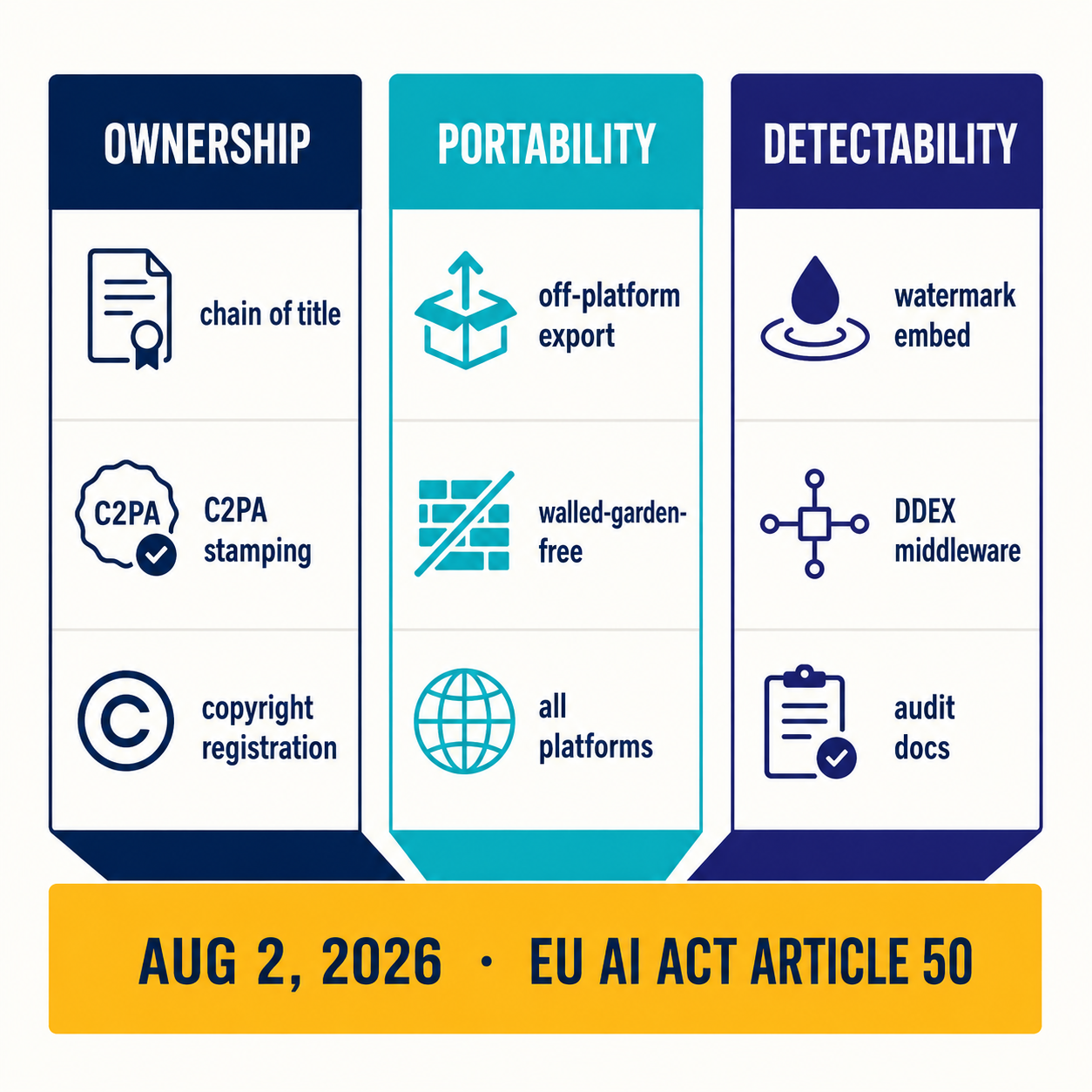
The provenance problem in audio is three problems with one deadline: chain of title (ownership, copyright registration), portability (assets that ship off any walled garden into any distribution context), and detectability (machine-readable labeling that survives the full content journey). All three require the same underlying architecture — the sequence of components just has to be right.
For a label or distributor: the work begins with a gap assessment against Article 50's multi-layer requirements on the current ingest chain, then moves to the watermark embedding decision (generation vs. ingest vs. re-encoding), then to DDEX middleware that injects AI disclosure fields before aggregator submission. The C2PA soft-binding layer and the multi-signal detection at the distribution gate follow once the embedding architecture is settled. Eight weeks is achievable with a well-scoped start. Twelve weeks produces a more defensible system. Waiting until July produces neither.
For ad agencies, the sequence is different: chain-of-title audit on existing AI-generated assets before new production begins, indemnification clause review on active client agreements, then the labeling infrastructure for new campaigns. The compliance picture and the IP-protection picture are the same audit.
Across all three buyer configurations — labels and publishers, DSPs and distributors, agencies and studios — the problem is the same shape. The August 2 deadline is not a planning prompt. It is a fixed point, and the Commission has been explicit that enforcement begins day one.
We've been building this provenance chain for media clients working toward that deadline. The technical questions — which watermark standard survives which transcode, how to handle DDEX field injection before your specific aggregator, how to architect multi-signal coexistence without degrading detection — are all solvable, and the reference architectures are converging. The full architecture — embedding decision, DDEX middleware, multi-signal detection, takedown runbook — is documented at AI Audio Licensing, Watermarking & Provenance for Media. If your team is navigating any of those specific problems, we'd genuinely like to hear where the friction is. The buyers who figure this out before August will define what compliant audio provenance looks like for the rest of the decade.