
When the UMG-Udio and WMG-Suno settlements came through in October and November 2025, the reaction in the industry was something between relief and celebration. Licensed AI music. The lawsuit era is over. I didn't feel that way.
What I kept thinking about was the download restriction. Both settlements landed on walled-garden outputs — no free off-platform export, fingerprinting and filtering on transition products, download caps on paid tiers. The music factory got licensed. The output didn't. For the clients I work with — labels that need assets in broadcast, social, in-game, and cinema simultaneously; ad agencies that need jingles that ship and survive across platforms — "you can make it but you can't take it anywhere useful" is a new problem with legal cover, not a solved one.
What I Tell Clients Who Ask About Using Suno or Udio for Commercial Work
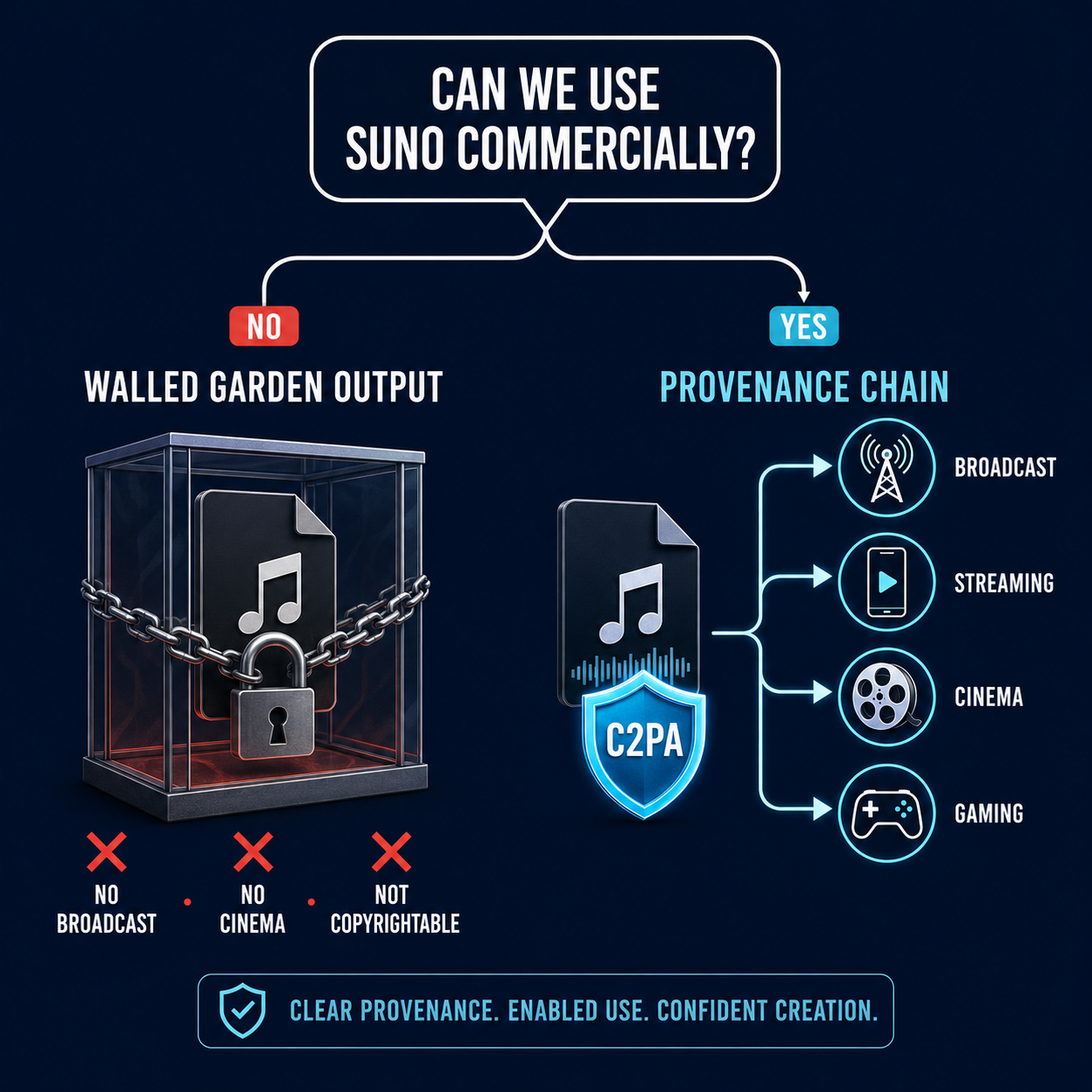
My first question is always what they need to do with the output. If the answer involves distribution outside a single platform — which it almost always does for commercial production — the walled-garden constraint makes the license agreement irrelevant to their actual workflow. You can't build a national ad campaign on an asset you can't export without restrictions.
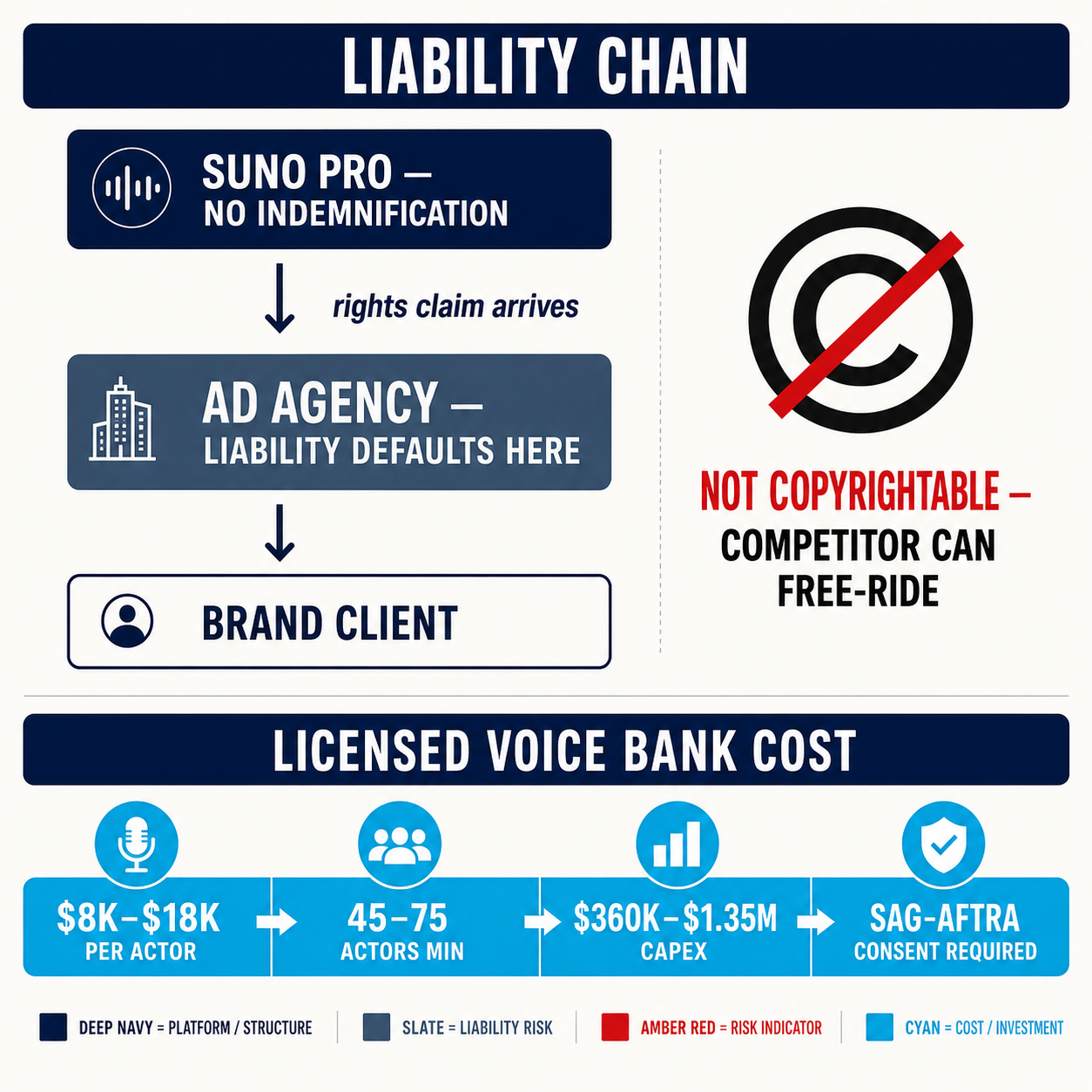
The copyright problem runs right underneath this. The US Copyright Office's January 2025 position is that prompt-only outputs are not copyrightable. A licensed Suno jingle can't be claimed by a rights holder who objects to it — but it can't be claimed by the brand that commissioned it either. A competitor can sample it and re-release it. I've had to walk marketing directors through this more than once when they assumed "licensed platform" meant "your brand owns the output." The work we do at AI Audio Licensing, Watermarking & Provenance for Media is built around this gap — not just the compliance deadline, but the ownership architecture that makes an AI-generated asset commercially durable.
The Watermark Test That Changed How I Make Recommendations
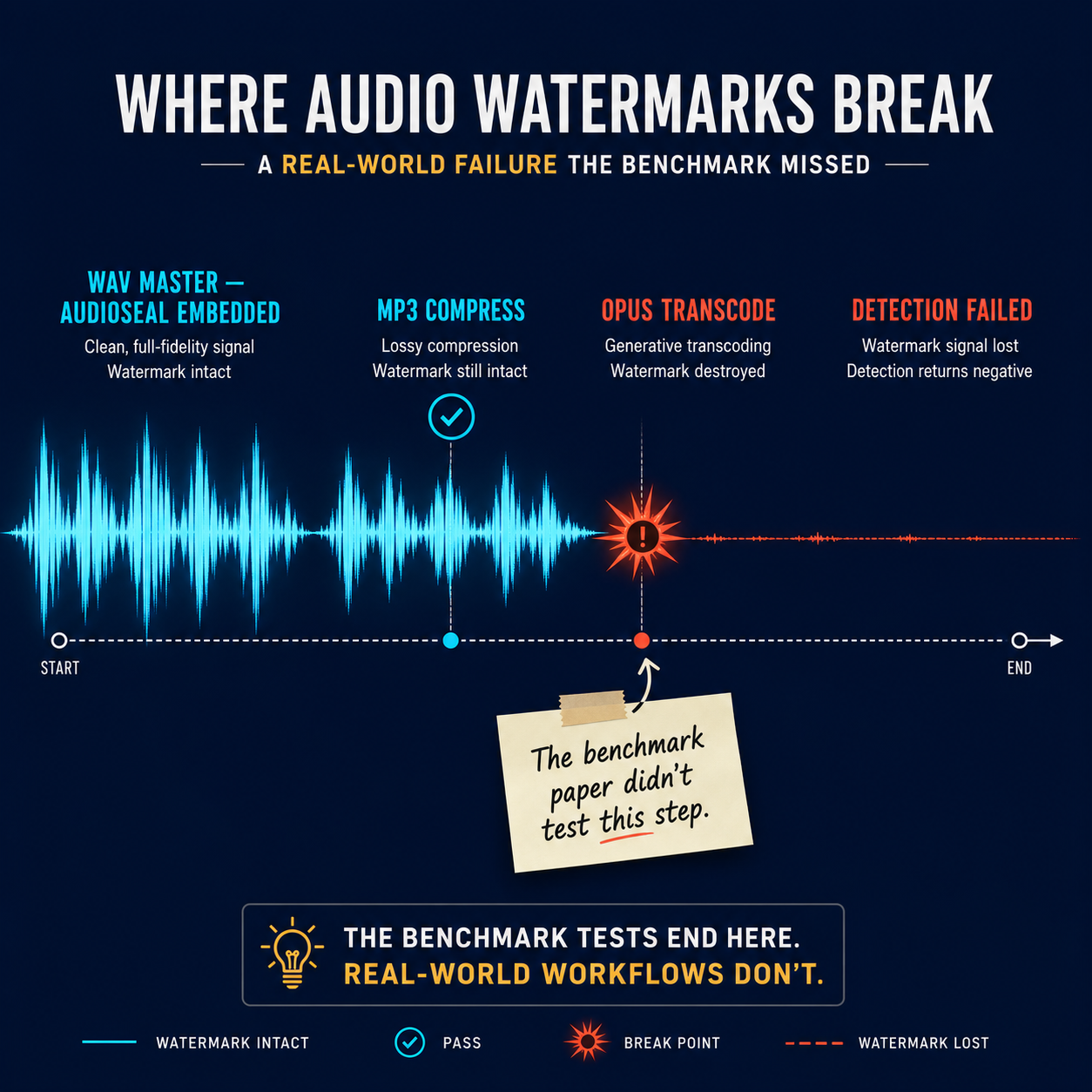
Our practice is to test any watermark stack against the client's actual ingest chain before we make architectural recommendations. On a client project, I was evaluating AudioSeal for a label with a standard label → aggregator → DSP distribution pipeline. AudioSeal's research numbers are good: survives MP3 compression, handles analog-gap capture, supports streaming. All of that held in our initial tests at WAV and MP3 bitrates.
What didn't hold was Opus. The DSP transcodes to Opus for mobile delivery, which is increasingly standard. When I ran the detection pass after the Opus transcode, the confidence scores had collapsed.
This is the ICML 2025 research played out on a real pipeline. XAttnMark (Liu et al.) maintains 91–94% detection after Stable Audio generative re-edits — significantly better than AudioSeal's 15% under waveform HSJA adversarial attacks — but XAttnMark has no commercial support and no integration tooling. The most robust option in the research literature isn't deployable without building all the infrastructure yourself. Google SynthID-Audio's robustness numbers are strong — over 10 billion assets watermarked since the November 2025 rollout — but detection only works on Google-generated content; if your pipeline doesn't route through Lyria or NotebookLM, it provides no Article 50 coverage.
What I came away from that project with is a rule I now state explicitly to every client at the start of an engagement: watermark selection is a pipeline test, not a procurement decision. The paper results and the production results are measuring different things.
The Schema Gap Nobody Mentioned in the Briefings
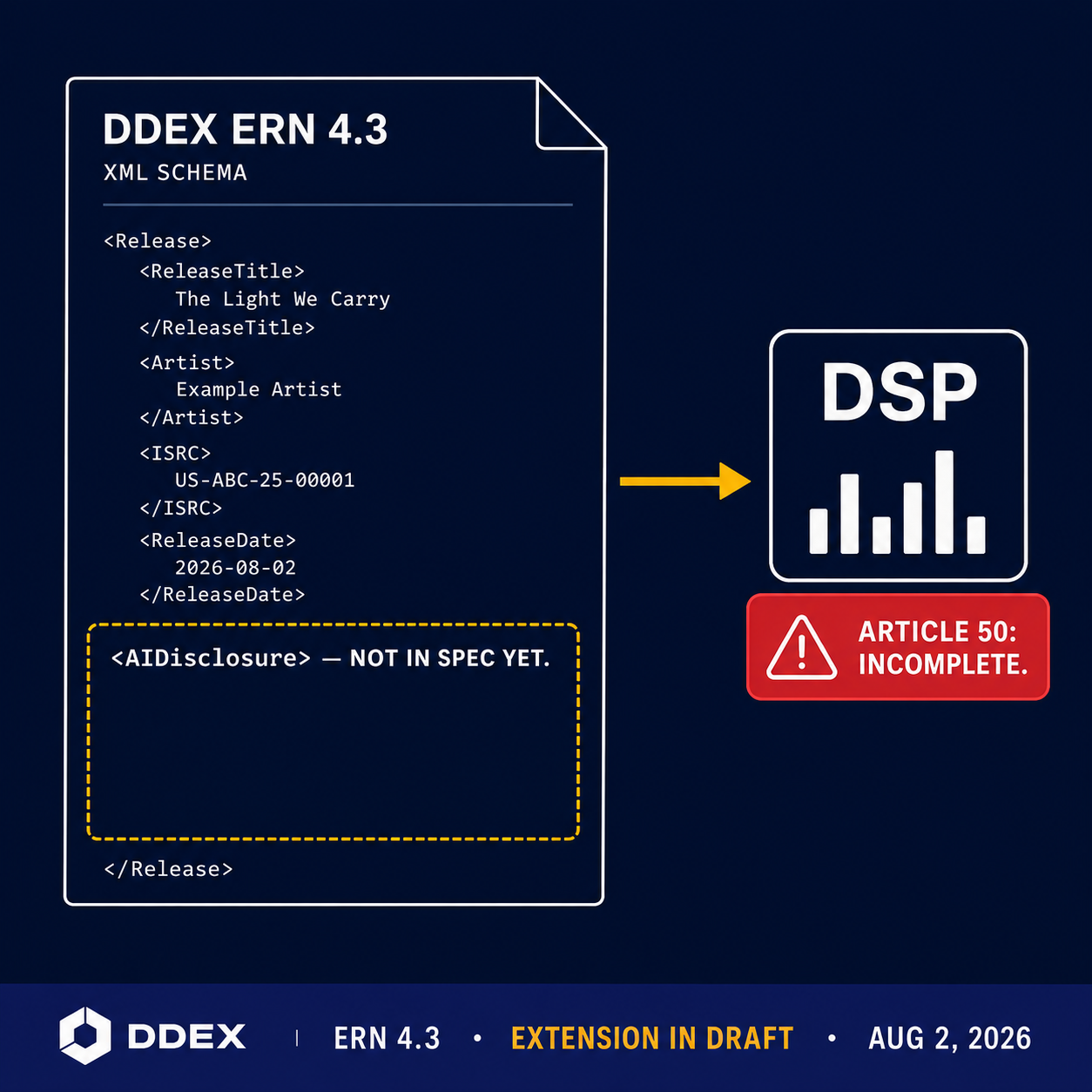
Midway through a label distribution project, I was working on the DDEX ERN delivery workflow for a client with several hundred AI-involved releases in distribution. The Spotify September 2025 AI disclosure policy requires labels to submit AI disclosure fields through their aggregator. EU AI Act Article 50, effective August 2, 2026, extends this to a statutory requirement for machine-readable disclosure from providers and deployers across EU-accessible content.
I pulled up DDEX ERN 4.3 — the delivery format used by CD Baby, DistroKid, and most major aggregators — and looked for the AI disclosure fields. They don't exist in the current spec. The extension adding them is still in draft.
When I followed up with the aggregator, the answer was that support would come when the extension was finalized — no date given. For a label with hundreds of AI-involved releases distributed into EU markets, that answer means building custom middleware to inject disclosure fields before aggregator submission. Not because of a principled architectural choice, but because the schema update and the Article 50 deadline are moving at different speeds. The penalties under Article 99 are up to EUR 15 million or 3% of global annual turnover for Article 50 violations. A label and its DSP can each face exposure in a regulatory audit when the disclosure chain is broken.
The aggregator's answer is not your compliance timeline. If the DDEX extension isn't finalized before August 2, you are building the middleware yourself — on a deadline nobody else is holding for you.
I think about this every time I hear someone say they'll wait for the aggregators to sort it out.
The Call Where We Read the Commercial ToS Together
I got a call from a GC at an ad agency after her creative team had started using Suno Pro for jingle production on a mid-sized national campaign. She had heard there were indemnification issues and wanted to understand the exposure before the first spots went to air.
We pulled up the Suno Pro commercial license terms together. The indemnification position is stated directly: Pro and Premier commercial plans do not include indemnification. The 4A's MSA guidance now recommends negotiating AI-specific indemnity clauses into client contracts, but most active agreements predate AI music production and haven't been renegotiated. Her question — whether this was typical or unusual for AI tool providers — got the harder answer: it's typical, and the liability for a rights claim on a national campaign defaults to the agency in the absence of explicit indemnification from the tool provider.
The legislative perimeter is one part of this I've had to map in detail. The bipartisan NO FAKES Act (S.1367 / H.R.2794) would create a federal property right in digital replicas of voice and likeness — notice-and-takedown for platforms hosting user-uploaded content. Tennessee's ELVIS Act already makes unauthorized AI voice cloning criminal, effective July 2024. California AB 2602 codifies performer voice contract protections. I track these because the agencies I work with are normalizing production workflows that each of these statutes is designed to reach.
For agencies doing voice transformation work — dubbing, radio imaging, podcast localization — I find the voice bank economics are almost always underestimated. Commissioned recordings run $8K–$18K per actor for 45 minutes of clean material; minimum viable coverage across age, gender, and accent dimensions takes 45–75 actors. SAG-AFTRA 2023 strike terms require explicit consent and separate compensation for any commercial AI voice replica use. The economics force narrow, per-use-case libraries with documented opt-in chains, not general-purpose banks assembled from open-source weights.
The chain-of-title documentation work — voice buy-out contracts, C2PA stamping at every transformation, human creative decisions recorded — is what makes an AI-generated asset commercially durable. It's the same underlying architecture as Article 50 compliance. The two problems share a solution.
The Coexistence Question That Isn't Benchmarked Yet
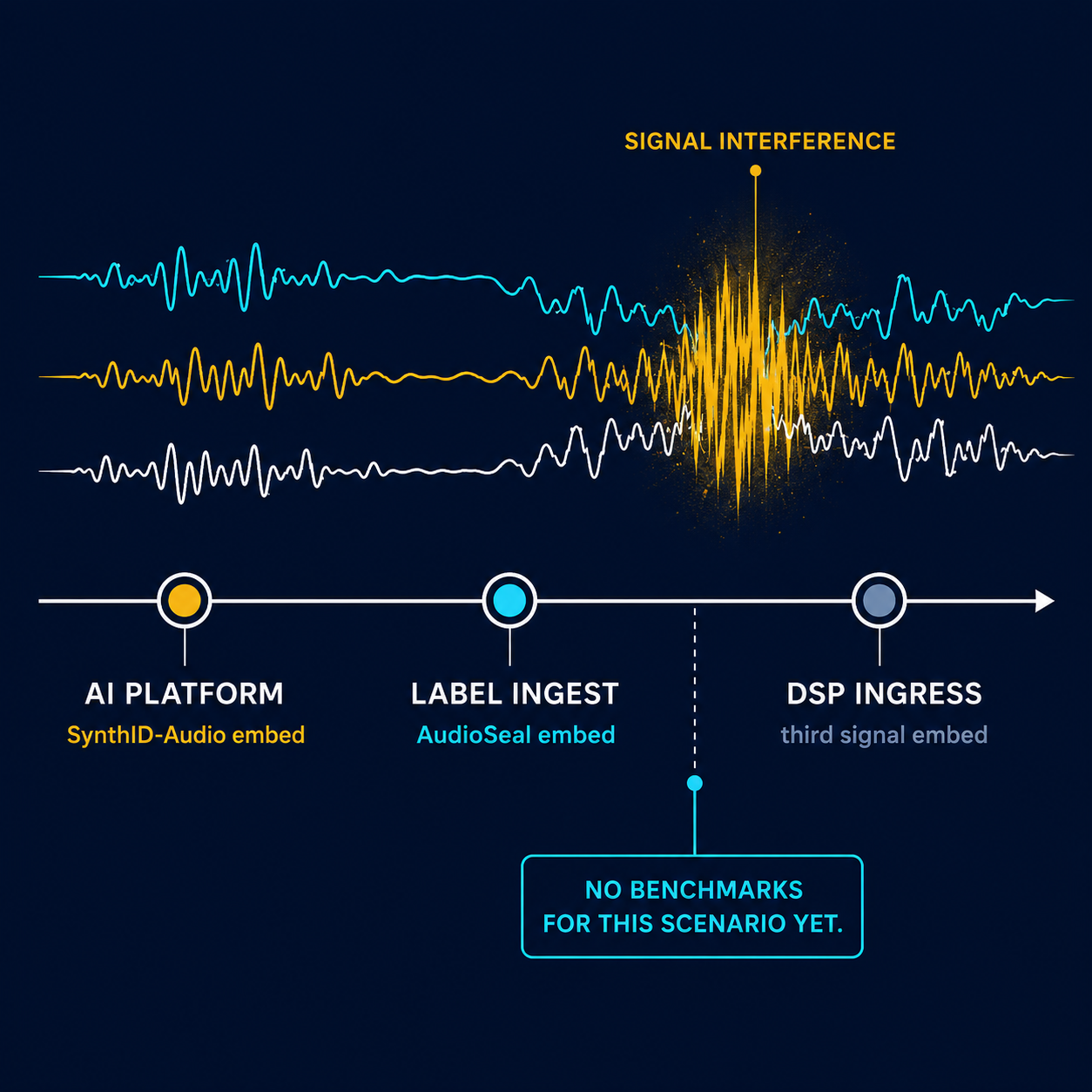
My own open question right now: multi-watermark interference. A licensed platform embeds SynthID-Audio at generation. Our client's ingest pipeline adds AudioSeal. The DSP adds a third signal at ingress. Signal-to-noise degradation from later embeds can reduce detection reliability on earlier ones. I've looked for published benchmarking on this coexistence scenario in production pipelines and found none. What exists are single-system benchmarks.
The implication for any client building toward August 2 is that the architecture decision — which watermark signals are authoritative at which pipeline stage, and in what order — has to be made, documented, and defensible before the deadline. You can't assume two watermarks coexist cleanly without testing. And right now you're designing your own experiment.
The first Article 50 regulatory audit that generates public findings will almost certainly surface coexistence failure modes that nobody is benchmarking today.
I find this genuinely interesting — not just as a compliance problem but as a signal that the gap between watermarking research and production deployment is wider than either side is acknowledging.
What I'm Actually Building Toward in the Next Four Months
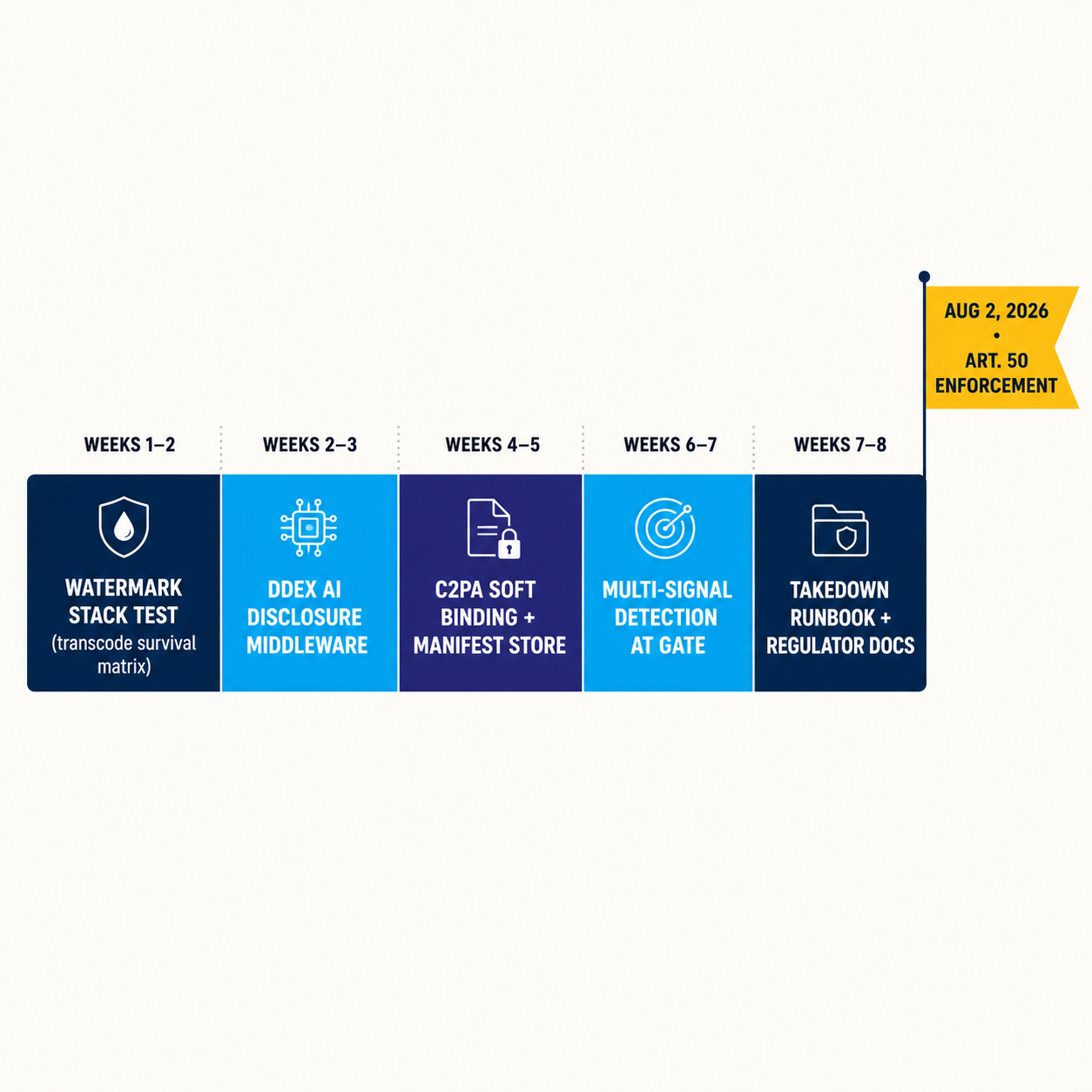
I'm building toward August 2 with clients right now, and the practical picture looks like this: watermark survival testing against the actual transcode chain, DDEX middleware for AI disclosure field injection before aggregator submission, C2PA soft binding with a manifest store, multi-signal detection at the distribution gate, a takedown runbook with named owners, documentation ready for a regulator inquiry. Eight weeks if you scope it right from the start. Twelve for a more defensible architecture. Starting in July doesn't leave enough room.
The full architecture is at AI Audio Licensing, Watermarking & Provenance for Media. If you're in the middle of any part of this — the DDEX middleware, the watermark survival matrix, the indemnification gap, the coexistence design question — I'd like to hear where your specific build is. The reference architectures being assembled right now are what compliant audio provenance will look like for the next several years.
The settlement era ended. The building era started. Those are different problems, and one of them doesn't have a licensing agreement to hide behind.