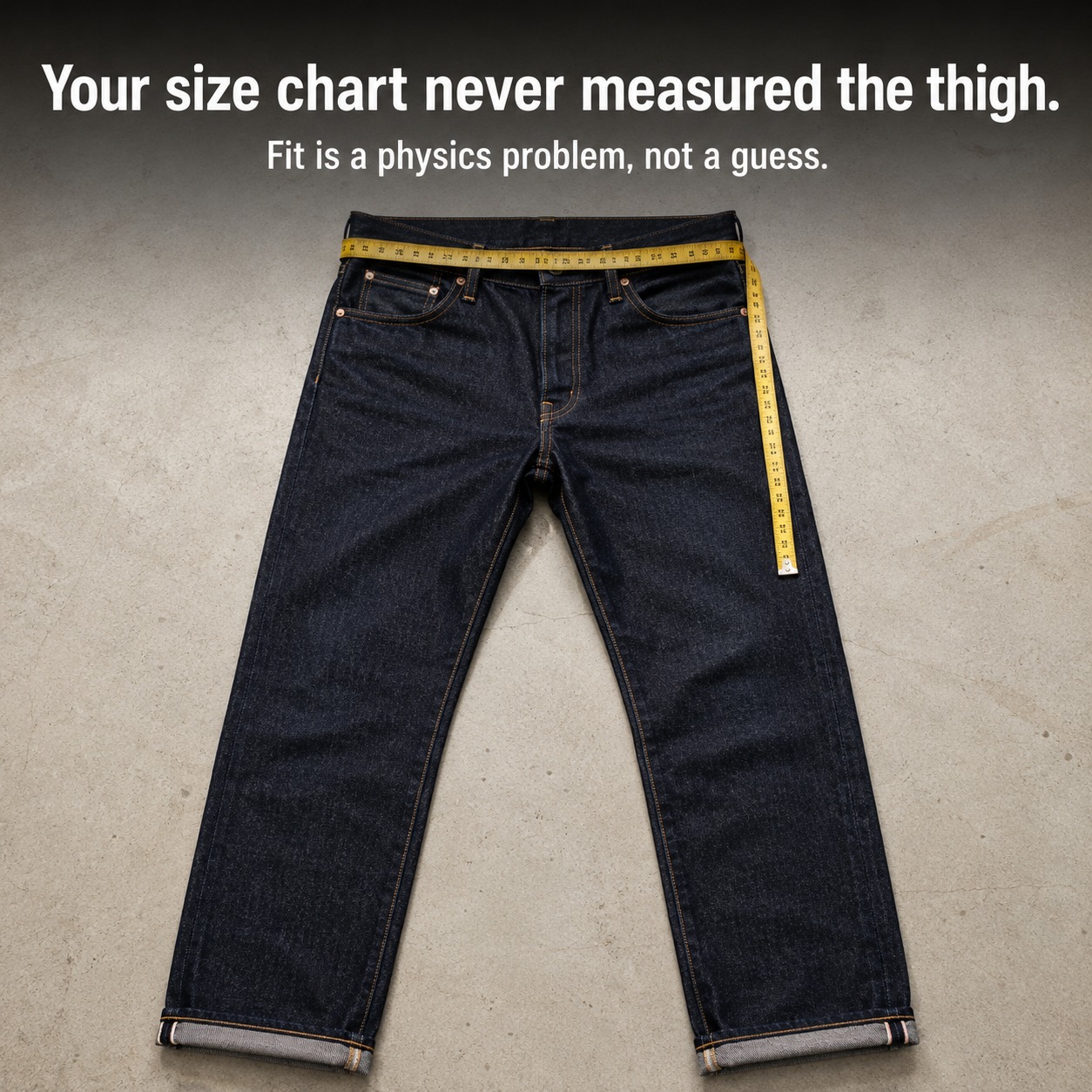
A women's size 6 waistline can vary by up to 5 inches across brands. 91% of shoppers already need a different size in every brand they buy. No wonder 53–70% of apparel returns come down to one thing: the garment didn't fit.
Here's the part most fashion e-commerce teams miss: fit isn't a visual problem. It's a physics problem.
Generative AI virtual try-on — the kind rolling out across Google Shopping and Zalando — creates a photorealistic image of a garment on a shopper's body. It looks convincing. But it's predicting likely pixels. It can't tell that 14oz raw selvedge denim has zero stretch, or that a hip is 2cm too narrow for how the fabric behaves when you sit down. The size chart never even measured the thigh — so the shopper had no way to know. The image flatters. The jeans still get returned.
A physics-based approach simulates the actual interaction: the fabric's bending rigidity, tensile stiffness, and shear, draped onto a 3D body mesh, with strain calculated at every point. High strain at the thigh means a tight fit. It's a calculation, not a guess.
That matters because the costs are brutal. U.S. retail returns hit $849.9B in 2025, processing can eat up to 66% of an item's price, and 63% of shoppers now "bracket" — ordering multiple sizes to send most back.
The fix isn't a single tool. We match the approach to the catalog: high-SKU ranges need statistical size recommendation, fit-sensitive categories need body-measurement pipelines, and brands with 3D design workflows can run true physics simulation. Done right, AI sizing cuts returns 25–50% in the first year — and it can stay privacy-first, with on-device measurement that keeps biometric data (GDPR special-category, BIPA-regulated) off your servers.
Save this if you're scoping a fit-prediction roadmap for 2026.
What's your highest-return category right now — denim, outerwear, something else?
#FashionTech #FashionEcommerce #AIFitPrediction #RetailReturns #FashionAI