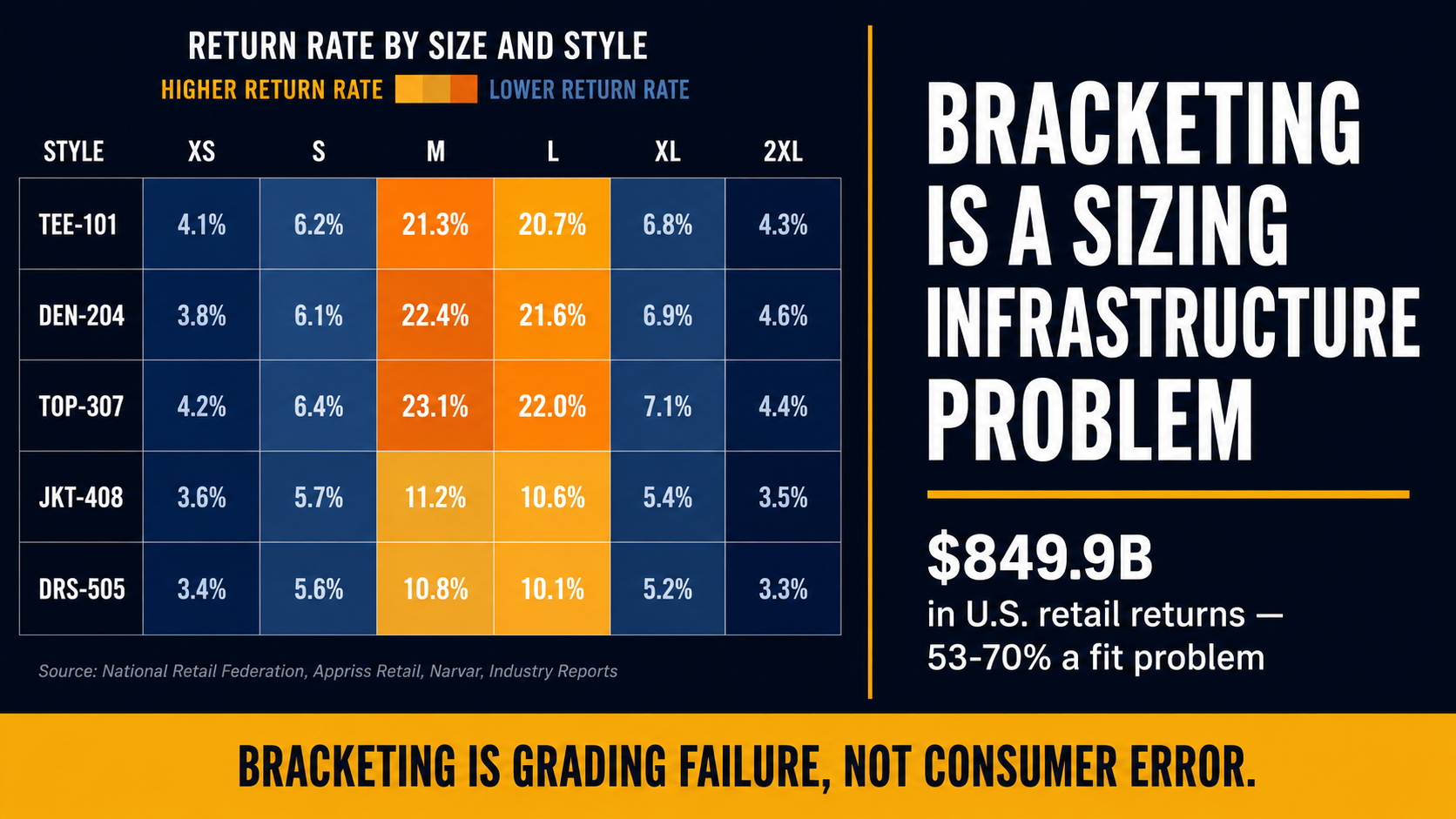
Fashion e-commerce spent 2025 running experiments in fit prediction. The macro numbers held steady: $849.9B in U.S. retail returns, 53-70% of apparel returns traceable to fit, a market of vendors offering to solve it. What hasn't held steady is the return-rate math after implementation. Some brands deploying AI sizing tools achieved the 25-50% return rate reductions the category promises. Others saw modest improvement and expensive integration debt. The difference, from our vantage point working on AI fit prediction architecture for fashion e-commerce, was almost never the vendor. It was the state of the brand's own sizing data before the vendor arrived.
Bracketing Is a Diagnostic, Not a Behavior
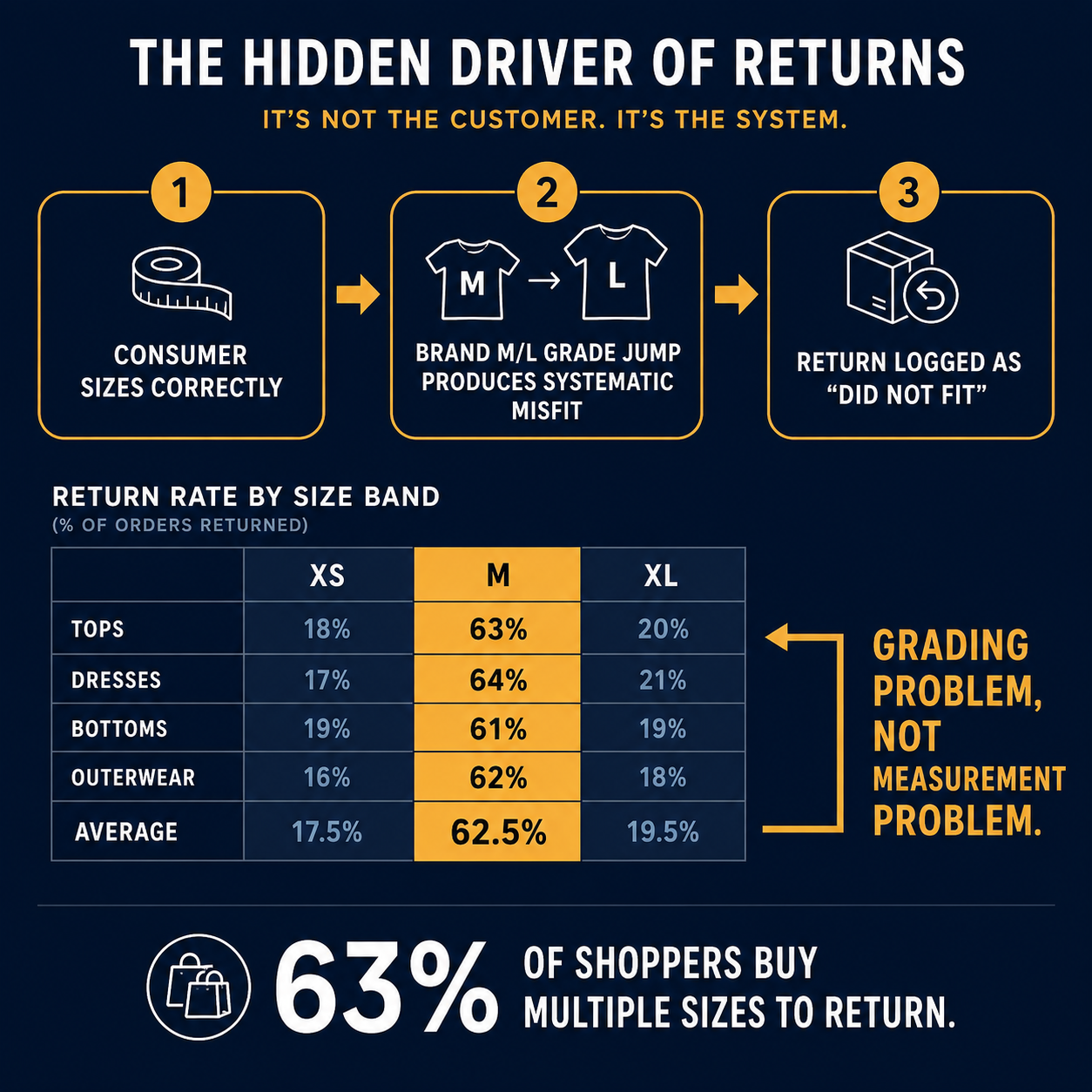
When 63% of online shoppers buy multiple sizes intending to return most of them — and when 51% of Gen Z shoppers bracket regularly — the instinct is to treat it as a consumer experience design problem: better photos, fit quizzes, improved size guides. These are fine interventions. None of them addresses what bracketing is actually signaling.
Bracketing is what shoppers do when they don't trust the size label. Size labels lose trust when the brand's own size grading is inconsistent across SKUs.
A returns-disposition spreadsheet from a 3PL warehouse tells a version of this story that a size guide never can. When the same style number clusters in the return queue in medium and large but almost never in extra-large, the problem isn't that consumers are measuring themselves wrong. The problem is that the medium-to-large grade jump in that style is off by enough to produce systematic misfit. Sizing variance across a brand's own catalogue — not consumer measurement error — is the structural driver of the bracketing cycle.
This is what we mean when we say fit prediction is a sizing infrastructure problem. AI can recommend the right size from a vendor's training data or from a shopper's measurements. It cannot compensate for a brand's size grading being internally inconsistent.
What the Vendor Landscape Is Actually Showing
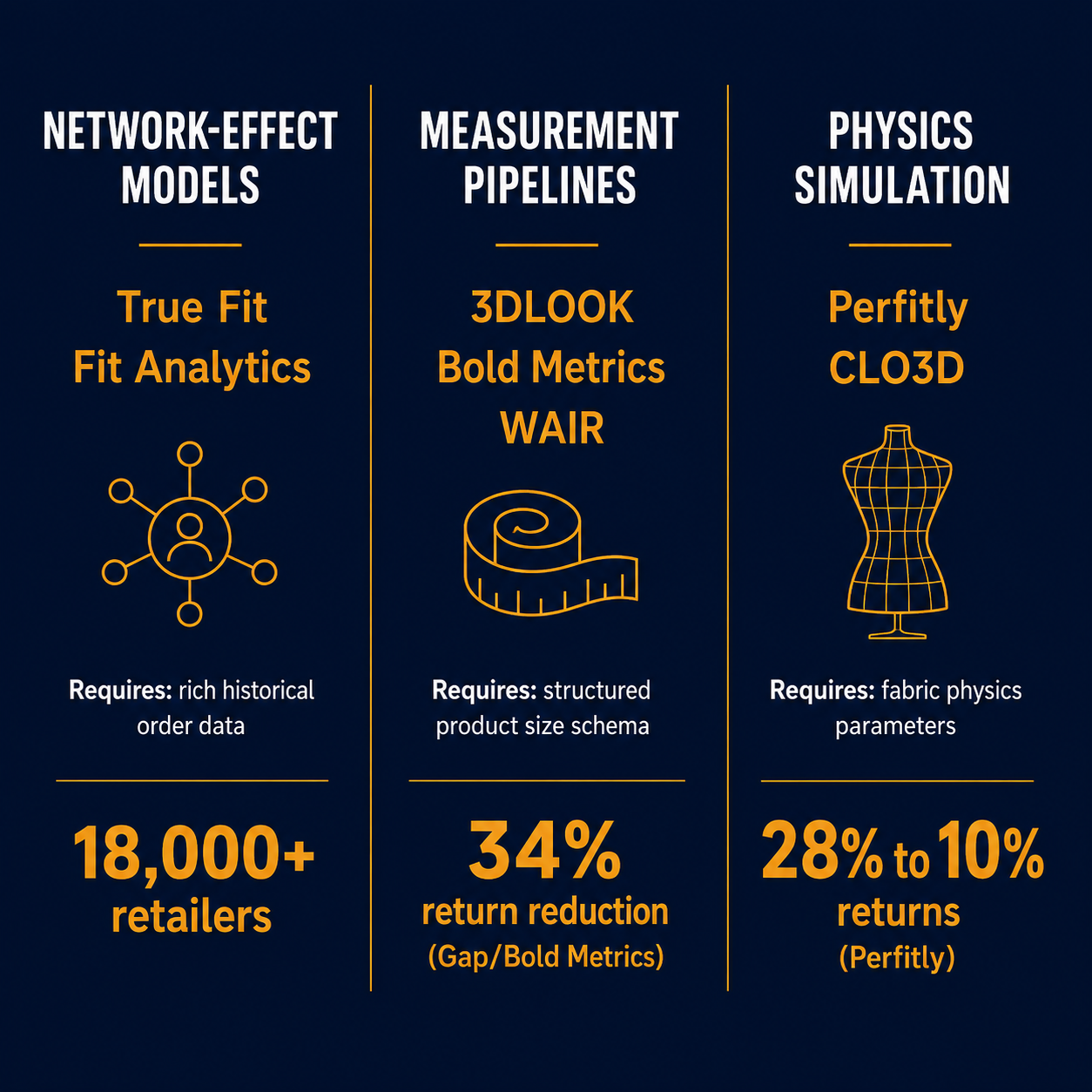
The fit prediction market that grew to $1.3B in 2025 (en route to a projected $2.95B by 2029, per GlobeNewsWire) has produced three recognizably different approaches, and they're not interchangeable.
True Fit and Snap/Fit Analytics built on the hypothesis that enough return data, accumulated across enough brands, would teach a model what fit means for each shopper. True Fit's training corpus now spans 20 years of data, $616B in transactions, and 91,000+ brand relationships. In March 2026, they launched an Agentic AI shopping agent built on Model Context Protocol (MCP), exposing fit intelligence to AI agents at checkout. Snap's 2021 acquisition of Fit Analytics ($124.4M) extended the same data network to 18,000+ retailers. For brands with substantial order histories and a clean data link to the network's anonymized return corpus, these tools work well. For newer brands or niche categories, the cold-start problem is real and vendor sales materials don't flag it.
A different branch starts fresh from the shopper's body rather than from historical data. 3DLOOK extracts 86 measurement points from two photos, reporting 6% fewer returns and 4x conversion uplift in partner deployments. Bold Metrics generates 50+ body measurements per shopper; their 2026 partnership with Gap Inc. produced claims of a 34% average return reduction, alongside a more notable integration: Gap is planning checkout within Google Gemini using Bold Metrics sizing data. Shopify-native tools like WAIR — deployed across 264 stores — report 12.5% higher conversion and 19.4% fewer returns without enterprise integration overhead.
These measurement pipelines share a common limitation: recommendation quality is capped by the brand's product size data. A Shopify product-variant mapping JSON that shows a size_guide_url where a fit_api_endpoint should appear is often where the integration bogs down. The API schema diff between vendor inputs and the product catalog is the engineering problem the vendor RFP process rarely surfaces.
The approach getting the most serious results for high-return, fit-complex categories is physics-based simulation. For denim — where a women's size 6 waistline can vary by up to 5 inches across brands and 91% of consumers report needing different sizes across different brands — pure measurement matching doesn't account for fabric stretch, rise behavior, and drape. Perfitly builds a 3D avatar from five measurements and runs garment physics through it; a partner brand (Otero Menswear) saw return rates drop from 28% to approximately 10%. Zalando's virtual try-on pilot with Levi's across 14 European markets claims up to 40% return reduction in testing. CLO3D, already used by 860+ companies on the design side, released a 2026.0 update moving toward consumer-facing fit visualization.
The Biometric Data Compliance Trap
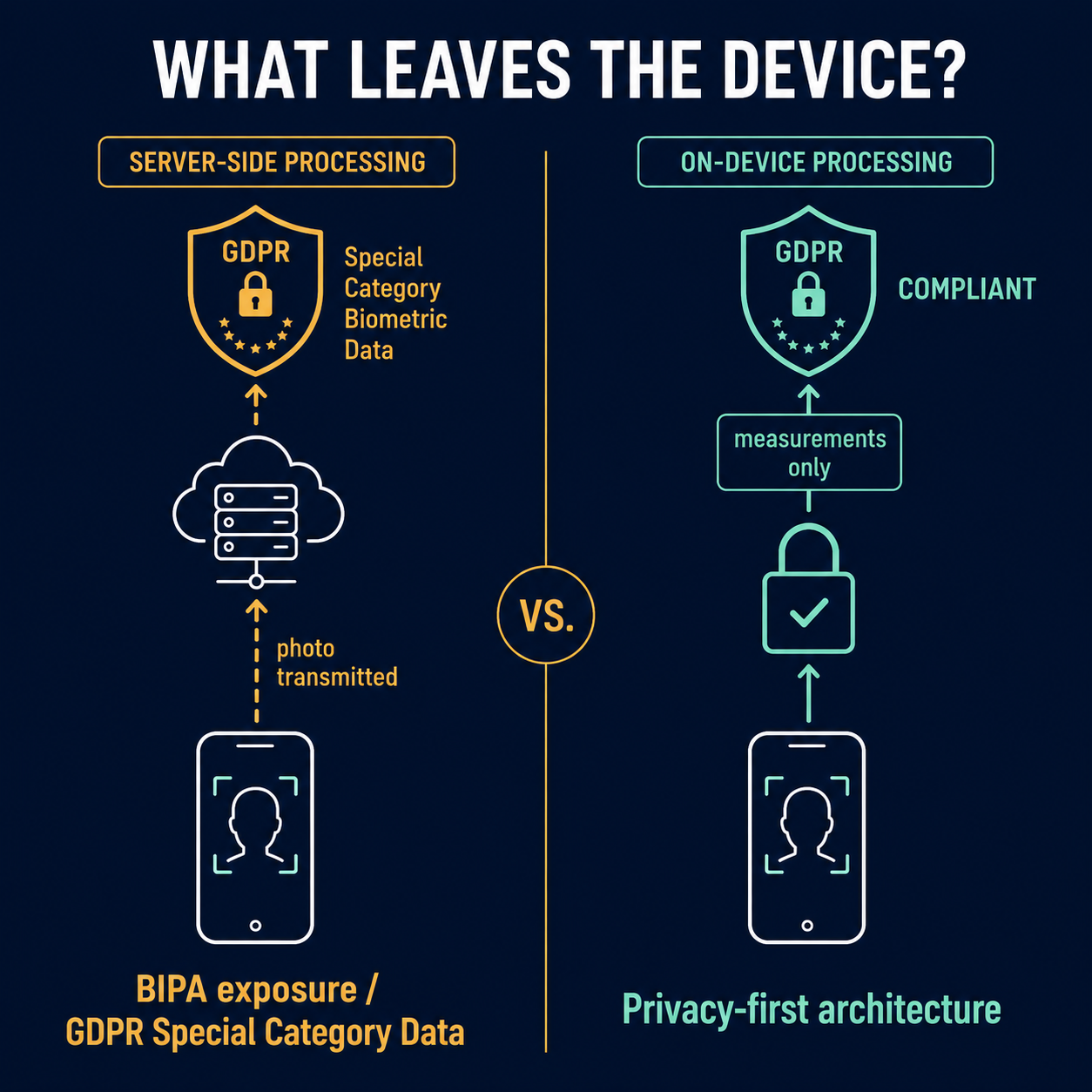
The moment a brand starts collecting photos, video, or 3D scans of shoppers for measurement purposes, it enters a different compliance category than the one its privacy team is used to.
Under GDPR, 3D body scans qualify as "special category" biometric data — the same regulatory tier as health records — requiring explicit consent, purpose limitation, and strict data minimization. In Illinois, BIPA (Biometric Information Privacy Act) imposes collection, storage, and disclosure requirements that carry per-violation statutory damages. Multiple U.S. states expanded biometric privacy laws significantly through 2025-2026.
The vendors that handle this carefully almost universally offer on-device processing — inference running on the user's phone, measurements generated locally, no body data transmitted to or retained on external servers.
On-device processing eliminates the consent-management infrastructure a brand would otherwise need to build and audit. It's the difference between adding a BIPA opt-in consent modal with biometric retention schedule disclosure to every checkout flow — and not having biometric data as a compliance object at all. Our evaluation framework for any vendor collecting body measurements starts with that question: what leaves the device?
The Build-vs-Buy Decision
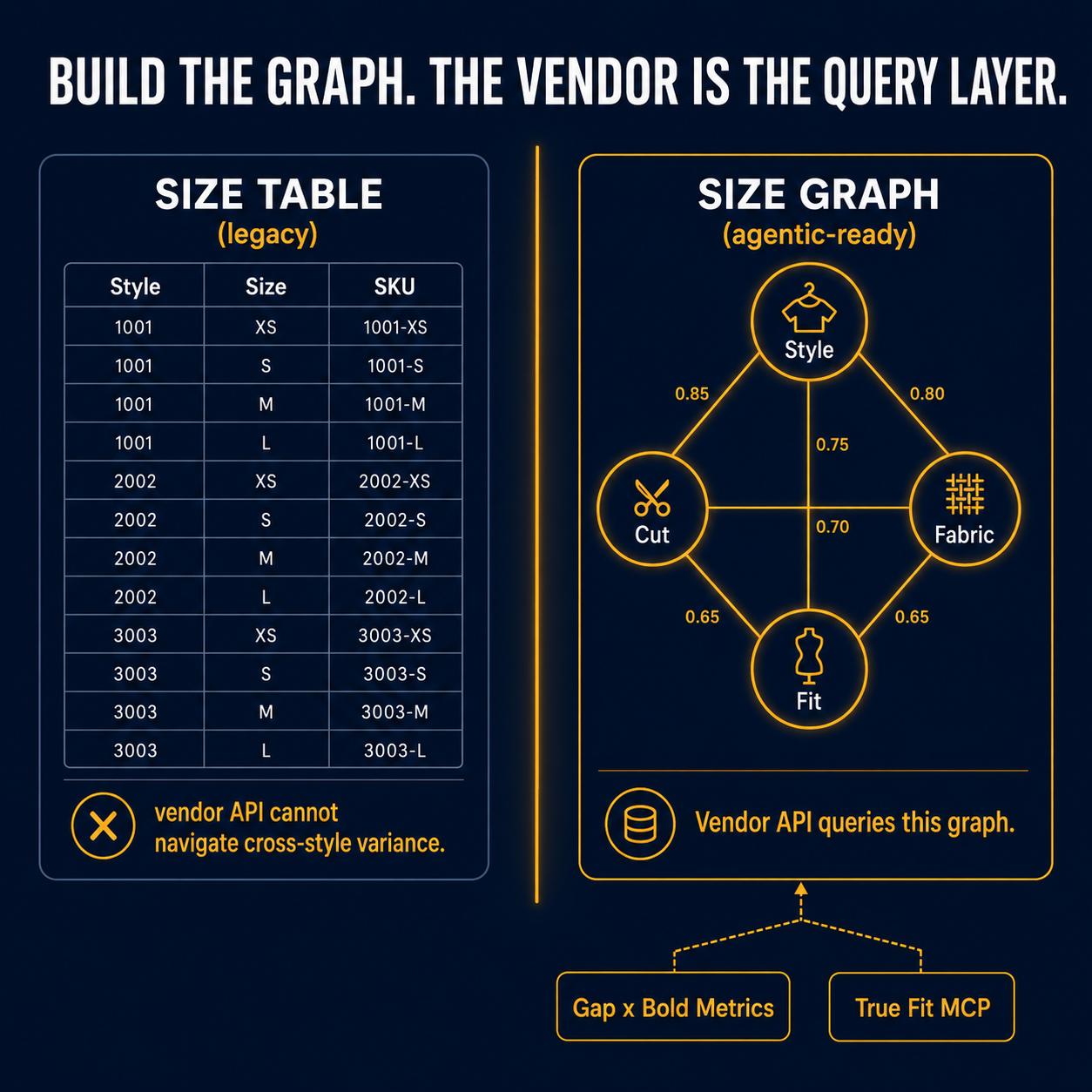
Most fit prediction APIs accept measurements in and return a recommended size out. What the documentation tends to understate is that the returned size is only as specific as the brand's product size data allows. A catalog that doesn't distinguish between a regular and a tall cut at size medium will produce recommendations that default in ways that generate returns.
The brands making agentic sizing work — Gap's Gemini integration, True Fit's MCP-based Fit Intelligence layer — have treated their product size data as a graph, not a table. Styles, cuts, fabrics, and fits as nodes; size recommendations as edges with weights derived from return and exchange data. That structure is the durable asset. The vendor is the query layer on top of it.
For brands that don't have that structure yet, the practical path is an instrumented A/B test: a fit-prediction variant against a size-guide control, with 30-day return delta by category as the primary metric. The returns heatmap by SKU × size band that emerges is more informative than any vendor demo. It tells you whether you're looking at a measurement problem — where a sizing API helps — or a grading problem, where no vendor can help until the product data is fixed.
What the Heatmap Actually Tells You
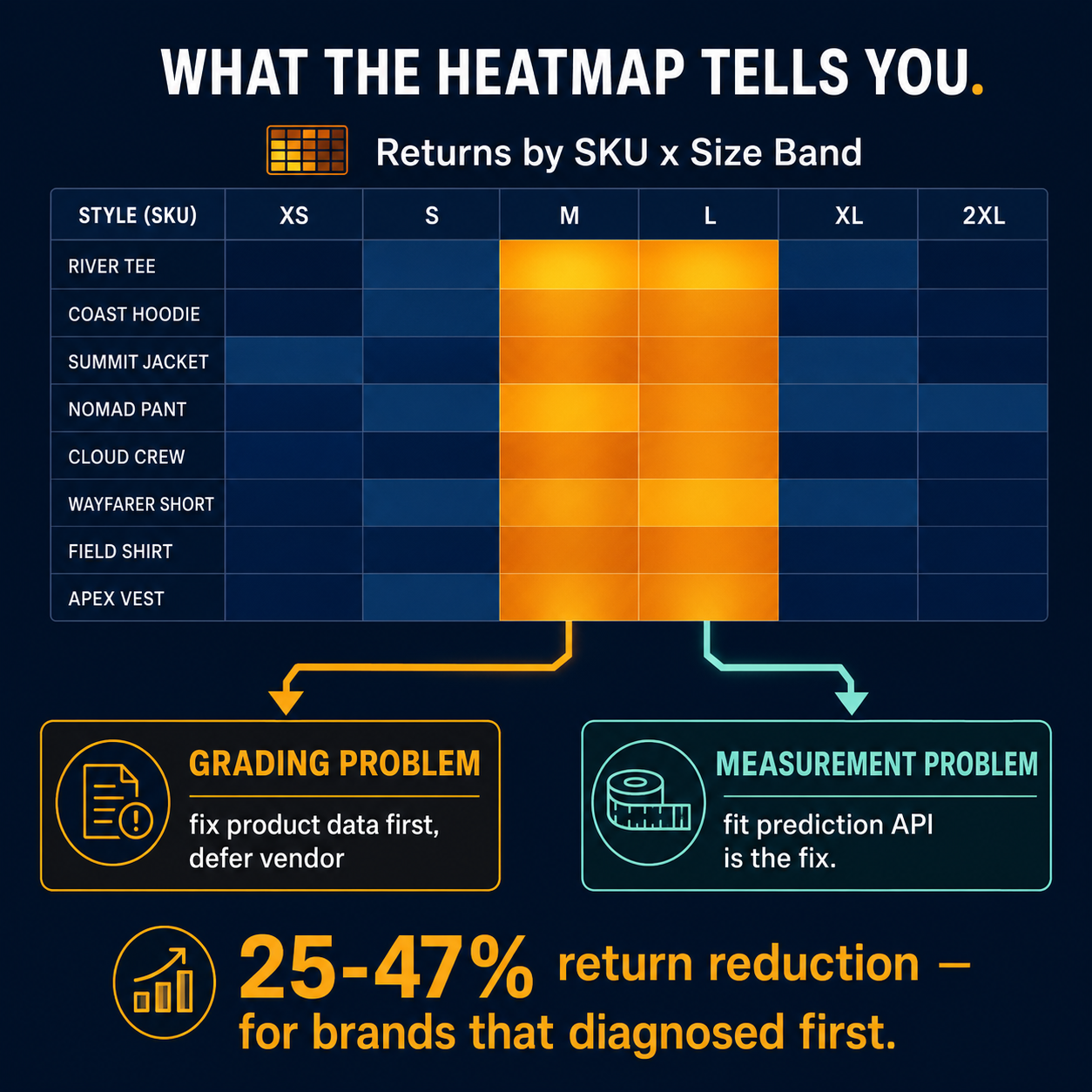
The question the vendor ecosystem has an incentive not to ask is the one worth asking first: what is your returns heatmap telling you about your own size grading?
A returns heatmap by SKU × size band doesn't just quantify the scale of the return problem — it distinguishes between measurement ambiguity and pattern failure. Measurement ambiguity is what a fit prediction API is built to solve. Pattern failure — a specific style or grade systematically producing misfit — requires fixing the product data before any AI layer can help.
The fashion brands that achieved 25-47% return rate reductions started with that diagnostic. They went into vendor evaluations knowing which SKUs were broken and what category of problem they were solving. The ones that skipped it got vendor solutions applied to data problems.
For teams starting that diagnostic — mapping the heatmap, auditing the grade structure, running the first vendor comparison — we've documented what those engagements look like in the AI fit prediction practice at Veriprajna. What signals are you seeing in your returns data? The architecture that works tends to look different depending on whether the root cause sits in the consumer-measurement layer, the brand-data layer, or somewhere in between.