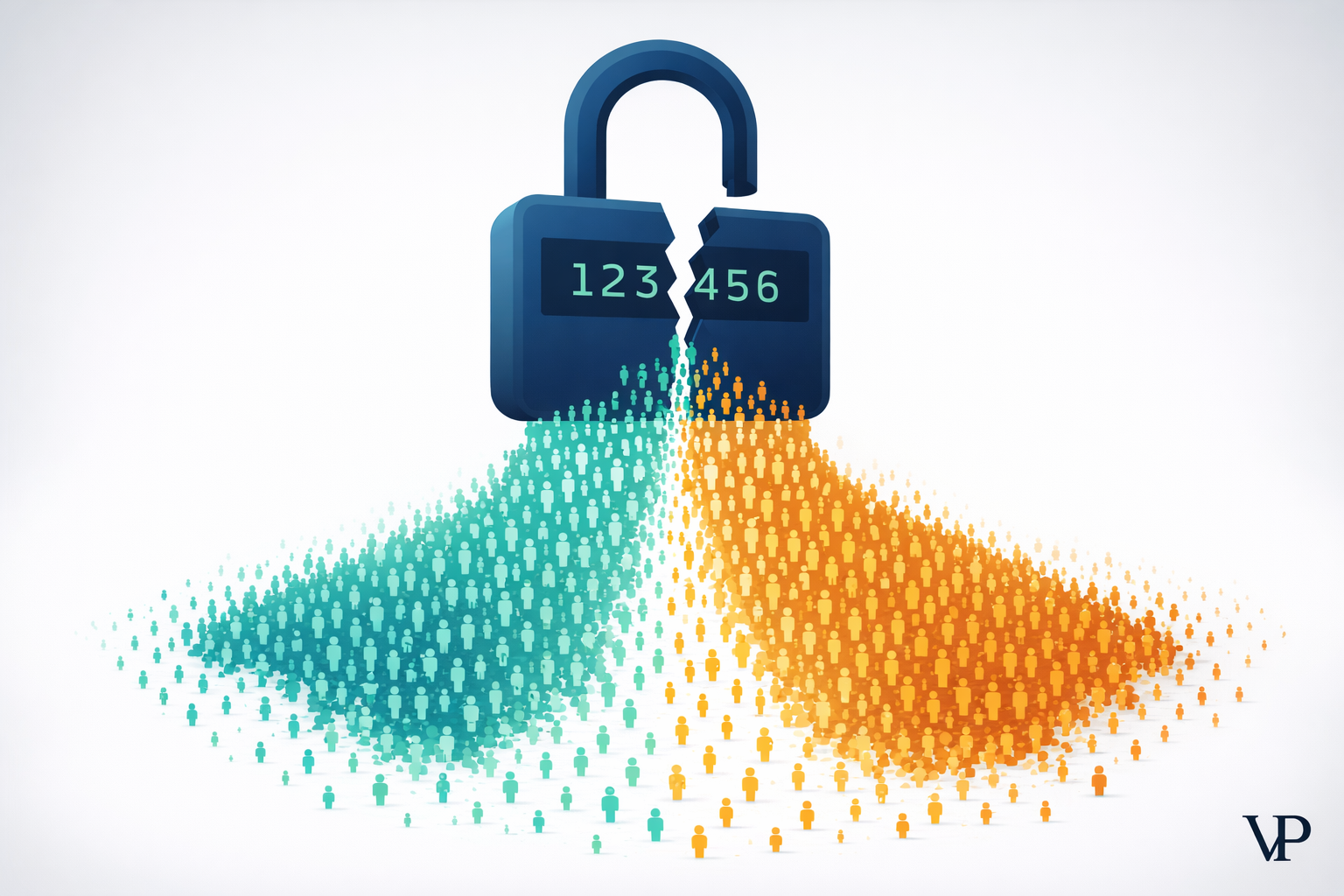
The password protecting 64 million job applicants' personal data — their names, phone numbers, personality test results, and AI interview transcripts — was "123456." Not a sophisticated exploit. Not a nation-state attack. Six digits that a child might use to lock a bicycle.
In June 2025, security researchers cracked open the McHire platform, an AI-powered hiring system used by McDonald's and built by the vendor Paradox.ai. What they found behind that password was a masterclass in how not to deploy enterprise AI — and a warning that applies to every organization trusting third-party AI with sensitive data. The breach didn't happen because the AI was flawed. It happened because the infrastructure around the AI was treated as an afterthought.
Our team spent weeks analyzing this incident, not because password hygiene is novel, but because of what the breach exposes about a much deeper problem: the way most enterprises deploy AI today is structurally indefensible.
What Actually Happened at McHire
The breach unfolded in two embarrassingly simple stages.
Researchers Ian Carroll and Sam Curry started investigating after noticing widespread complaints about "Olivia," the Paradox.ai chatbot that serves as the front door for McDonald's hiring. Buggy user interfaces, they reasoned, often signal deeper architectural neglect. They were right.
First, they found a management portal intended for Paradox employees. A test restaurant account — active but unmonitored since 2019 — was secured with "123456" as both username and password. No multi-factor authentication. No credential rotation. A six-year-old admin account sitting wide open.
Second, once inside, they discovered the platform's API didn't properly check whether a logged-in user was authorized to view a specific applicant's data. By simply changing the applicant ID number in the browser's address bar, they could scroll through the full records of millions of real candidates — names, emails, phone numbers, IP addresses, chat logs with the AI, and personality assessment scores.
Sixty-four million records, exposed not by a zero-day exploit, but by the digital equivalent of leaving the office door unlocked with a sticky note that says "key under mat."
Paradox patched the vulnerability within hours of being notified. But the damage was done — and the real lesson isn't about one company's mistake. It's about a pattern.
The "Wrapper" Problem: Why Bolting AI Onto Bad Infrastructure Fails
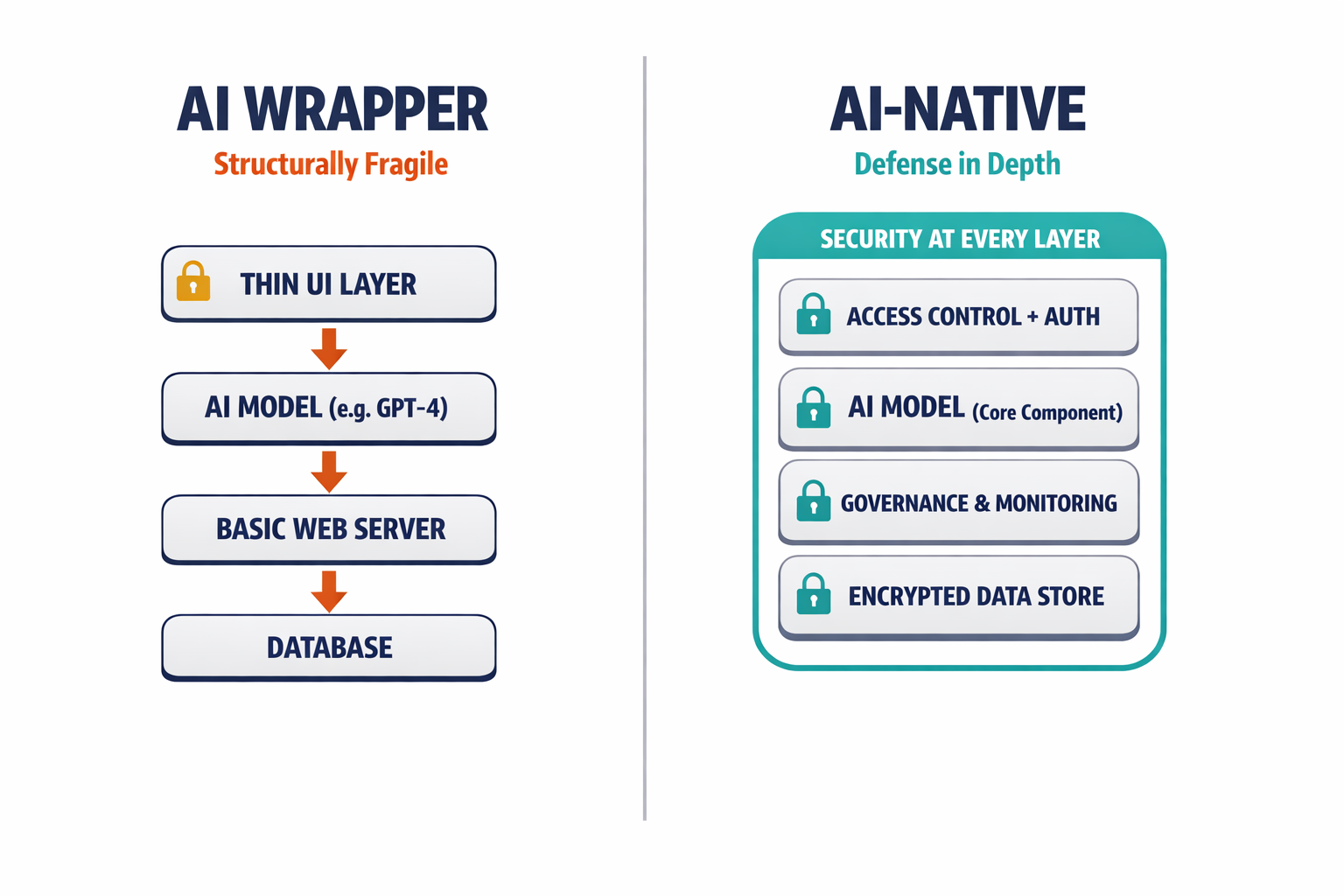
We've been studying a distinction that matters enormously for enterprise AI security: the difference between what we call "AI wrapper" applications and "AI-native" architectures.
A wrapper application is essentially a thin software layer that sends prompts to a foundation model (like GPT-4 or Claude) and displays the response. The AI is the feature; everything else — authentication, data storage, access control — relies on conventional web infrastructure. This is how most AI products ship today. Fast to build. Easy to demo. Structurally fragile.
The McHire platform fits this pattern. The conversational AI worked fine. "Olivia" could chat with applicants, schedule interviews, and run personality assessments. But the systems managing who could access that data, and how, were built with the security posture of a 2015 WordPress site.
An AI-native architecture, by contrast, treats the AI model as a core component of the system — like a database or a message queue — with security, access control, and governance embedded at every layer. It's the difference between bolting a lock onto a screen door and building a vault.
We explored this distinction in depth in our interactive analysis of the McHire breach, including a side-by-side comparison of wrapper versus native architectures across five dimensions.
This Wasn't Just About Passwords — It Was About People
The technical details matter. But the human cost of this breach deserves more attention than it's getting.
Credit card numbers can be canceled. Passwords can be changed. But the McHire breach exposed something that can't be reset: psychometric profiles. Personality test results. Behavioral screening scores. AI-generated assessments of how someone thinks, communicates, and handles stress.
This is data that claims to quantify who a person is on the inside. When it leaks, there's no "new card in 5-7 business days."
Research into the psychological impact of data breaches paints a grim picture. Nearly 70% of victims report lasting difficulty trusting others. Two-thirds experience profound feelings of powerlessness. Studies have linked personal data exposure to anxiety, depression, and PTSD — with 85% of victims reporting sleep disturbances and 77% reporting elevated stress.
When the leaked data includes an AI's assessment of your personality, the harm isn't just privacy loss. It's the feeling that a machine judged you, and now everyone can see the score.
For job seekers — many of them hourly workers applying for entry-level positions — the exposure of "failed" screening results adds a layer of shame to an already vulnerable process. And because psychometric data is persistent (your personality doesn't change like a password), victims can feel retraumatized every time they apply for a new role, wondering whether the leaked profile will follow them.
The Credential Supply Chain You Didn't Know Existed
The "123456" password was the headline. But our analysis uncovered a second, quieter failure that's arguably more alarming.
In late June 2025, a Paradox.ai developer based in Vietnam had their device infected by a malware strain called Nexus Stealer — a password-theft tool sold on cybercrime forums. The infection exfiltrated hundreds of passwords from the developer's machine, many of them reused variations of the same weak base password across multiple internal and client-facing services.
Data leak aggregators reported that this single developer's compromised device exposed credentials associated with Paradox.ai accounts linked to Pepsi, Lockheed Martin, Lowe's, and Aramark.
One developer. One infected laptop. One recycled password. Multiple Fortune 500 companies potentially exposed.
The security of your AI system is only as strong as the weakest password on your vendor's least-monitored employee's personal device.
This is what we call the "human node" problem. Organizations invest millions in firewalls, encryption, and model safety — then hand administrative access to humans who reuse passwords and don't enable multi-factor authentication. The average cost of a data breach in 2025 hit $4.44 million. Yet the most common root cause remains the cheapest to fix.
The Regulatory Hammer Is Coming Down
The McHire breach didn't just expose data. It exposed legal liability on multiple fronts.
Under the California Consumer Privacy Act, businesses face statutory damages of $750 per consumer per incident when unencrypted personal information is stolen due to a failure to maintain "reasonable security procedures." A default password of "123456" is difficult to defend as "reasonable" in any courtroom. Multiply $750 by 64 million records, and the math gets existential.
Under the EU AI Act — which classifies recruitment AI as "high-risk" — companies face fines of up to €35 million or 7% of global turnover for non-compliance with mandatory governance, data quality, and human oversight requirements.
And under GDPR, the penalties reach €20 million or 4% of global turnover, with specific requirements for the right to explanation and the right to human review of automated decisions.
The regulatory message is clear: if you're using AI to make decisions about people's livelihoods, you need governance that matches the stakes. "We trusted our vendor" is not a defense.
Five Layers Between Your AI and a Breach
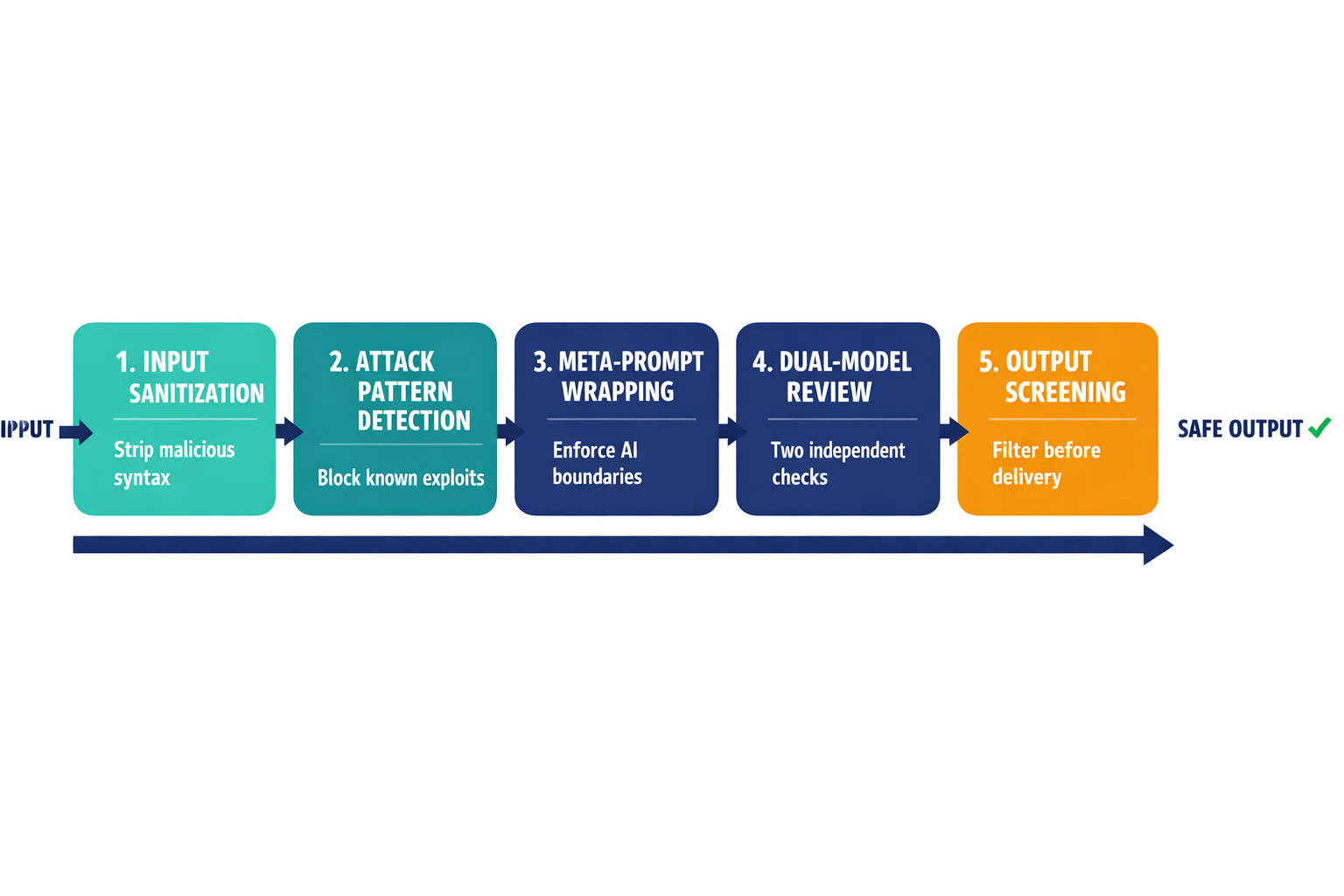
So what does defensible AI security actually look like? Our team advocates for a defense-in-depth approach — five distinct layers, each assuming the one before it might fail.
Clean every input before it reaches the model. Every prompt gets stripped of code-like syntax and formatting that could be misinterpreted as a hidden command. Think of it as a metal detector at the entrance.
Scan for known attack patterns. A detection layer watches for prompt injection signatures, jailbreaking attempts, and other adversarial techniques. Suspicious prompts get blocked before processing — like a bouncer checking IDs.
Wrap every prompt in unbreakable rules. The user's input gets enclosed inside a meta-prompt that reinforces the AI's permissions and boundaries. The model literally cannot see the user's request without also seeing its constraints.
Use a "buddy system" for decisions. A smaller, faster model evaluates each prompt for malicious intent before the primary model processes it. If the first model flags something, a second model makes the final call. Two independent judgments are harder to fool than one.
Treat every output as untrusted. Even after all the input safeguards, the AI's response gets screened for toxic content, hallucinations, and — critically — any personal information that might have leaked into the output. Nothing reaches the user without passing through a final filter.
For the full technical methodology behind this framework, including how each layer maps to OWASP's Top 10 risks for agentic AI, see our detailed research.
"But We Use a Reputable Vendor"
This is the objection we hear most often. And the McHire breach is the perfect rebuttal.
McDonald's is a Fortune 100 company with sophisticated procurement processes. Paradox.ai is a well-funded, widely adopted HR technology vendor. The system wasn't built in a garage. It was deployed at scale across one of the world's largest employers. And it was protected by "123456."
Vendor reputation is not a security control. The question isn't whether your AI vendor is reputable. It's whether you've independently verified their credential management, their API authorization logic, their account decommissioning processes, and their employee device security. If you haven't, you're outsourcing your security posture to someone else's password habits.
A second common objection: "Our AI doesn't handle sensitive data." We'd push back on that, too. If your AI system interacts with customers, employees, or job applicants, it's collecting behavioral data — how people phrase questions, what they ask about, how they respond to prompts. That behavioral data, aggregated and analyzed, becomes a psychometric profile whether you intended it to or not.
What to Do in the Next 90 Days
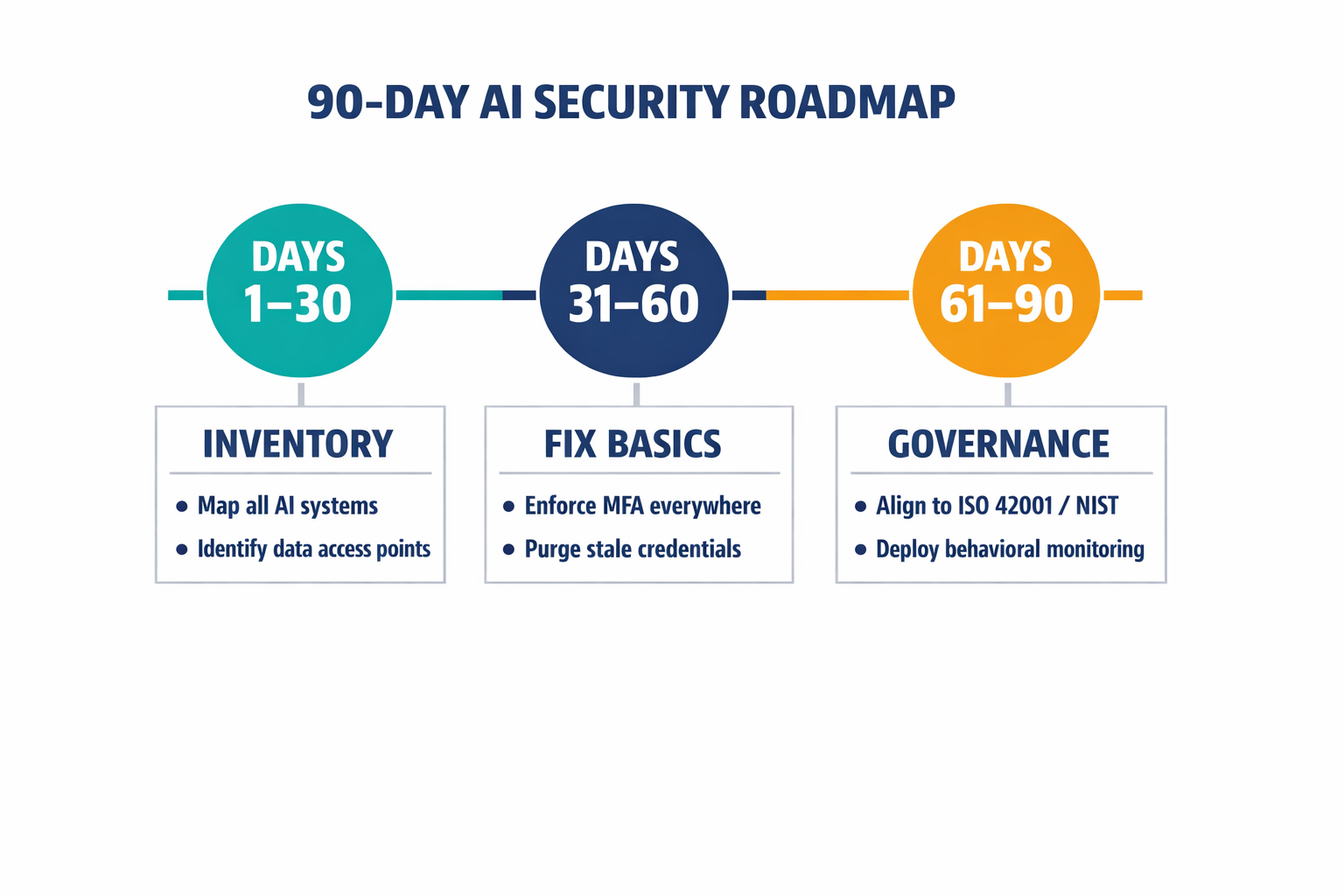
We won't pretend there's a single fix. But based on our analysis, three priorities stand out for any organization deploying AI at scale:
First 30 days: Know what you have. Create a complete inventory of every AI model, application, and third-party dependency in your organization. Map which systems have access to personal data, financial records, or critical tools. You can't secure what you can't see.
Days 31–60: Fix the basics. Implement multi-factor authentication on every administrative interface connected to AI infrastructure. Audit for stale credentials — accounts created for testing that were never decommissioned. Assign unique cryptographic identities to all human and non-human actors in your AI stack. This alone would have prevented the McHire breach.
Days 61–90: Build governance that scales. Align your AI risk management with ISO 42001 (the first international standard for AI management systems) and the NIST AI Risk Management Framework. Establish human approval gates for any AI action involving high-stakes decisions. Deploy behavioral monitoring to detect when autonomous agents drift from their intended objectives.
By 2026, AI governance won't be a competitive advantage. It will be a prerequisite for market participation.
The Era of "Good Enough" AI Security Is Over
The McHire breach was not a black swan. It was a predictable consequence of treating AI deployment as a software feature rather than an architectural commitment. Sixty-four million people trusted a hiring process with their personal data, and that trust was betrayed by six digits.
The organizations that will thrive in the age of agentic AI aren't the ones with the most sophisticated models. They're the ones that embed security, ethics, and governance into the foundation — not as a compliance checkbox, but as a design principle.
The password was "123456." The lesson shouldn't be that simple to ignore.
If your organization is grappling with how to audit or secure its AI deployments, we'd welcome the conversation. What's the biggest gap you're seeing between AI capability and AI governance in your industry?