The password protecting the personal data of 64 million job applicants was "123456." Not a sophisticated exploit. Not a nation-state attack. Six digits that a child could guess — and behind them, the names, phone numbers, chat transcripts, and personality test results of every person who'd applied to work at McDonald's through their AI hiring chatbot.
When I first read the technical disclosure from security researchers Ian Carroll and Sam Curry, I assumed I was missing something. An enterprise-grade AI recruitment platform, used by a Fortune 100 company, processing millions of candidates — secured by a default password that hasn't changed since 2019? No multi-factor authentication? I kept looking for the complex part. There wasn't one.
This is the breach that should terrify every executive deploying AI. Not because of what the attackers did, but because of how little they had to do.
The Breach Was Embarrassingly Simple
The McDonald's AI hiring system, called McHire, is powered by a vendor named Paradox.ai. If you've applied for an hourly job at McDonald's recently, you've probably chatted with "Olivia" — the conversational AI that screens candidates, schedules interviews, and administers personality assessments.
Carroll and Curry weren't trying to hack anything. They started investigating because users were complaining about buggy experiences with Olivia. Their instinct — one I've learned to trust after years in this space — was that a sloppy front end usually signals deeper architectural neglect.
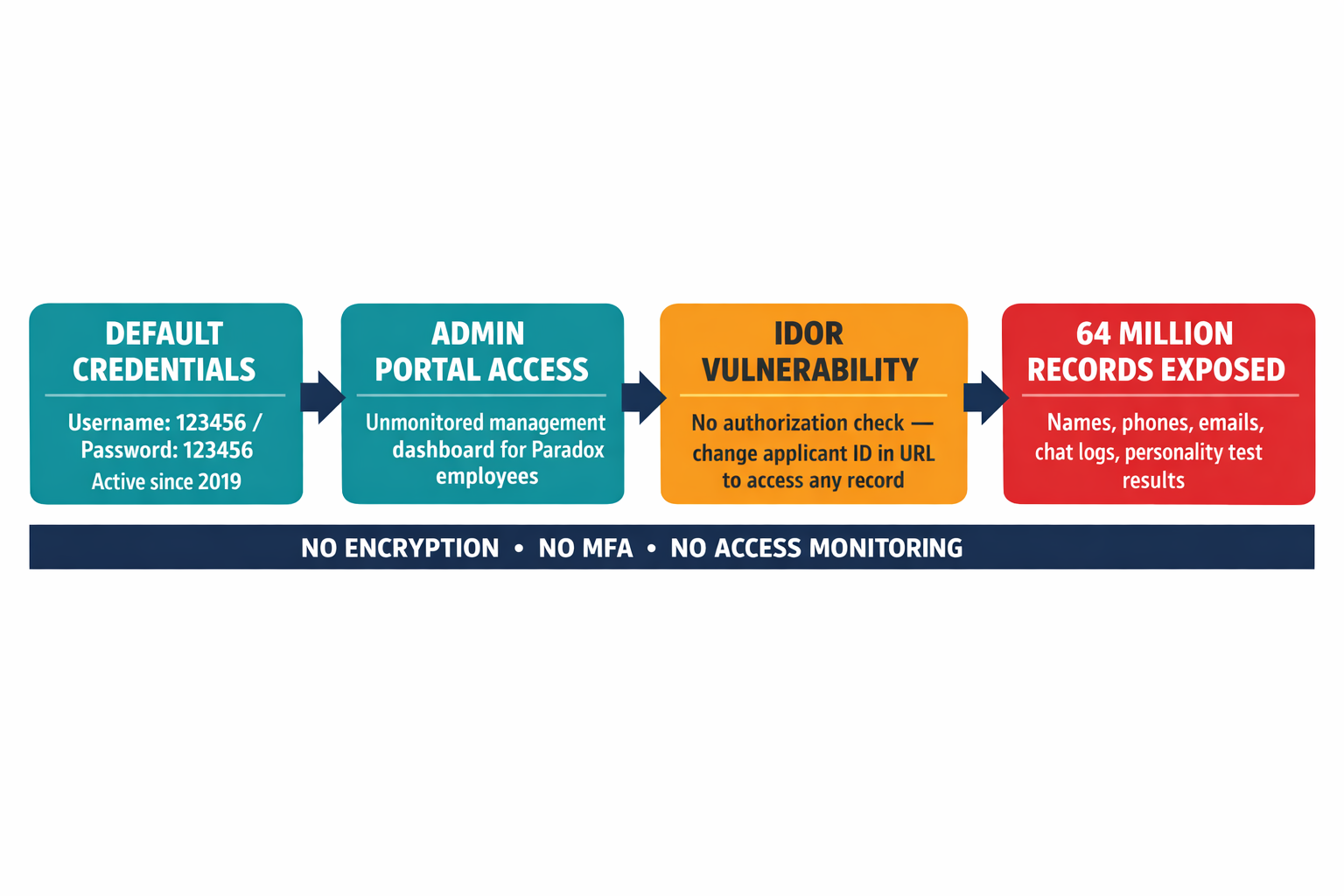
They were right. They found a management portal intended for Paradox employees. The admin credentials? Username: "123456." Password: "123456." The account had been sitting there, active and unmonitored, for six years.
But that was only the door. Behind it, they discovered something worse: an API vulnerability called an Insecure Direct Object Reference, or IDOR. In plain English, this means the system didn't check whether a logged-in user was actually authorized to see a specific applicant's data. By simply changing the ID number in the browser's address bar — going from applicant #1000 to #1001 to #1002 — they could pull up anyone's full record.
Sixty-four million records. Names, emails, phone numbers, IP addresses, AI chat histories, and psychometric screening results — all accessible by counting upward in a URL.
I walked through the full technical anatomy of this breach in our interactive analysis. What struck me wasn't the sophistication of the vulnerability. It was the complete absence of it.
This Wasn't a Model Problem. It Was an Infrastructure Problem.
There's a conversation happening in boardrooms right now about "AI safety" — making sure models don't produce biased or harmful outputs. That conversation matters. But the McDonald's breach had nothing to do with the AI model misbehaving. Olivia worked exactly as designed. The chatbot was fine. Everything around it was broken.
This is the distinction I keep hammering home with my team: AI safety protects people from the model. AI security protects the entire system — the model, the data, the infrastructure, the humans managing it — from attackers. Most companies are investing heavily in the first and ignoring the second.
The Paradox breach also revealed a malware infection on a developer's personal device in Vietnam. A credential-stealing tool called Nexus Stealer had exfiltrated hundreds of passwords from this single developer — many of them reused across internal systems for multiple clients, including Pepsi, Lockheed Martin, and Lowe's. One compromised human. One recycled password. Hundreds of enterprise accounts exposed.
The security of your AI is only as strong as the password hygiene of the least careful developer in your vendor's supply chain.
The Real Danger: Your Personality Test Is Now Public
Credit card numbers can be canceled. Passwords can be changed. But what do you do when someone leaks the results of your personality assessment?
This is what makes the McHire breach different from a typical data incident. Among those 64 million records were psychometric profiles — the kind of behavioral and personality data that AI hiring tools use to screen candidates before a human ever sees their application. These profiles attempt to quantify who you are: how you handle stress, whether you're agreeable, how you make decisions.
That data is permanent. You can't rotate your personality like you rotate a password.
Research on the psychological impact of data breaches paints a grim picture. Nearly 70% of victims report a lasting inability to trust others. Two-thirds experience feelings of profound helplessness. The effects include anxiety, depression, sleep disturbances, and in severe cases, symptoms resembling PTSD. And the invasiveness of the exposed data directly amplifies the harm — losing an email address is one thing. Having your AI-generated personality profile made public is something else entirely.
I think about the people on the other end of this breach. Many of them were applying for hourly jobs. They chatted with an AI because that was the only option. They answered personality questions because the system required it. They had no way to know their data was sitting behind a six-character password. And now their behavioral profiles could be in the hands of anyone who scraped that API before it was patched.
What I Mean by "Deep AI" vs. the Wrapper Trap
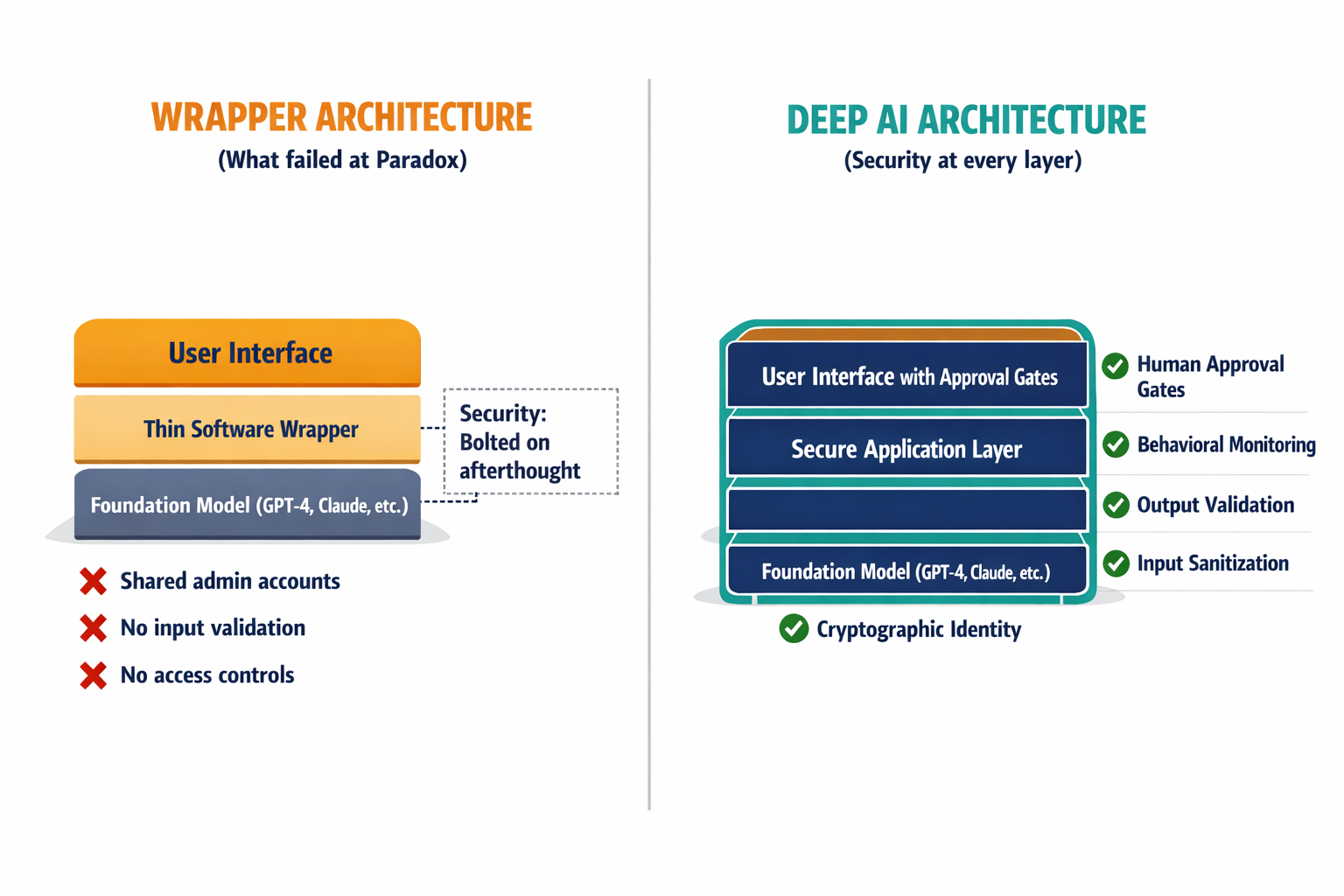
When I talk to enterprise leaders about AI architecture, I use a simple distinction. Most AI products today are what the industry calls "wrappers" — thin software layers built on top of a foundation model like GPT-4 or Claude. The wrapper handles the user interface and shuttles prompts back and forth. The actual intelligence lives somewhere else, and the security is bolted on as an afterthought using standard web development practices.
This is the architecture that failed at Paradox. The conversational AI was impressive. The infrastructure securing it was vintage 2005.
A "Deep AI" architecture treats the model as a core component of the system — like a database or a message queue — with security, governance, and access controls woven into every layer. Think of it as the difference between putting a padlock on a tent and building a vault. The padlock might be strong, but the tent walls are fabric.
Here's what that looks like in practice:
Identity: Every human and every AI agent gets a unique cryptographic identity. No shared admin accounts. No default passwords. Period.
Input sanitization: Every prompt gets cleaned before it reaches the model, stripping anything that could be interpreted as a hidden instruction.
Output validation: Every response from the AI is treated as untrusted until it's been checked for leaked personal data, hallucinated content, or toxic language.
Behavioral monitoring: Real-time dashboards track what AI agents are doing, flagging anomalous behavior before it causes damage.
Human approval gates: Any high-stakes action — accessing sensitive data, making a decision that affects someone's employment — requires a human to sign off.
None of this is exotic. None of it requires a PhD to implement. It requires treating AI deployments with the same rigor we've applied to databases and financial systems for decades.
The Regulatory Hammer Is Coming
The legal exposure from this breach is staggering. Under the California Consumer Privacy Act, a business can face $750 in statutory damages per consumer per incident when unencrypted personal data is stolen due to a failure to maintain "reasonable security procedures." A default password of "123456" is the definition of unreasonable. Multiply $750 by 64 million records and the math gets existential.
Under the EU's AI Act, which classifies recruitment AI as "high-risk," companies face fines up to €35 million or 7% of global revenue for failing to meet governance and data quality standards. GDPR adds another layer: up to €20 million or 4% of global turnover.
But beyond the fines, there's a structural problem. Regulations like the CCPA now require businesses to offer consumers the ability to opt out of automated decision-making in high-stakes contexts like hiring. If your AI hiring system lacks transparency — if candidates can't understand why they were screened out, or can't appeal the decision — you're building legal liability into every interaction.
For the detailed regulatory analysis and the technical framework we've developed for addressing these risks, see our full research paper.
"But We Use a Reputable Vendor"
I hear this constantly. It's the most dangerous sentence in enterprise AI right now.
McDonald's used a reputable vendor. Paradox.ai is not some fly-by-night operation — they serve Fortune 100 companies across industries. And yet the security of one of the world's most recognizable brands was entirely dependent on whether a third-party vendor remembered to change a test account password. They didn't. For six years.
The lesson isn't "choose better vendors." The lesson is that delegation is not governance. When you outsource your AI hiring to a vendor, you outsource the candidate experience, the data handling, and the security posture. But you cannot outsource the accountability. When 64 million records leak, nobody remembers the vendor's name. They remember yours.
Outsourcing your AI doesn't outsource your risk. It just makes the risk invisible until something breaks.
This is why frameworks like ISO 42001 — the first international standard for AI management systems — matter. Not because certification is a magic shield, but because the process forces you to inventory your AI exposure, map your data permissions, and build accountability structures before a breach forces you to do it in a crisis.
What Should You Actually Do Monday Morning?
If you're a CXO reading this, here's what I'd prioritize:
This week: Audit every AI vendor relationship for default credentials and stale admin accounts. Yes, literally ask: "Are there any test accounts with default passwords still active?" The answer might horrify you.
This month: Implement multi-factor authentication on every administrative interface connected to your AI systems. Map which AI agents and tools have access to personal data, and document who authorized that access.
This quarter: Build a decommissioning protocol. Every account, every API key, every agent credential should have an expiration date and an owner. If nobody owns it, kill it.
By year-end: Align your AI governance to a recognized framework — ISO 42001 or the NIST AI Risk Management Framework. Not because regulators require it today, but because they will tomorrow, and retrofitting governance into a live system is exponentially harder than building it in from the start.
The Era of "Good Enough" Is Over
I keep coming back to that password. "123456." It's the most commonly used password in the world, and it was protecting the psychometric data of 64 million people. Not because the technology to prevent this doesn't exist — it does, and it's not expensive. But because the organization that built the system treated security as someone else's problem.
The AI systems we're deploying today are not chatbots. They're decision engines that determine who gets hired, who gets a loan, who gets flagged for review. The data they collect isn't just names and emails — it's behavioral profiles, emotional patterns, inferred personality traits. This data is more intimate than financial records, and we're protecting it with less rigor than we protect a Netflix account.
We've entered an era where AI systems know more about job applicants than the companies hiring them — and we're securing that knowledge with the digital equivalent of leaving the front door open.
The next breach won't be caused by a brilliant hacker. It'll be caused by the same thing that caused this one: the assumption that someone else is handling security, that default settings are good enough, that the AI vendor has it covered.
They don't. And the 64 million people whose personality profiles are now floating in the wild are paying the price for that assumption.
If you're building or deploying AI systems that touch people's lives — hiring, lending, healthcare, insurance — I'd genuinely like to hear how you're thinking about this. Not the vendor pitch. The real architecture. The hard conversations you're having internally about where the accountability actually lives.