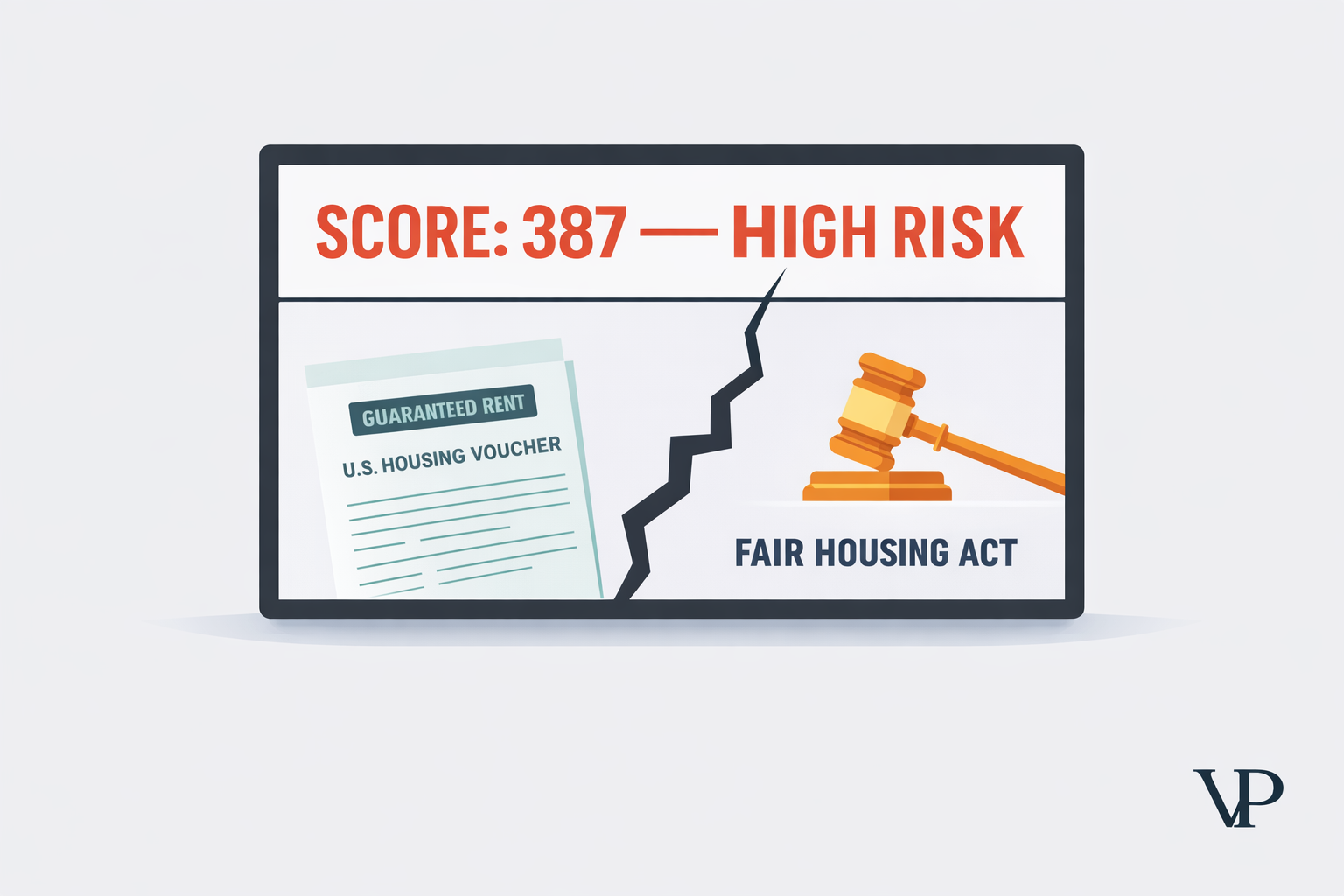
Two Black women applied for apartments with federally funded housing vouchers — guaranteed rent, backed by the government. An AI scoring tool rejected them anyway. The algorithm treated their credit histories as proof of risk while completely ignoring the steady income stream their vouchers provided. In November 2024, that algorithmic failure cost SafeRent Solutions $2.275 million and forced a nationwide overhaul of their screening products. The case, Louis et al. v. SafeRent Solutions, LLC, isn't just a cautionary tale about AI bias in tenant screening — it's the clearest signal yet that enterprises deploying automated decision systems in housing, lending, or hiring can no longer treat fairness as an afterthought.
The implications extend far beyond real estate. Any organization using AI to make high-stakes decisions about people — who gets a loan, who gets hired, who gets housed — is now operating under a legal and ethical standard that most current systems weren't built to meet.
The Algorithm Said "High Risk." The Data Said Otherwise.
SafeRent's tool, called "Registry ScorePLUS," generated scores between 200 and 800 — similar to a credit score — that landlords used to approve or reject applicants. The problem was what the model weighted and what it ignored.
The system leaned heavily on traditional credit history and non-tenancy debt. But it gave no meaningful credit for housing vouchers, which are government-funded subsidies that guarantee a significant portion of the tenant's rent. Someone holding a voucher is, by definition, less likely to miss rent payments — the government pays directly.
By treating credit history as a neutral predictor, the algorithm inherited decades of systemic inequality. The numbers are stark: as of October 2021, the median credit score for White consumers was 725, compared to 661 for Hispanic consumers and 612 for Black consumers. When a model treats those scores as race-neutral, it isn't neutral at all. It's encoding racial disparities into housing decisions.
An algorithm that ignores guaranteed income while penalizing historical credit gaps isn't predicting risk. It's perpetuating exclusion.
Why the "We're Just a Software Vendor" Defense Collapsed
SafeRent tried an argument that many AI companies have relied on: we don't make housing decisions, landlords do. We just provide the scores.
The court rejected this outright. If a landlord relies primarily on a third-party score to approve or deny applicants, the provider of that score is part of the decision-making chain — and shares liability under the Fair Housing Act (FHA). The Department of Justice filed a Statement of Interest reinforcing this position.
This ruling dismantles the "neutral vendor" defense that has shielded technology companies from accountability for their outputs. If your AI system produces a recommendation that a client follows, you own the consequences of that recommendation.
The settlement wasn't just financial. SafeRent is now prohibited from issuing automated approve/decline recommendations for voucher holders unless the model has been independently validated for fairness by civil rights experts. Without that validation, the system can only provide raw background information — no scores, no predictions. The company must also train its clients on the limitations of scoring models for subsidized populations.
These terms apply nationwide. They set a new floor for the entire tenant-screening industry.
HUD Drew a Line in the Sand
In May 2024, the Department of Housing and Urban Development issued comprehensive guidance on how the Fair Housing Act applies to artificial intelligence. The core standard: disparate impact. A policy or algorithm can be illegal even without any intent to discriminate, as long as it produces a disproportionate negative effect on a protected class that can't be justified by a legitimate, nondiscriminatory purpose.
We analyzed the full scope of this guidance in our interactive research on algorithmic integrity and enterprise risk. The key mandates for developers and housing providers include:
Relevant screening: Every data point must have a demonstrable causal link to the predicted outcome. Using credit scores to predict lease compliance among voucher holders fails this test.
Accuracy assurance: Models must use current, verified data — not stale records or overbroad proxies.
Transparency: Screening criteria must be available to applicants before they apply. Black-box proprietary scoring is explicitly targeted.
Dispute mechanisms: Applicants must have a clear path to challenge AI-generated decisions, which means human review layers are no longer optional.
Less Discriminatory Alternatives (LDAs): If a fairer model can achieve the same business goal, you're required to use it.
That last point deserves emphasis. The legal standard isn't "is your model accurate?" It's "is your model the least discriminatory accurate model you could have built?"
The LDA Requirement Changes Everything
The concept of Less Discriminatory Alternatives may be the most consequential element of modern AI regulation. It shifts the burden from "prove our model is biased" to "prove you searched for a fairer one."
Research on what's called model multiplicity shows that for any given dataset, there are often millions of models that perform with roughly equal accuracy but have vastly different fairness profiles. Without deliberately searching for fairer alternatives, developers will typically settle on the first model that meets their accuracy threshold — which, as SafeRent demonstrated, often inherits the biases baked into historical data.
The legal question is no longer "does your AI work?" It's "did you look for an AI that works just as well without discriminating?"
In the SafeRent case, the answer was clearly no. The model could have incorporated voucher payment history, direct rent payment records, or alternative scoring models like VantageScore 4.0 that some of SafeRent's own clients had already adopted. These alternatives existed. SafeRent simply didn't use them.
The settlement now requires civil rights experts to validate SafeRent's models — effectively mandating an LDA search. Enterprises that conduct these searches proactively, before a lawsuit forces them to, gain both legal protection and a genuine competitive advantage in trustworthiness.
Why Bolting Fairness Onto a Finished Model Doesn't Work
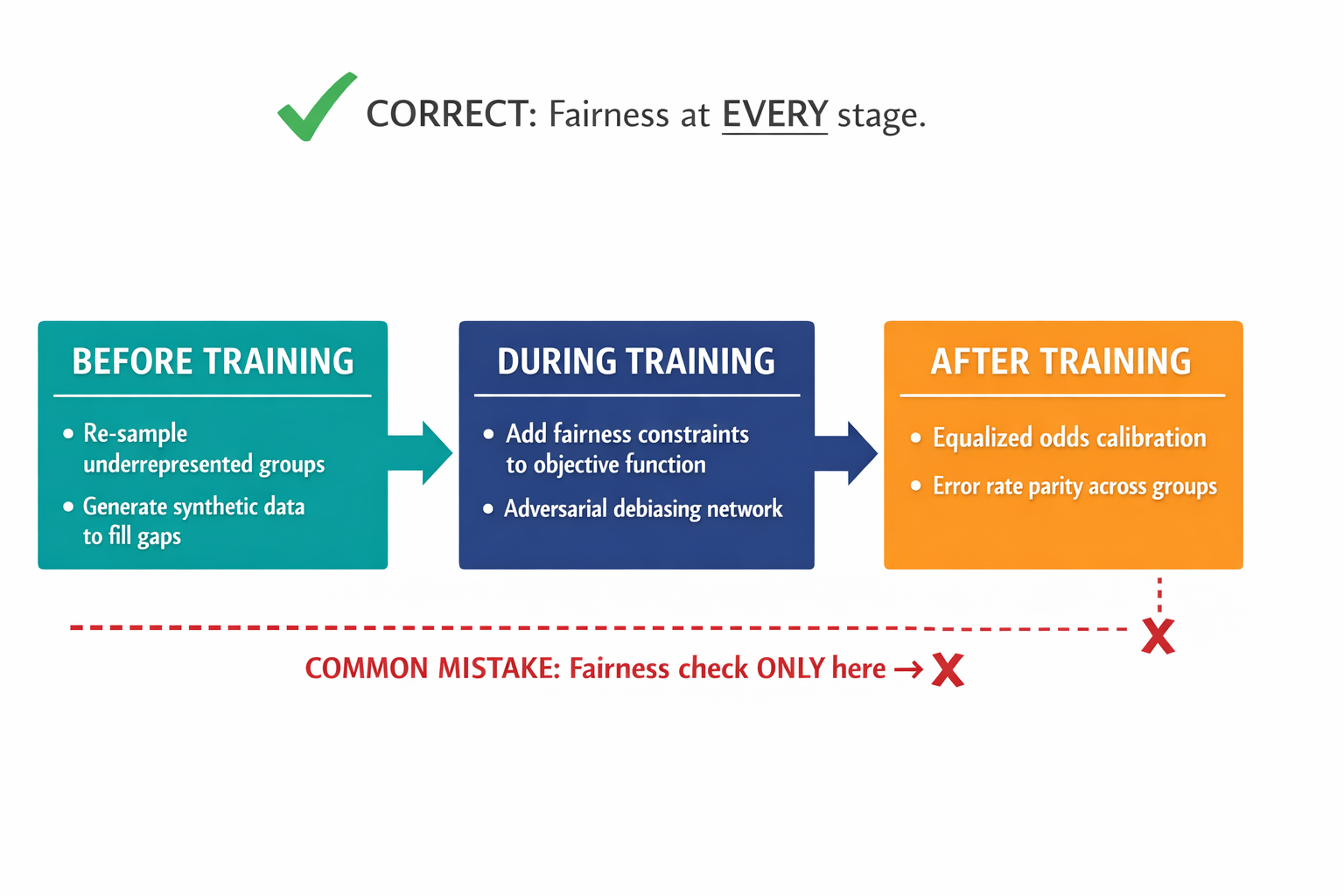
A common response to algorithmic bias concerns is to add a fairness check at the end of the development pipeline — run an audit, adjust some thresholds, call it compliant. This is the equivalent of spell-checking a document written in the wrong language.
Meaningful algorithmic fairness has to be built into three stages, not patched onto one.
Before training, the data itself needs correction. If your training data underrepresents successful voucher holders — because the historical system denied them housing in the first place — your model will learn that voucher holders are risky. Techniques like re-sampling underrepresented groups or generating synthetic data to fill gaps can address this before a single model parameter is set.
During training, the model's objective function needs to include fairness as a constraint, not just accuracy. One approach, called adversarial debiasing, trains a secondary network alongside the primary model. The secondary network tries to guess a protected attribute — like race — from the primary model's predictions. If it succeeds, the primary model is penalized. Over time, this forces the model to learn features that genuinely predict outcomes rather than proxying for demographics.
After training, output calibration ensures that error rates are equitable across groups. A model might be 95% accurate overall but reject qualified minority applicants at twice the rate of qualified majority applicants. Post-processing adjustments like equalized odds — ensuring false positive and false negative rates are consistent across demographics — catch these disparities before they reach real people.
Fairness isn't a feature you add. It's an architectural decision you make at every stage of the pipeline.
Static, one-time audits can't keep pace with shifting demographics, evolving regulations, or data drift. Our team has studied emerging frameworks like the "Fair Game" approach, which treats fairness as a continuous loop: an auditing agent samples the model's decisions, a debiasing agent adjusts the model's behavior, and human reviewers provide preference feedback. The model doesn't just meet today's standards — it adapts as standards evolve.
Measuring Fairness: The Metrics That Matter
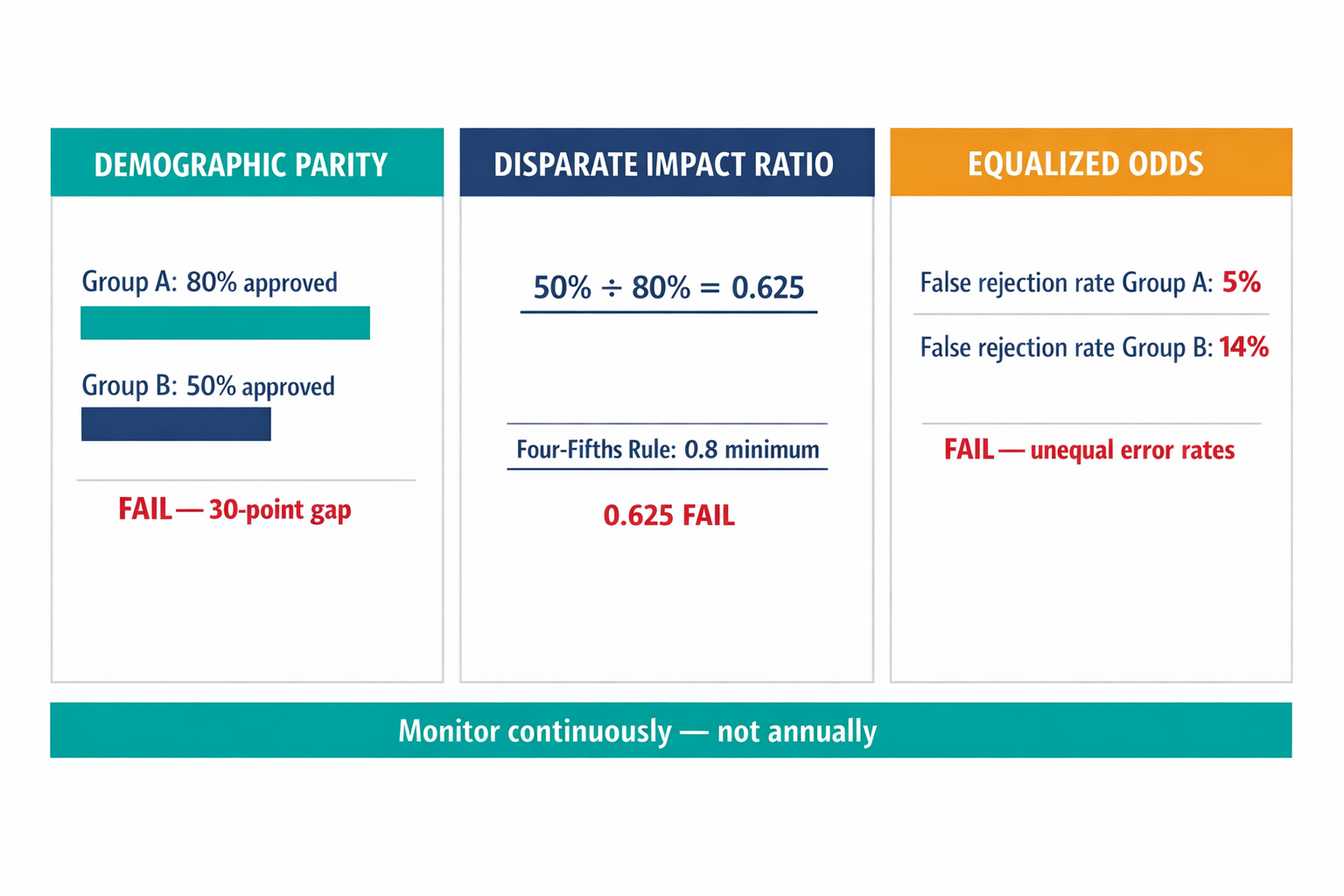
Fairness claims without measurement are just marketing. Enterprises need quantifiable, auditable metrics embedded into their operations — not annual reports, but real-time dashboards.
Three metrics matter most:
Demographic parity asks whether the probability of a positive outcome (approval, hire, loan) is the same regardless of group membership. If your model approves 80% of White applicants and 50% of Black applicants, you have a parity problem.
Disparate impact ratio compares the positive outcome rate for the unprivileged group against the privileged group. Regulators commonly apply the "four-fifths rule": if the ratio falls below 0.8, it's evidence of discrimination. SafeRent's failure to credit voucher income almost certainly pushed this ratio well below that threshold for voucher holders.
Equalized odds checks whether the model's error rates are consistent across groups. This is critical in screening contexts — it ensures that qualified applicants from minority groups aren't rejected at higher rates than equally qualified applicants from majority groups.
For the full technical methodology behind these metrics and how they integrate into enterprise MLOps pipelines, see our detailed research on the SafeRent precedent and algorithmic accountability.
When these metrics are monitored continuously, organizations can detect "fairness drift" — the gradual degradation of equitable outcomes as real-world conditions shift — before it becomes a legal violation.
What About Industries Outside Housing?
The SafeRent ruling applies directly to tenant screening, but the legal logic extends to any domain where AI makes decisions about people in protected classes. The Fair Housing Act's disparate impact standard has close parallels in employment law (Title VII), lending regulation (Equal Credit Opportunity Act), and the EU AI Act, which classifies credit scoring and hiring systems as "high risk" with mandatory fairness requirements taking effect in 2025-2026.
If your organization uses AI to screen job applicants, approve loans, set insurance premiums, or allocate healthcare resources, the SafeRent precedent is relevant to you. The "neutral vendor" defense is collapsing across sectors, not just housing.
Can Fairness and Accuracy Coexist?
This is the objection we hear most often: "If we constrain the model for fairness, won't we lose accuracy?"
The model multiplicity research suggests the opposite. Because so many equally accurate models exist for any given problem, the constraint isn't accuracy versus fairness — it's whether you bothered to search the solution space for models that deliver both. In many cases, fairer models actually perform better on out-of-sample data because they've learned genuine predictive signals rather than demographic shortcuts.
The real cost isn't building fairer models. It's the $2.275 million settlements, the five-year injunctions, the reputational damage, and the human harm that come from not building them.
What Enterprises Should Do Now
The period of treating AI fairness as aspirational is over. Based on our analysis of the SafeRent settlement, HUD's 2024 guidance, and the broader regulatory trajectory, we recommend three immediate priorities:
Audit your decision chain. If your organization relies on third-party AI scores to make decisions about people, you share liability for those scores. Understand exactly what your vendors' models weight, what they ignore, and whether they've been validated for fairness.
Conduct an LDA search. For every model making high-stakes decisions, ask: is there a less discriminatory alternative that achieves the same business objective? Document the search and the results. This documentation is your strongest defense if challenged.
Embed continuous monitoring. Annual fairness audits are insufficient. Implement real-time tracking of demographic parity, disparate impact ratios, and equalized odds across every protected class relevant to your domain.
The SafeRent case proved that algorithms are not exempt from civil rights law. The enterprises that internalize this now — building fairness into their architecture rather than bolting it on after a lawsuit — will be the ones that earn lasting trust from regulators, customers, and the communities they serve.
We'd welcome hearing how your organization is approaching algorithmic accountability. What's working? What's proving harder than expected?