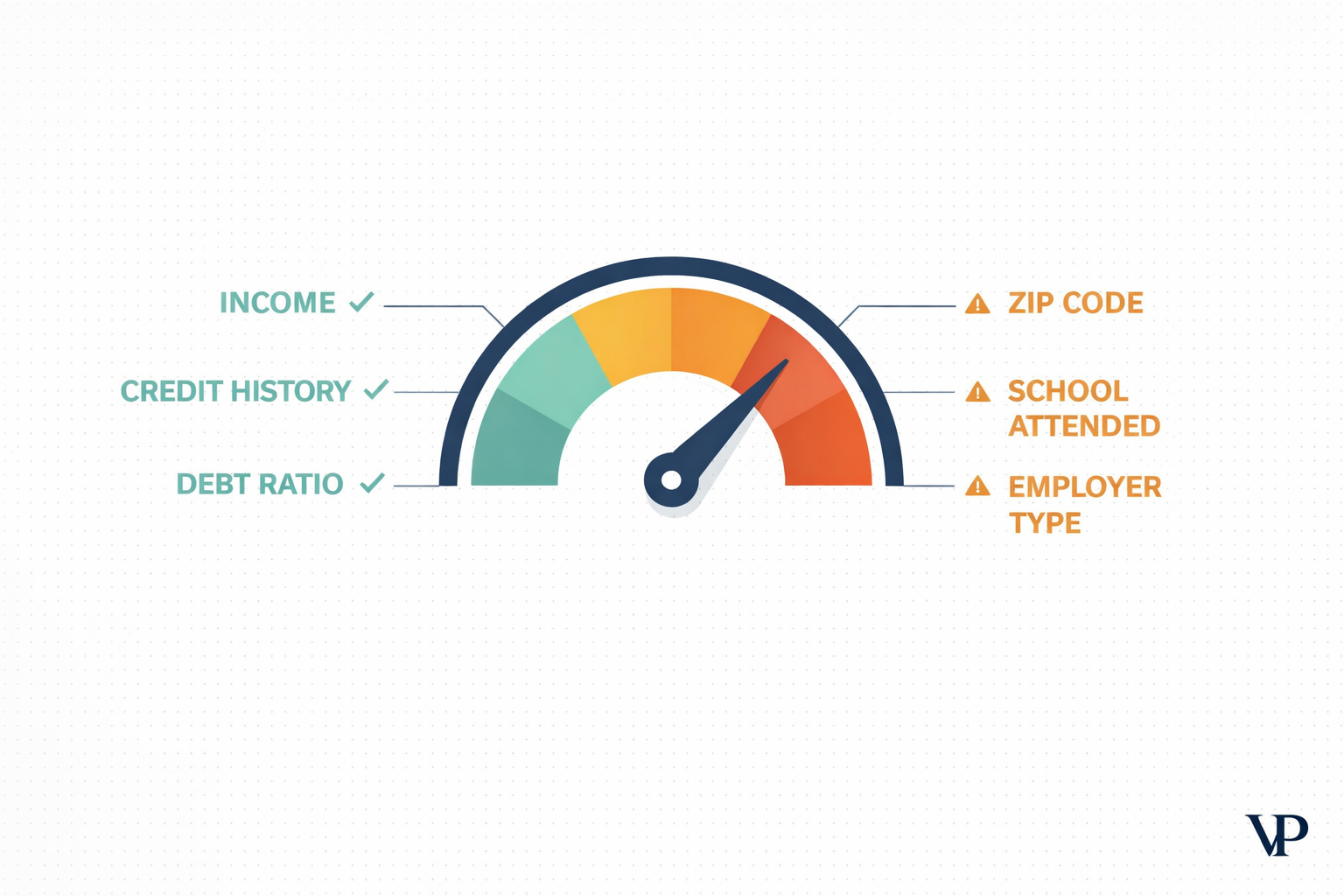
A student loan company just paid $2.5 million because its algorithm penalized applicants for where they went to school. Not their grades, not their income, not their credit history — their school's average default rate. If you attended a Historically Black College, the model quietly worked against you before it ever looked at your finances.
This isn't an edge case. It's the new front line of algorithmic accountability in lending — and the Earnest Operations settlement, announced by the Massachusetts Attorney General in July 2025, is just the beginning. Paired with Navy Federal Credit Union's ongoing litigation over a 29-percentage-point gap in mortgage approval rates between white and Black applicants, these cases reveal something uncomfortable: the AI systems financial institutions deployed to remove human bias may be encoding it at scale.
Our team has spent the past year studying how these failures happen architecturally — not just ethically — and what it takes to build AI systems that can actually survive regulatory scrutiny. What we found is that the problem isn't artificial intelligence itself. It's the way most institutions have bolted it on.
A School's Reputation Became a Borrower's Penalty
The Earnest case is worth understanding in detail because the mechanism is so subtle — and so replicable across the industry.
Earnest used something called the Cohort Default Rate (CDR) as a factor in its student loan refinancing model. The CDR measures the average rate at which graduates of a particular institution default on their federal loans. On paper, it looks like a reasonable risk signal. In practice, it functions as a demographic filter.
HBCUs and institutions serving high concentrations of low-income minority students carry higher CDRs — not because their individual graduates are less creditworthy, but because of decades of systemic underfunding and intergenerational wealth gaps. By weighting CDR in its scoring model, Earnest applied a collective penalty to individuals regardless of their personal financial strength.
When a model punishes you for a statistic about your school rather than a fact about your finances, it's not assessing risk — it's inheriting history.
The investigation also uncovered "knockout rules" — hard-coded gates that automatically denied anyone without at least a green card. And perhaps most damning: while internal policies required senior oversight for model exceptions, underwriters were routinely bypassing the algorithm with arbitrary, undocumented decisions. The system had both algorithmic bias and unmonitored human bias operating simultaneously, making it essentially impossible to audit.
We mapped the full anatomy of these failures in our interactive analysis of the algorithmic accountability crisis, which traces how proxy variables, knockout rules, and governance gaps compound into systemic discrimination.
Navy Federal: The Widest Disparity Gap Among Top 50 Lenders
If Earnest illustrates how a specific variable can go wrong, Navy Federal Credit Union shows what happens when an entire system drifts toward inequity over time.
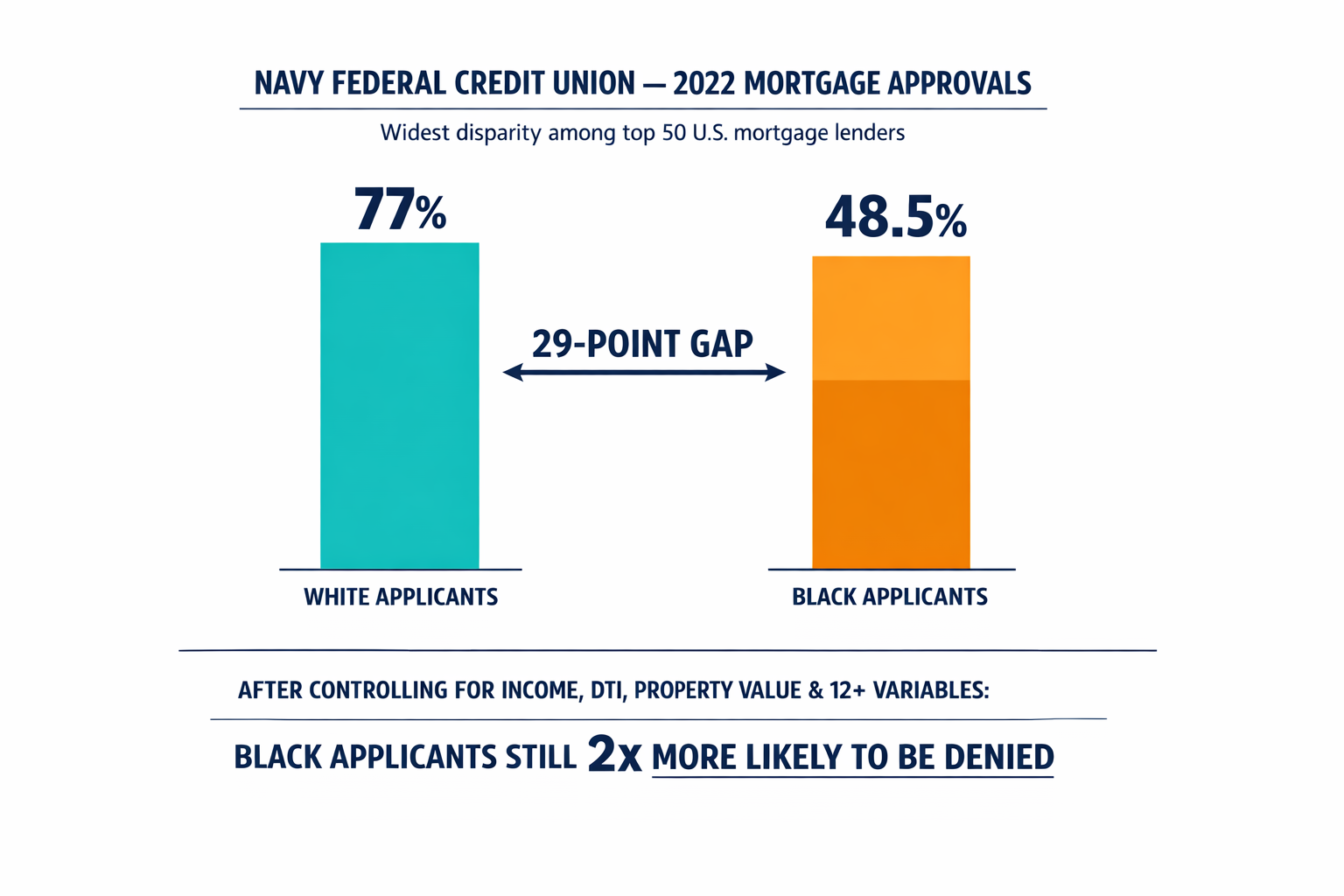
Analysis of 2022 Home Mortgage Disclosure Act data revealed that Navy Federal — the nation's largest credit union — approved roughly 77% of white applicants but only 48.5% of Black applicants. That nearly 29-point gap was the widest of any top 50 mortgage lender in the country.
Navy Federal's defense was predictable: public data doesn't include credit scores or cash reserves, so the comparison is incomplete. But when independent researchers controlled for more than a dozen variables — income, debt-to-income ratio, property value, neighborhood characteristics — Black applicants were still more than twice as likely to be denied as white applicants with identical financial profiles.
In May 2024, a federal judge ruled that disparate impact claims against Navy Federal could proceed to discovery. That ruling carries a critical implication for every institution using automated underwriting: statistical disparity alone is often enough to get past a motion to dismiss. The burden then shifts to the lender to prove its model is both necessary and the least discriminatory alternative available.
Statistical disparity doesn't just trigger lawsuits. It shifts the burden of proof to the institution — and "the algorithm decided" is not a legal defense.
Why "Wrapper" AI Architectures Can't Survive Scrutiny
Most financial institutions that have adopted AI in underwriting haven't built AI systems. They've built wrappers — thin integration layers that pass data to third-party large language models (LLMs) like GPT-4 or Gemini and return whatever comes back.
This creates a fundamental mismatch. Lending decisions require precise, repeatable, auditable logic. LLMs are probabilistic — they predict the most likely next word in a sequence, not the correct answer to a regulatory question. Three problems emerge immediately.
The hallucination problem. An LLM might generate a plausible-sounding justification for denying a loan that has no basis in the applicant's actual file. If a bank's automated system misstates eligibility criteria or fabricates a reason for denial, the institution faces direct liability. This isn't theoretical — a Canadian court already held Air Canada liable when its AI chatbot gave a customer incorrect policy information.
The context vacuum. Generic AI platforms lack the specialized knowledge to accurately interpret mortgage documents, tax returns, or alternative income patterns. Without industry-specific training, these models produce false negatives — rejecting creditworthy borrowers because the model can't recognize non-traditional financial profiles.
Training data contamination. LLMs learn from the internet, which is saturated with historical biases. When these models evaluate a borrower's employment history or financial narrative, they may apply stereotypes embedded in their training data — associating certain professions, nationalities, or backgrounds with higher risk, regardless of the individual's actual creditworthiness.
A wrapper doesn't add intelligence to a lending decision. It adds liability.
The Regulatory Walls Are Closing In
The regulatory landscape for 2025 and 2026 has moved from guidance to mandates. Three frameworks now define what "defensible" means.
The Consumer Financial Protection Bureau (CFPB) has finalized guidance requiring lenders to provide "accurate and specific reasons" for adverse actions. Broad categories like "insufficient income" aren't acceptable if the real reason was an algorithmic flag on a non-traditional data point. Every denial needs a traceable, specific explanation.
SR 11-7, the Federal Reserve's supervisory regulation for model risk management, now demands three things of AI systems: documented economic logic proving the model isn't relying on spurious correlations, independent validation by a team completely separate from the developers, and regular back-testing against real-world outcomes.
The NIST AI Risk Management Framework 2.0, released in 2025, introduces the concept of an "AI Bill of Materials" — essentially a supply chain manifest for AI. Institutions must know exactly where their data comes from, which models they're using (including third-party APIs), and how all the components interact. Think of it as a nutritional label for your algorithm.
What "Deep AI" Actually Means in Practice
When we talk about Deep AI, we don't mean more powerful models. We mean architecturally sound systems where fairness, transparency, and auditability are built into the structure — not bolted on after deployment.
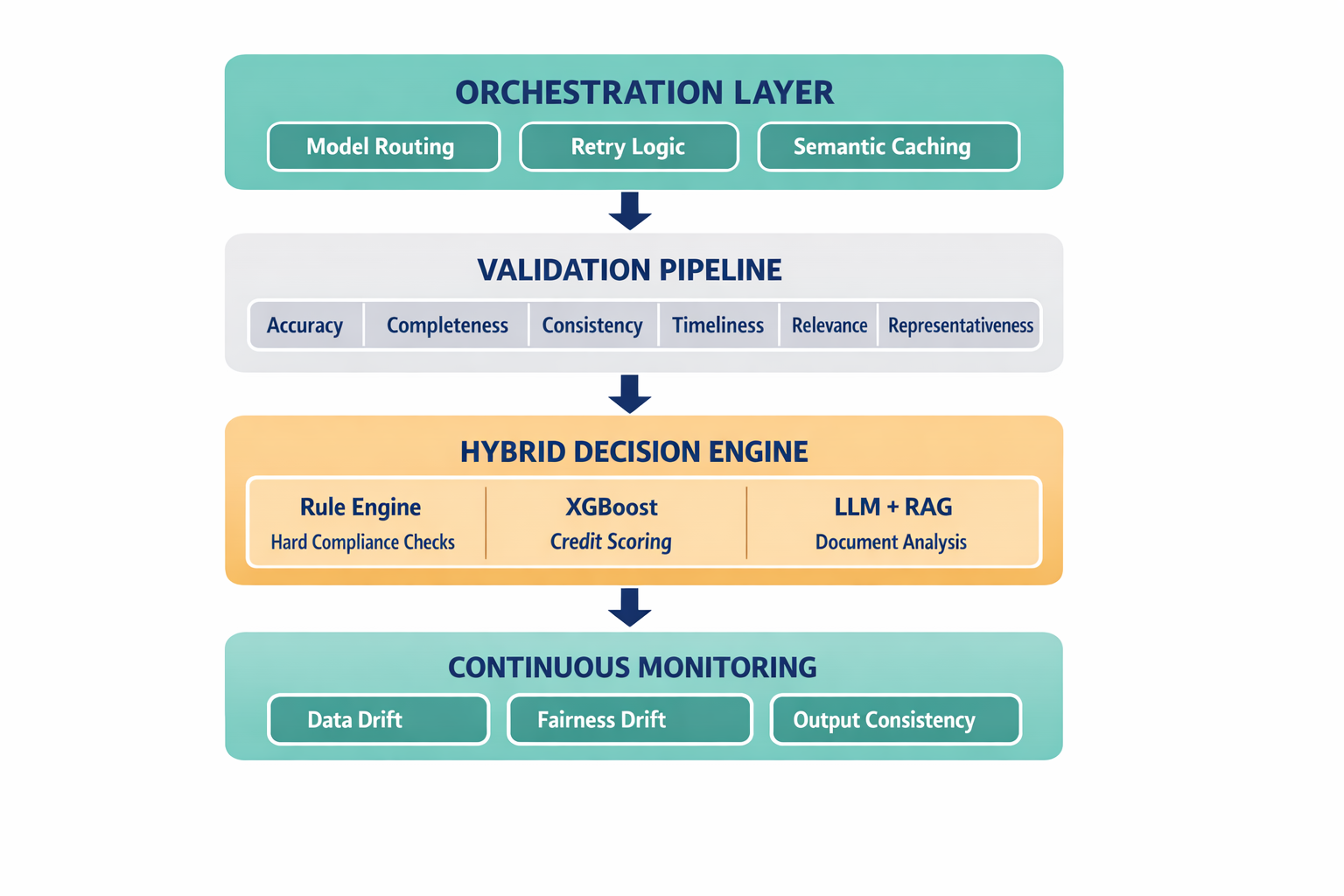
Our approach replaces the single-model wrapper with a layered architecture. An orchestration layer manages model calls, handles retries, and uses semantic caching so the system doesn't waste resources re-processing identical queries. Before data reaches any AI model, it passes through a validation pipeline that checks six dimensions: accuracy, completeness, consistency, timeliness, relevance, and representativeness.
The decision engine itself is a hybrid. Hard compliance checks — age requirements, residency rules — run through deterministic rule engines that are 100% predictable. Structured credit scoring uses gradient-boosted models like XGBoost, which are inherently more interpretable than neural networks. LLMs are reserved for what they're actually good at: analyzing unstructured documents like bank statements and tax returns, grounded by retrieval-augmented generation that forces the model to cite the applicant's actual paperwork.
And a continuous monitoring layer tracks three kinds of drift in real time: whether incoming data has shifted from what the model was trained on, whether approval-rate disparities are widening across demographic groups, and whether the AI is generating outputs that contradict the source documents.
For the full technical methodology behind this architecture — including the mathematics of fairness engineering and debiasing strategies — see our detailed research on Deep AI for fair lending.
Fairness as Engineering, Not Aspiration
One of the most consequential shifts in this space is the move from treating fairness as a value to treating it as a measurable engineering constraint.
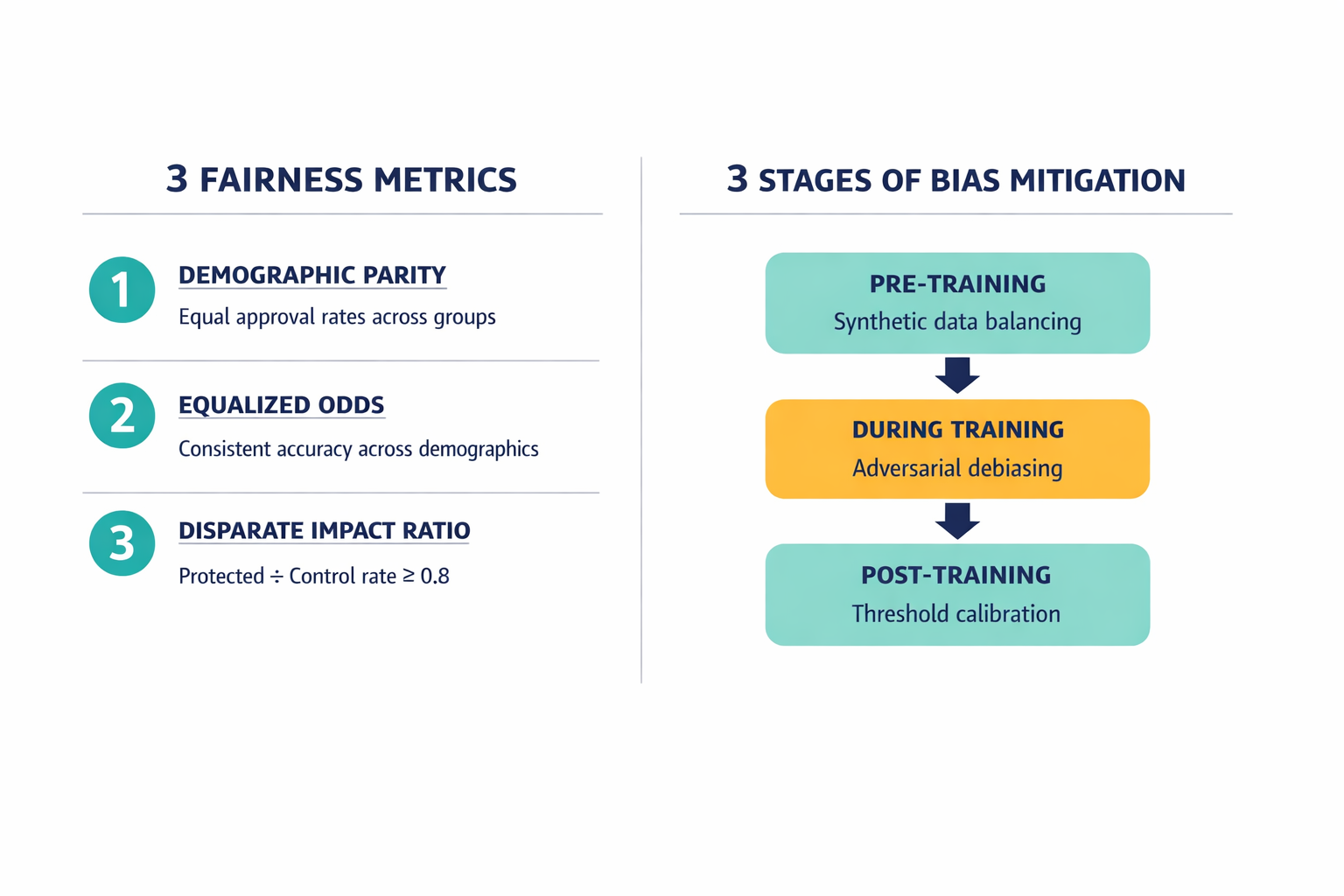
Three metrics now define the standard. Demographic parity asks whether approval rates are comparable across protected groups. Equalized odds goes deeper — requiring that the model's accuracy (both true positives and false positives) is consistent across demographics, so it isn't systematically better at evaluating one group than another. And the disparate impact ratio — where the protected group's approval rate divided by the control group's rate should stay above 0.8 — provides a clear regulatory threshold.
Bias mitigation happens at three stages. Before training, techniques like synthetic data generation balance underrepresented groups in the dataset. During training, adversarial debiasing pits a secondary model against the primary one: the adversary tries to guess the applicant's demographic from the primary model's predictions, and the primary model is optimized to make that guess impossible. After training, decision thresholds can be adjusted to equalize outcomes without retraining from scratch.
Fairness isn't a checkbox. It's a continuous calibration — and it requires the same rigor as the credit model itself.
What About the Accuracy Trade-Off?
The most common objection we hear: "If we constrain for fairness, won't we lose predictive accuracy?"
The honest answer is that there is a trade-off — but it's far smaller than most institutions assume. When we search for less discriminatory alternatives (a process regulators now explicitly expect), we typically find model configurations that maintain strong predictive performance while dramatically reducing disparate impact. The key is testing multiple configurations systematically rather than optimizing for a single accuracy metric and hoping fairness follows.
The real accuracy risk runs in the opposite direction. An unfair model that triggers a regulatory action, a class-action lawsuit, or a Congressional inquiry is not an "accurate" model in any meaningful business sense. Navy Federal's litigation costs and reputational damage will dwarf whatever marginal lift its underwriting algorithm provided.
Can Explainability Actually Work at Scale?
Yes — and regulators are no longer accepting "it's too complex to explain" as an answer.
SHAP values — a technique rooted in cooperative game theory — assign a specific, mathematically rigorous contribution score to every input feature for every individual decision. This means the system can generate adverse action notices that say: "Your application was declined primarily because your credit utilization was 82%, which contributed negatively to your score. If your utilization were 15% lower, the outcome would likely have changed."
That level of specificity satisfies the CFPB's requirement for "behavioral detail" in denial notices. It also gives the applicant something actionable — a concrete path to approval rather than a form letter.
What This Means for Your Institution
The Earnest settlement and Navy Federal litigation aren't anomalies. They're the first wave of enforcement in a regulatory environment that has decided algorithmic opacity is no longer acceptable.
Three things should be on every financial institution's near-term agenda:
Audit your variables. Every feature in your model needs to be tested for proxy discrimination — not just obvious ones like zip code, but subtle ones like school attended, employer category, or shopping patterns.
Document your alternatives. Regulators expect you to have searched for less discriminatory model configurations. If you can't show that work, you're exposed.
Make every override auditable. The Earnest case showed that undocumented human overrides are just as dangerous as biased algorithms. Every exception needs a logged justification and independent review.
The institutions that treat this moment as a compliance burden will spend the next five years in reactive mode. The ones that treat it as an architectural challenge — rebuilding their AI systems for transparency, fairness, and defensibility from the ground up — will set the standard for what responsible lending looks like in the age of AI.
We'd welcome hearing how your organization is navigating these challenges. The problems are industry-wide, and the solutions will be too.