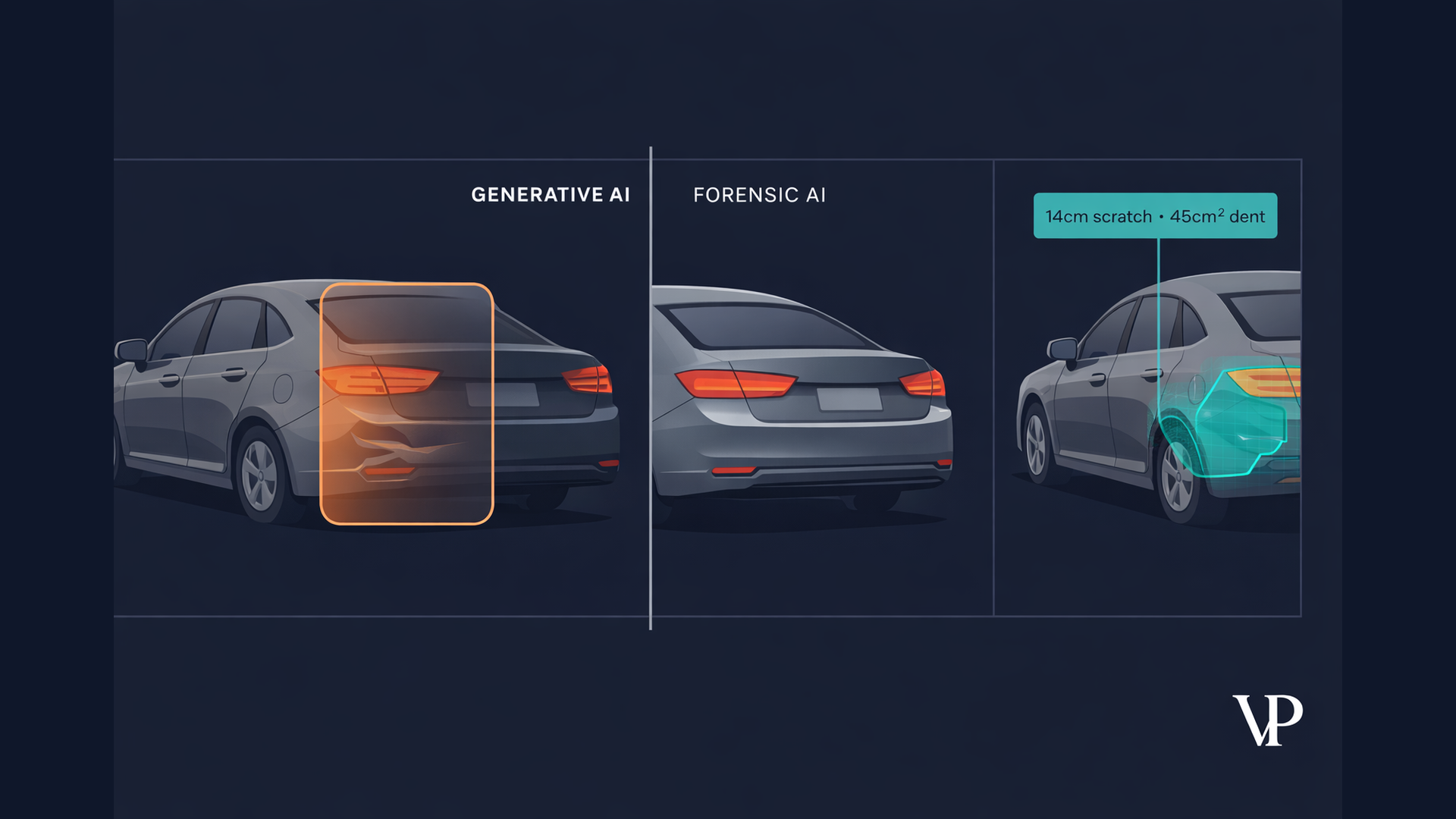
A policyholder photographs a severely dented bumper after a collision. The insurer's AI "enhances" the photo for clarity. The output? A pristine, undamaged car. The claim gets denied — zero visible damage. The customer, staring at a wrecked vehicle in their driveway, sues for bad faith.
This actually happened. It's now known in industry circles as the "Pristine Bumper" incident, and it perfectly captures a problem I've been obsessing over for years: generative AI doesn't understand the difference between making something look good and telling the truth. In insurance claims — where every pixel is evidence — that distinction is everything.
I founded Veriprajna because I believe the insurance industry is sleepwalking into a forensic evidence crisis. Carriers are integrating AI tools built for art and marketing into workflows where accuracy has legal consequences. The result isn't just bad technology. It's automated evidence destruction.
The AI Saw a Dent and Thought It Was Dirt
To understand the "Pristine Bumper" failure, you need to understand one thing about how generative image models work. Tools like Stable Diffusion, DALL-E, and Midjourney are trained on billions of images. They learn statistical patterns — what a "car" typically looks like. And in those billions of images, a car is overwhelmingly smooth, symmetrical, and undamaged.
When a generative model encounters a dent, it doesn't think "collision damage." It sees a disruption in the expected pattern — chaos where there should be order. It treats the crunched metal the same way it would treat grain on an old photograph or a smudge on a lens.
So it "fixes" it. Through a process called inpainting, the model fills in the damaged area with what it statistically expects to see: smooth, unbroken metal. The dent vanishes. The AI has done exactly what it was designed to do — produce an image that looks normal.
In art, that's a feature. In insurance, it's the automated spoliation of evidence.
This wasn't a bug. The model performed flawlessly by its own standards. It just has no concept of indemnity, forensic integrity, or the legal weight of a photograph.
The "Wrapper" Problem Nobody Talks About
The "Pristine Bumper" case points to a deeper structural issue in how insurers are adopting AI. Most InsurTech companies selling "AI-powered claims processing" aren't building AI at all. They're building user interfaces — thin wrappers — around APIs from OpenAI, Google, or similar providers.
This means the insurer has zero control over the brain making decisions about their claims. If the underlying model provider updates their weights to be more "aesthetic" or adds a new safety filter that refuses to process crash images (flagging them as "violent content"), the insurer's tool breaks overnight. Yet the insurer retains 100% of the liability for every decision that tool makes.
I remember the exact conversation with my team when this clicked for us. We were reviewing how a major carrier's mobile app handled photo uploads, and someone asked: "Wait — does anyone here actually know what model version is running on their backend right now?" Nobody did. Not even the carrier's own engineering team. They'd outsourced the most consequential part of their claims workflow to a model they couldn't audit, couldn't version-control, and couldn't explain in court.
That's when we decided Veriprajna would never be a wrapper. We train our own models. We own our weights. We can tell you exactly why our system flagged a bumper for replacement, down to the pixel.
While Insurers Delete Damage, Fraudsters Manufacture It
Here's the part that keeps me up at night. The same generative AI tools that accidentally erase legitimate damage are being weaponized to create fake damage.
A fraudster can photograph a pristine car, type "add a smashed front bumper" into a text-to-image tool, and get a photorealistic result — complete with accurate shadows, lighting, and reflections. A standard image classifier will look at that deepfake and confirm: yes, this is a damaged car. It checks the content of the image but has no way to examine whether the damage was physically generated or digitally fabricated.
The fraud goes deeper than dents. Criminal rings are using AI to create entirely synthetic identities — realistic faces of people who don't exist, fake driver's licenses, fabricated medical records. These digital ghosts buy policies, pay premiums for a few months to establish legitimacy, then file catastrophic claims. In life insurance, AI-generated obituaries and fabricated coroner reports. In health insurance, invoices from clinics that were never built and X-rays showing fractures that never happened.
Humans detect high-quality deepfakes at roughly the rate of a coin flip. The old defenses aren't working.
Traditional fraud detection relied on checking image metadata or trusting an adjuster's gut instinct. But AI-generated images often come with scrubbed or synthesized metadata. And research consistently shows humans perform barely better than random chance at identifying sophisticated deepfakes. The barrier to entry for insurance fraud hasn't just lowered — it's collapsed.
I wrote about the full scope of this threat, including the specific technical countermeasures we deploy, in our detailed technical research.
Measuring Truth Instead of Generating Fiction
The core philosophy we built Veriprajna on is simple: never change a pixel. Our AI reads evidence. It doesn't write it.
We use what's called deterministic computer vision — models that analyze and measure, rather than create. Think of the difference between a forensic photographer documenting a crime scene and a Photoshop artist retouching a portrait. Both work with images. Only one is admissible in court.
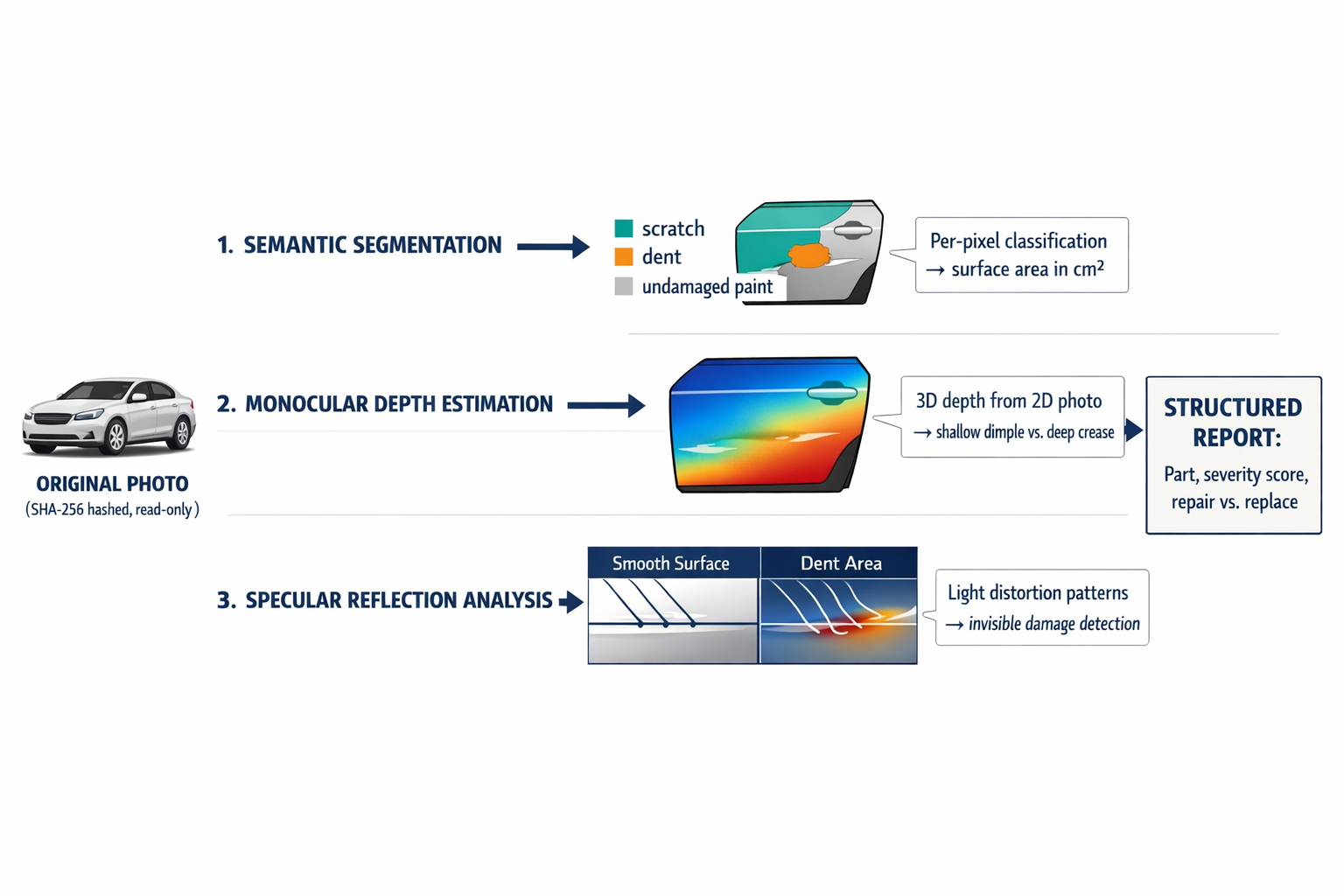
Our system runs three layers of analysis on every claim photo, all operating on a read-only copy of the original image.
Semantic segmentation identifies damage at the pixel level. Not just "this car is damaged" — but exactly where, what kind, and how much. Every pixel gets classified: undamaged paint, scratch, dent, rust, crack. The system then calculates precise surface area by correlating pixel counts with known vehicle dimensions. A scratch measuring 14 centimeters on a rear quarter panel. A dent covering 45 square centimeters. Numbers an adjuster can verify and an estimating system can price.
Monocular depth estimation solves a problem generative AI doesn't even attempt: understanding the 3D geometry of damage from a flat photo. By training on massive datasets of vehicle geometry with ground-truth depth data, our models calculate whether a dent is a shallow dimple fixable with paintless repair or a deep crease requiring panel replacement. The depth map shows what the naked eye can miss — the difference between a $200 fix and a $2,000 one.
Specular reflection analysis is the layer I'm most proud of, because it catches what every other system misses. Modern cars are shiny. Their surfaces act like mirrors. A dent on a glossy black panel might not change the color of any pixel, but it warps every reflection. Straight lines — a horizon, a power line, a building edge — reflected in a car's clear coat should follow the body's curvature. A dent bends those reflections like a funhouse mirror.
We don't just look at the car. We analyze how light bounces off it. Physics doesn't hallucinate.
This technique, borrowed from factory quality control (where it's called deflectometry), lets us detect hail damage invisible to the naked eye, structural rippling far from the impact site, and even signs of previous repairs — sanding marks or "orange peel" texture in the clear coat that flag potential pre-existing damage or fraud.
The Regulatory Walls Are Closing In
If the technical argument doesn't convince you, the legal one should. The regulatory landscape for AI in insurance has shifted dramatically, and it's moving in one direction: toward accountability and explainability.
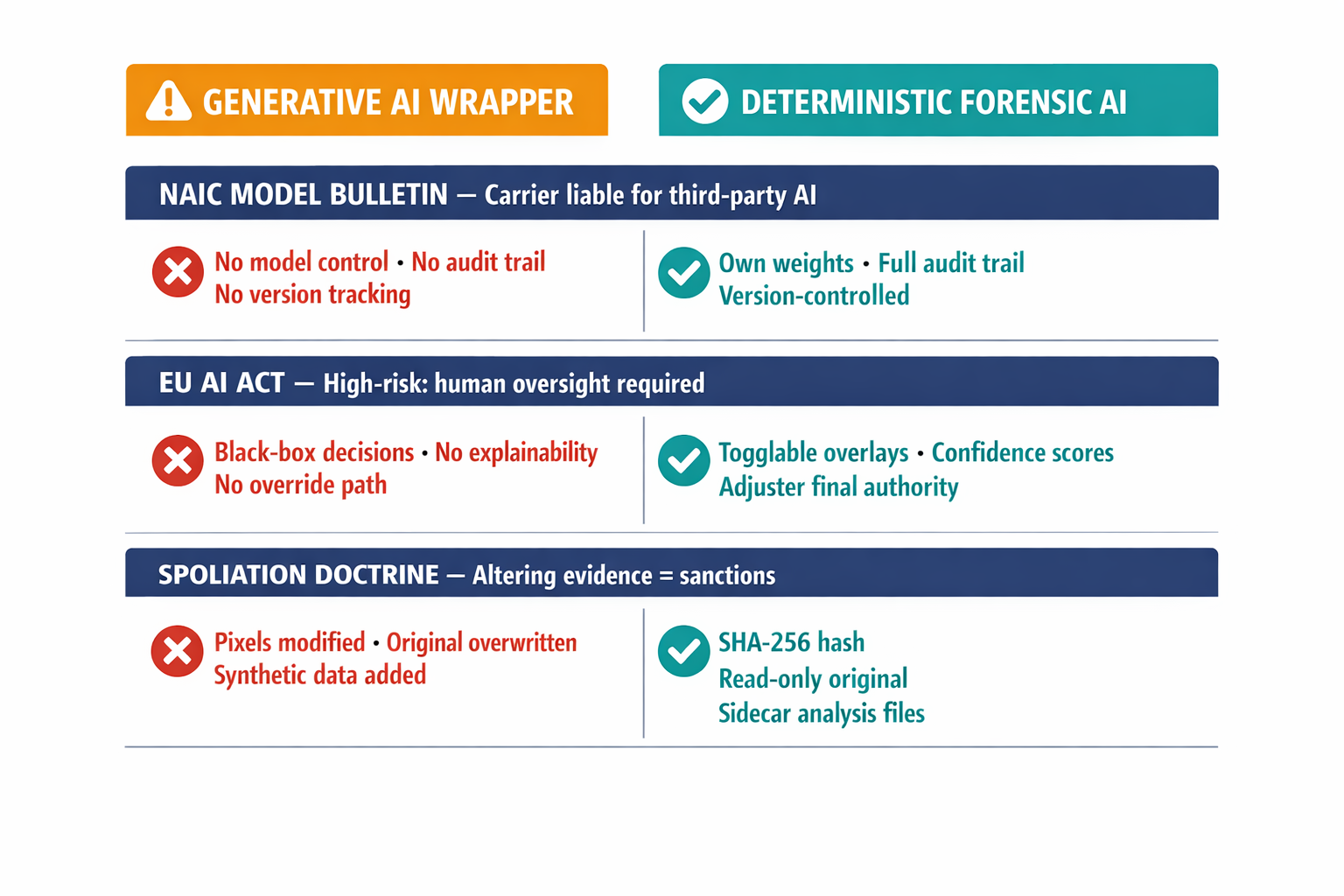
The NAIC's Model Bulletin on AI use by insurers — now adopted by numerous states — explicitly holds carriers responsible for the outcomes of any AI they deploy, including third-party tools. You cannot hide behind a wrapper. If an outsourced model hallucinates, discriminates, or destroys evidence, the insurer is liable. The bulletin requires a written governance program covering data lineage, model architecture, and validation testing.
The EU AI Act goes further. AI used in insurance risk assessment is classified as high-risk, triggering strict obligations around data governance, record-keeping, and — critically — human oversight. Systems must be designed so a human can meaningfully review and override AI decisions.
And then there's the doctrine of spoliation. In US courts, altering evidence relevant to a legal proceeding — even unintentionally — can result in sanctions, adverse jury instructions, or summary judgment. When an insurer's workflow automatically "enhances" a claim photo using generative AI, it introduces synthetic pixels that weren't captured by the camera sensor. If the original is overwritten, that's spoliation. The insurer has destroyed evidence in a case where they're a party.
We explored the full regulatory analysis, including how our architecture maps to specific NAIC and EU AI Act requirements, in our interactive whitepaper.
Our approach to this is almost paranoid by design. We hash every original image with SHA-256 the moment it arrives. Our analysis — masks, depth maps, structured reports — is saved as a separate sidecar file linked to that hash. Every access is logged. The original photo remains untouched and admissible.
What the Adjuster Actually Sees
I want to be clear about something: we're not replacing adjusters. We're giving them a magnifying glass they've never had before.
When our system processes a claim, the adjuster opens a dashboard showing the original photo with a togglable analysis overlay. Damage mask on, damage mask off. Depth heatmap showing severity gradients. A structured report listing every damaged part, its severity score, and a repair-versus-replace recommendation based on the insurer's own business rules. A full audit trail explaining exactly why the AI flagged what it flagged.
For straightforward, low-severity claims where the AI's confidence is high, the system can enable straight-through processing — automated payout in seconds. For complex claims, it gives the adjuster a head start that used to take hours of manual inspection.
The adjuster stays in the loop. They have final authority. That's not just good design — under the EU AI Act's human oversight requirements, it's a legal safe harbor.
"But What About Simple Classification Models?"
Fair question. Some carriers use basic computer vision — not generative AI, but simple classifiers that look at a photo and output "damaged" or "not damaged." That's better than generative AI, certainly. It won't delete your evidence.
But it also won't measure anything. A binary yes/no on damage doesn't tell you whether a scratch is 5 centimeters or 50. It can't distinguish between a soft dent repairable for a few hundred dollars and a deep crease requiring full panel replacement. It fails completely on reflective surfaces, where glare blinds the model.
Our system treats glare as data, not noise. The way light distorts on a surface tells us about the geometry underneath. That's the difference between flagging damage and forensically quantifying it.
"Can't Fraudsters Fool Your System Too?"
Another question I get constantly. The honest answer: no system is fraud-proof forever. But deterministic computer vision is structurally harder to fool than generative AI.
You can't "talk" a semantic segmentation model into ignoring a dent. There's no prompt to inject, no instruction to override. The model operates on pixel intensity gradients and texture analysis — math, not language. We also run PRNU analysis (sensor noise fingerprinting) on every image, which can detect whether a photo was captured by a real camera sensor or generated by software. A deepfake that fools a human's eye still leaves traces in the noise pattern that physics-based analysis can catch.
Is it a permanent advantage? No. Fraud evolves. But measuring physics is a fundamentally more defensible position than pattern-matching against what the internet thinks a car should look like.
The Choice Is Forensic Accuracy or Legal Exposure
The insurance industry's AI adoption is accelerating, and that's genuinely exciting. But speed without direction is just expensive chaos.
Every carrier deploying AI in claims needs to answer one question: is your system modifying evidence or analyzing it? If you can't answer that with certainty — if you don't know what model version is running, whether it's altering pixels, or how you'd explain its output in a deposition — you have a liability, not a tool.
The job of claims AI isn't to make photos prettier. It's to measure truth.
I built Veriprajna because I believe the industry deserves AI that treats every pixel as evidence and every claim as a potential courtroom exhibit. Not because carriers are adversaries to their policyholders, but because trust — real, verifiable, auditable trust — is the only foundation worth automating on.
If you're navigating the build-versus-buy decision on claims AI, or wrestling with how to satisfy the NAIC's governance requirements without slowing down your modernization roadmap, I'd genuinely like to hear how you're thinking about it.