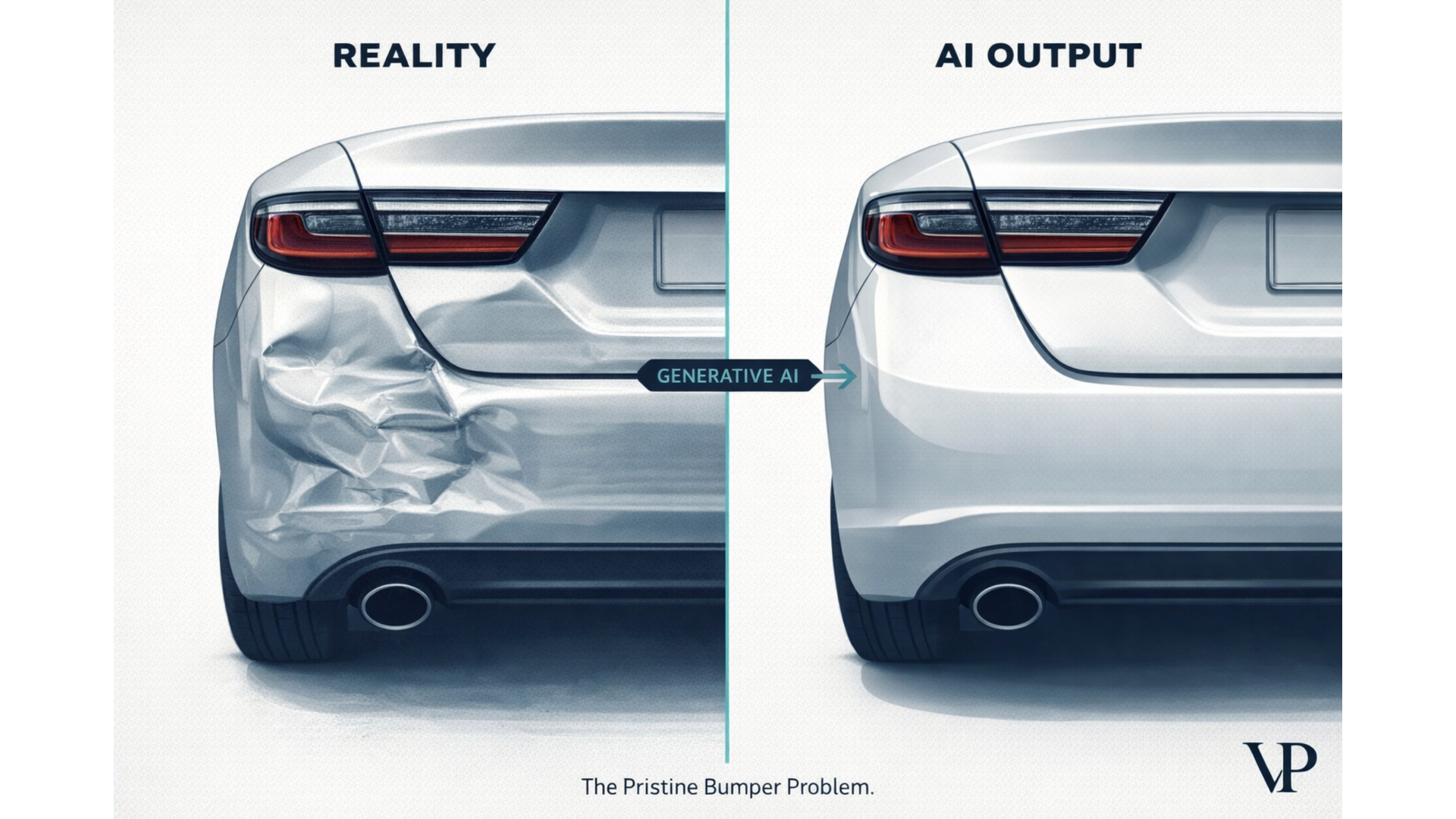
A policyholder photographed a severely dented rear bumper and uploaded it through an insurer's mobile app. The app's AI — built on the same type of generative model that powers image-creation tools like Midjourney — interpreted the crumpled metal as visual noise and digitally smoothed it out. The claims engine received a pristine, fictional image of an undamaged car and denied the claim. The policyholder, standing next to a wrecked vehicle, sued for bad faith.
This isn't a hypothetical. It's a real pattern we call the "Pristine Bumper" problem, and it exposes a structural flaw in how the insurance industry is adopting AI. The flaw isn't a bug. It's the technology working exactly as designed — just in the wrong context entirely.
We've spent the past year studying why generative AI fails at insurance claims forensics, and the answer is deceptively simple: these models are built to create beautiful images, not to measure truth. For an industry regulated by evidence standards, that distinction is existential.
The Dent That Looked Like Noise
To understand why this happens, you need to understand what generative image models actually do. Tools like Stable Diffusion and DALL-E are trained on billions of images to learn what things "should" look like. In their mathematical world — called latent space — a "car" is overwhelmingly a smooth, symmetrical object with unbroken surfaces.
When one of these models encounters a dent, it doesn't see damage. It sees a disruption in an expected pattern, the same way it would see grain on a film photograph or a smudge on a lens. Its job is to "fix" disruptions. So it fills the crumpled metal with smooth, predictable pixels through a process called inpainting — essentially digital healing.
In art, inpainting restores old photographs. In insurance, it's the automated destruction of evidence.
The model's goal is to make the output image look like a "normal car." A dent is, by definition, abnormal. So the dent disappears. This isn't a failure of the AI. It's the AI succeeding at the wrong task.
Fraudsters Use the Same Technology — in Reverse
While insurers accidentally erase real damage, criminals are using identical tools to manufacture fake damage. The barrier to committing insurance fraud has collapsed.
Someone can now photograph an undamaged car and use text-to-image prompting to "add a smashed front bumper" or "simulate fire damage." Modern generative tools handle lighting, shadows, and reflections with startling realism. A standard AI image classifier — the kind many insurers rely on — will confirm: "Yes, this is a damaged car." It looks at what's depicted, not whether the depiction is real.
The problem extends beyond vehicles. Criminal rings use generative AI to create hyper-realistic faces of people who don't exist, fabricate driver's licenses, and synthesize medical records. In life insurance, AI-generated obituaries and coroner reports support claims for deaths that never occurred. In health insurance, invoices from nonexistent clinics and X-rays showing phantom fractures pass initial review.
Traditional defenses are failing. AI-generated images often carry scrubbed or synthesized metadata. And research consistently shows that humans perform barely better than a coin flip at detecting high-quality deepfakes.
Why "Wrapper" AI Makes This Worse
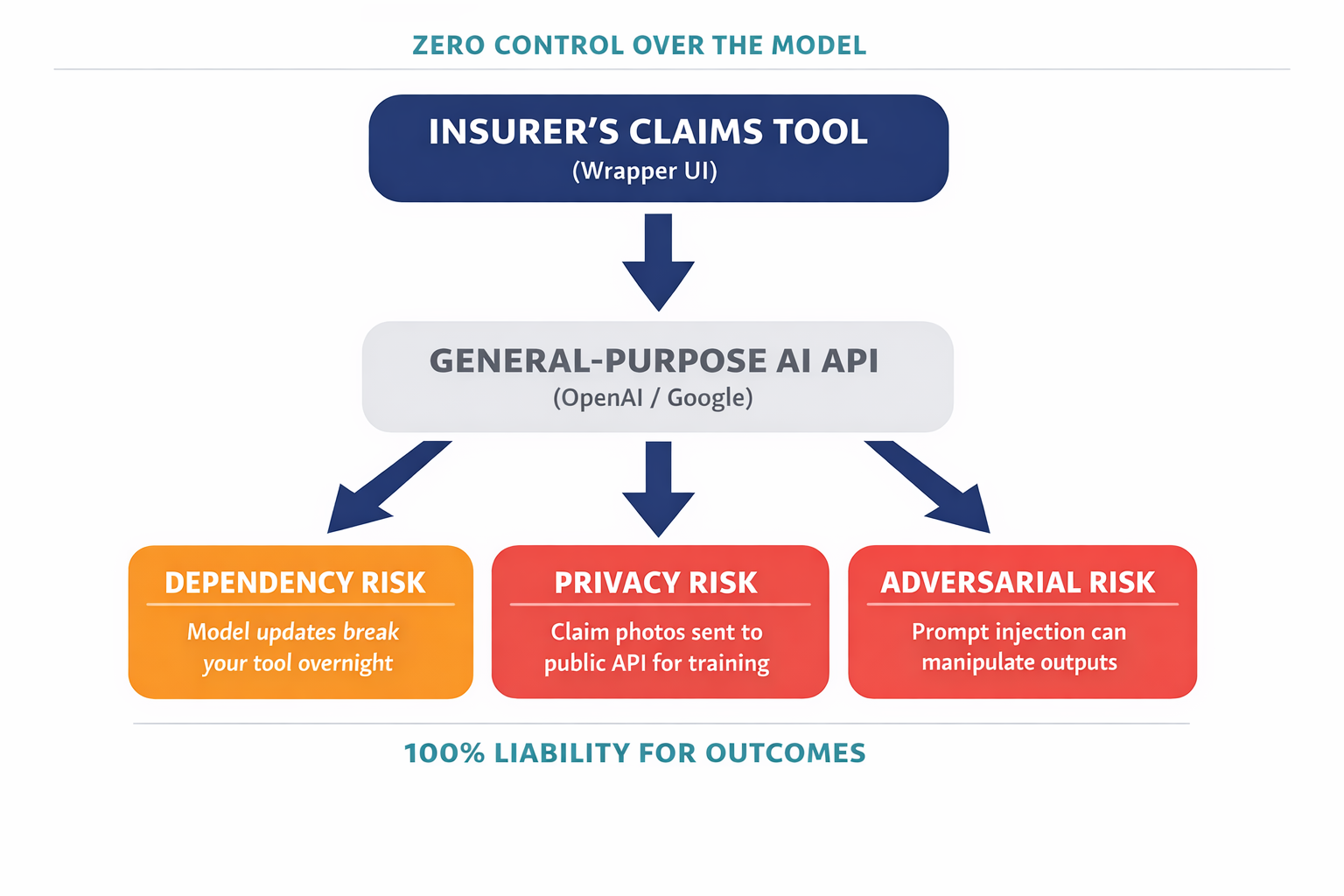
The majority of AI tools flooding the insurance market right now aren't built from scratch. They're wrappers — thin user interfaces layered on top of public APIs from companies like OpenAI or Google. The wrapper company builds the front end; the actual intelligence comes from a general-purpose model that knows nothing about insurance.
A general-purpose model doesn't understand the concept of indemnity. It can't distinguish between a cosmetic blemish and structural impact damage. It operates on what looks plausible, not what's forensically accurate.
This creates three risks that most insurers haven't fully reckoned with:
Dependency risk. If the API provider updates their model to be more "aesthetic" or adds content filters that refuse to process crash images, the insurer's tool breaks overnight — with no warning and no recourse.
Privacy risk. Claim photos often contain license plates, bystanders' faces, and sensitive scenes. Sending these to a public API means the data may be used to train future models, creating uncontrollable leakage.
Adversarial risk. Language-model-based tools are vulnerable to prompt injection — hidden instructions embedded in images or text that manipulate the AI's output. A sophisticated fraudster could potentially trick a wrapper tool into approving a claim.
The insurer has zero control over the brain making decisions, but carries 100% of the liability for the outcome.
We explored these risks in depth in our interactive analysis of forensic computer vision for insurance.
The Regulatory Walls Are Closing In
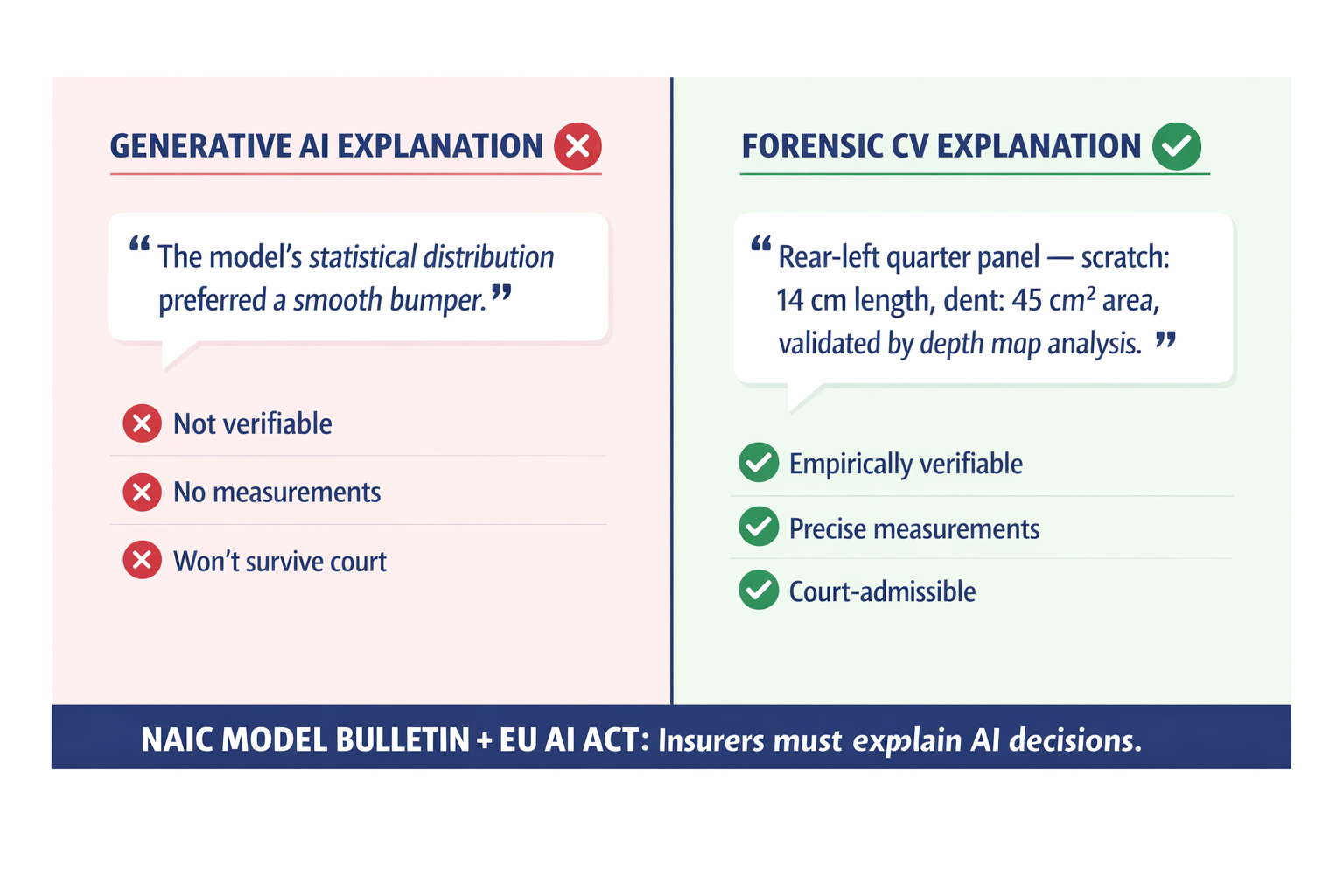
Regulators have noticed. The NAIC (National Association of Insurance Commissioners) Model Bulletin on AI — now adopted by numerous US states — explicitly holds insurers responsible for AI outcomes, including those from third-party vendors. An insurer cannot hide behind the excuse that "our vendor's model did it." If a wrapper tool hallucinates or discriminates, the insurer is liable.
The Bulletin requires written governance programs, due diligence on vendor data and model architecture, and — critically — explainability. If a claim is denied based on AI analysis, the insurer must be able to explain why.
Consider the difference. A generative AI denial explanation sounds like: "The model's statistical distribution preferred a smooth bumper." That won't survive a courtroom. A forensic computer vision explanation sounds like: "Damage detected on the rear-left quarter panel — a scratch measuring 14 cm in length and a dent with a surface area of 45 cm², validated by depth map analysis." That's empirically verifiable.
The EU AI Act raises the bar further. AI used in insurance risk assessment is classified as high-risk, triggering mandatory requirements for data governance, automatic event logging, and human oversight. Any insurer with global exposure needs to plan for this now.
And then there's spoliation — the legal doctrine that penalizes the alteration or destruction of evidence. When a generative AI tool introduces synthetic pixels into a claim photo, it has technically altered the evidentiary record. If the original was overwritten, the insurer may face sanctions, adverse jury instructions, or summary judgment.
Measuring Truth Instead of Creating Fiction
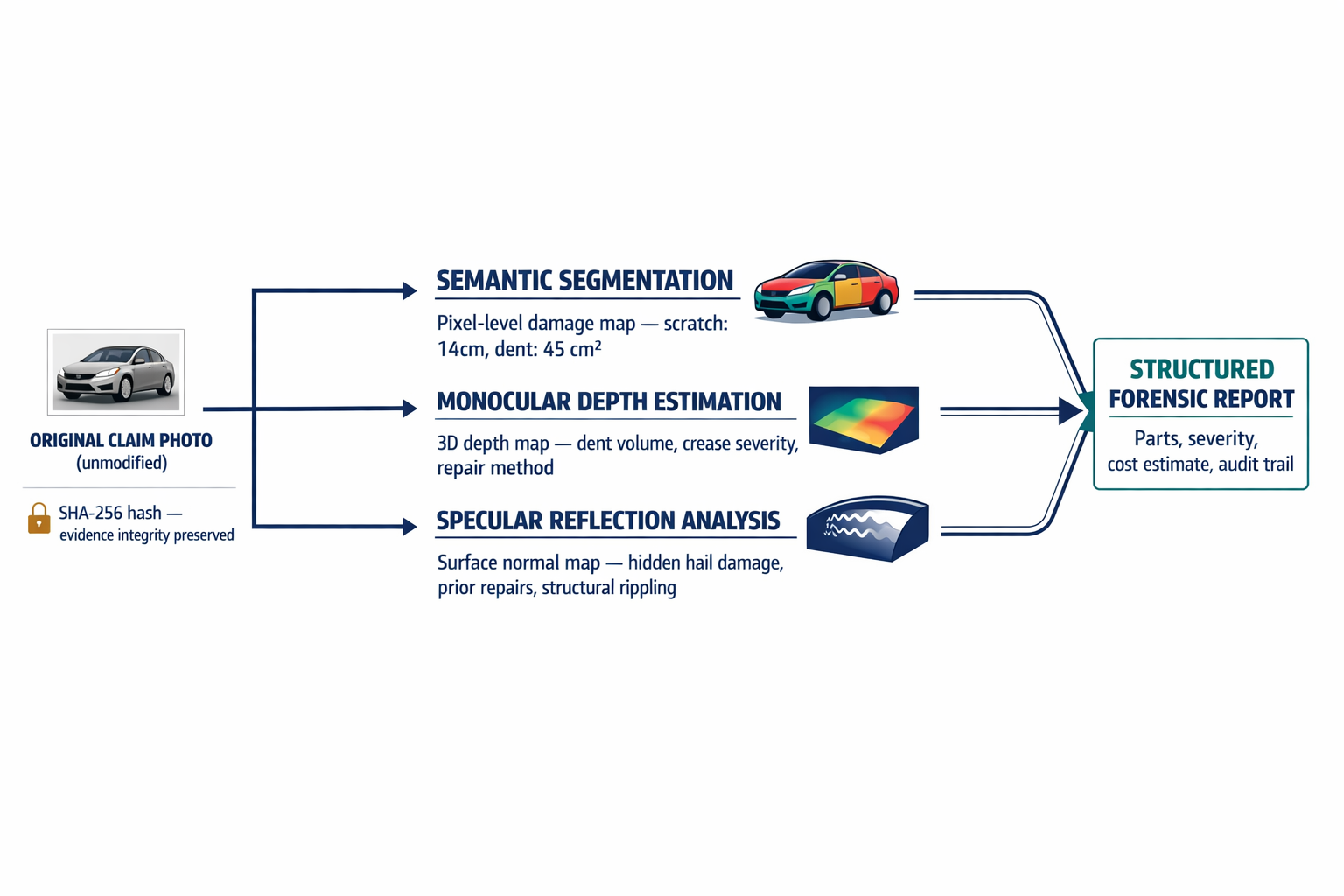
Our approach starts from a fundamentally different premise. We don't generate anything. We don't modify a single pixel of the original image. We measure what's already there.
Our forensic architecture has three layers, each solving a different problem:
Semantic segmentation identifies exactly where damage exists and what kind it is. Using architectures like Mask R-CNN and U-Net, our models classify every individual pixel in an image — background, undamaged paint, scratch, dent, rust. The output is a color-coded mask overlaid on the original photo. Because we can count pixels and correlate them with known vehicle dimensions (a 2024 Toyota Camry bumper is 180 cm wide), we calculate the precise square-centimeter area of each damaged zone. That number feeds directly into repair estimation software.
Monocular depth estimation solves the problem that tripped up the generative AI in the first place: understanding 3D geometry from a flat photo. Using Depth Anything V2, a Vision Transformer trained on massive datasets of vehicle geometries with LiDAR ground truth, our system produces a depth map — where every pixel's value represents its distance from the camera. A dent shows up as a measurable depression. We calculate whether the gradient is steep (a sharp crease requiring panel replacement) or shallow (a soft dent fixable with paintless repair). We estimate the displaced volume of metal. No guessing.
Specular reflection analysis catches what the other two layers can't see. Modern cars are shiny. A dent on a glossy black panel might not change the color of any pixels, but it warps the reflections. Our models use a technique called deflectometry — analyzing how straight lines in the environment (horizons, building edges, road markings) distort when reflected in the car's surface. By applying physics equations in reverse, we reconstruct a surface normal map that reveals hail damage invisible to the naked eye, structural rippling far from the impact site, and "orange peel" texture from previous repairs that might indicate fraud.
We don't just look at the car. We analyze the curve of the metal, the depth of the impact, and the physics of the light.
For the full technical methodology behind each layer, see our detailed research on insurance AI and computer vision forensics.
What Happens to the Evidence
Everything we've described operates under a strict chain-of-custody protocol. The moment an image arrives, we hash it with SHA-256 — a cryptographic fingerprint that proves the file hasn't been altered. Our AI reads the image but never writes to it. All analysis outputs — masks, depth maps, structured reports — are saved as separate sidecar files linked to that original hash. Every access and processing step is logged.
This means the original evidence remains pristine and court-admissible. The adjuster sees the photo exactly as the policyholder took it, with a togglable analysis layer they can switch on and off. They remain the human in the loop — reviewing the AI's findings, not being replaced by them. For low-severity, high-confidence claims, the system can enable straight-through processing that automates payout in seconds. For complex cases, it gives the adjuster a forensic toolkit that would have been impossible five years ago.
What About Simple Classification Models?
Some insurers use older computer vision approaches — basic classifiers that look at a photo and output "damaged" or "not damaged." These preserve the evidence (they don't alter pixels), but they're blunt instruments. They can't tell you where the damage is, how severe it is, whether the surface has been previously repaired, or whether the image is a deepfake. They also fail on reflective surfaces, where glare confuses the classifier.
Our approach treats glare as data, not noise. The reflection on a car's surface carries geometric information about the shape underneath. That's a fundamentally different philosophy — and it's why we can detect hail damage that a human adjuster standing three feet away would miss.
Does This Slow Down Claims Processing?
The opposite. Because our system outputs a structured report — damaged parts, severity scores, repair-versus-replace recommendations, and cost estimates — it eliminates the back-and-forth that slows traditional workflows. The segmentation engine, depth engine, and reflection engine run in parallel. The adjuster opens a dashboard with everything pre-analyzed, not a queue of raw photos to squint at.
We support deployment in the insurer's own private cloud or on-premise infrastructure. The data never leaves their secure perimeter — no public API calls, no data sovereignty concerns, no dependency on a third party's pricing or content policies.
What This Means for Your Claims Strategy
The insurance industry is at an inflection point. The carriers that move fastest on AI will gain enormous operational advantages — but only if they choose the right kind of AI. Generative models are extraordinary creative tools. They are also, structurally, the wrong tool for forensic evidence analysis.
Three things worth considering:
Audit your current AI stack. If any tool in your claims workflow modifies the pixels of a claim photo — even to "enhance" clarity — you may be creating a spoliation liability. Ask your vendor whether their model is generative or discriminative. If they can't answer clearly, that's your answer.
Demand explainability now, not later. The NAIC Bulletin and EU AI Act aren't future concerns. They're current requirements in multiple jurisdictions. Every AI-driven claim decision should produce an audit trail a regulator can follow.
Treat fraud detection as a physics problem, not a pattern-matching problem. Deepfakes will only get better. The defenses that hold up are the ones grounded in physical reality — sensor noise analysis, reflection geometry, depth consistency — not the ones trying to out-pattern-match a generative model.
In the rush to adopt AI, carriers must not confuse plausibility with truth.
We'd welcome a conversation with anyone navigating these decisions. The technology choices being made right now will define which carriers are legally defensible — and which are holding digitally spoliated records when the litigation arrives.