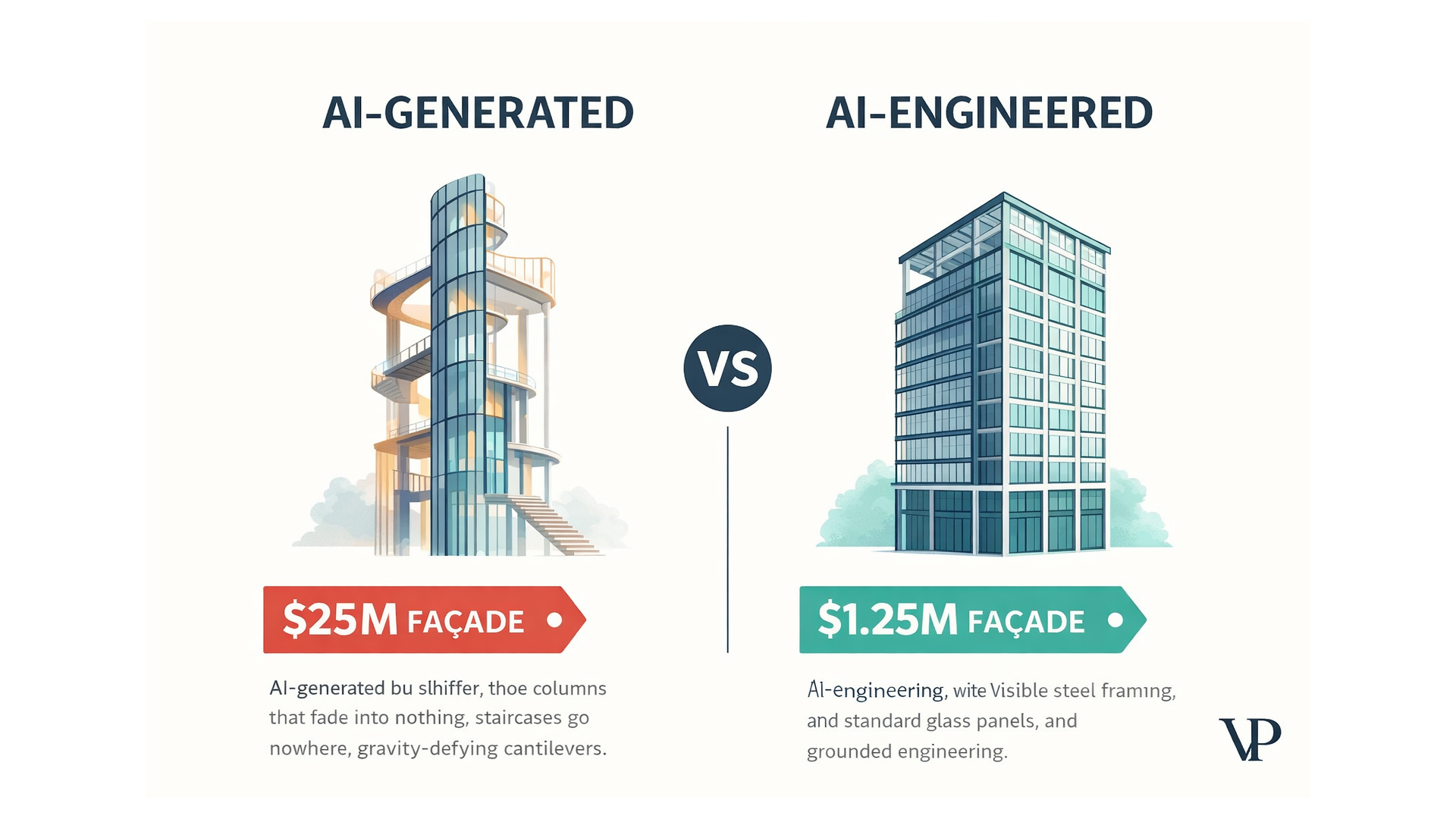
A building designed by Midjourney melted my intern's brain last month. Gorgeous render — cantilevered glass, organic curves, moody lighting. She asked me what it would cost to build. I ran the geometry through our cost engine. The façade alone came back at $25 million. For context, a buildable version of that same façade would cost about $1.25 million.
That's not a rounding error. That's the difference between a profitable project and a bankrupt one. And it captures the central problem with how our industry is using generative AI right now: we've confused generating pictures of buildings with generating buildings.
I've spent the last three years building AI systems that actually design constructible structures. Not renders. Not concept art. Real assets with real steel sizes, real glass specs, and real price tags. What I've learned is that the hard part of architecture was never the creativity. It was the constraints.
The "Escher Painting" Problem
Prompt any major image-generation tool — Midjourney, DALL-E, Stable Diffusion — to design a high-rise, and you'll get something that looks like architecture. Look closer and you'll find staircases that terminate into walls, columns that dissolve into ceilings without transferring any load, and windows that couldn't physically open.
I started calling these "Escher paintings" after the artist who drew impossible staircases. They're visually coherent and structurally nonsensical. Research published in MDPI's Buildings journal confirmed what we were seeing: AI-generated architectural images routinely violate basic spatial logic and construction feasibility.
These tools don't understand buildings. They statistically predict what a building looks like based on billions of training images. They have no model of gravity. No awareness of building codes. No connection to what steel is actually available at your local service center.
A diffusion model doesn't know the difference between a flat pane of glass and a curved one. To the AI, they're both just pixels. To your budget, one costs $18 per square foot and the other costs $500.
Why This Matters More Than You Think
For anyone outside construction, this might sound like a niche technical complaint. It's not. It's an economic time bomb.
The construction industry operates on what I call the 90/10 rule: aesthetics drive about 10% of a project's success, while manufacturability, structural integrity, supply chain logistics, and cost control drive the other 90%. When an AI generates a design that ignores that 90%, it doesn't just create extra work — it can sink an entire development.
The Sydney Opera House is the canonical cautionary tale. Jørn Utzon's original design was a sculptural masterpiece, but the concrete shells were geometrically undefined and essentially unbuildable. The project budget exploded from $7 million to $102 million — a 1,400% overrun — and took an extra decade to complete.
That was one visionary architect pushing one unbuildable concept. Now imagine thousands of developers using AI tools that generate unbuildable concepts by default, at the click of a button, dozens of times per day.
When Buildings Become Weapons
The consequences aren't just financial. They're physical.
The Vdara Hotel in Las Vegas has a sleek, crescent-shaped glass façade. Beautiful design. One problem: the concave surface acts as a giant parabolic mirror. At certain times of day, it focuses solar radiation onto the pool deck with enough intensity to melt plastic lounge chairs and singe guests' hair. They call it the "Vdara Death Ray."
The fix was inelegant — giant umbrellas and non-reflective film slapped onto the glass, destroying the original aesthetic.
The same architect repeated the same physics mistake in London with the "Walkie-Talkie" building at 20 Fenchurch Street. Its concave façade focused sunlight onto the street below and literally melted the bodywork of a parked Jaguar.
These weren't AI-generated designs. They were created by one of the world's top architects with a full engineering team. The physics was simple and predictable — concave mirrors focus light. But nobody ran the simulation early enough.
Now hand that same curved-glass aesthetic to an AI image generator that has zero understanding of optics, and you've automated the creation of death rays.
Generative AI makes it trivially easy to create complex curved geometries. It does nothing to warn you that those geometries might cook your tenants.
I explored this failure pattern in depth in our interactive analysis of constraint-based generative design, which walks through how physics constraints change what AI can produce.
What We Built Instead
My team took a fundamentally different approach. Instead of starting with image generation and hoping the result is buildable, we start with the constraints and let the AI find the best design within them.
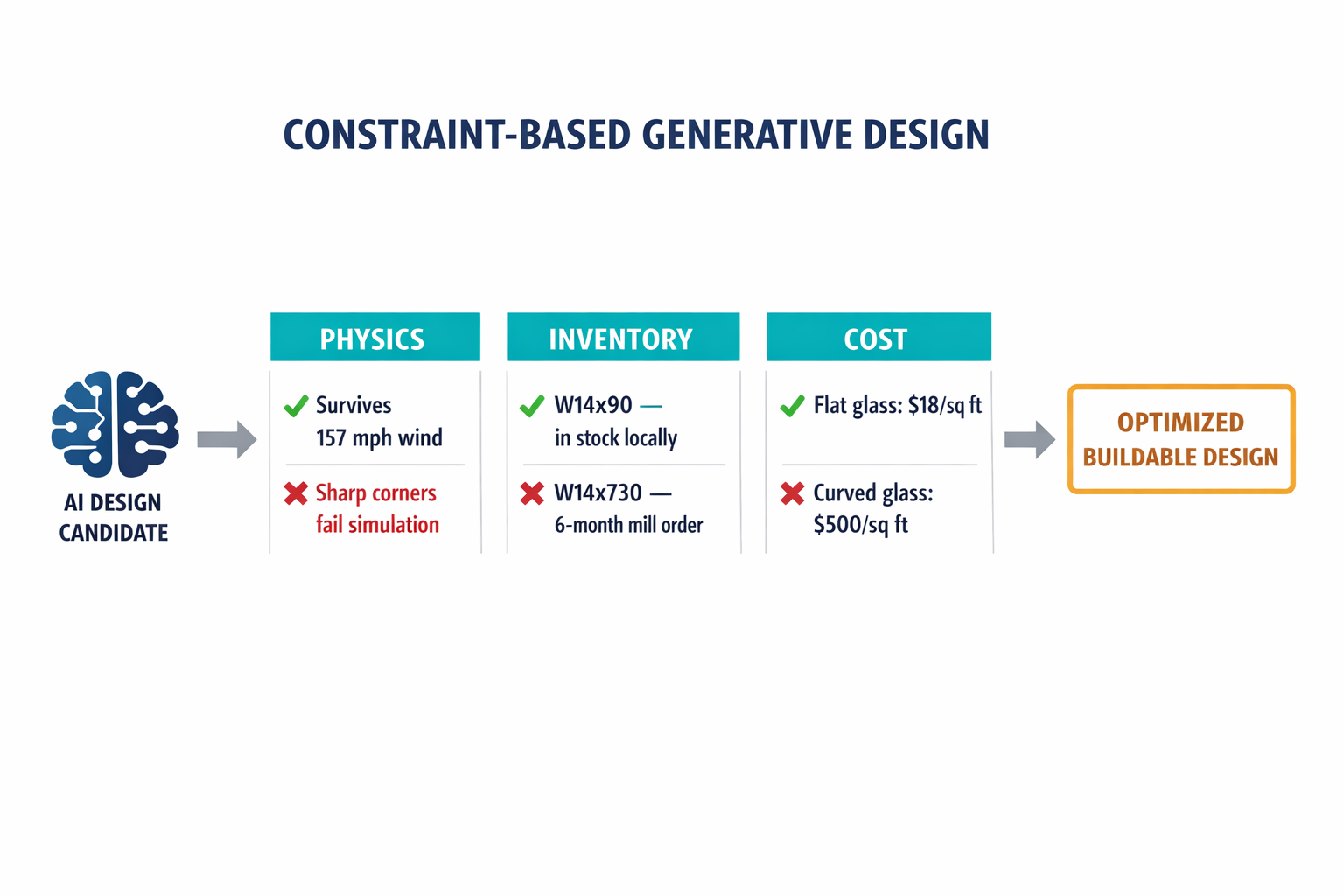
We call this Constraint-Based Generative Design (CBGD). The AI doesn't draw pictures. It makes engineering decisions — placing columns at specific coordinates, selecting specific steel beam profiles, adjusting slab thicknesses — and then gets graded on whether those decisions work.
The grading system is a reward function with three pillars:
Physics. Does the structure stand up? Can it survive a Category 5 hurricane? We simulate wind speeds exceeding 157 mph on every design candidate. The AI learns on its own that softening corners and tapering building forms reduces wind loads — not because we told it to, but because designs with sharp corners kept failing in simulation.
Inventory. Can you actually buy the materials? Our AI connects to live databases of structural steel inventory. It can't just specify a generic "I-beam." It has to pick from real AISC standard shapes — W14x90, W24x68, and so on. Sections available at local service centers get a reward bonus. Sections that require a mill order with a six-month lead time get penalized.
Cost. Can the developer afford it? Standard flat tempered glass ($18–$25 per square foot) is rewarded. Custom curved glass ($100–$500+ per square foot) is penalized unless the design benefit is enormous. Standard bolted connections are cheap and fast — rewarded. Complex full-penetration field welds are expensive and slow — penalized.
Over millions of training episodes, the AI converges on designs that aren't just structurally valid but optimally balanced across safety, cost, and supply chain reality.
The Supply Chain Is a Design Constraint
This is the insight that changed how I think about generative design entirely.
Most people think of the supply chain as something you deal with after you design a building. You finish the blueprints, send them to a fabricator, and then find out that the beam you specified has a four-month lead time because it's only rolled once a quarter.
We flipped that. In our system, the supply chain shapes the design from the first iteration.
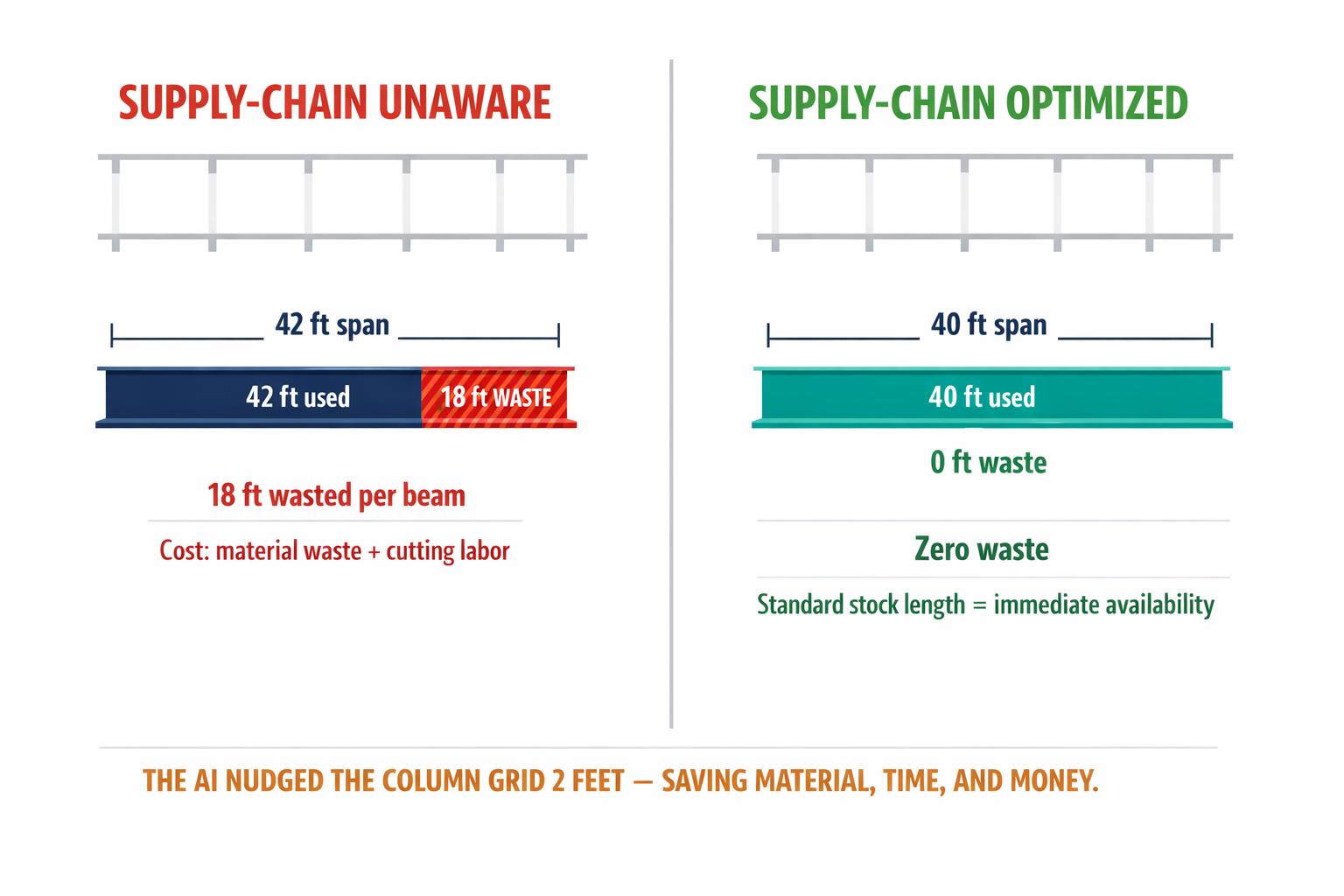
The AI knows that structural steel comes in standard stock lengths — 40 feet, 60 feet. If a design calls for a 42-foot beam cut from 60-foot stock, that's 18 feet of waste. The system penalizes that. It might nudge the column grid to 40 feet instead, eliminating the waste entirely.
It knows that a W14x730 beam might be the mathematically perfect choice for a specific load condition, but if it's a mill-order item that won't arrive for six months, the financing charges alone could cost more than using a slightly heavier in-stock alternative.
We didn't build an AI architect. We built an AI procurement strategist that happens to design buildings.
For the full technical methodology behind our reward function and system architecture, see our detailed research paper.
How Do You Simulate Physics Fast Enough?
This was the hardest engineering problem we faced. Running a full structural simulation (called Finite Element Analysis, or FEA) on a single design can take hours. Our AI needs to evaluate millions of designs. Do the math — that doesn't work.
The breakthrough came from Physics-Informed Neural Networks, or PINNs. Instead of running a full simulation every time, we trained neural networks that have the actual equations of physics baked into their learning process. The network doesn't just learn patterns from data — it's mathematically constrained to obey the laws of equilibrium and stress-strain behavior.
Think of it like this: a regular neural network learns that "columns are usually vertical" by looking at examples. A physics-informed network knows why columns must be vertical — because the equations of force transfer require it. The result is a system that can approximate complex structural and wind simulations in milliseconds instead of hours.
The moment I saw our PINN predict wind pressure distributions on a building façade in under a second — matching results that took our FEA solver forty minutes — I knew we had something real.
What About Creativity?
The most common pushback I get: "Aren't you killing creativity by constraining the AI?"
The opposite is true. Unconstrained AI produces creative-looking images that all get value-engineered into the same boring boxes once a contractor prices them. The creativity was always an illusion — it just delayed the reality check.
Our constrained AI finds creative solutions within the boundaries of what's actually buildable. It discovers aerodynamic profiles that reduce wind loads. It finds structural configurations that use less steel. It optimizes thermal envelopes in ways no human would think to try, because no human can iterate through millions of options.
The creativity isn't in the pixels. It's in the problem-solving.
Does This Replace Architects?
No. It replaces the months of expensive back-and-forth between an architect's vision and an engineer's reality check. The architect still sets the intent, the program, the aesthetic direction. Our system ensures that what comes back is something you can actually build, buy materials for, and afford.
I think of it as giving architects a co-designer that has memorized every steel catalog, every building code, and every glass supplier's price list — and can run a structural simulation in its head before suggesting a single beam.
What This Means If You Build Things
If you're a developer, an architect, or anyone who commissions buildings, the question isn't whether AI will change your industry. It already has. The question is whether you'll use AI that generates art or AI that generates assets.
The difference is a 20x cost multiplier on your façade. It's a six-month delay because your steel is a mill order. It's a "death ray" that melts your tenants' lawn chairs.
The technology to prevent all of this exists today. It's not a better prompt. It's better physics.
I'd genuinely love to hear from anyone wrestling with this — whether you're an architect who's tried using image generators in your workflow, a developer who's been burned by concept-to-construction cost gaps, or an engineer who's tired of value-engineering AI-generated fantasies back to reality. What's your experience been?