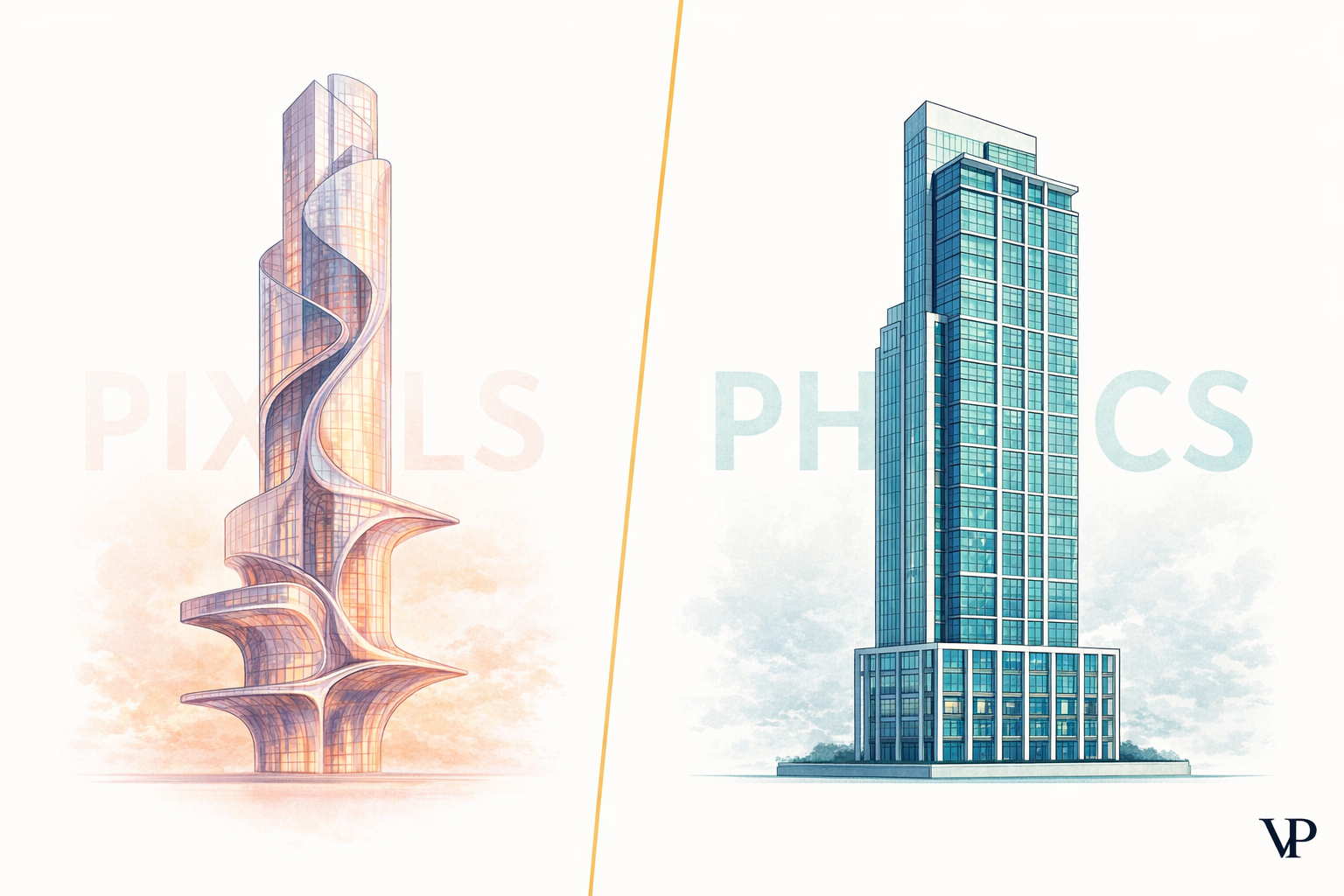
A building that can't be built is not a building. It's a painting.
Right now, the most popular AI tools in architecture — Midjourney, DALL-E, Stable Diffusion — are producing thousands of photorealistic building renders every day. They're gorgeous. They feature sweeping glass façades, gravity-defying cantilevers, and atmospheric lighting that would make any developer's heart race. They're also, in almost every engineering sense that matters, fiction.
We've spent considerable time analyzing what these generalist AI models actually produce when asked to "design" buildings. The outputs are what we call Escher paintings — visually arresting structures where staircases terminate in solid walls, load-bearing columns dissolve into ceilings without transferring force, and windows lack any operability mechanism. They look like architecture. They function like fantasy. And for enterprise developers operating in a world where a single material miscalculation can sink a $200 million project, the distinction between a cool render and a constructible asset isn't academic. It's existential.
This is the core problem with AI in architecture today, and it's why we've built our methodology around something fundamentally different: Constraint-Based Generative Design.
The Pixel Doesn't Know It's Supposed to Hold Weight
When you prompt a generalist AI model to "design a sustainable high-rise in Miami," the model does something that feels like architecture but isn't. It statistically predicts what an architectural image looks like based on billions of internet images. It has no internal model of the Miami-Dade County Building Code. It has no awareness of the shear forces generated by a Category 5 hurricane. It has no connection to the real-time inventory of local steel service centers.
The result is what we call a hallucination of function. The generated image may depict a glass façade that appears structurally sound, but which relies on material properties that don't exist or construction methods that would bankrupt the project.
A diffusion model doesn't understand that load must be transferred continuously to the foundation. It only understands that columns are typically vertical features found in buildings.
This matters because of a concept we call the latent space vs. physical space gap. In the AI's mathematical world, a "window" is defined by its visual similarity to other images of windows. In the physical world, a window is a complex assembly defined by thermal breaks, glazing ratios, rough opening dimensions, and flashing details. The AI sees pixels. The building needs physics.
The 1,400% Budget Overrun That Predicted Our Current Crisis
The collision between beautiful geometry and buildable reality isn't new. The Sydney Opera House is the canonical example. Jørn Utzon's competition entry was a masterpiece of expressionist sculpture — and it was structurally undefined. The concrete shells, as originally drawn, were geometrically indeterminate and virtually unbuildable. The project proceeded without a resolved structural solution.
The consequences: the budget exploded from $7 million to $102 million — a 1,400% overrun — and the project was delayed by a full decade.
That was one building, one architect, one set of unbuildable curves. Now imagine generalist AI tools encouraging thousands of developers to explore similarly unconstrained forms simultaneously. Every sinuous façade, every organic curve that looks stunning in a JPEG but hasn't been "rationalized" — broken down into planar, developable surfaces that can actually be cut from standard flat sheets of material — is a potential budget catastrophe waiting to happen.
We explored this dynamic in depth in our interactive analysis of constraint-based generative design, examining how the gap between what AI can render and what humans can build has become the central risk in modern architectural development.
The $25 Million Difference Between a Flat Pixel and a Curved One
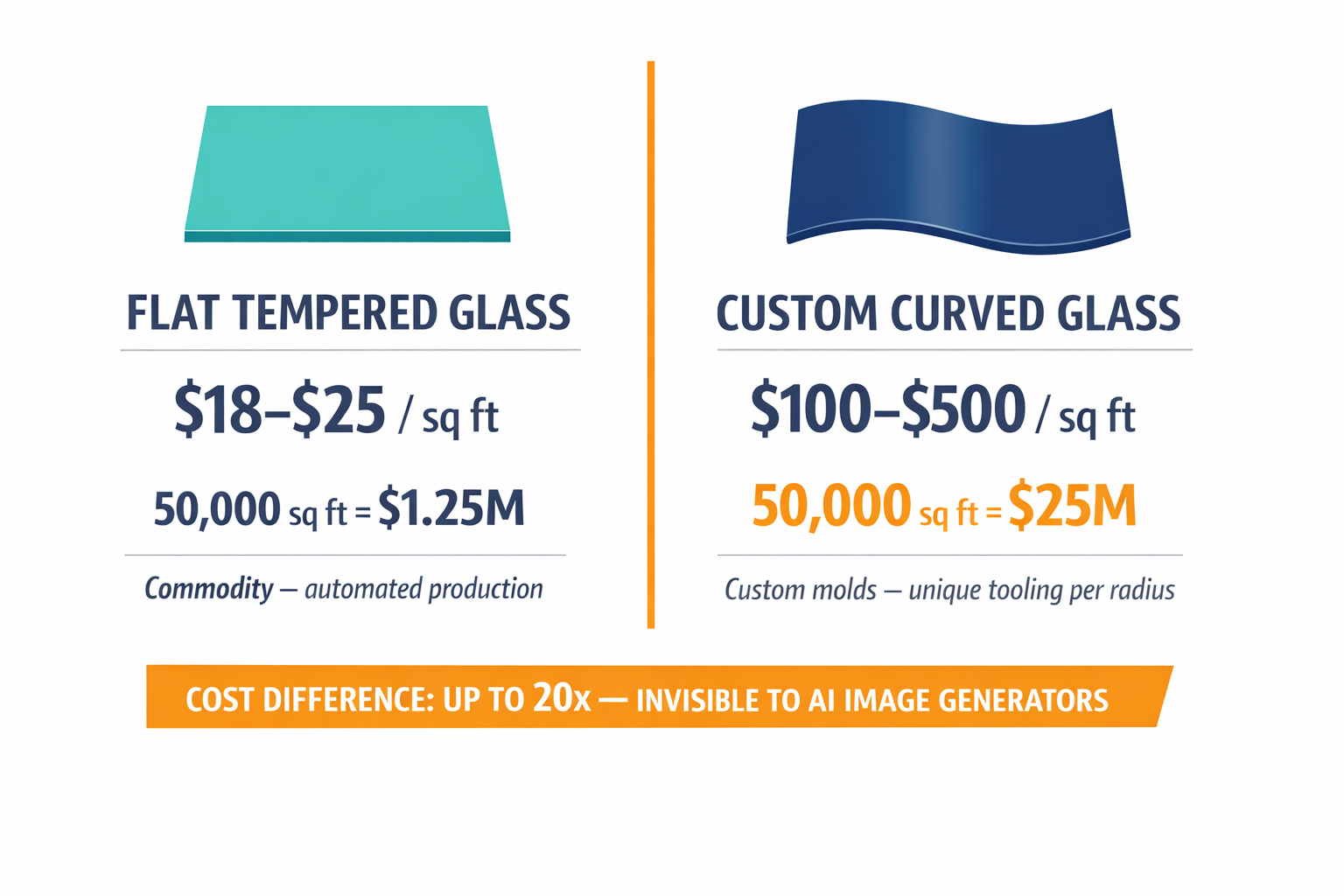
To a diffusion model, a flat surface and a curved surface are equally easy to generate. To a developer, they are worlds apart.
Standard flat tempered glass — the industry workhorse — costs between $18 and $25 per square foot in 2025. It's a commodity. Automated float plants churn it out. It's easy to transport, easy to install, easy to replace.
Custom curved glass requires a secondary heating process where the glass is slumped over a custom mold or mechanically forced into shape. Each unique radius needs distinct tooling. The cost: $100 to over $500 per square foot.
That's a 20x price differential that is completely invisible to a generalist AI model. On a project with 50,000 square feet of glazing, the difference between specifying flat glass ($1.25 million) and curved glass ($25 million) is the difference between a profitable asset and an insolvent one.
The AI sees no distinction between a flat pixel and a curved pixel. The developer sees a $23.75 million problem.
The same logic applies to structural steel. When a design calls for a beam size that isn't stocked at regional service centers, the steel must be ordered directly from the mill — with minimum tonnage requirements and lead times stretching to months. A specific shape might only be rolled once per quarter. An AI that selects a structurally perfect but logistically unavailable beam has just introduced a critical path delay that could cost millions in financing charges alone.
When Buildings Become Weapons: The Physics That AI Ignores
The consequences of physics-blind design aren't just financial. Sometimes they're dangerous.
The Vdara Hotel in Las Vegas features a distinctive crescent-shaped, south-facing glass façade. The concave geometry acted as a massive parabolic reflector — think of a magnifying glass focusing sunlight. During certain times of day, the façade concentrated solar radiation onto the pool deck, creating a convergence zone that melted plastic lounge chairs and singed guests' hair. The phenomenon was dubbed the "Vdara Death Ray."
The physics were simple and entirely predictable: a concave mirror focuses light. Yet the design process failed to simulate this interaction.
The same architect repeated the same error in London with 20 Fenchurch Street — the "Walkie-Talkie" building — whose concave design focused sunlight onto the streets below with enough intensity to melt the bodywork of a parked Jaguar.
As AI tools make it trivially easy to generate complex, curved, and reflective geometries, the risk of creating inadvertent death rays, wind tunnels, and thermal hazards doesn't decrease. It multiplies.
What Constraint-Based Generative Design Actually Means
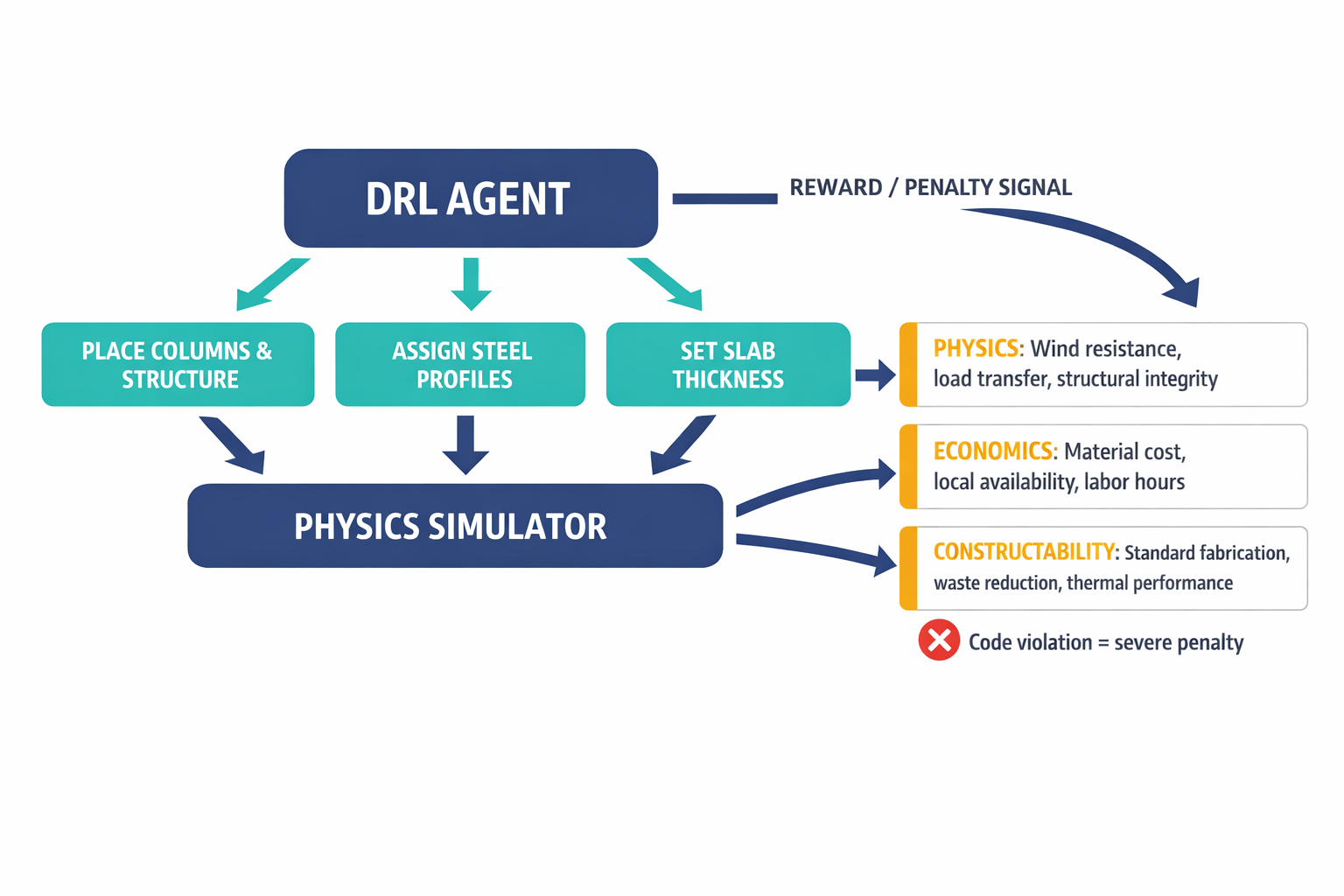
Our methodology starts from a fundamentally different premise than text-to-image generation. We don't ask an AI to imagine what a building looks like. We ask it to engineer what a building must be.
The core technology is Deep Reinforcement Learning (DRL) — a branch of machine learning where an AI agent learns through trial and error, not by studying images, but by interacting with a high-fidelity physics simulator. Think of it like training a pilot in a flight simulator rather than showing them photographs of cockpits.
The agent's actions aren't "draw a pixel." They're engineering decisions: place a column at these coordinates, assign this specific steel profile to that beam, increase slab thickness to this measurement. And every action is evaluated against a composite reward function that simultaneously weighs three things:
Physics performance — Does the structure stand up? Does it resist wind? Does it transfer load properly to the foundation?
Economic viability — What does this material cost? Is it available from a local service center, or does it require a six-month mill order? How many labor hours does this connection type require?
Constructability — Can this geometry be fabricated with standard methods? Does it generate excessive material waste? Does it create thermal bridging that will inflate energy costs for decades?
We don't just ask the AI to minimize weight. We ask it to minimize weight subject to using standard steel sections and resisting Category 5 wind loads.
When the agent proposes a design element that violates a hard constraint — a code violation, a safety factor breach — it receives a severe penalty. Over millions of training episodes, the agent converges on designs that aren't just structurally valid but optimally balanced across safety, cost, and supply chain availability.
How an AI Learns That Gravity Is Non-Negotiable
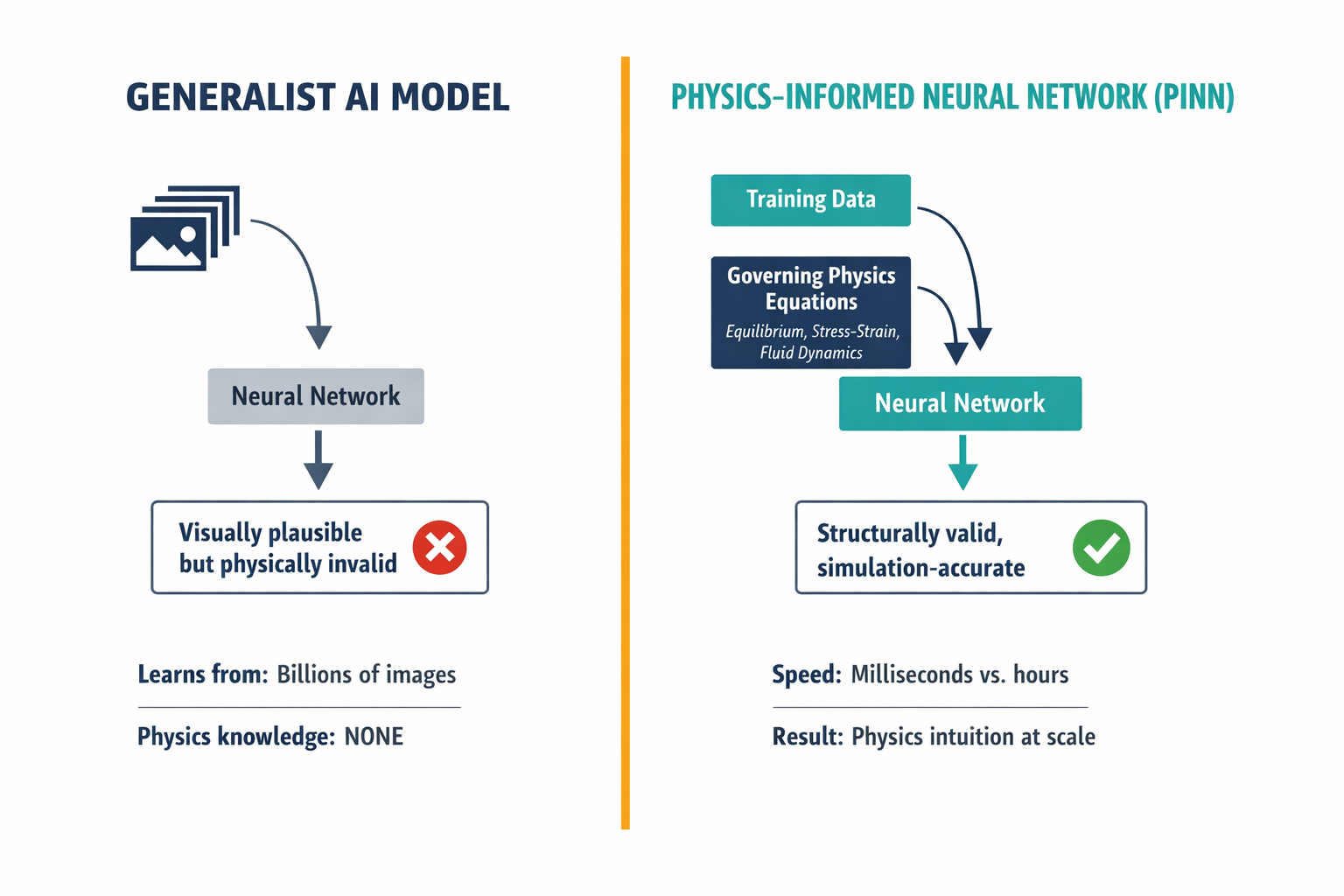
Running a full structural simulation for every design iteration would take hours per cycle, making it impossible to explore millions of options. We solve this with Physics-Informed Neural Networks (PINNs) — neural networks that have the governing equations of physics embedded directly into their mathematical structure.
Instead of learning physics purely from data (which is how generalist models work and why they fail), PINNs are constrained by the equations of equilibrium, stress-strain compatibility, and fluid dynamics. The network can approximate the results of a complex structural or wind simulation in milliseconds rather than hours, giving the AI what amounts to physics intuition at the speed of thought.
For projects in hurricane-prone regions, the AI subjects every generated design to simulated wind speeds exceeding 157 mph — Category 5 conditions — following the provisions of ASCE 7-16, the standard for minimum design loads. Through millions of iterations, the agent independently discovers principles that human engineers have developed over decades: that softening corners reduces drag, that tapering building forms cuts base shear, that strategic cutouts can manage vortex shedding.
The difference is that safety becomes a driver of the form itself, not a check performed after the creative work is done.
For the full technical methodology behind our physics simulation, reinforcement learning architecture, and cost engine integration, see our detailed research paper.
"But Won't Constraints Kill Creativity?"
This is the objection we hear most often, and it reflects a misunderstanding of how creativity works in engineering. Constraints don't kill creativity — they direct it. Every great building ever constructed was shaped by gravity, budgets, material availability, and building codes. The Sydney Opera House became iconic because of the spherical solution that resolved its unbuildable geometry, not despite it.
What constraints kill is waste. They kill the months spent developing a concept that gets value-engineered into something unrecognizable the moment a contractor prices it. They kill the "sticker shock" that occurs when a beautiful render meets a bill of quantities.
Our system doesn't prevent an architect from specifying curved glass. It ensures the AI only proposes curved glass when the value it creates — views, branding, functional performance — genuinely justifies a 20x cost increase. That's not a limitation. That's fiduciary intelligence.
What About Existing BIM Tools? Don't They Already Handle This?
Building Information Modeling tools are powerful, but they operate downstream. They help you document and coordinate a design that already exists. They don't generate designs that are pre-optimized for constructability, cost, and physics from the first sketch.
The gap we're addressing is at the conceptual phase — the moment when form is being explored and major cost commitments are being locked in, often without anyone running the numbers. By the time a design reaches BIM, the most expensive decisions have already been made.
The Real Question for Enterprise Developers
Aesthetics are 10% of a building's success metric. Manufacturability, structural integrity, supply chain logistics, and economic viability are the other 90%.
The construction industry doesn't suffer from a lack of imagination. Generalist AI has made imagination nearly free. What the industry lacks is certainty — confidence that a design can be built, on budget, on schedule, with materials that actually exist in the supply chain.
Every enterprise developer evaluating AI tools for their design pipeline should be asking one question: Does this tool know what things cost, what's in stock, and what physics allows? If the answer is no, you're looking at an art generator, not a design tool.
The future of architecture isn't better prompts. It's better physics.
If your team is wrestling with how to integrate AI into design workflows without introducing constructability risk, we'd welcome that conversation.