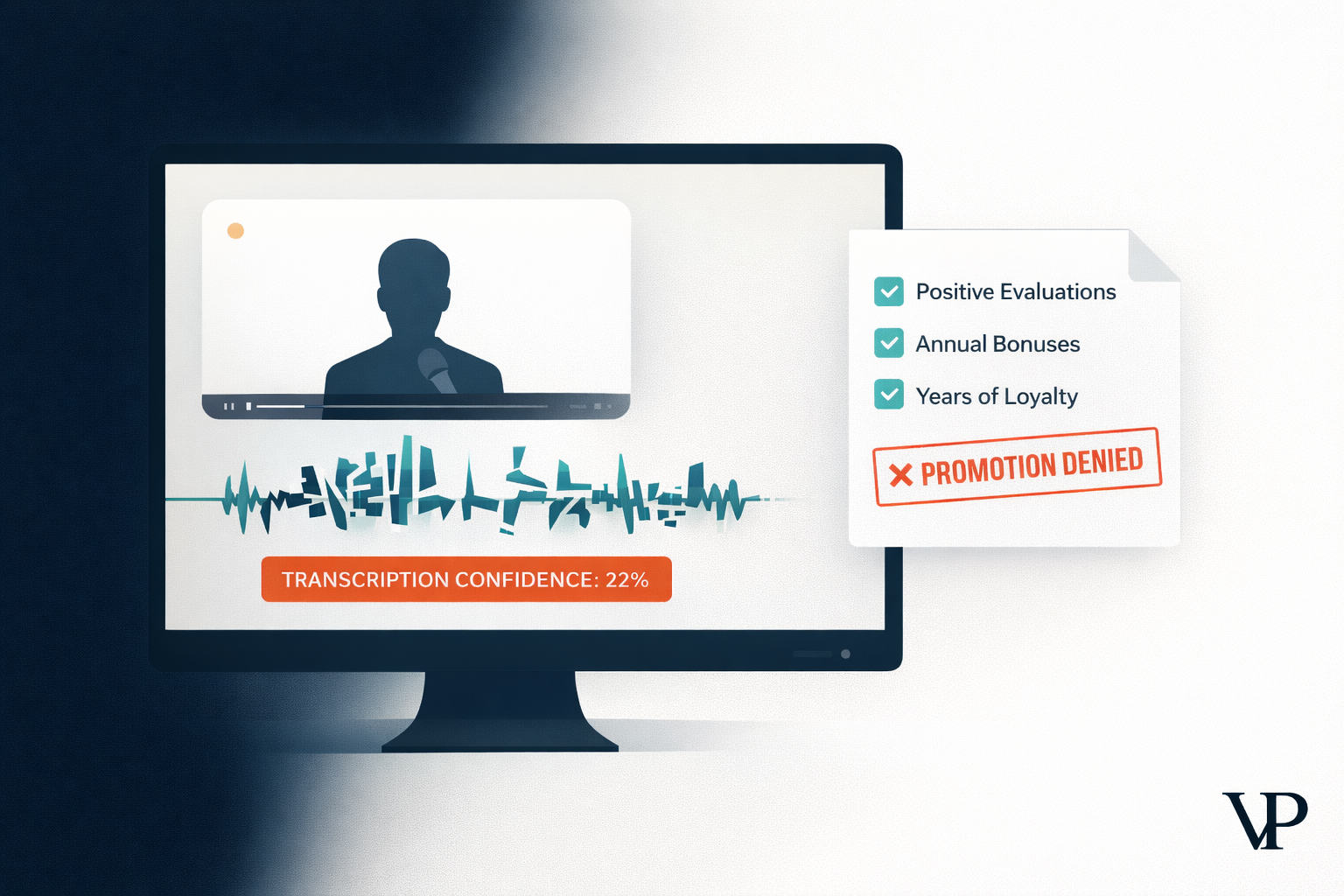
A high-performing employee — positive evaluations, annual bonuses, years of loyalty — applied for a promotion. The AI video interview tool her employer required told her to "practice active listening." She is Deaf.
That's not a hypothetical. In March 2025, the ACLU of Colorado filed an administrative complaint against Intuit and its technology vendor HireVue on behalf of D.K., a Deaf Indigenous woman whose promotion to Seasonal Manager was blocked by an automated video interview system. The system's speech recognition couldn't handle her accent. Its feedback was nonsensical. And when she requested a human captioner as an accommodation, she was forced to use error-prone automated captions instead.
This case isn't an edge case. It's the inevitable result of how most enterprise AI hiring tools are built today — as thin wrappers around general-purpose language models that were never designed for the precision that high-stakes human assessment demands. And as new laws from Colorado to the EU begin to take effect, the gap between what these tools promise and what they actually deliver is becoming a legal and operational crisis.
We've spent months analyzing this case, the underlying technology failures, and the regulatory landscape closing in on enterprises. What we found is a systemic problem that no amount of prompt engineering can fix.
The System Worked Exactly as Designed — That's the Problem
The instinct is to call what happened to D.K. a "glitch." It wasn't. The automated speech recognition (ASR) system powering her video interview performed precisely as its training data dictated. It was trained overwhelmingly on standard, hearing-centric speech patterns. When it encountered D.K.'s Deaf accent, it didn't adapt. It broke.
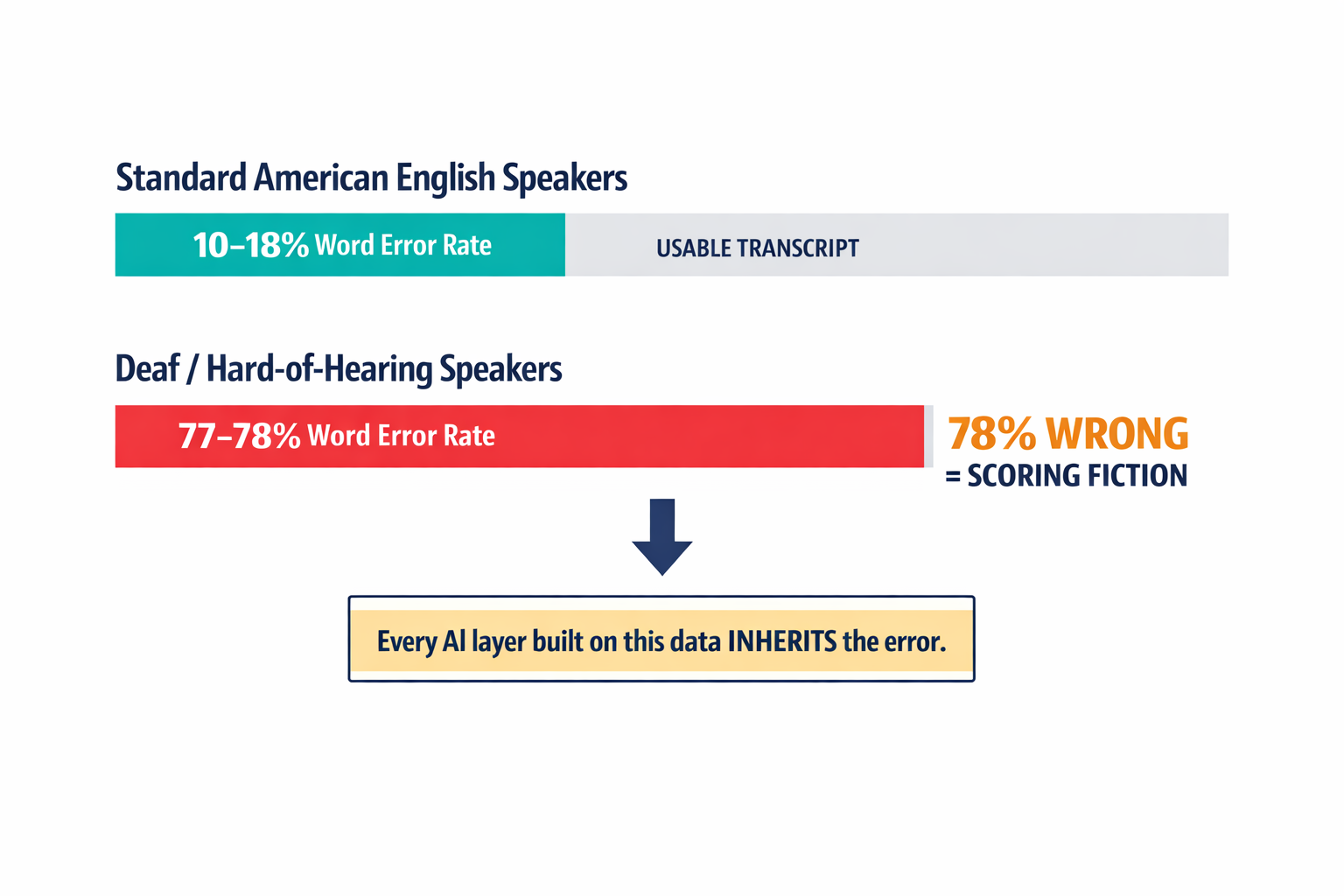
And the numbers behind that breakdown are staggering. Research on ASR performance across speaker groups shows that while standard American English speakers experience word error rates of 10–18%, Deaf and hard-of-hearing speakers with average intelligibility see error rates of 77–78%. That's not a transcription with some gaps. That's noise.
When your transcript is 78% wrong, any AI model analyzing it for "leadership potential" is scoring fiction.
The downstream effect is mathematical. If the foundational data — the transcript — is catastrophically inaccurate for a specific group of people, then every layer of analysis built on top of it inherits that inaccuracy. The model isn't evaluating D.K.'s qualifications. It's evaluating its own failure to understand her, and then penalizing her for it.
This is what the law calls disparate impact: a system that appears neutral on its face but creates a barrier that is functionally insurmountable for a protected class.
Why Generic AI Models Can't Solve This
The market is flooded with companies selling "AI-powered hiring" that are, architecturally, thin interfaces on top of public large language models — GPT-4, Claude, and their peers. These models are extraordinary at general reasoning. They are fundamentally unsuited for deciding who gets a job.
The core issue is training data. General-purpose LLMs learn from massive, uncurated internet datasets. If historical hiring patterns show a preference for certain demographics in certain roles, the model absorbs that pattern as a feature, not a bug. It optimizes for what has been, not what should be.
The second issue is auditability. When a candidate is rejected, can the system explain exactly which features drove that decision? And can it prove — mathematically — that the outcome would have been identical if the candidate's race, gender, or disability status had been different? This is called counterfactual fairness, and most wrapper-based tools can't even approximate it.
We explored this technical gap in depth in our interactive analysis of the algorithmic accountability mandate, examining how the architecture of these systems predetermines their failure modes — the predictable ways they break down — before a single candidate ever logs in.
The question isn't whether your AI hiring tool is biased. It's whether you can prove it isn't.
A Regulatory Reckoning Is Already Underway
For years, AI ethics in hiring lived in the realm of voluntary guidelines and aspirational principles. That era is over.
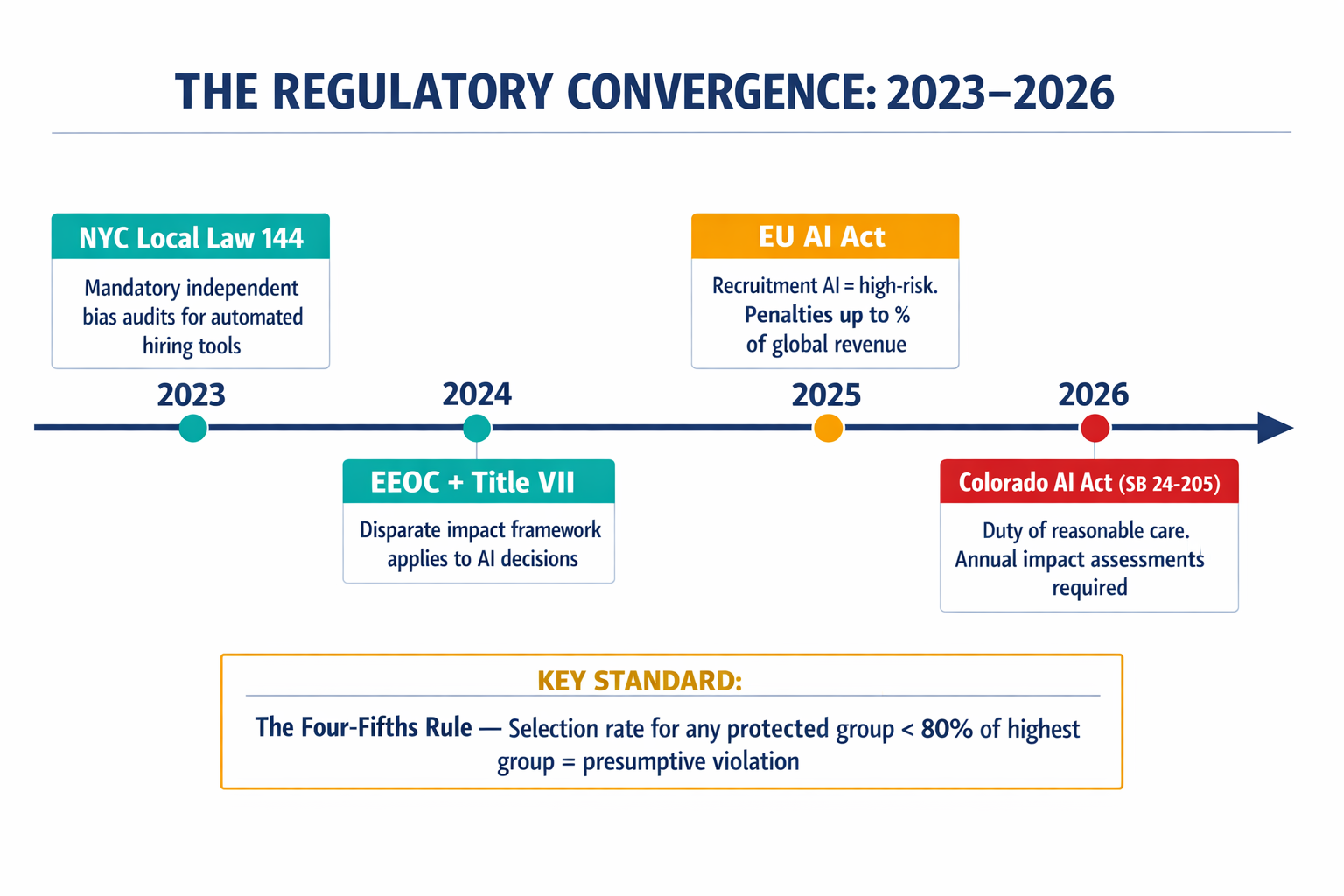
The Colorado Artificial Intelligence Act (SB 24–205), taking effect in early 2026, establishes a legal "duty of reasonable care" for anyone who builds or deploys high-risk AI. Hiring and promotion systems are explicitly covered. The law requires annual impact assessments that screen for algorithmic discrimination — not as a best practice, but as a condition of legal operation.
It's not alone. New York City's Local Law 144 already mandates independent bias audits for automated employment decision tools. The EU AI Act classifies recruitment AI as high-risk, requiring transparency and human oversight with penalties tied to global revenue. And at the federal level, the EEOC's existing disparate impact framework under Title VII applies to AI decisions just as it applies to human ones.
The legal standard that matters most is deceptively simple: the Four-Fifths Rule. If your AI system's selection rate for any protected group falls below 80% of the rate for the highest-selected group, you have a presumptive disparate impact violation. The system's intent is irrelevant. Only the outcome matters.
Perhaps most consequentially, in Mobley v. Workday, a federal court certified a collective action on the theory that an AI vendor acts as an "agent" of the employer when its software performs functions traditionally handled by a human hiring manager. The legal shield that vendors once enjoyed — "we just provide the tool, the client makes the decisions" — is dissolving.
What "Deep AI" Actually Means for Talent Systems
The term gets thrown around loosely, so let us be specific about what we mean. A Deep AI approach to talent assessment isn't about using a bigger model or a fancier interface. It's about building systems where fairness is an architectural constraint, not an afterthought.
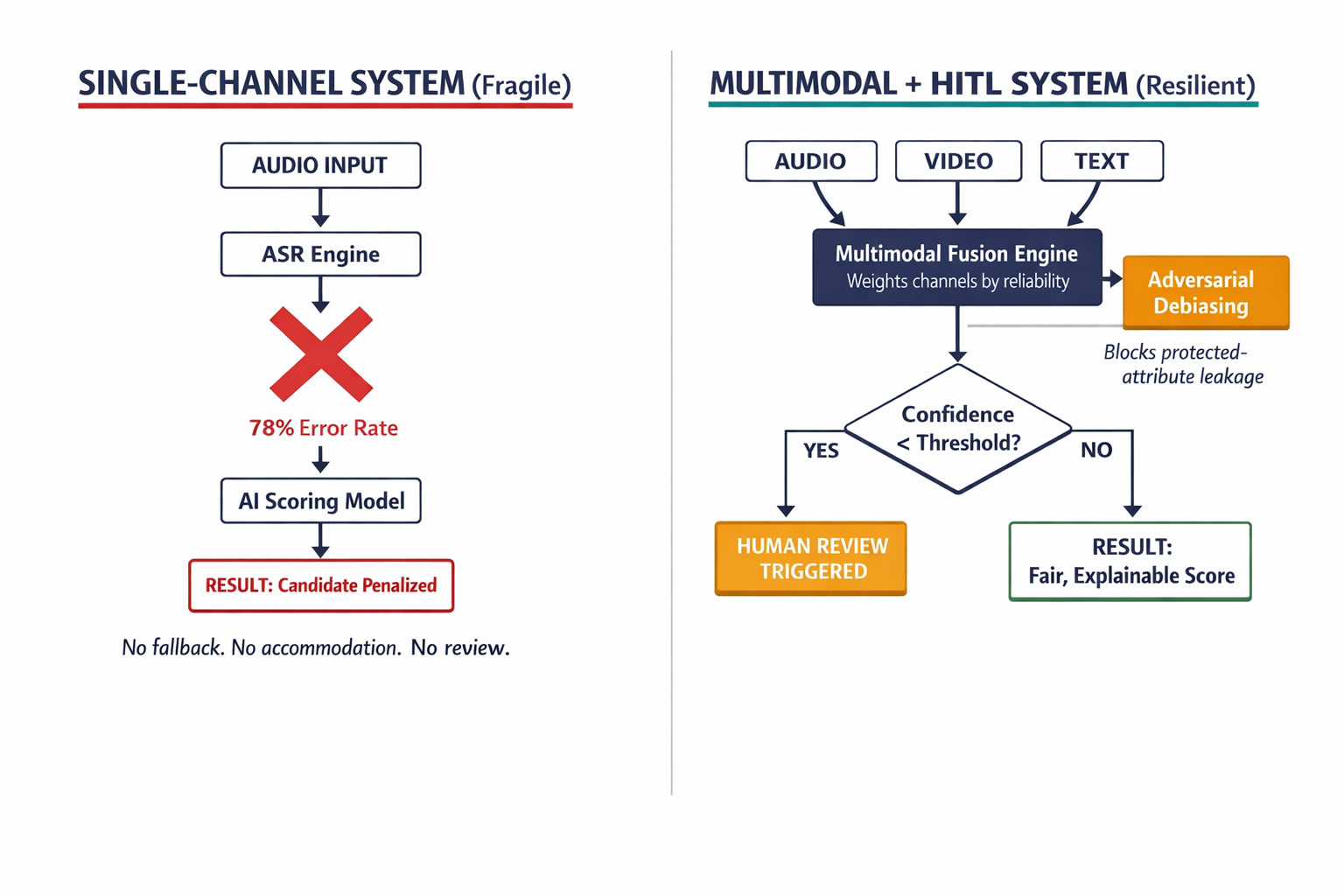
One critical technique is adversarial debiasing. Our systems train two models simultaneously: a primary model that scores candidates on job-relevant competencies, and an adversary model whose sole purpose is to detect whether the primary model's internal representations leak information about protected attributes — race, gender, disability status. The primary model is penalized until the adversary can no longer distinguish between groups. The result is a scoring system that is mathematically constrained to ignore what it legally must ignore.
Another is multimodal fusion — and this is precisely where the Intuit/HireVue system failed. D.K.'s assessment collapsed because the system over-relied on a single channel: audio. When that channel produced garbage data, the entire assessment became garbage. A properly architected system integrates video, audio, and text at a foundational level, weighting each channel based on its reliability for a given candidate. If the audio signal is degraded — whether by a Deaf accent, background noise, or a poor connection — the system shifts weight to visual engagement cues and written responses rather than penalizing the candidate for something outside their control.
AI should be a bridge to talent, not a barrier to it.
When the Machine Should Step Aside
The most revealing detail in the ACLU complaint isn't the technology failure. It's the human failure: D.K. asked for a human captioner. She was denied.
In any serious AI deployment, human intervention isn't an exception to be minimized — it's a designed component of the system. We build what's called Human-in-the-Loop (HITL) architecture, where the system itself triggers human review when its confidence drops below a defined threshold.
For a candidate like D.K., this would unfold naturally. The system detects a non-standard speech pattern during the initial audio check. The ASR model flags low transcription confidence. Instead of plowing ahead with bad data, the workflow automatically routes the interview to a human captioner or offers the candidate a written-response alternative. The assessment continues. The candidate is evaluated on what they actually said, not on what the machine thought it heard.
This isn't a luxury feature. Under emerging regulations, it's becoming a requirement. The EU AI Act explicitly mandates human oversight for high-risk AI systems. Colorado's law requires impact assessments that account for accommodation workflows. The technical architecture and the legal architecture are converging on the same conclusion: machines that can't explain when they're uncertain shouldn't be making consequential decisions about people's careers.
Can Explainability Actually Be Measured?
Skeptics rightly ask: how do you audit something this complex? The answer lies in techniques like SHAP analysis (SHapley Additive exPlanations), which quantifies exactly how much each input feature contributed to a final recommendation. If a SHAP analysis reveals that a candidate was penalized for vocal prosody — the rhythm and intonation of their speech — rather than the substance of their answers, that's a red flag with a specific, measurable magnitude.
This matters because prosody correlates strongly with accent, which correlates with race, national origin, and disability status. A system that weights prosody heavily isn't measuring job fitness. It's measuring how closely someone sounds like the majority population in the training data.
For the full technical methodology behind bias detection and multimodal fairness architectures, see our detailed research on deep AI hiring systems.
What If Our Workforce Is Too Small for Bias to Show Up Statistically?
This is the most common objection we hear from mid-size enterprises, and it's a fair one. The Four-Fifths Rule requires enough data to be statistically meaningful. But the regulatory framework doesn't give small-sample employers a free pass — it shifts the burden. If you can't demonstrate statistical fairness because your numbers are small, you need to demonstrate procedural fairness: documented accommodation workflows, explainable scoring, human review triggers.
The deeper point is that bias doesn't require scale to cause harm. D.K. was one person. One promotion. One interview. The damage to her career, her dignity, and her employer's legal exposure was complete.
What Should Enterprises Do Now?
The March 2025 complaint isn't an indictment of AI in hiring. It's an indictment of the specific way most companies have been deploying it — quickly, cheaply, and without the architectural rigor that consequential decisions about people's lives demand.
Three things matter right now:
Audit your current tools against the Four-Fifths Rule across every protected class, including disability status and accent/dialect. If your vendor can't provide this data, that's your answer.
Demand explainability from any AI system making hiring or promotion recommendations. If the vendor can't tell you which features drove a specific decision, the system is a black box with a lawsuit inside it.
Build accommodation into the architecture, not the exception-handling process. Human-in-the-loop workflows should trigger automatically, not require a candidate to fight for them.
The regulatory reckoning of 2025–2026 will separate enterprises that treated AI fairness as a technical requirement from those that treated it as a marketing claim. The cost of getting this wrong isn't just financial — it's measured in the careers of people like D.K., who did everything right and were failed by a system that couldn't hear them.
We'd welcome hearing how your organization is approaching these challenges — particularly if you've navigated the gap between what AI hiring vendors promise and what your legal and HR teams actually need.