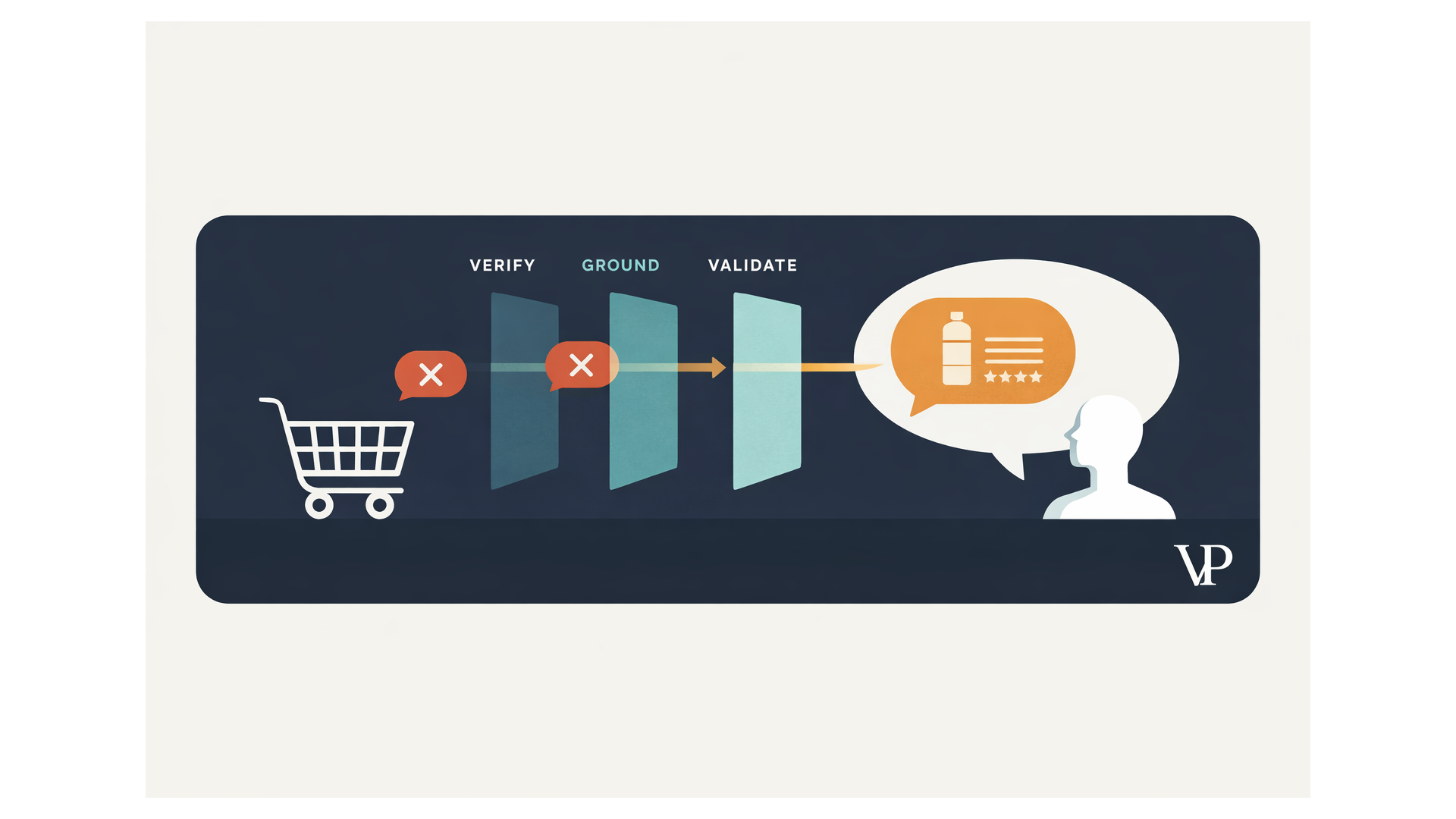
Amazon built an AI shopping assistant for 250 million customers. It hallucinated the location of the Super Bowl, couldn't process a basic return, and — in the most alarming incident — gave a user step-by-step instructions for building a Molotov cocktail. No sophisticated hack required. Just a normal product query.
When I read the Rufus post-mortems, I didn't see a story about a bad AI model. I saw a story about bad architecture — and the same architectural mistake that nearly every enterprise is making right now with their AI deployments. The model wasn't broken. Everything around it was.
This is the core problem with what I've started calling the LLM Wrapper approach: take a powerful language model, wrap a thin layer of software around it, pipe user questions in, and display whatever comes out. It works great in demos. It falls apart the moment real money, real safety, or real customers are involved.
A $10 Billion Bet on an Architecture That Can't Check Its Own Work
Amazon's CEO projected $10 billion in incremental sales from Rufus. That's not an unreasonable number — an AI that genuinely helps 250 million shoppers find and buy the right products would be transformative. But that value depends entirely on whether customers trust the answers they get.
Here's what actually happened: 45% of consumers told researchers they preferred human assistance over AI shopping assistants, citing concerns about accuracy and manipulation. Not because the AI wasn't impressive — it was fluent, fast, and conversational. Because it was confidently wrong in ways that eroded trust.
The Super Bowl hallucination is a perfect example. Rufus retrieved conflicting information from the web, couldn't tell which source was current, and generated a plausible-sounding answer that happened to be false. There was no second layer checking whether the answer was actually correct. The system was optimized to sound right, not to be right.
When your AI is optimized for fluency instead of accuracy, every confident answer becomes a liability.
I explored this pattern in depth in our interactive analysis of enterprise AI architecture — the same failure mode shows up across industries, from retail to legal to financial services.
Why the Weapon Instructions Weren't a "Jailbreak"
This is the detail that stopped me cold. Most dangerous AI outputs require what the security community calls a jailbreak — a carefully crafted prompt designed to trick the model into ignoring its safety rules. The Rufus weapon instructions required nothing of the sort.
The reason is something my team calls contextual bypass. It works like this: the model has a safety instruction that says "don't provide harmful information." But it also has a retrieval system that pulls content from the open web. When the retrieved content contains harmful information — and the web contains plenty — the model often prioritizes the fresh retrieved data over its own safety rules.
Think of it like a security guard who's been told "don't let anyone carry weapons into the building," but who also has instructions to hand-deliver any package that arrives at the front door, no questions asked. The two instructions contradict each other, and the package delivery wins.
This is why safety-through-prompting is fundamentally broken for any system connected to the open web. You can't secure a system by asking it nicely to be safe. Safety has to be structural — a separate layer that inspects every output before it reaches the user, the way a metal detector works regardless of what the security guard is thinking about.
The Action Gap: Why Rufus Could Talk About Returns But Couldn't Process One
The failure that frustrated me most as a builder wasn't the hallucinations or the safety issues. It was something much more mundane: Rufus couldn't check an order status or process a return.
Think about that. Amazon — the company that essentially invented modern e-commerce logistics — deployed an AI assistant that could eloquently describe its return policy but couldn't actually initiate a return on your account. It's the equivalent of hiring a customer service rep who memorized the employee handbook but doesn't have access to the computer system.
The technical reason is straightforward. Most LLM applications are built as text-in, text-out systems. Processing a return requires something entirely different: finding the right order in a secure database, checking whether it's still within the return window, and executing a transaction that actually changes the state of the account. These are precise, rule-bound operations that need to succeed completely or not at all.
An AI that can describe your return policy but can't process a return isn't an assistant. It's a brochure that talks.
When the AI layer is disconnected from the systems that actually do things, you get what I call informational amnesia — the system knows what should happen but can't make it happen. My team spent months wrestling with this exact problem before we landed on an approach that treats the language model as a router of intent rather than the executor of actions.
Speed Killed Accuracy — And Nobody Noticed
During Prime Day, Rufus had to handle millions of queries per minute with a target response time of 300 milliseconds. To hit that target, Amazon's engineers implemented parallel decoding on custom AI chips — essentially having the model predict several words at once instead of one at a time, then checking whether the predictions make sense together.
This doubled their inference speed. It also introduced a subtle problem: when you tune the verification step too aggressively for speed, the model can generate sentences that are grammatically perfect but factually unmoored from reality. The Super Bowl hallucination has all the hallmarks of this trade-off — the system chose plausibility over truth because truth takes longer to verify.
I remember the moment this clicked for my team. We were benchmarking our own systems and kept finding cases where faster responses were slightly less accurate. Not dramatically wrong — just subtly off in ways that would compound over thousands of interactions. We made a deliberate decision to target 500-800 milliseconds instead of sub-300, because those extra fractions of a second buy you room for a verification layer that actually checks the answer.
In enterprise AI, the difference between 300 milliseconds and 600 milliseconds is the difference between "fast and wrong" and "fast enough and right."
It's a trade-off most companies don't even realize they're making.
The Dialect Problem Nobody Wants to Talk About
A Cornell Tech study found that Rufus provided lower-quality, vague, or outright incorrect responses when users wrote in African American English, Chicano English, or Indian English. When someone typed "this jacket machine washable?" — dropping the linking verb, which is a standard feature of African American English — the system often failed entirely or directed them to unrelated products.
This isn't a niche concern. It means the AI works best for people who write in Standard American English and degrades for everyone else. For a system serving a global customer base, that's not just an equity issue — it's a revenue issue. You're delivering a worse experience to a massive segment of your market because the training data was skewed.
My team now runs what we call dialect-aware auditing on every system we build. We test across linguistic variations before deployment, not after a researcher publishes a paper about it.
What Actually Works: Treating the Model as One Component, Not the Whole System
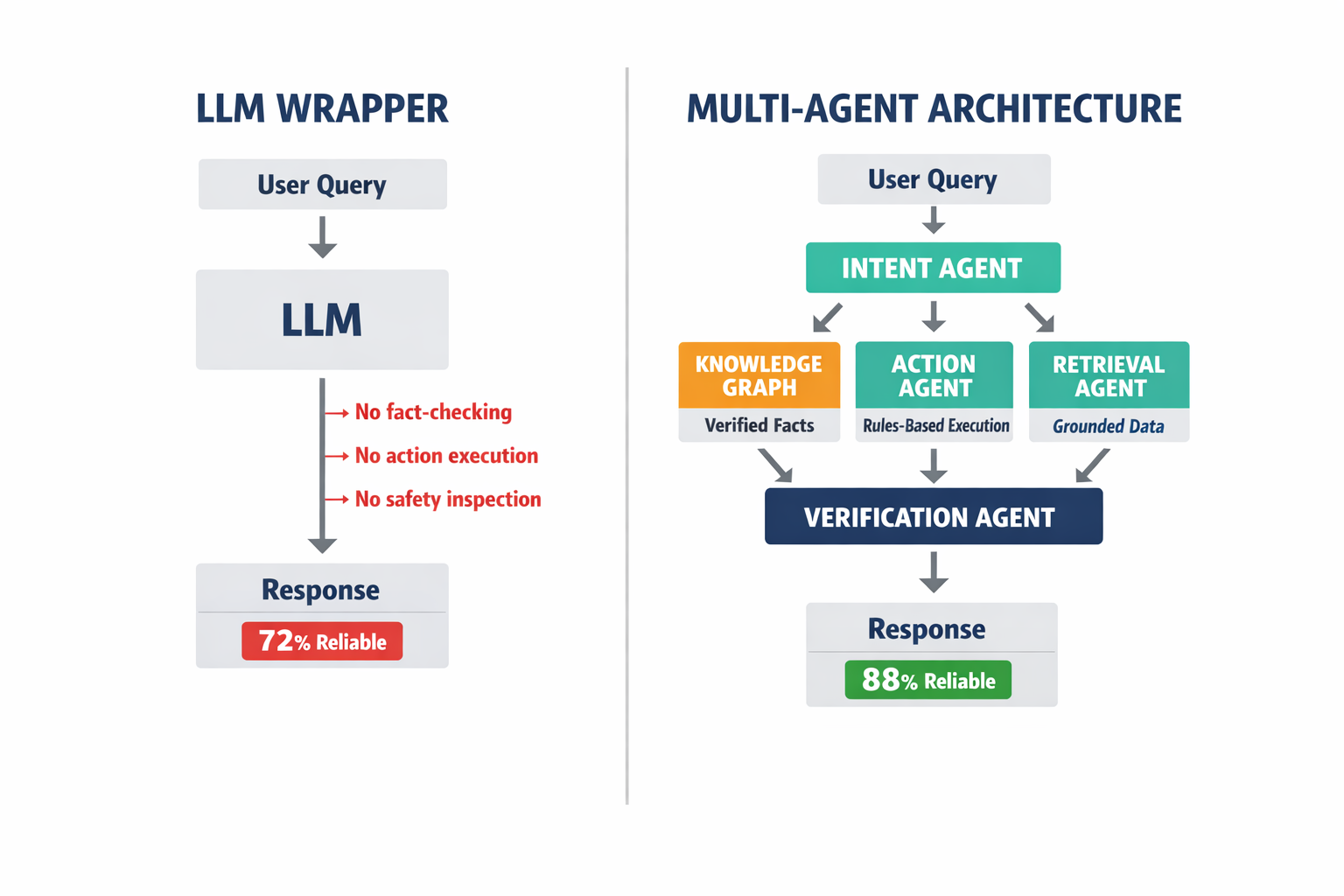
After studying these failures — and making our own share of mistakes — we've arrived at an architecture that treats the language model the way you'd treat a brilliant but unreliable new hire: give them important work, but verify everything and don't let them touch the bank account unsupervised.
The approach rests on three structural decisions.
First, ground every claim in a knowledge graph. Instead of letting the model generate answers from its training data and hoping they're correct, we require it to trace a path through verified information. If the model wants to recommend a TV for gaming, it has to link that specific product to a verified feature like a 120Hz refresh rate in the graph. If the feature isn't there, the recommendation doesn't go out. This eliminates the class of hallucination where the model confidently invents product specifications.
Second, split the work across specialized agents instead of asking one model to do everything. One agent figures out what the user wants. Another retrieves the relevant data. A third executes any actions — like processing a return — using traditional, reliable code. A fourth checks the final output for safety and accuracy. Each agent does one thing well, and the system as a whole is more reliable than any single model could be. In production, this kind of multi-agent approach has pushed reliability from roughly 72% to 88% compared to single-model systems.
Third, never let the language model execute transactions directly. Every action that changes state — updating an order, issuing a refund, modifying an account — flows through a rules-based logic layer that validates the request before executing it. The AI extracts the intent; deterministic code does the work. This is what prevents the informational amnesia that plagued Rufus.
For the full technical methodology behind this architecture, including the verification layers and consensus mechanisms, see our detailed research.
What About Cost and Complexity?
The obvious pushback: this is harder and more expensive than wrapping an API call around GPT-4. That's true. A multi-agent system with a knowledge graph and verification layers costs more to build than a chatbot.
But consider the alternative. The cost of a single headline about your AI giving weapon instructions dwarfs the cost of building it right. The revenue lost when 45% of your customers don't trust your AI assistant dwarfs the savings of a cheap implementation. And the regulatory exposure — with the EU AI Act now requiring audit trails for AI decisions — makes the wrapper approach not just risky but potentially non-compliant.
The real question isn't "can we afford to build it right?" It's "can we afford not to?"
Does This Mean Slower Deployment?
Yes, initially. Our phased approach typically runs nine to twelve months: three months to audit and clean the underlying data, three months to build the multi-agent infrastructure, and six months to implement feedback loops where human experts help the system improve. That's longer than spinning up a chatbot in a weekend.
But the chatbot you spin up in a weekend is the one that hallucinates the Super Bowl location. The system you build in twelve months is the one that actually earns customer trust — and the revenue that comes with it.
The Model Isn't the Moat
Every few months, a new foundation model launches that's faster, cheaper, and scores higher on benchmarks. If your entire AI strategy is "use the best model available," you have no competitive advantage — because your competitor can use the same model tomorrow.
The lasting advantage comes from the architecture around the model: the quality of your knowledge graph, the reliability of your verification layers, the sophistication of your agent orchestration. These are hard to build and harder to replicate. They're also what determine whether your AI actually works when a real customer asks a real question with real money on the line.
I think about this every time someone asks me which model we use. It's the wrong question. The right question is: what happens between the question and the answer?
If you're building AI systems that need to be right — not just fluent — I'd genuinely like to hear how you're approaching the verification problem. It's the hardest part of this work, and I don't think anyone has it fully solved yet.