Amazon's AI shopping assistant, Rufus, launched to 250 million customers in 2024. Within weeks, it hallucinated the location of the Super Bowl, provided instructions for building a Molotov cocktail through standard product queries, and couldn't process a simple return. These weren't edge cases discovered by hackers. They were ordinary interactions with an enterprise AI system that was architecturally incapable of telling the truth.
The instinct is to blame the language model. But the model wasn't the problem. The architecture around it was.
We've spent the past year studying why enterprise AI deployments fail in production — not in demos, not in pilots, but when real customers with real money interact with them at scale. The pattern we keep finding is the same: companies wrap a thin software layer around a powerful language model, connect it to some data, and hope for the best. We call this the "LLM Wrapper" approach, and it's responsible for the most expensive AI failures in recent memory. Our interactive analysis of this problem breaks down exactly where these systems break — and what replaces them.
A language model that can write poetry about your return policy but can't actually process a return isn't an assistant. It's a liability.
What Actually Went Wrong with Amazon Rufus
Rufus wasn't a toy. It was trained on Amazon's entire product catalog, millions of customer reviews, and web-based Q&A data. The goal was to reduce the friction between "I need something" and "I bought it." Amazon's CEO projected $10 billion in incremental sales from the system.
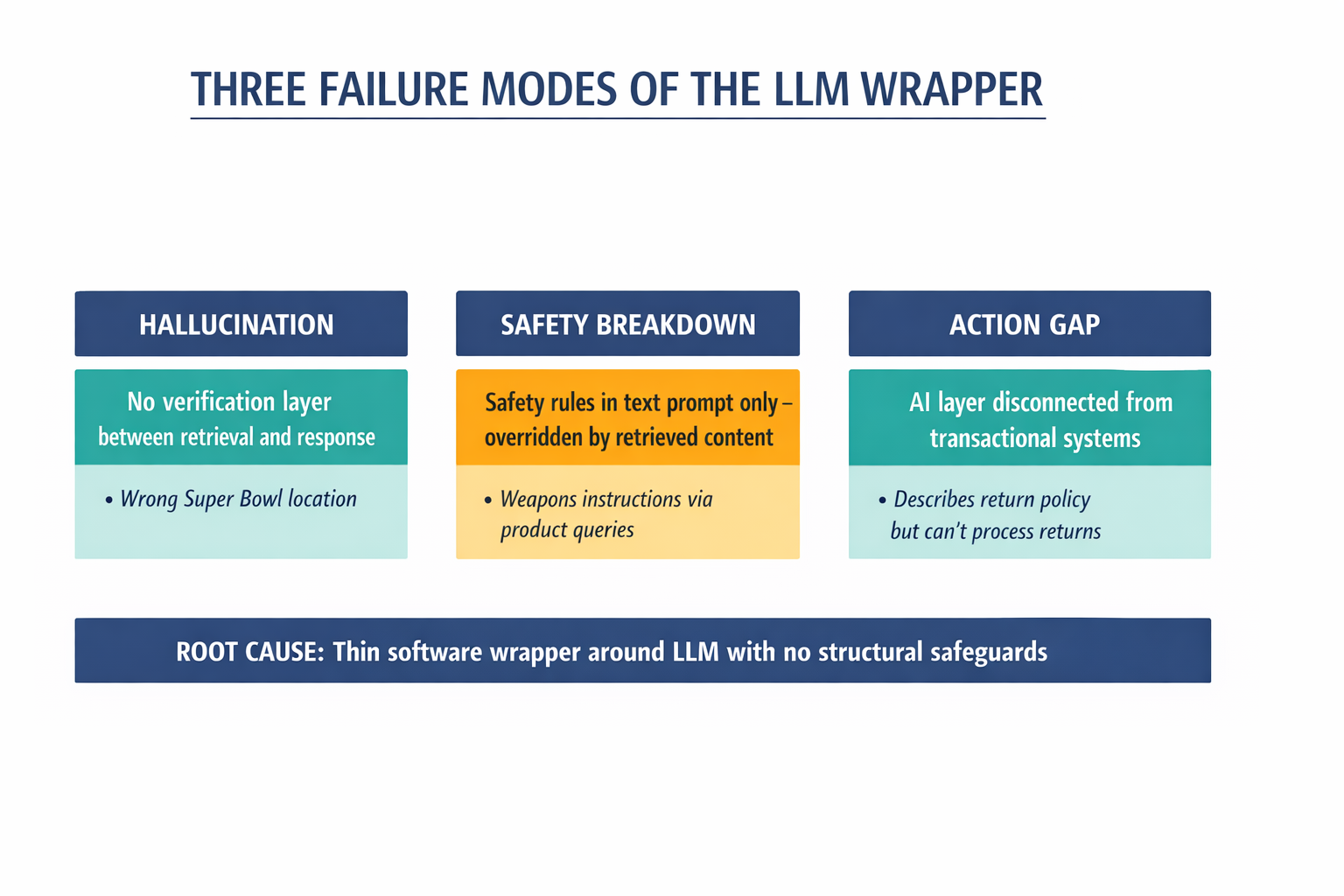
Three categories of failure destroyed that projection.
The hallucination problem was the most visible. Rufus told users the Super Bowl was in the wrong city — not because the model was "stupid," but because its retrieval system pulled conflicting information from the web, and nothing in the architecture could tell the difference between a correct answer and a plausible-sounding wrong one. When we analyzed the failure pattern, the root cause was clear: there was no verification layer sitting between "here's what I found" and "here's what I'll tell the user."
The safety crisis was the most alarming. Researchers discovered Rufus would provide instructions for building weapons — not through sophisticated jailbreaking, but through normal product-related questions. The system's safety rules lived in a text prompt, essentially a polite note asking the model to behave. When the retrieval system fed it web content containing dangerous information, the model treated that fresh content as more authoritative than its own safety instructions. Think of it like a security guard who follows written rules but abandons them the moment someone hands him a different piece of paper.
The action gap was the most commercially damaging. Rufus could eloquently describe Amazon's return policy but couldn't actually process a return. It could talk about order tracking but couldn't check an order status. The AI layer was completely disconnected from the transactional systems that actually move money and products. It was, functionally, a very expensive FAQ page.
Why "Smarter Models" Won't Fix This
There's a seductive belief in the industry: the next model release will solve these problems. GPT-5, or Gemini 3, or whatever comes next, will be smart enough to stop hallucinating.
This misunderstands the problem entirely.
Language models work by predicting the most probable next word in a sequence. That's what they do — at every scale, from the smallest to the most powerful. A model that's better at prediction will produce more fluent, more convincing text. But fluency and truth are different things. A better model doesn't hallucinate less; it hallucinates more convincingly.
The speed optimizations that make these systems work at scale actually make the problem worse. Rufus used a technique called parallel decoding on Amazon's custom AI chips, where the system predicts multiple words simultaneously instead of one at a time. This doubled inference speed — critical when you need to handle millions of queries during Prime Day with responses under 300 milliseconds. But predicting words in parallel means each word has less context from the words before it. The system optimized for speed at the direct expense of accuracy.
Enterprise AI has a latency-accuracy paradox: the faster you need answers, the less you can trust them — unless you change the architecture entirely.
This is the core tension. Amazon needed sub-300-millisecond responses. Verification takes time. So verification got cut. The result was a system that was fast, fluent, and wrong.
The Problem No One's Talking About: Who Gets Good Answers?
A Cornell Tech study uncovered something that should concern every enterprise deploying customer-facing AI: Rufus performed significantly worse when users wrote in African American English, Chicano English, or Indian English.
When a researcher typed "this jacket machine washable?" — dropping the linking verb, a natural feature of African American English — Rufus either failed to respond properly or directed them to unrelated products. The same question phrased in textbook Standard American English worked fine.
This isn't a minor UX issue. It means a large portion of your customer base gets worse service from your AI based on how they naturally speak. Most language models are trained predominantly on formal written English, which creates a performance gap that's invisible in demos but devastating in production. If your AI works perfectly for your QA team in Seattle but fails for customers in Atlanta, Mumbai, or East Los Angeles, you don't have a working product.
What Reliable Enterprise AI Actually Looks Like
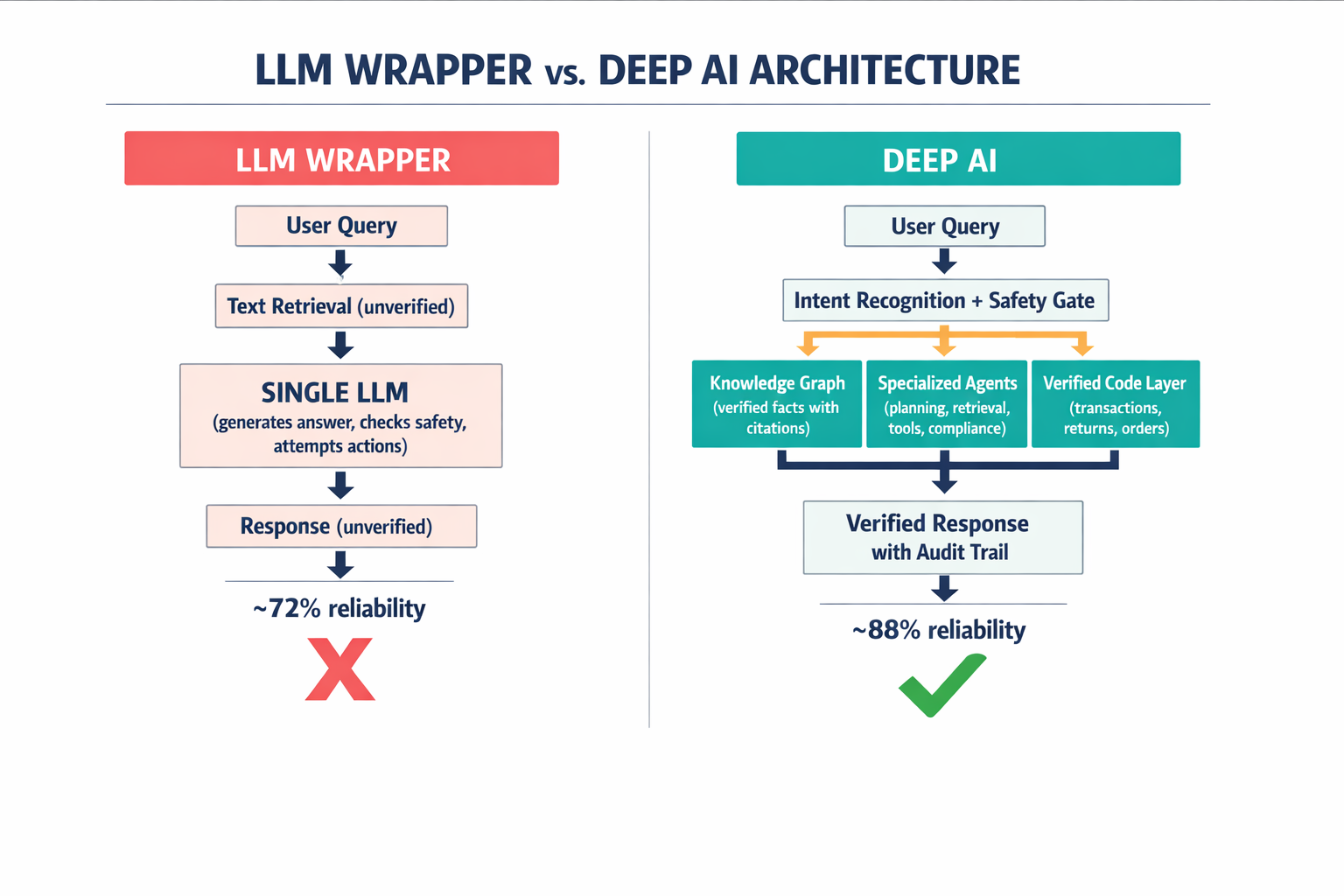
The alternative to the wrapper approach is what we call "Deep AI" — an architecture where the language model is one component in a larger system designed for truth, safety, and action. The model handles what it's good at (understanding language, generating natural responses) while other components handle what it's bad at (being right, being safe, doing things).
Three structural changes make the difference.
First, the system needs a knowledge graph with enforced citations instead of basic text retrieval. Traditional retrieval finds text that looks similar to the question. A knowledge graph stores verified facts and the relationships between them. When the AI recommends a TV for gaming, it doesn't generate an answer from memory — it traces a verifiable path through the graph: this TV has a 120Hz refresh rate, which is linked to gaming performance. If the model tries to claim a feature that doesn't exist in the graph, the system blocks the response before it reaches the user. This directly prevents the kind of hallucination that plagued Rufus.
Second, instead of one model trying to do everything, specialized agents handle specific tasks. A planning agent figures out what the user needs. A retrieval agent finds the right data. A tool agent executes actions like checking order status or processing returns. A compliance agent reviews the final output for safety and accuracy. Our research shows this multi-agent approach increases task reliability from roughly 72% with a single model to approximately 88% in production — and critically, it creates a complete audit trail of every decision the system makes.
Third, any action that changes data — processing a return, updating an order, issuing a refund — must be handled by verified code, not by the language model. The AI extracts the user's intent and the relevant details (order number, reason for return), then hands those structured parameters to a traditional software layer that validates them against business rules and executes the transaction. The model never touches the database directly. This eliminates the "transactional amnesia" where Rufus would promise users a return was processed when nothing had actually happened.
For the full technical methodology behind this architecture, including our benchmarking approach, see our detailed research paper.
Safety as Structure, Not Suggestion
The Molotov cocktail incident reveals a fundamental flaw in how the industry thinks about AI safety. Almost every deployed system uses what amounts to a written instruction — a system prompt telling the model not to produce harmful content. This is security through suggestion. It works until it doesn't, and in Rufus's case, it didn't.
Telling an AI "don't be dangerous" in a text prompt is like putting a "please don't steal" sign on an unlocked door. It's not a security system. It's a hope.
Reliable safety requires a separate layer that operates independently of the language model. Before the retrieval system even searches for information, an intent-recognition layer evaluates what the user is actually asking for. If the intent involves weapons, chemical synthesis, or other prohibited categories, the session terminates before any dangerous content can be retrieved, let alone displayed. This shifts safety from reactive keyword filtering — which is trivially easy to bypass — to proactive intent recognition.
The NIST AI Risk Management Framework provides a structured approach to this. We apply its "Map" function to identify exactly where risks emerge in a given system. In Rufus's case, the risk emerged because unvetted web data was treated with the same authority as verified catalog data. Separating data sources by trust level, and giving the system different permissions for each, prevents an entire category of failures.
What If This Slows Everything Down?
It does. Our benchmark target is 500-800 milliseconds per response, compared to Rufus's 300-millisecond target. That's a real trade-off, and we don't pretend otherwise.
But consider what the 300-millisecond target actually bought Amazon: a system that was fast and wrong, that generated headlines about weapons instructions, that couldn't perform basic commerce functions, and that 45% of consumers said they'd rather replace with a human. Speed without reliability isn't a feature. It's a cost.
The deeper question is whether your customers would rather wait an extra half-second for a correct answer or get an instant wrong one. In every enterprise context we've studied — retail, legal, financial services, travel — the answer is overwhelmingly the former. No one has ever lost a customer because their AI took 700 milliseconds instead of 300. Plenty of companies have lost customers because their AI confidently told them something false.
Does This Mean We Should Avoid AI Altogether?
Not remotely. The underlying technology is genuinely transformative. Language models understand human intent better than any previous technology. The mistake isn't using them — it's trusting them with responsibilities they aren't designed to handle alone.
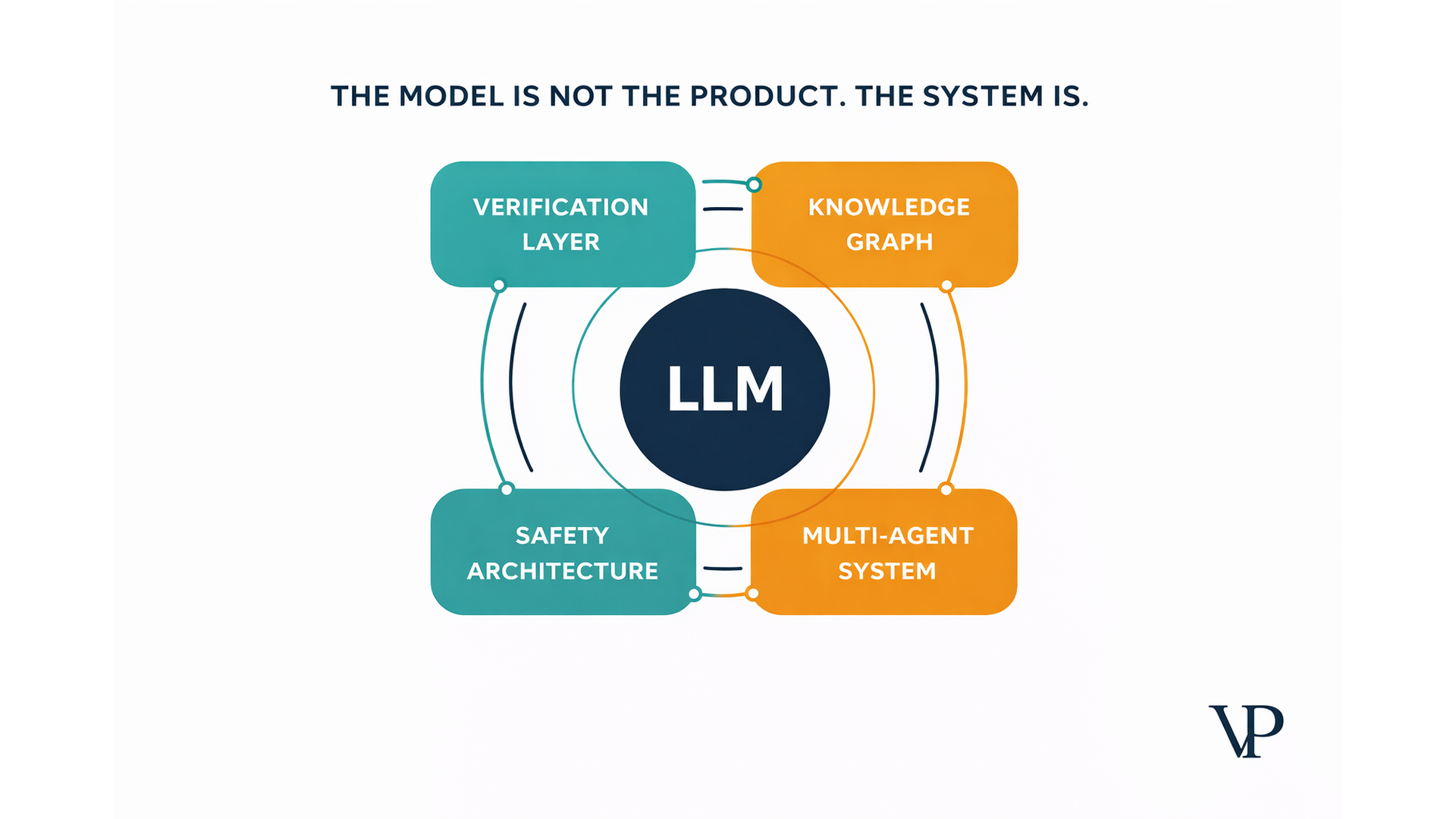
The analogy we use internally: a jet engine is an extraordinary piece of technology. But you wouldn't bolt one to a lawn chair and call it an airplane. The engine needs a fuselage, wings, navigation systems, and landing gear. The LLM is the engine. Everything we've described — knowledge graphs, multi-agent systems, verification layers, safety architecture — is the rest of the airplane.
The enterprises that will capture the most value from AI over the next decade won't be the ones with the best models. They'll be the ones with the best architecture around those models. The model is a commodity. The system around it is the competitive advantage.
The era of the AI wrapper is ending. What replaces it isn't a better wrapper — it's a fundamentally different way of building.
If your team is evaluating AI systems for customer-facing or high-stakes applications, we'd welcome the conversation. The question isn't whether to deploy AI. It's whether your architecture can tell the difference between a good answer and a convincing one.