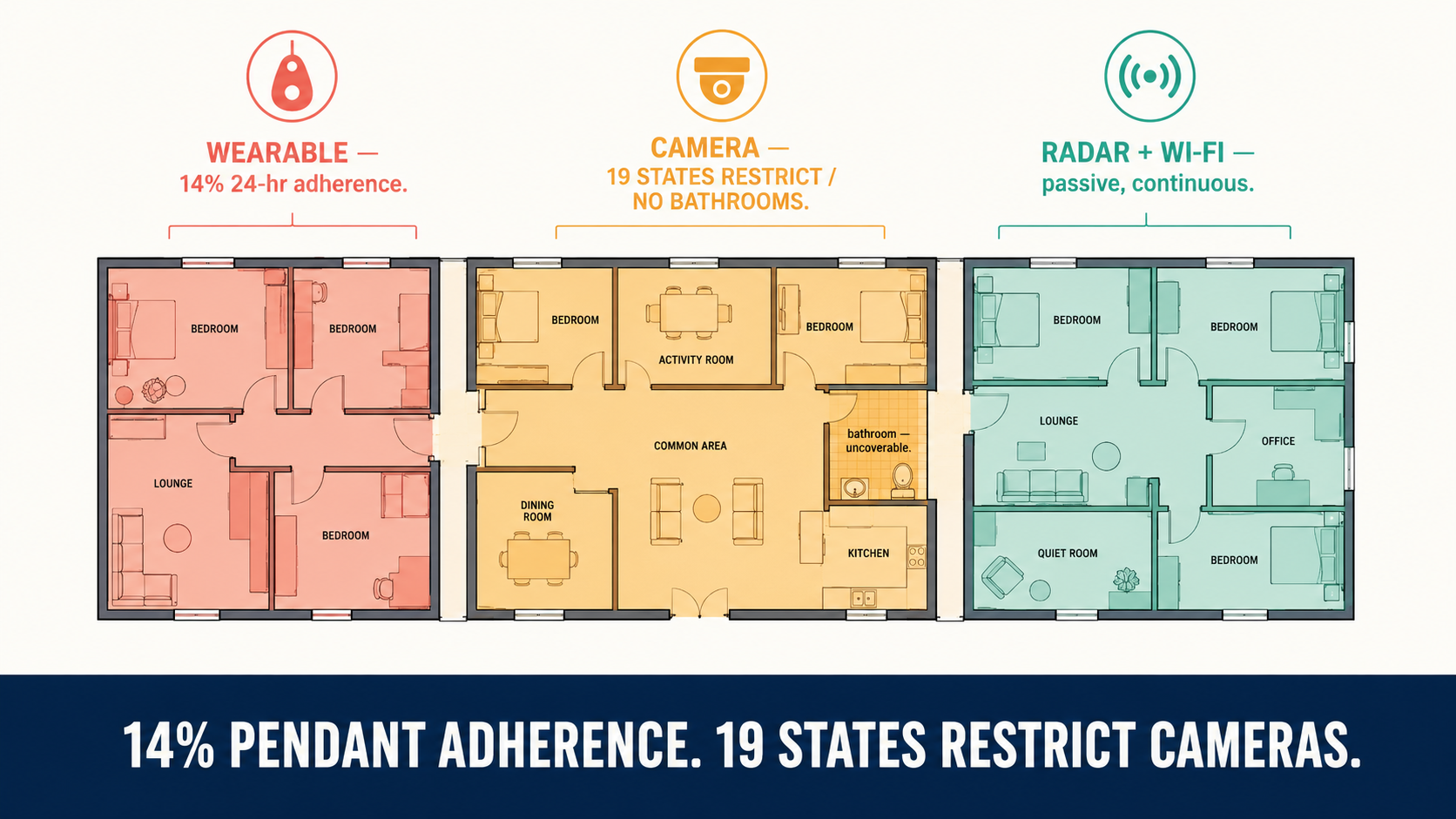
Only 14% of assisted living residents who receive wearable pendants actually wear them around the clock. Another 24% never put the device on at all. These aren't outlier compliance failures — they're consistent findings from PERS research, and they mean the category that still dominates fall detection purchasing in senior living fails its intended users in the overwhelming majority of cases. The industry's response has been cameras. SafelyYou's wall-mounted AI camera system claims 40% fewer falls and 80% fewer fall-related ER visits — real numbers. But nineteen states now regulate cameras in care settings, that count keeps rising, and no state camera law authorizes bathroom monitoring. The bathroom is where the highest-consequence falls happen: confined spaces, hard floors, often unwitnessed for extended periods.
The gap between what wearables deliver and what cameras can legally cover is exactly the zone that passive contactless detection — mmWave radar and Wi-Fi channel state information sensing — was built to fill. The architecture question facing senior living operators in 2026 isn't which vendor to call. It's which modality belongs in which room, and how to wire it back to the nurse call system without causing the alarm fatigue that kills compliance in the first six months. Our Smart Facility Fall Detection & Ambient Monitoring work was built around answering exactly that question.
Why Floor-Time Is the Variable That Actually Matters
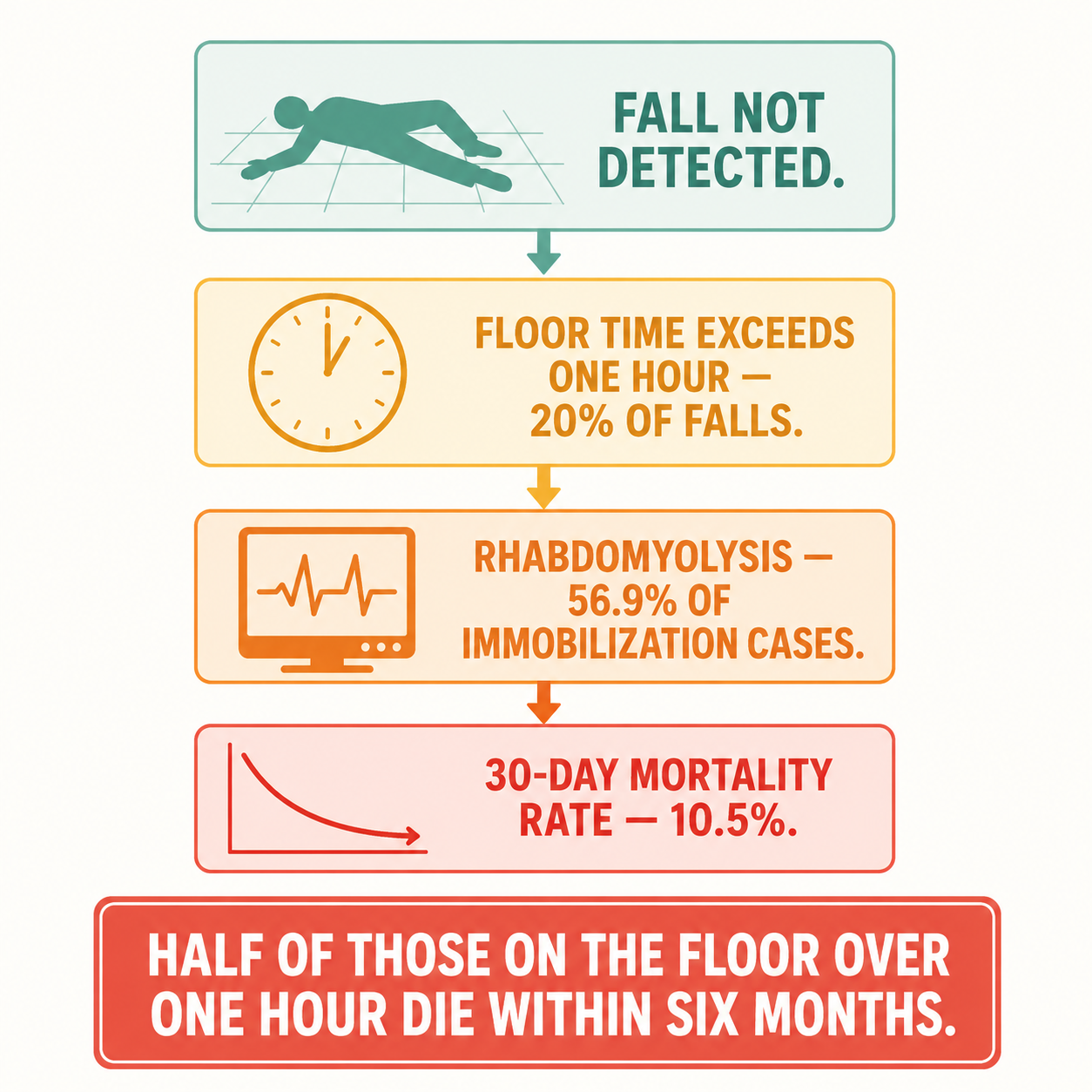
Fall frequency gets all the attention in prevention marketing. The more urgent clinical problem is what happens after the fall.
Half of elderly residents who remain on the floor for more than an hour die within six months — not always from the fall injury itself, but from the cascade of complications that follows: rhabdomyolysis (which occurs in 56.9% of prolonged immobilization cases), hypothermia, dehydration, and acute renal failure. Thirty-day in-hospital mortality from fall-related rhabdomyolysis runs at 10.5%. Twenty percent of elderly emergency department fall patients had been on the ground for more than an hour before anyone found them.
None of this is preventable through wearables that residents won't wear or cameras that can't cover the rooms where these events most often happen. Detection speed is the variable passive contactless sensing was designed to optimize — continuous operation, no action required from the resident, no coverage gaps in the rooms that matter most.
The most dangerous fall isn't the one that causes injury. It's the one nobody finds for an hour.
The Modality Decision No Vendor Will Make for You
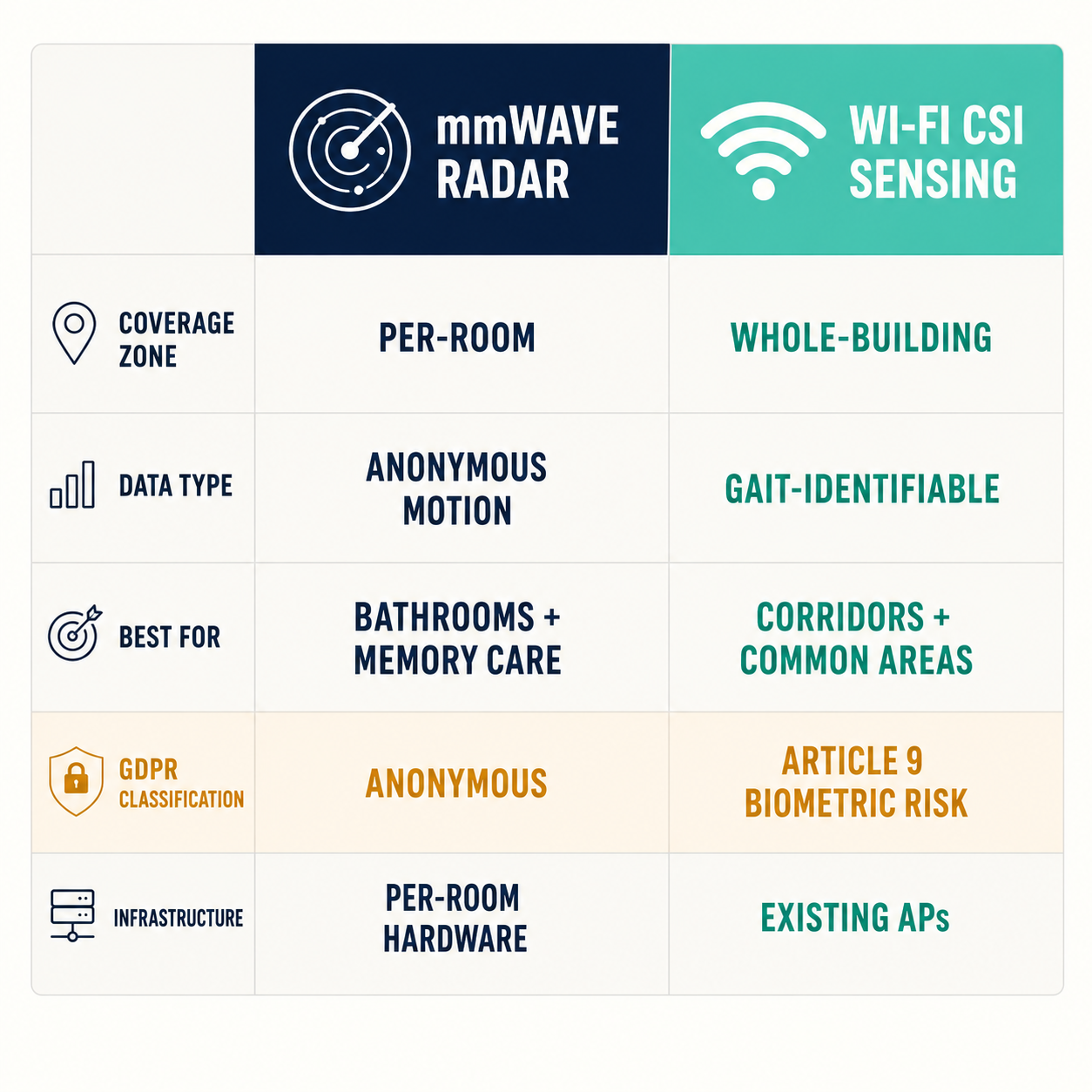
mmWave radar — Vayyar Care's 4D imaging radar, Milesight's VS373 at 60 GHz — detects motion, falls, occupancy, and in some configurations breathing rate, through walls and in complete darkness. No images are captured. Radar data is anonymous motion data, not personally identifiable information under HIPAA and not biometric data under most applicable frameworks. A Vayyar installation at a UK facility published documented reductions in hospital admissions and extended floor lies in January 2026. Helpany's radio-wave monitoring system, deployed across fourteen Arizona senior communities, has averaged 66% monthly fall reduction — with Fellowship Square Mesa at 69% and Westminster Village Scottsdale at 72%.
Wi-Fi channel state information sensing works differently. It measures how moving bodies disturb the Wi-Fi signal propagating between access points and translates those disturbances into motion, presence, and fall events. The practical appeal is coverage breadth: a facility with existing Wi-Fi infrastructure can extend fall detection to common areas, hallways, and dining rooms without per-room hardware. IEEE 802.11bf-2025, ratified in September 2025, standardized Wi-Fi sensing enhancements across the 1–7.125 GHz and above-45 GHz bands — future Wi-Fi chipsets will include native CSI extraction, meaning the next AP refresh a facility purchases may carry fall detection capability by design.
The tradeoff requires care. Wi-Fi CSI can identify gait patterns with enough fidelity that it may constitute biometric data under GDPR Article 9 — a meaningful distinction for any facility with European ownership or international residents, and one that determines whether data processing requires a full Article 35 Data Protection Impact Assessment. Radar data does not carry this classification risk.
Neither modality is categorically superior. Bathrooms, high-fall-risk resident rooms, and memory care units call for radar. Common areas and corridors may be better served by Wi-Fi sensing, particularly as 802.11bf-capable APs proliferate. What this means practically: the right architecture for most facilities isn't a single vendor across all spaces — it's a deployment matrix that matches modality to room type, resident risk profile, and infrastructure readiness.
Worth noting: Origin Wireless's ISP-channel Wi-Fi sensing partnership with Verizon Fios, the most visible consumer-facing Wi-Fi sensing deployment, was shut down on April 15, 2026. Facilities that piloted Wi-Fi sensing through ISP channels now need facility-direct deployment architectures.
Where Most Deployments Break Down
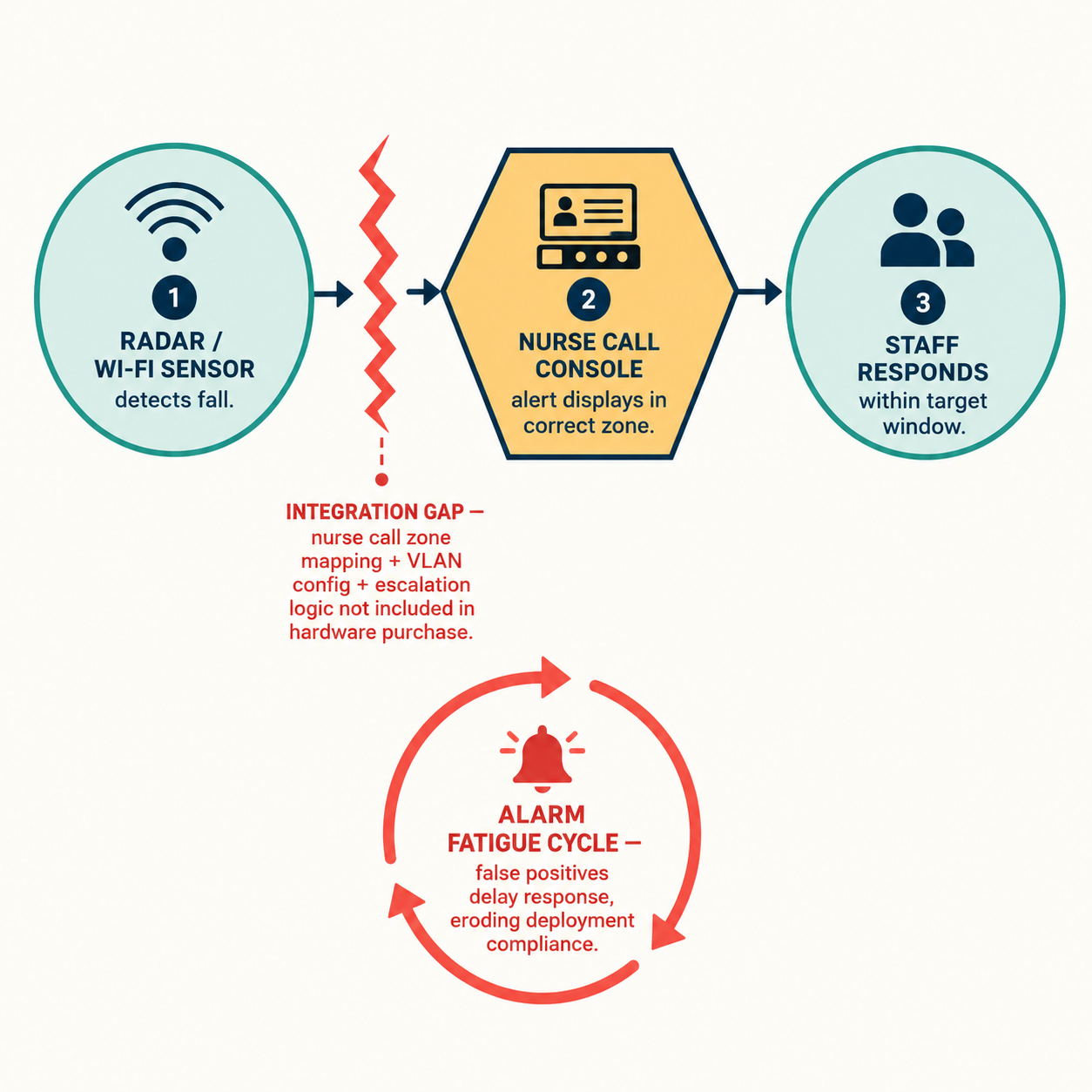
The implementation failure most senior living facilities hit isn't sensor selection. It's alarm fatigue.
False alarms desensitize staff. In an industry where 63% of facilities are short-staffed, 87% report difficulties hiring, and night-shift ratios routinely reach 1:20, a sensor system generating frequent false positives doesn't just cause frustration — it trains staff to delay response. The clinical consequence of that delay is exactly the floor-time complication chain above. Milesight publishes under 5% false alarm rates; VirtuSense claims 95% false alarm elimination in its LiDAR-based system. Those numbers are achievable — but only with environment-specific calibration after deployment, adjusting sensitivity thresholds for the specific room dimensions, resident mobility profiles, and interference sources in each facility. That calibration work happens post-installation, by practitioners who understand both sensor firmware and clinical context. It is not included in the hardware purchase.
The second gap is nurse call integration. Vayyar has established integration partnerships with Austco, Rauland, and several other nurse call system vendors. But nurse call systems are facility-specific, often more than a decade old, and integration depth varies even within a single vendor's partner ecosystem. Getting a fall detection sensor to appear as a properly categorized alert in the right call zone on the right console — with the correct escalation path and documentation for CMS F689 compliance purposes — is systems integration work that vendors don't fully handle. CMS updated the Fall with Major Injury quality measure methodology in 2025 and the PDPM model now ties rehospitalization rates to per-diem reimbursement. A facility that deploys sensors but doesn't connect them correctly to the NCS documentation chain misses the regulatory and financial upside the deployment was supposed to deliver.
The 802.11bf Transition Window
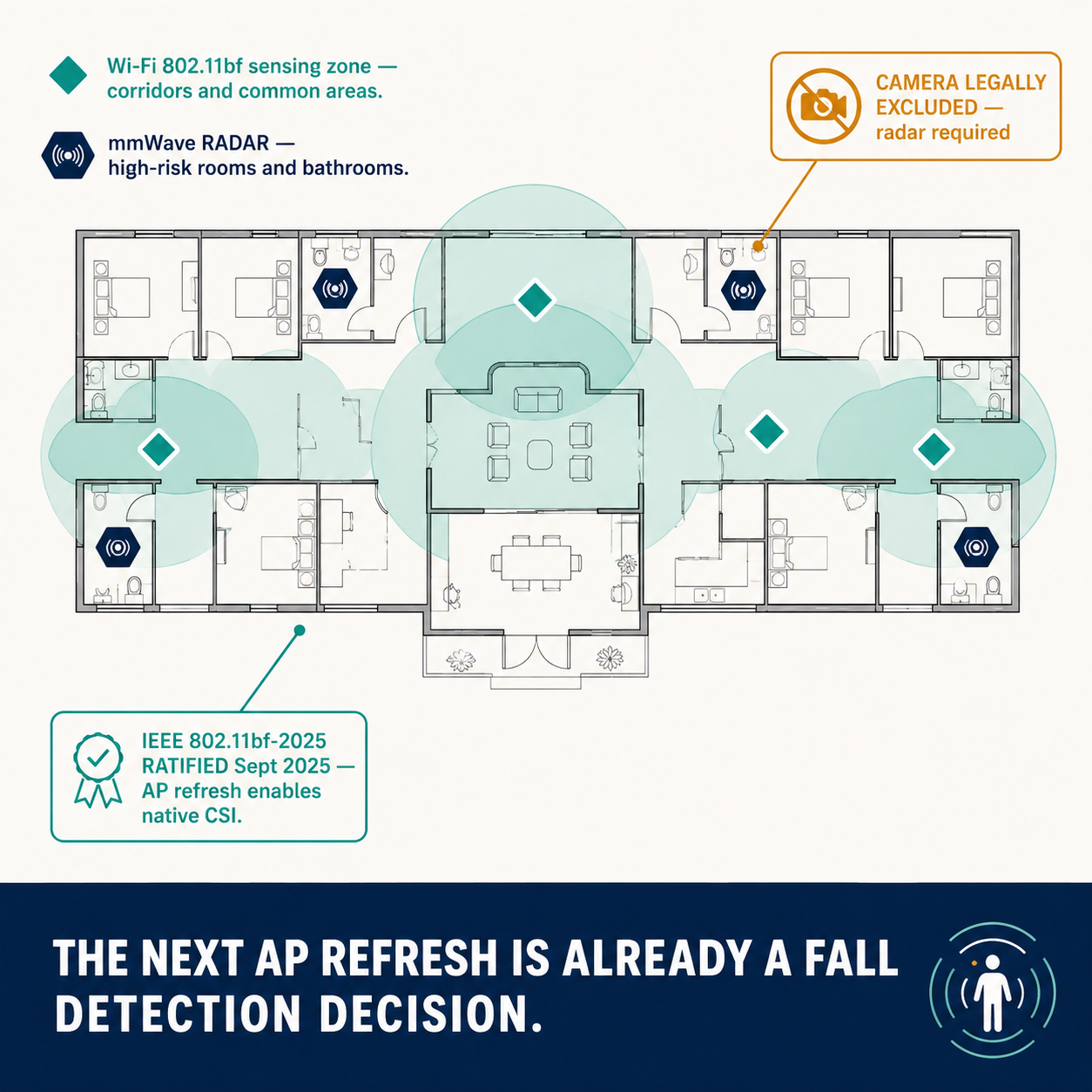
The 802.11bf ratification opens a capital planning opportunity that most operators haven't yet built into their infrastructure roadmaps. Facilities upgrading Wi-Fi — 65% were already increasing technology budgets by 6–30% in 2025 versus 2024 — can specify sensing-enabled APs and fold fall detection coverage into the infrastructure refresh rather than running a separate sensor program. The upfront cost difference is modest. The operational difference is substantial.
The caveat is timing. The gap between "802.11bf-capable hardware exists" and "working fall detection with sub-5% false alarm rates across a 200-bed facility" remains a multi-month implementation project. For facilities with acute fall risk in memory care or skilled nursing units, that gap is a reason to layer radar now rather than wait for AP-native sensing to reach volume availability. For common areas and lower-acuity spaces, the 802.11bf refresh plan may make better capital sense than deploying interim Wi-Fi sensing hardware.
The architecture decision, as with most of the real problems in senior living technology, is a room-by-room call.
Every facility planning an AP refresh already has the hardware justification for sensing-capable chipsets. The question is whether anyone on the project team adds it to the spec.
The Business Case Is Not the Hard Part
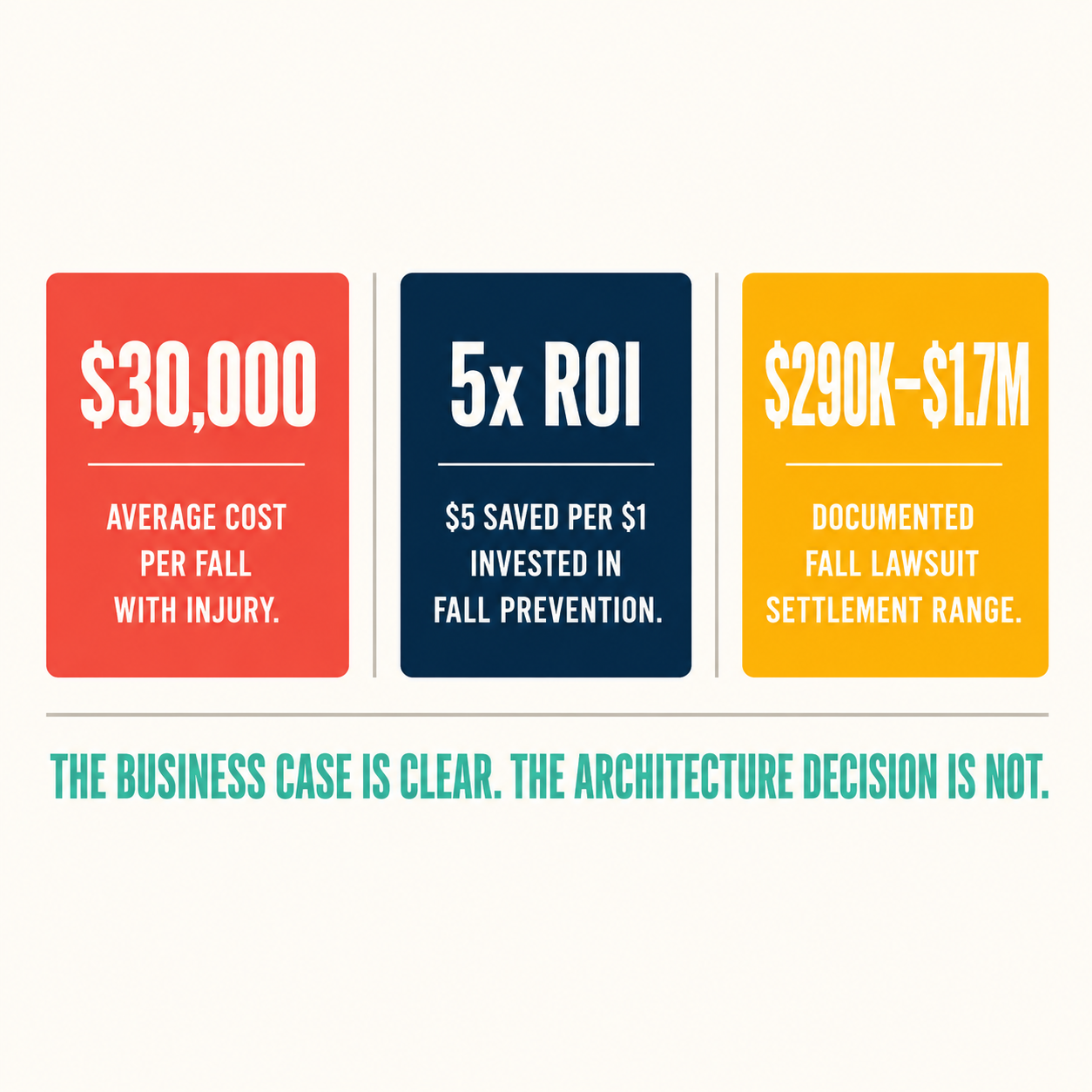
A fall with injury in an assisted living setting costs an average of $30,000 in direct hospital, liability, and increased-care expenses. Hip fractures — 300,000+ annually among U.S. seniors — carry 40% one-year mortality risk. Fall-related negligence settlements run from $290,000 to $1.7 million in documented cases, with negligent-monitoring claims increasing specifically when fall prevention technology existed but wasn't deployed. Evidence-based fall prevention programs deliver roughly $5 saved for every $1 invested across the population.
The business case for passive contactless detection is not difficult to build. The harder questions are which rooms to instrument first, which modality to deploy where, and how to calibrate the system against each facility's specific operational reality — room layout, infrastructure vintage, resident risk stratification, and NCS architecture.
Those decisions sit at the intersection of sensor physics, clinical context, and systems integration. If your team is in the middle of an AP refresh, a nurse call system upgrade, or a post-incident review that has elevated fall detection on the capital plan, Smart Facility Fall Detection & Ambient Monitoring lays out the deployment framework in detail.
What tends to be most useful for operators at this stage is a clear view of the room-by-room decision matrix before the vendor conversations start — so the RFP is written around the right question.