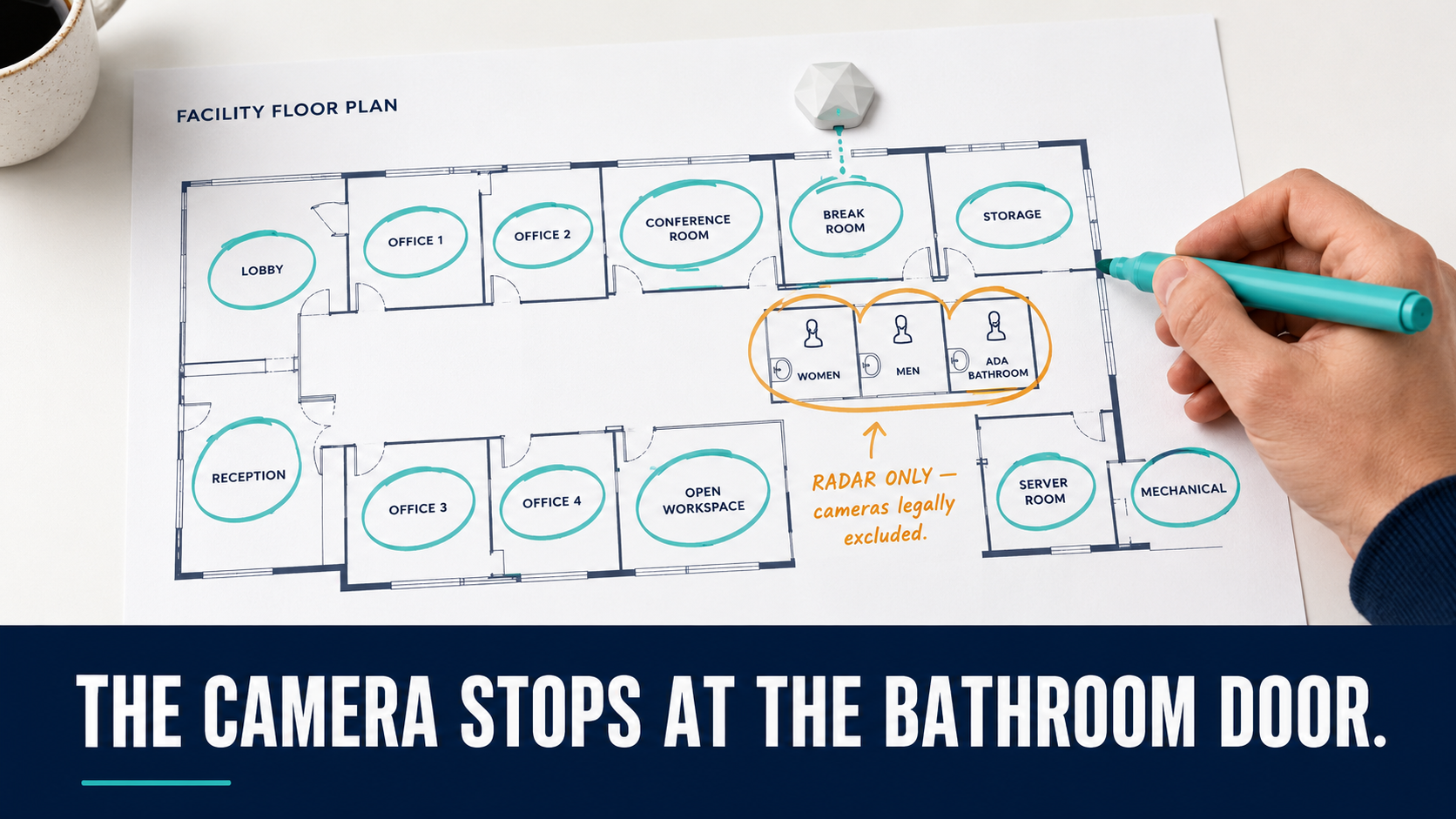
When I started working with senior living operators on fall detection architecture, I expected the hard part to be the sensor selection. Vayyar vs. Milesight vs. SafelyYou vs. wearables — I thought the work was helping operators navigate that vendor matrix. It isn't. The hard part is the floor plan conversation that happens before any vendor is mentioned — which room gets which modality, why, and what has to be true about the building's infrastructure before the answer even makes sense.
I got to that insight the slow way.
The Wearable Adherence Number Nobody Talks About in the Pitch
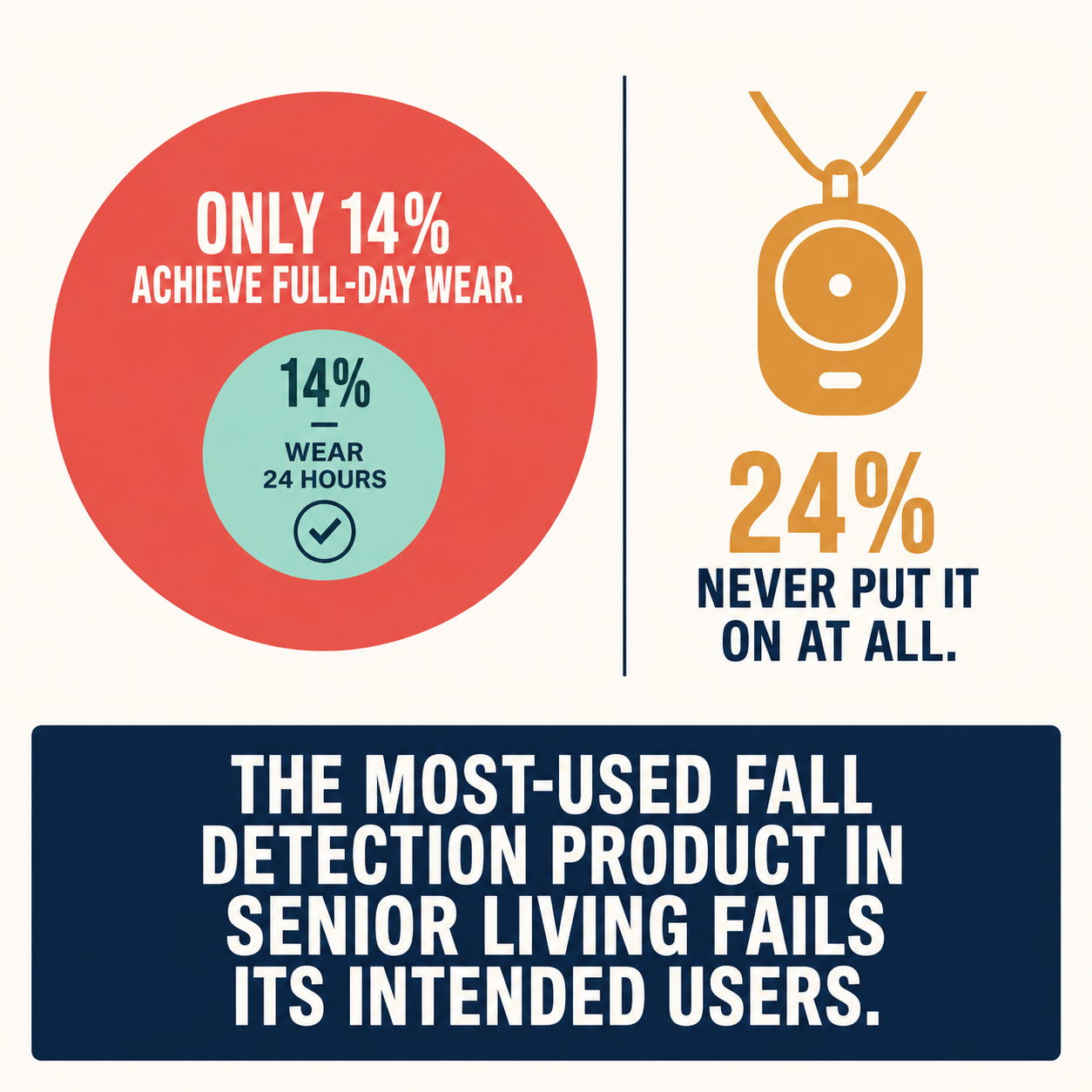
My first real surprise in this space was realizing how durable the wearable-pendant market is despite a number that should have killed it. Only 14% of assisted living residents who receive personal emergency response pendants actually wear them around the clock. Another 24% never put the device on at all. These aren't edge cases in poorly run facilities — they're consistent findings across PERS research, and they describe the product category that still dominates fall detection purchasing in senior living.
I raised this with a director of nursing at a mid-size assisted living operator I was working with. She wasn't surprised. Her explanation stayed with me: a pendant, even one sitting on a bedside table, is something she can see and account for. A radar sensor behind the ceiling tile is something she has to trust. The pendant's failure is visible. The sensor's failure mode might not be.
That's not a technology problem. That's an operator-trust problem — and no product spec sheet addresses it. What actually moves operators toward passive contactless detection isn't the adherence stat. It's a specific kind of incident that makes the adherence stat stop feeling abstract. Usually that incident involves a resident who was on the floor for a long time before anyone found them.
What the Incident Reports Actually Show
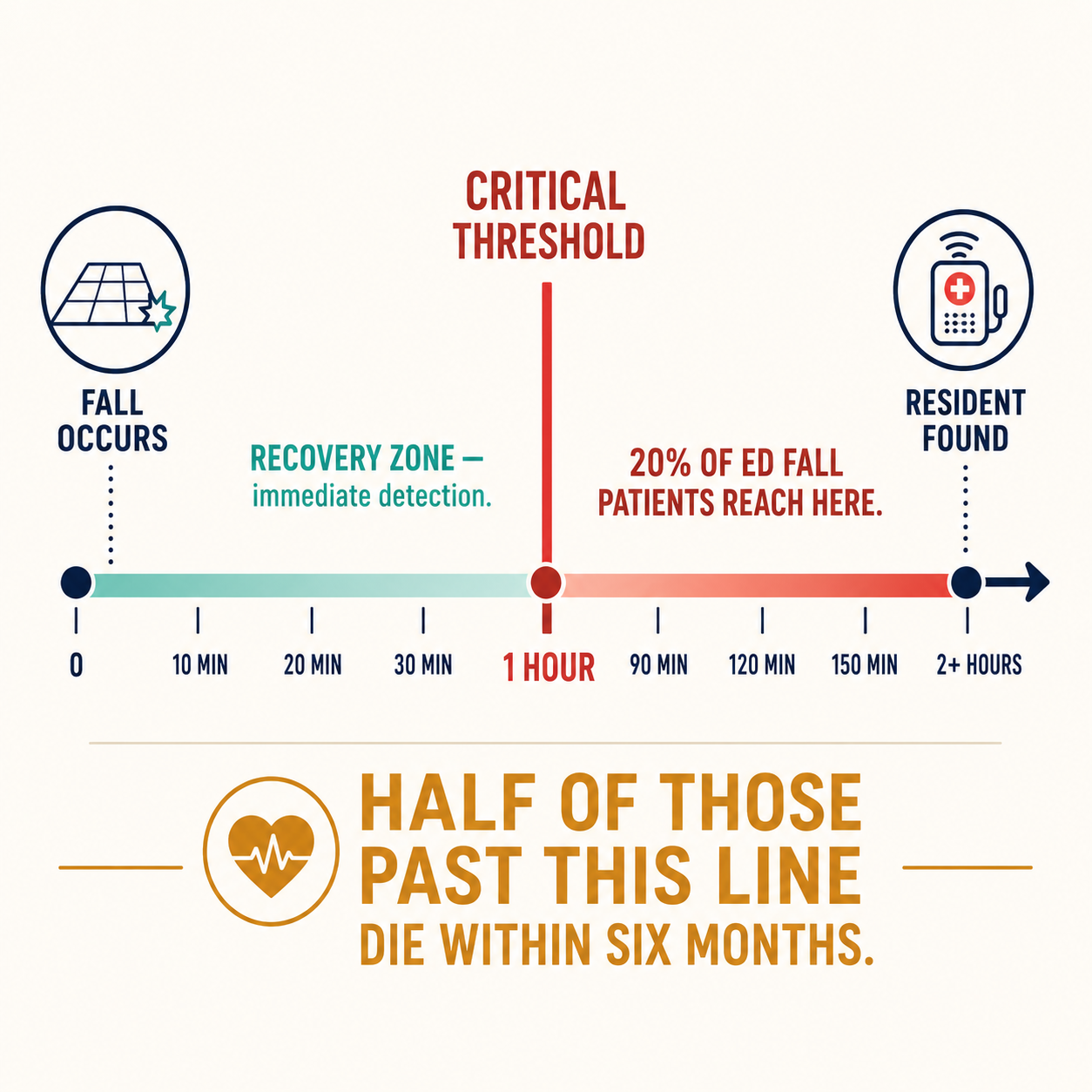
I started asking clients to pull their incident reports, specifically the floor-time field on unwitnessed fall events. The pattern I kept seeing wasn't about fall frequency — it was about floor time. Half of elderly residents who remain on the floor for more than an hour die within six months, not necessarily from the fall injury but from the cascade that follows: rhabdomyolysis, which occurs in 56.9% of prolonged immobilization cases, along with hypothermia, dehydration, and acute renal failure. Thirty-day in-hospital mortality from fall-related rhabdomyolysis is 10.5%. Twenty percent of elderly emergency department fall patients had been on the ground for more than an hour before anyone found them.
The fall-prevention marketing conversation focuses almost entirely on fall frequency — Helpany's 66% reduction across fourteen Arizona facilities, SafelyYou's 40% fewer falls. Those numbers are real and they matter. But the floor-time problem is what makes this a life-safety architecture question, not just a quality metric. A system that detects falls thirty seconds after they happen is a fundamentally different clinical tool than a system that might generate an alert when the resident finally presses the button — if they're conscious, if they can reach it, if they're wearing it.
The Bathroom Problem No Camera Can Solve
I started drawing coverage maps on facility floor plans early in my engagements — marking every high-risk room, every bathroom, every night-shift dead zone. The exercise crystallized something that should have been obvious from the start.
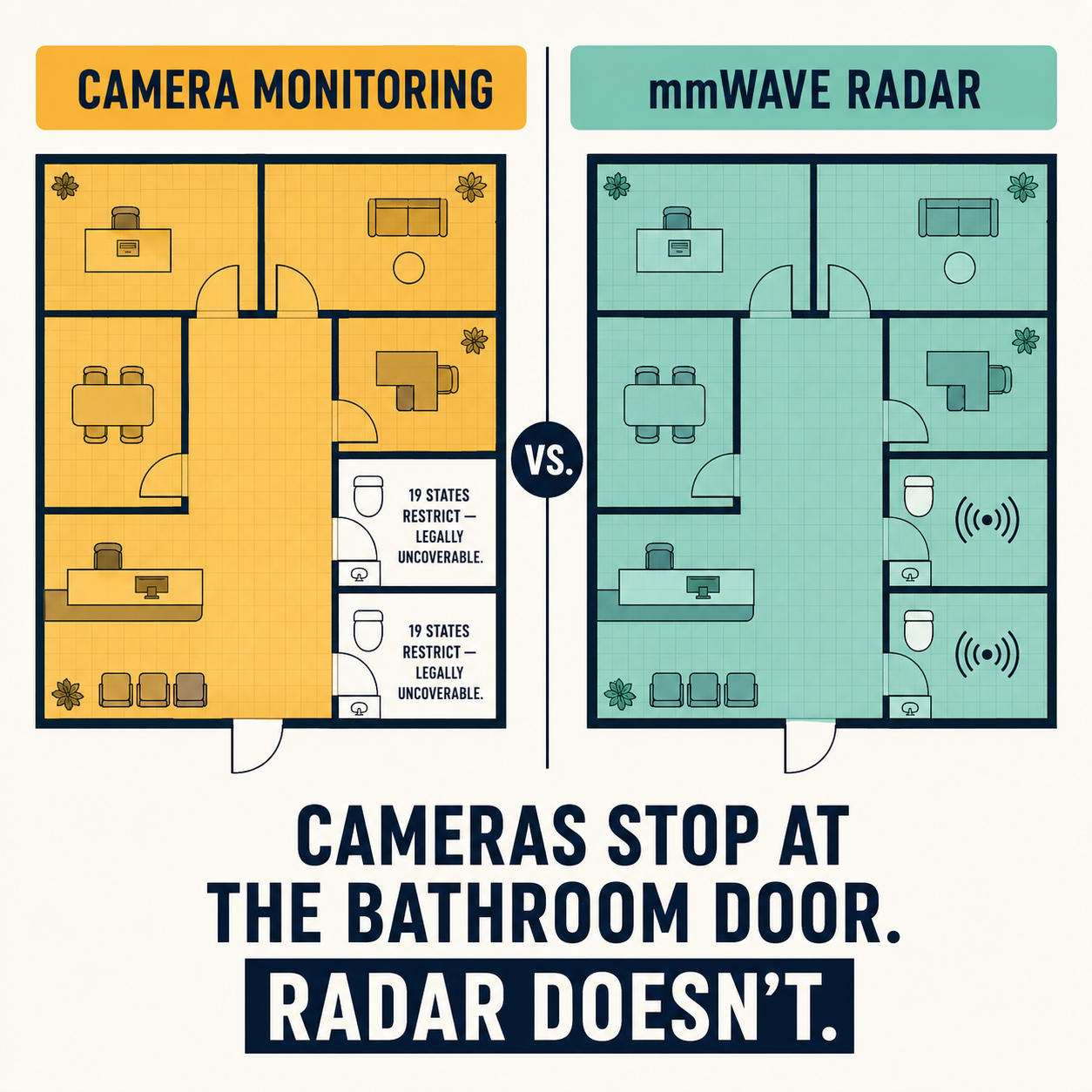
What those coverage maps kept showing me is that cameras can't legally cover bathrooms — nineteen states now regulate cameras in nursing home and assisted living settings, and the bathroom is categorically excluded. That's also where many of the most dangerous falls happen: hard tile floors, wet surfaces, no furniture to break a fall, often the last place a resident is found when something goes wrong. I believe SafelyYou's 80% fewer fall-related ER visits number. In the rooms cameras can cover. The coverage map has a structural hole where it matters most.
That hole is what made me certain radar belongs in the architecture regardless of the Wi-Fi sensing strategy a facility chooses. Radar — Vayyar Care's 4D imaging radar, Milesight's VS373 operating at 60 GHz — is anonymous motion data, not imagery. It can legally and practically cover bathrooms. A Vayyar installation in a UK facility published documented reductions in hospital admissions and extended floor lies as recently as January 2026. You deploy radar in the rooms where camera coverage is legally impossible and where the physics of the fall risk are worst.
The Infrastructure Question That Decides the Rest
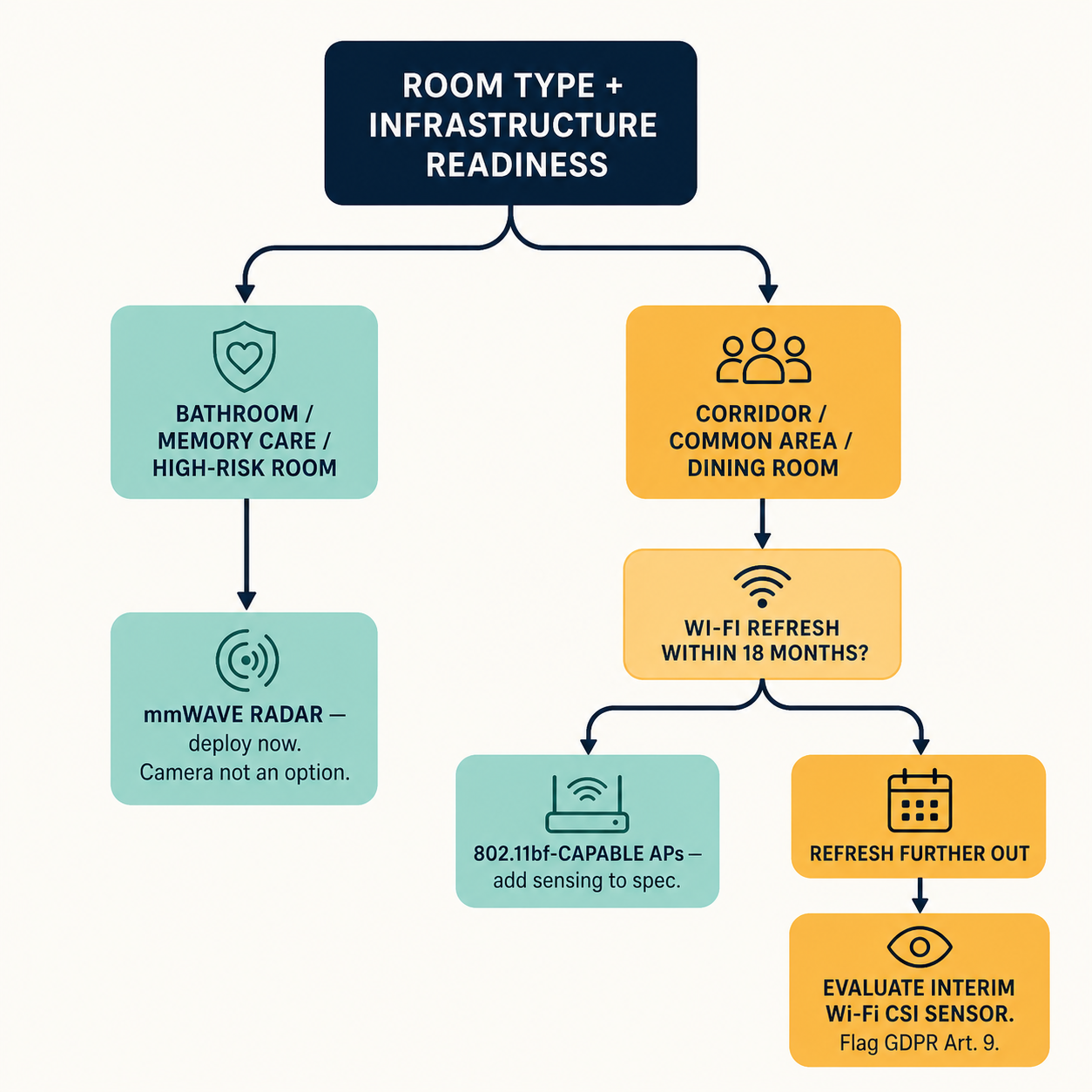
My thinking about Wi-Fi sensing shifted after the IEEE 802.11bf-2025 standard ratified in September 2025. Before that, Wi-Fi channel state information sensing was an interesting technology waiting for standardization. The ratification — which covers sensing enhancements across 1–7.125 GHz and above-45 GHz bands — means future AP chipsets will include native CSI extraction. The AP hardware your facility buys in the next refresh cycle may already support fall detection by design, at marginal additional cost.
What I now ask early in every engagement: when is the Wi-Fi infrastructure refresh? Sixty-five percent of senior living operators were already increasing technology budgets by 6–30% in 2025. If a facility is within eighteen months of an AP refresh, I push hard to make sensing-capable chipsets part of the spec. If they're further out, the conversation shifts to where radar coverage makes sense now.
There's a complication I raise every time. Wi-Fi CSI sensing can identify gait patterns with enough fidelity that it may qualify as biometric data under GDPR Article 9 — which determines whether the facility needs a full Article 35 Data Protection Impact Assessment rather than a standard privacy notice. This matters if the facility has European ownership, international partners, or residents with European citizenship. Radar data doesn't carry this classification risk. The distinction is rarely covered in vendor presentations, but it's come up in contract reviews often enough that I flag it before the architecture decision is made.
Origin Wireless's ISP-channel sensing partnership with Verizon Fios shut down on April 15, 2026 — the most visible consumer Wi-Fi sensing deployment is now gone, and facilities that piloted through that channel need a different architecture. I'm working through several of those right now.
The Nurse Call Meeting That Changed How I Scope Engagements
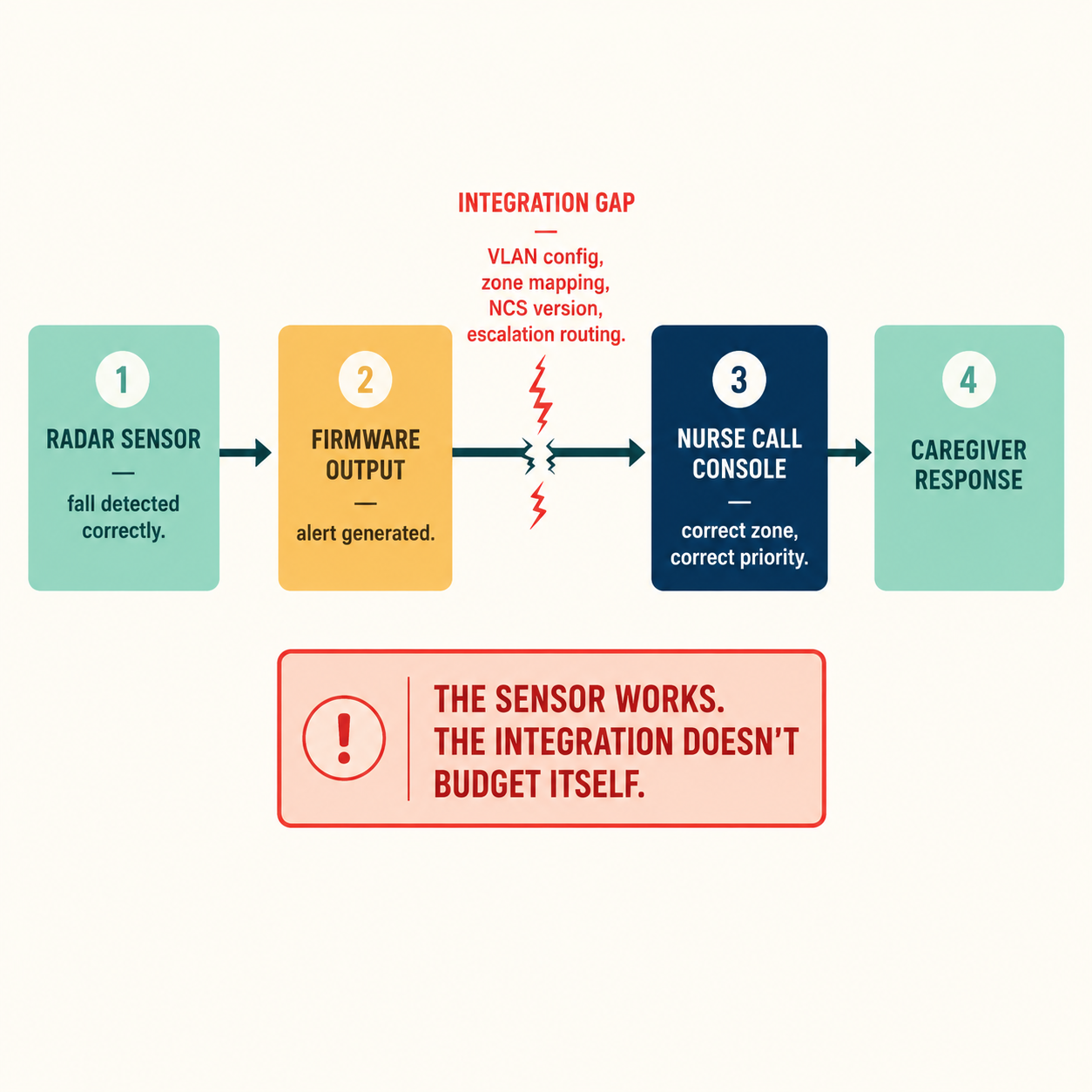
Six weeks into my first radar deployment, I was in a meeting with the facility's IT director and the nurse call system vendor. The radar sensors were installed and working. The firmware was updated. The test falls were being detected. None of it was showing up correctly on any nurse call console.
The nurse call system was over a decade old. The radar vendor had a listed integration with the system's manufacturer, but listed integration and working integration across a specific facility's cabling, VLAN configuration, and zone mapping are different things. It took several more weeks of systems integration work to get the alerts appearing in the right call zones with the right escalation logic. Work that wasn't in the original project budget and that neither the facility nor the sensor vendor had planned for.
Alarm fatigue is what kills fall detection deployments operationally. In an industry where 63% of facilities are short-staffed and night-shift ratios routinely reach 1:20, a system that generates frequent false positives doesn't just annoy staff — it trains them to delay response. Milesight's <5% false alarm rate and VirtuSense's 95% false alarm elimination claim are achievable. They require environment-specific calibration after deployment, tuned to the specific room dimensions and resident mobility profiles in each facility. That calibration isn't included in the sensor purchase. And it can't happen until the nurse call integration is working correctly.
I now scope the nurse call integration and alarm calibration as separate workstreams from the sensor deployment in every engagement. The sensor is the easier part. The Smart Facility Fall Detection & Ambient Monitoring framework we built documents what that integration layer actually involves — it's where most of the real implementation time goes.
The Question I'd Ask Before Any Vendor Conversation
If I were advising a senior living operator starting this process today, I'd ask three questions before any vendor is mentioned: Which rooms have the highest fall-risk concentration? When is the next Wi-Fi infrastructure refresh? And what nurse call system is currently installed, how old is it, and who owns the integration relationship?
The answers to those three questions — not the vendor feature matrices — determine the architecture. Memory care units with high-fall-risk residents and no camera coverage path need radar now. Common areas may wait for 802.11bf-native APs if the refresh is within a year. Nurse call integration is the workstream that will consume more time and budget than the sensors themselves.
The $30,000 average cost of a fall with injury, the $290,000 to $1.7 million in documented liability settlements, the PDPM quality measure that now ties rehospitalization rates to per-diem reimbursement — these make the business case for passive contactless detection straightforward to build. They don't tell you which room to wire first. That's a floor plan question.
What I've found matters most is whether the operator understands this is an architecture decision before it becomes a purchase order. The facilities that get this right tend to be the ones who brought someone in to think through the floor plan before they took the first vendor call.