A firmware release gate earns its place when a refusal tells the engineering team what to investigate next. A lower failure estimate can be useful progress and still leave the release unacceptable. A very low estimate can also be unpersuasive when the candidate's behavior is poorly understood.
I want those reasons kept distinct. Otherwise, teams can spend time refining a risk calculation when the real gap is evidence about the firmware, or seek a more reassuring description while the estimated impact still breaches policy.
Our MeterGuard demo makes this distinction concrete with synthetic fleets and synthetic firmware manifests. Its firmware profiler estimates write behavior from a changelog; a simulator applies that estimate to generated battery, radio and flash-wear conditions; a deterministic policy gate produces a local recommendation. The examples below use cached model-assisted profiles. They are modeled decisions, with no firmware update executed.
When improvement leaves too much risk
On the generated Plano-labelled fleet, a hotfix manifest lowers the predicted failure rate from 74.22% to 2.85% of 86,078 scored endpoints. That is a large modeled improvement. It still receives NO-GO because the upper end of its 90% modeled interval reaches 4.10%, above the configured 3.0% hard-block boundary.
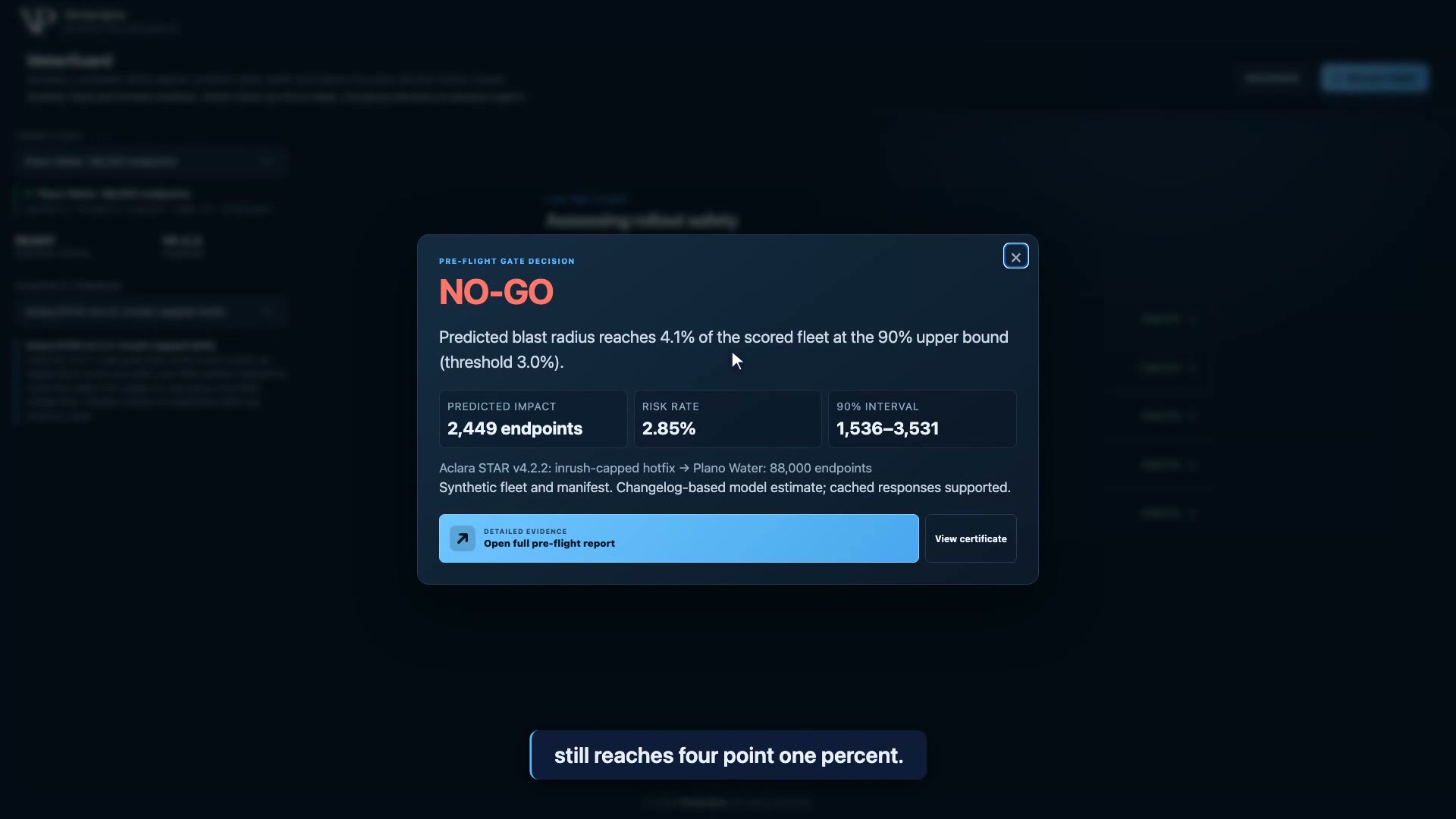 Synthetic fleet and firmware manifest, including the displayed vendor labels; cached model-assisted estimate. The hotfix's upper modeled risk exceeds the 3.0% boundary for 86,078 scored endpoints; 1,922 endpoints are excluded.
The policy checks that upper boundary first. Passing it would not automatically authorize GO: the demo also requires adequate profile confidence and a mean failure rate at or below 0.5%. The 3.0% threshold is a refusal boundary, not an acceptable average to aim for. These are configured demo rules, not a validated utility safety standard; the modeled interval does not establish field coverage.
For a real workflow, my next question would be which assumptions and fleet conditions drive the remaining risk. Here, the profile includes extra modem current during flash writes and recovery after a reset. Measurements of those behaviors on relevant hardware, together with trustworthy fleet telemetry, would help establish whether the predicted impact is credible. A better release label would answer neither question.
When low risk rests on weak evidence
A different case pairs a sparse firmware changelog with the generated Co-op population. Its predicted mean failure rate is 0.05% of 118,222 scored endpoints, and its upper modeled rate is 0.06%. Both sit below the numerical policy boundaries. Yet low profile confidence produces STAGED-CANARY, displayed as STAGED in the compact modal.
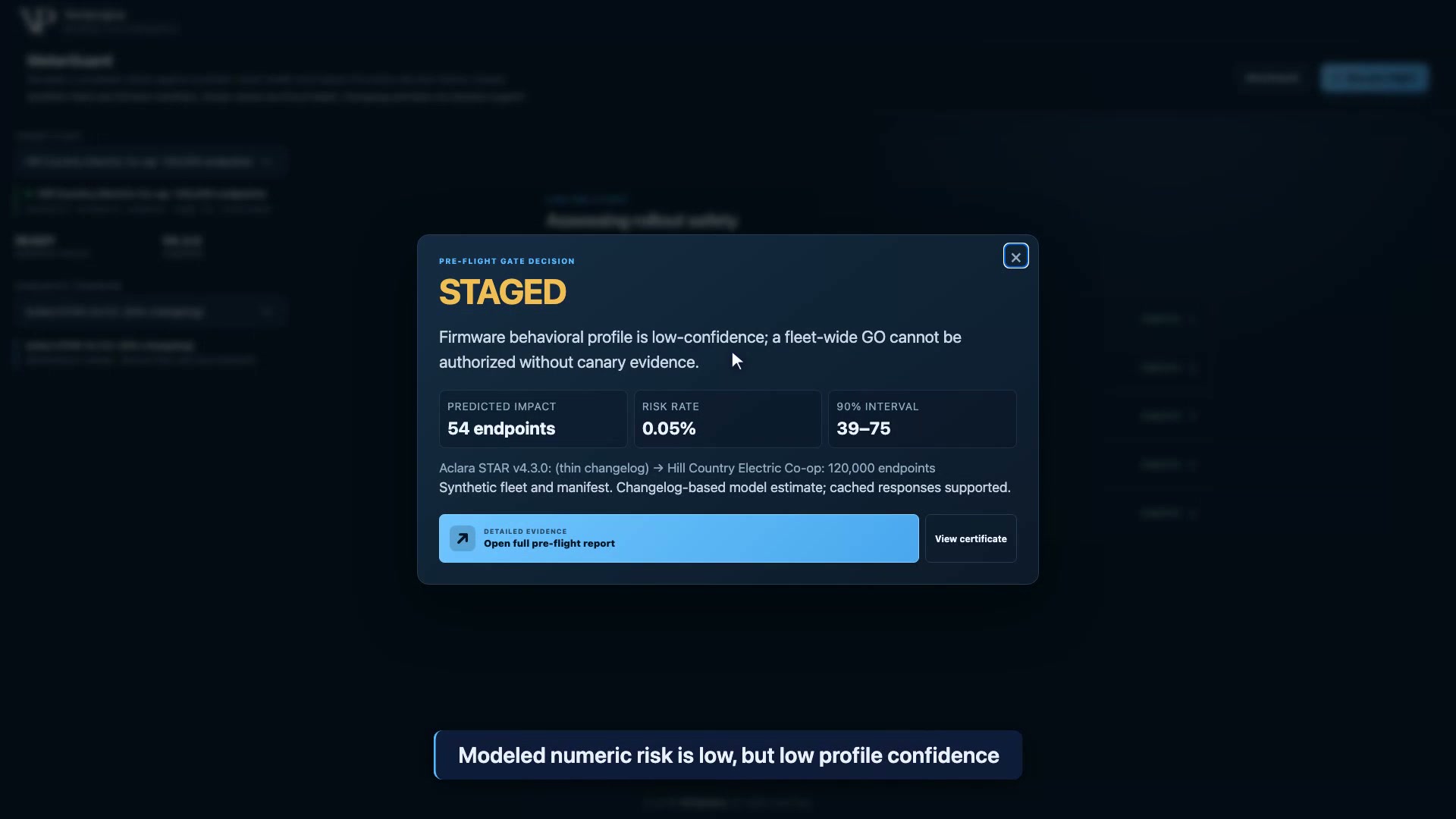 Synthetic Co-op fleet and thin firmware manifest, with fixture vendor labels; cached model-assisted estimate. Low profile confidence withholds GO for 118,222 scored endpoints. Another 1,778 endpoints are excluded; no canary has been executed.
This refusal calls for different work. Repeating the simulation with the same cached estimate would not supply the missing firmware evidence. Before treating the small predicted impact as persuasive, an engineering team needs a firmer account of what the candidate changes and observations that test those assumptions. The demo proposes a canary and re-evaluation with observed telemetry, but it has collected no such observations.
I also would not treat a successful test on healthy endpoints as sufficient evidence for aged batteries or weak radio conditions. That is a proposed review criterion beyond the app: the evidence must address the population for which permission is sought. Nor do these fixture comparisons establish that a vendor-labelled binary is compatible with another manufacturer's hardware.
Make the disagreement useful
Putting the gate in code makes its rule inspectable. It does not validate the model's profile: changed estimates can change the simulation and the verdict. That is why I favor keeping the profile, fleet snapshot, exclusions and deciding rule together when reviewing a recommendation.
On reconsideration, the team should be able to say whether new evidence changed an input, a revised candidate reduced estimated risk, or someone changed the acceptable boundary. Those are different decisions with different justifications. Missing telemetry must stay visible as unresolved work, even when the scored population eventually qualifies for GO.
The MeterGuard explainer shows this firmware rollout pre-flight design. My standard for an AI-assisted release workflow is that the path back from a refusal should improve the evidence or the candidate, with any change in risk tolerance made explicit.