A smart meter firmware hotfix can look like a convincing improvement while leaving a change owner with a reason to hold the rollout. The difficult judgment is whether the remaining risk meets the declared policy for the population being assessed. Comparing the update with its predecessor answers a different question.
Our MeterGuard demo makes that distinction concrete. It evaluates synthetic firmware manifests against generated meter fleets, using cached model-assisted estimates of firmware behavior. In one example, a hotfix reduces the predicted failure rate from 74.22% to 2.85% of scored endpoints. The recommendation remains NO-GO.
For utility metering operations and firmware partners, the useful lesson is how to read that result. A large improvement deserves attention, but it cannot substitute for checking the boundary that governs the recommendation.
What the hotfix improves
The example uses a generated population labelled Plano Water and a synthetic manifest labelled as an inrush-capped hotfix. Those labels identify demo fixtures, not a customer deployment or an actual vendor release.
The profiler estimates the modem's current during flash writes and its ability to reconnect after a reset. Extra current during a write can lower modeled battery terminal voltage. In this simulator, voltage below the brownout floor causes a reset; failed reconnection or modeled flash corruption can then produce endpoint failure. These are assumed mechanisms, not a reconstruction of a historical outage.
The hotfix profile estimates lower write current and much better recovery than the earlier manifest. Applying those estimates to the same generated population substantially lowers the predicted impact. Of 86,078 scored endpoints, the hotfix produces a mean prediction of 2,449 failures, or 2.85%.
That is useful evidence of improvement within this model. It also leaves a material predicted failure count. The release decision needs an acceptance rule that remains meaningful after the comparison has become reassuring.
Why the gate still returns NO-GO
MeterGuard checks the upper end of its 90% modeled interval first. At or above 3.0% of scored endpoints, the configured rule returns NO-GO. The hotfix's interval runs from 1,536 to 3,531 modeled failures. Its upper rate is 4.10%, so it crosses that hard-block boundary.
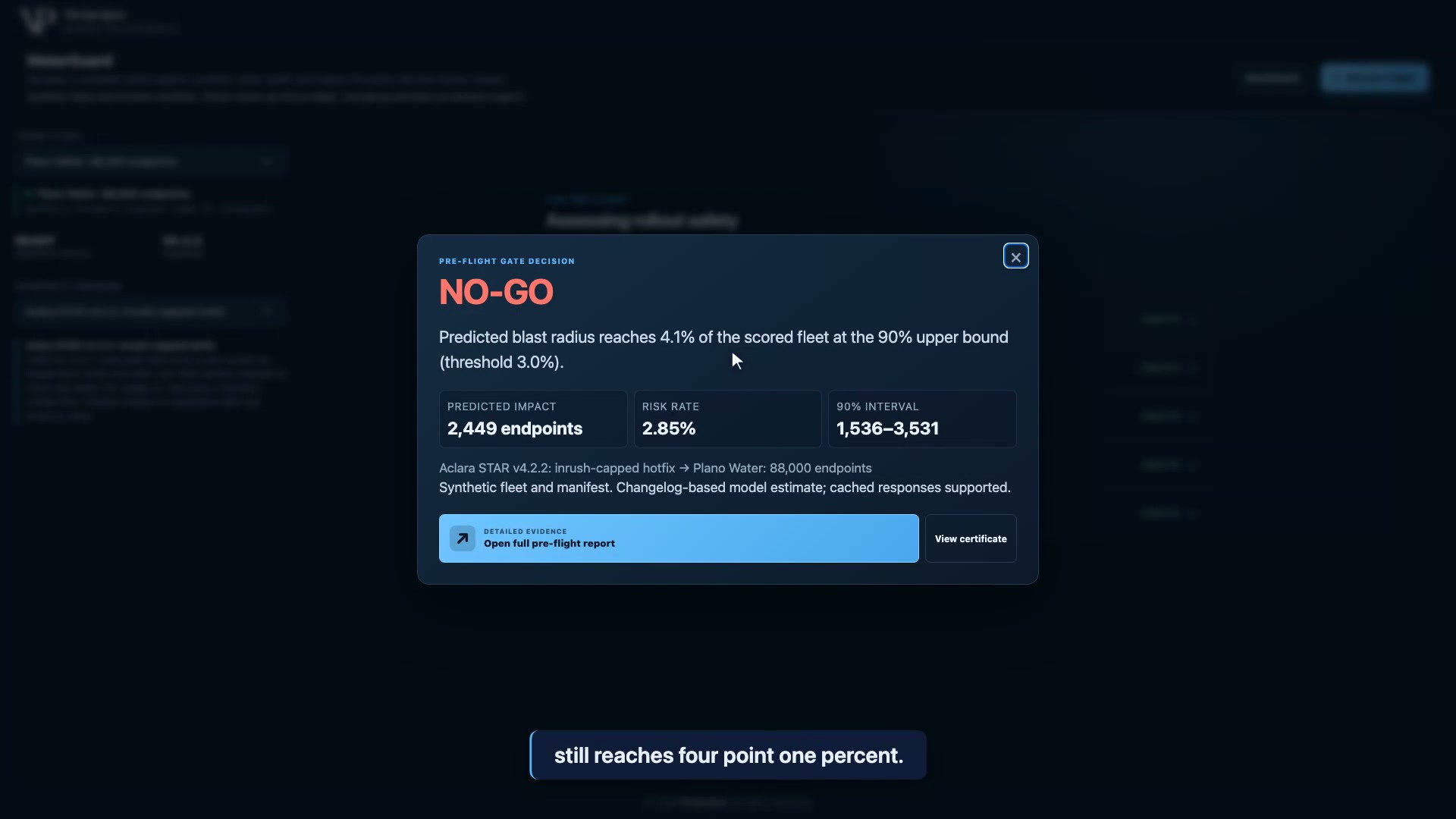 The synthetic Plano-labelled hotfix remains NO-GO: its upper modeled rate is 4.10% of 86,078 scored endpoints, above the configured 3.0% boundary. The visible version and fleet labels are fixtures; the profile is a cached model-assisted estimate.
The mean is below 3.0%, but that is not the quantity this rule tests. Nor is 3.0% the threshold for GO. If the upper rate avoids the hard block, the gate still checks profile confidence and requires a mean at or below 0.5% for GO. Intermediate modeled risk receives a staged-canary recommendation.
We favor making that order visible because each test answers a different concern. The upper interval controls whether modeled downside triggers a hold. The mean contributes to the lower-risk acceptance branch. Profile confidence asks whether the behavioral estimate is sufficiently supported under the configured policy. A favorable answer to one does not erase the others.
The interval itself also has a limit. It summarizes variation across 200 simulation iterations, using modeled inputs. Calling it a 90% interval does not establish 90% coverage in the field. A change owner still needs evidence that the input estimates and simulated mechanisms represent the hardware and operating conditions at issue.
A recommendation belongs to its population
The same estimated hotfix behavior produces a different result against the generated Hill Country Electric Co-op population. This fixture has healthier battery conditions and less weak radio signal. With the simulation and policy unchanged, the prediction becomes 24 failures among 118,222 scored endpoints, a mean of 0.02% and an upper rate of 0.03%. The gate returns GO for those scored endpoints.
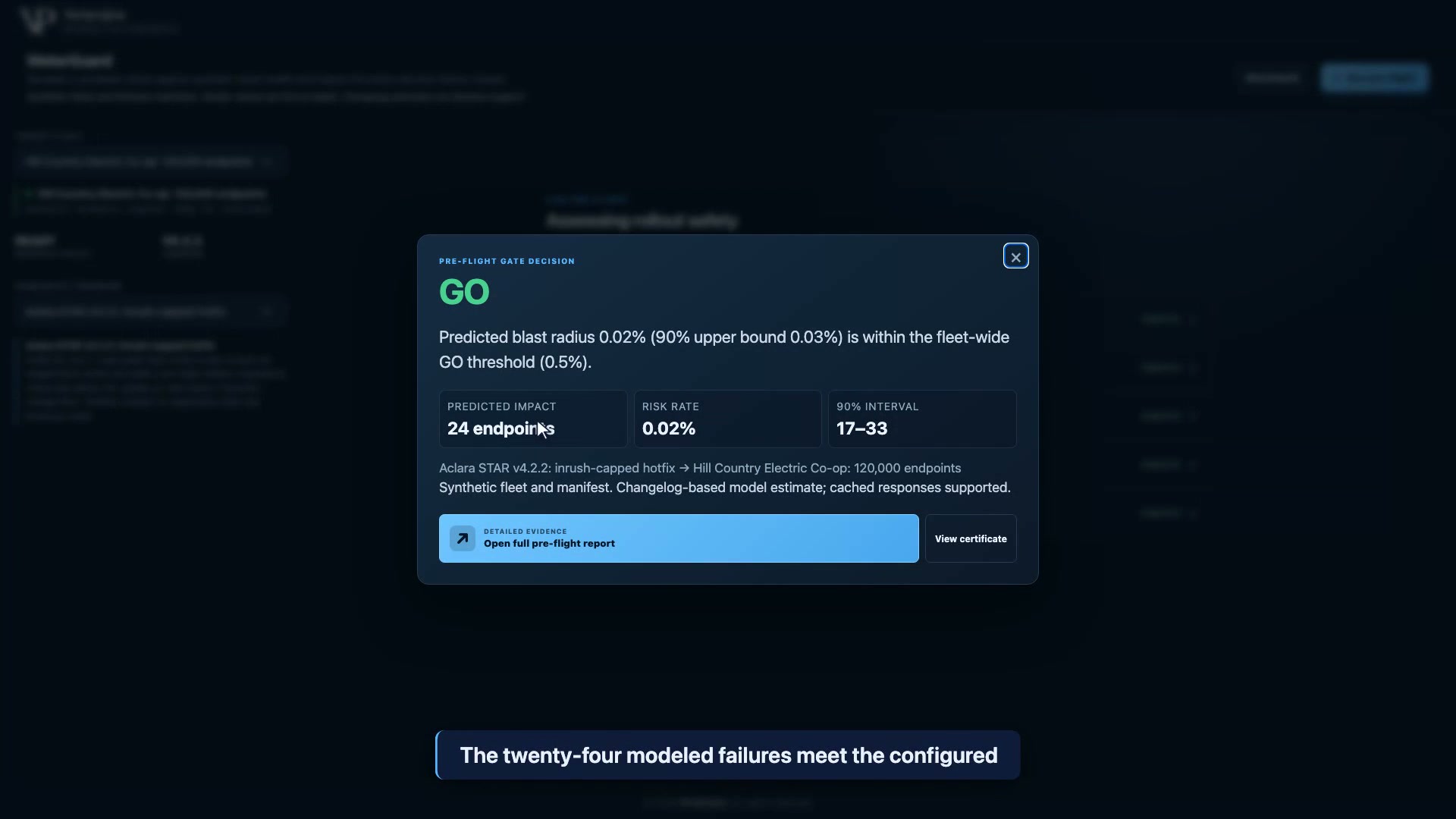 The same cached hotfix behavior clears the configured gate on a healthier synthetic population. GO concerns 118,222 scored endpoints; 1,778 endpoints with missing telemetry remain excluded and recommended for manual review. This is a behavior comparison, not firmware compatibility evidence.
This comparison illustrates why a firmware label alone is a poor unit of approval. The modeled outcome depends on the population as well as the behavioral estimate. It does not show that the same firmware image can be installed across different manufacturers' hardware. No binary compatibility analysis or hardware installation is performed.
Missing telemetry also limits the scope of a reassuring result. The excluded endpoints did not acquire a low risk score; they received no prediction. Treating them as covered would enlarge the recommendation beyond the evidence. Keeping the scored denominator beside GO makes that boundary inspectable.
Code makes the rule inspectable, not the estimate correct
In this workflow, plain code issues the gate verdict. The model-assisted memo follows the decision and cannot directly override it. However, the profiler supplies inputs to the simulation, so its quality still affects the outcome. A deterministic policy does not validate a changelog-derived estimate.
The demo's hotfix regression control makes that dependency visible. Its configured target is GO, while the current cached profile produces NO-GO on the Plano-labelled population. The suite marks that row for review. The mismatch calls for examining the expectation and the inputs; it is not permission to substitute an older, more favorable estimate.
The MeterGuard explainer shows the workflow and its evidence. The local app records recommendations, without operating a live meter connector or executing a firmware release. Production work would require real telemetry, validation derived from the firmware binary and calibration against actual campaign outcomes.
For a change owner, the handoff should therefore preserve the population assessed, the profile used, the uncertainty boundary and the unresolved endpoints beside the verdict. A better estimate can justify further review. Release acceptance requires evidence that meets the stated policy for the stated scope.