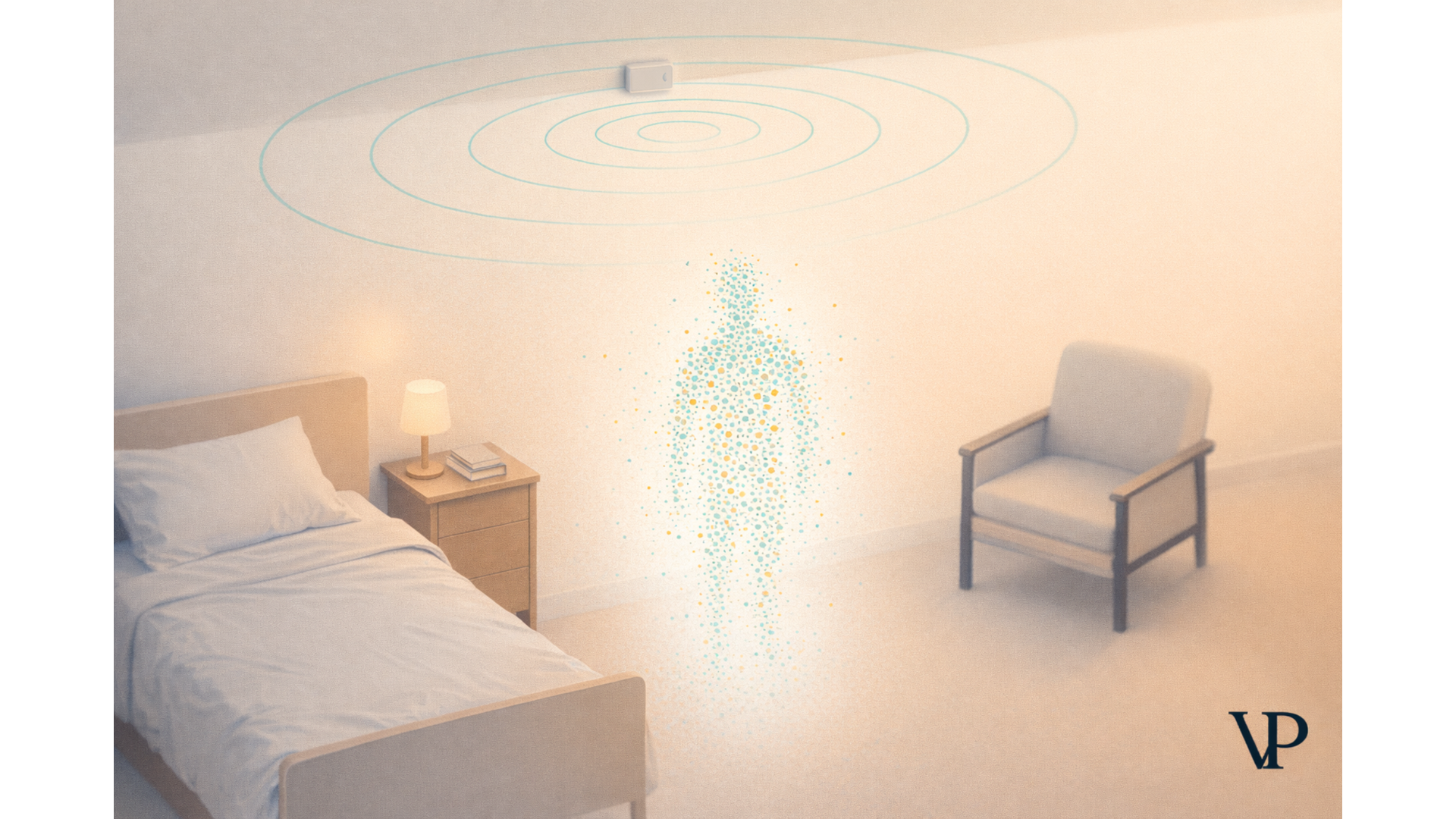
A single fall costs a nursing home between $30,000 and $60,000 in medical bills, liability, and increased care. Falls are the leading cause of injury-related death among adults over 65, and the most dangerous moments happen in the most private spaces — the bathroom, the bedroom, the middle of the night. The industry's answer for decades has been cameras or wearable pendants. One destroys dignity. The other gets left on the nightstand.
We believe this trade-off between safety and privacy is a failure of engineering imagination, not an inevitability of care. Our work at Veriprajna focuses on a fundamentally different approach: mmWave radar combined with edge AI — a system that can detect a fall, track breathing, and alert a nurse, all without capturing a single image of the person it's protecting.
The Camera Problem Nobody Wants to Talk About
Cameras are extraordinarily good at recognizing human activity. That's precisely the problem.
Optical surveillance captures personally identifiable information by default. Even with "privacy masking" or low-resolution feeds, the psychological weight of a lens pointed at someone in their bedroom is real. Residents know they're being watched. Families know it. Staff know it.
Beyond the ethics, cameras have hard physical limits. They fail in low light. They can't see through shower curtains or blankets. They create blind spots in exactly the places where falls are most likely to happen.
A monitoring system that can't work in a dark bathroom at 2 AM isn't a safety system. It's a liability.
Wearable pendants solve the visual privacy issue but introduce what the industry calls the compliance gap. The device only works if someone remembers to wear it and charge it. Cognitive decline, arthritis, simple forgetfulness — any of these breaks the chain. Many falls happen at night, when the pendant is on the nightstand, or during bathing, when it's removed entirely.
A passive system — one that requires zero interaction from the resident — is the only approach that doesn't have a human failure point.
Why 60 GHz Radar Changes the Equation
Millimeter-wave radar works by sending out radio waves and analyzing what bounces back. No lens. No microphone. No image of any kind. It is physically incapable of capturing a face, a body, or any visual identifier. Privacy isn't a software setting — it's baked into the physics.
We work specifically with 60 GHz FMCW radar (Frequency Modulated Continuous Wave), and the choice of frequency matters enormously.
At 60 GHz, the wavelength is roughly 5 millimeters. That's small enough to detect the sub-millimeter rise and fall of a chest during breathing — even when the person is sitting perfectly still. The system doesn't just see movement; it sees the micro-movements that distinguish a living, breathing human from a piece of furniture.
There's a useful physical bonus: 60 GHz signals sit within the oxygen absorption band, meaning they attenuate rapidly over distance and don't penetrate thick walls effectively. The monitoring data stays contained within the room. It's a layer of physical data security that no software firewall can match.
With up to 4 GHz of available bandwidth, the sensor achieves a range resolution of about 3.75 centimeters — fine enough to distinguish a person's limbs from their torso. That granularity is what makes it possible to tell the difference between a fall and someone crouching to pick up a shoe.
We explored this sensing architecture in depth in our interactive analysis, which walks through the physics and signal processing behind the approach.
What the Sensor Actually "Sees"
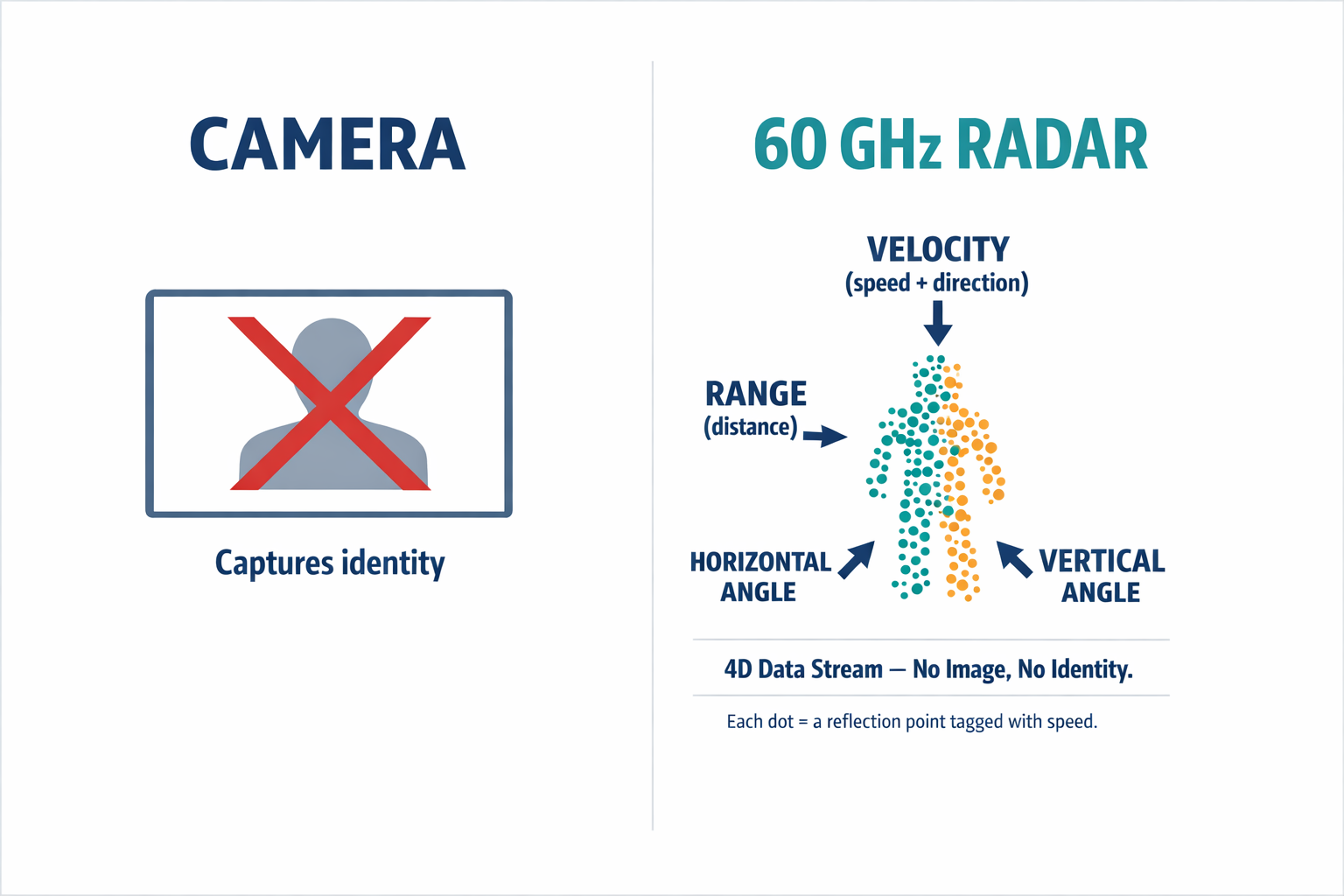
Think of it less like a camera and more like a bat's echolocation, but in four dimensions.
The radar transmits a signal whose frequency ramps up linearly — a "chirp." When that signal bounces off a person and returns, the frequency difference between what was sent and what came back tells the system exactly how far away the reflection is. Stack hundreds of these chirps together and you can also measure velocity — how fast the person is moving, and in which direction.
Add multiple antennas, and you get horizontal and vertical angles. The result is a 4D data stream: range, velocity, horizontal angle, and vertical angle. Not a picture. A dynamic cloud of moving points in three-dimensional space, each tagged with its speed.
This is where radar has an advantage even over LiDAR, which provides excellent 3D geometry but no instantaneous velocity data. Radar gives you Doppler velocity for every point. A stationary chair returns nothing interesting. A motionless human returns subtle phase modulations from breathing and heartbeat. The system can separate the two even when they're side by side.
Radar doesn't see what you look like. It sees how you move — and whether you've stopped moving.
Teaching AI to Recognize a Fall (Without a Single Photo)
Raw radar data is noisy and complex. Walls, furniture, and ceilings generate massive reflections that can drown out the signal from a human body. The intelligence isn't in the sensor alone — it's in the processing pipeline that transforms electromagnetic noise into a clear answer: did someone just fall?
Our approach uses multiple AI architectures working in parallel, each analyzing a different aspect of the data.
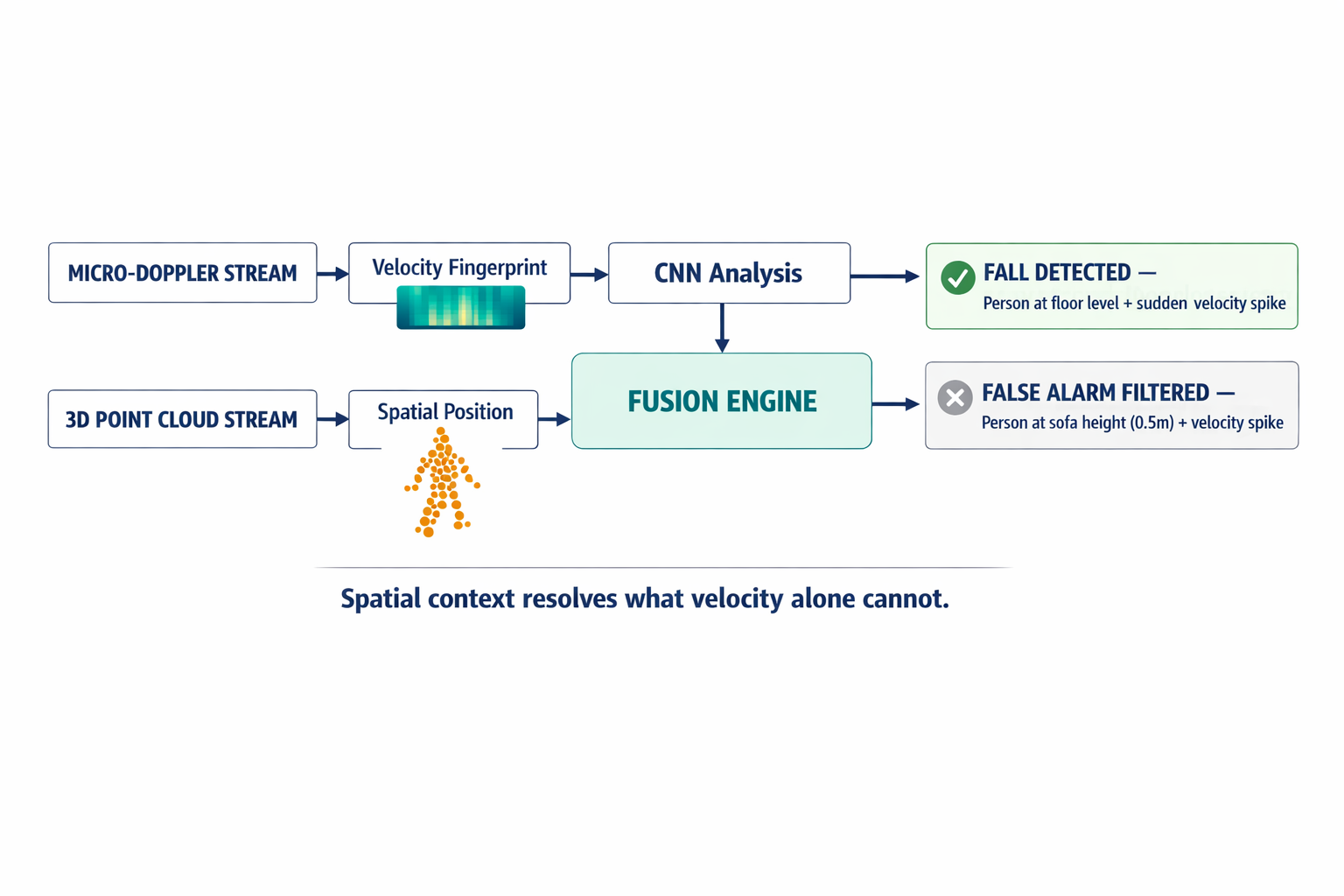
One stream processes micro-Doppler spectrograms — essentially velocity fingerprints over time. A person walking produces a distinctive pattern: torso at constant speed, limbs oscillating faster. A fall produces a sudden broadband burst of energy followed by silence. Our convolutional neural networks learn to recognize these "shapes" of motion, consistently outperforming classical machine learning methods by 7–10% in accuracy according to benchmark studies.
A second stream processes the 3D point cloud — the spatial distribution of radar reflections. Specialized architectures like PointNet can distinguish a person standing (a vertical column of points) from a person lying on the floor (a horizontal spread). Graph neural networks take this further, learning the geometric relationships between body parts — effectively building a skeleton from radar reflections, no camera required.
The critical innovation is fusing these two streams. Velocity analysis alone can be fooled — a person collapsing heavily onto a sofa generates a Doppler spike that looks a lot like a fall. But when the spatial stream shows the person's final position is at sofa height (roughly half a meter up) rather than floor level, the system correctly classifies it as sitting, not falling.
The hardest problem in fall detection isn't detecting the fall. It's not detecting everything else.
The Real-World Enemies: Ceiling Fans, Pets, and Curtains
Laboratory accuracy means nothing if the system generates false alarms every time a ceiling fan turns on. False alarms are the primary obstacle to commercial adoption — they cause alarm fatigue, erode staff trust, and eventually get the system ignored or unplugged.
A rotating ceiling fan generates a constant high-frequency Doppler signature that can look like a flailing limb. Our system handles this by building a spatial map of the room during setup. If high velocity is consistently detected at a fixed coordinate — say, the center of the ceiling — that location gets masked from the fall detection logic. The AI learns that "fast movement at that specific spot is normal."
Large pets present a subtler challenge. A 70-pound dog jumping off a couch can produce a radar signature uncomfortably similar to a falling person. We address this through geometry: a human typically occupies a tall, narrow volume (vertical column), while a dog occupies a low, wide one (horizontal spread). Combined with differences in radar reflectivity, the classification model includes an explicit "Animal" class to filter these events.
Even curtains blowing in a draft create ghost targets. During installation, areas near windows and AC vents are designated as interference zones, and the tracking algorithm raises its confidence threshold before initiating alerts from those locations. The micro-Doppler signature of a billowing curtain — a low-frequency, sinusoidal oscillation — is also distinct from human motion and gets filtered by the deep learning classifier.
Why Processing Happens on the Device, Not in the Cloud
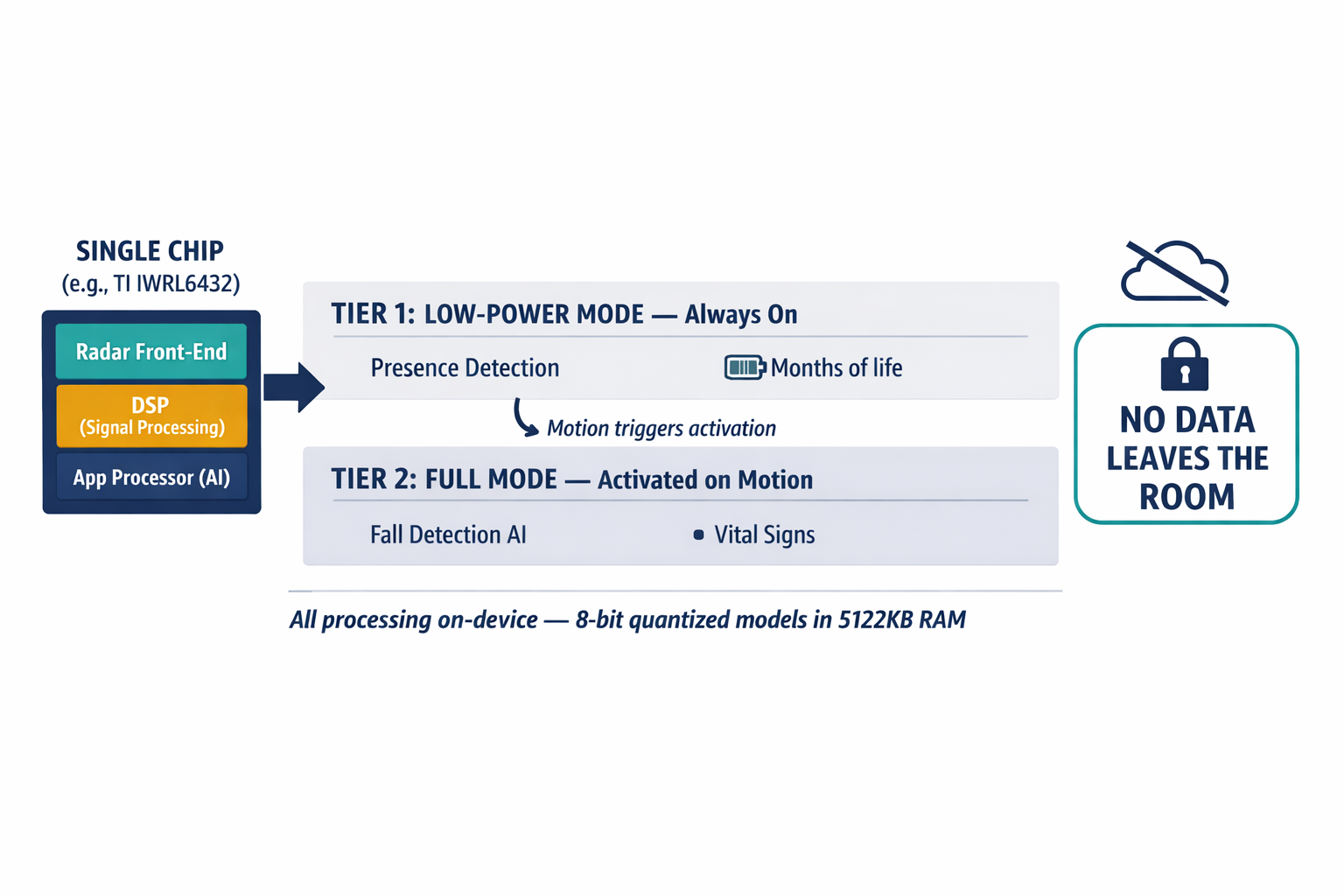
Sending high-bandwidth radar data to a cloud server for processing would undermine every privacy claim we make. It would also introduce latency — a delay between a fall and an alert — and create a dependency on internet connectivity that no hospital safety system should tolerate.
All neural network processing runs directly on the sensor's embedded processor. We target systems-on-chip like the Texas Instruments IWRL6432, which integrates the radar front-end, a digital signal processor for the heavy math, and an application processor for decision-making — all on a single chip.
Running deep learning models on a microcontroller with 512KB of RAM requires aggressive optimization. We convert standard 32-bit neural network weights to 8-bit integers, reducing model size by 4x with typically less than 1% accuracy loss. We prune redundant connections. We use ARM's hand-optimized computation libraries to squeeze every cycle of performance from the hardware.
Power management uses a cascading approach: a low-power presence detection mode runs continuously, consuming minimal energy. Only when it detects coarse motion does the full fall detection model activate. This hierarchy can extend battery life from days to months.
For the full technical methodology behind our edge AI architecture and signal processing pipeline, see our detailed research.
Fitting Into the Systems That Already Exist
A sensor that detects a fall but can't communicate with the nurse call system is a science project, not a product.
The central nervous system of any care facility is the Nurse Call System, governed by UL 1069 — the standard for hospital signaling equipment that mandates rigorous reliability and failsafe operation. Our sensors include an opto-isolated relay output. When a fall is detected, the relay closes, connecting to the auxiliary input of the existing nurse call station on the wall. It triggers the standard call light and pager system. Simple, failsafe, and compatible with roughly 90% of existing infrastructure.
For facilities with modern IP-based platforms, the sensor pushes structured data via standard protocols. Instead of a generic "Room 302 Alarm," the nurse sees "Room 302: Fall Detected (High Confidence)" or "Room 302: Resident has not moved for 4 hours."
Because mmWave radar captures no biometric identifiers — no faces, no fingerprints, no recognizable images — it is inherently more compliant with GDPR and HIPAA than any camera-based system. It processes anonymous motion data. We do note that behavioral patterns like bathroom frequency constitute protected health information and must be encrypted accordingly. All data in transit uses TLS 1.2+ encryption; all data at rest uses AES-256.
Beyond Emergency Alerts: The Quiet Value of Longitudinal Data
The most compelling use case isn't the fall itself — it's the weeks before.
By tracking gait speed and activity levels over time, the system can detect the subtle decline that typically precedes a fall. "Mrs. Jones is walking 20% slower this week" is a powerful leading indicator that allows clinical intervention before an accident occurs.
Staff efficiency improves too. Nurses no longer need to perform intrusive rounds just to confirm a resident is in bed. A real-time presence dashboard lets them focus attention on residents who actually need help, rather than checking on everyone out of obligation.
Evidence-based fall prevention programs can deliver an ROI exceeding 500% — $5 saved for every $1 invested.
The math is straightforward: if the system prevents a single hospitalization-level fall every five years, the investment pays for itself.
What About Multi-Person Rooms and Scaling?
Fair question. When two people share a room, the radar must track multiple point clouds simultaneously and attribute activity to the correct individual. This is an active area of development across the industry. Our dual-stream fusion approach — combining velocity signatures with spatial trajectories — helps here, because each person occupies a distinct spatial track even when their Doppler signatures overlap. It's not a solved problem at infinite scale, but for the one-to-three occupant rooms typical in assisted living, the tracking is robust.
On the question of cost: a single fall with injury costs a facility $30,000 to $60,000. The sensor hardware — systems-on-chip, no moving parts, no consumables — is a fraction of that. The deployment complexity is comparable to installing a smoke detector, not a security camera system.
The Shift from Surveillance to Sensing
The transition happening in elder care technology is not incremental. It's philosophical. For decades, safety meant watching. Watching meant cameras. Cameras meant choosing between protecting someone's body and respecting their dignity.
mmWave radar dissolves that choice. It replaces the camera lens with an antenna that is physically incapable of capturing an image. It replaces the cloud server with an edge processor that never transmits raw data. It replaces the wearable pendant with a passive system that works whether the resident remembers it or not.
The future accelerates this further. Emerging 6G networks will integrate sensing and communication directly — the Wi-Fi router of the future may itself become a fall detection sensor, using the radio waves already filling our homes.
We'd welcome hearing from anyone working on the operational side of this challenge — facility administrators, clinical directors, technology architects. The engineering is advancing fast. The question now is how quickly care delivery models adapt to match it.