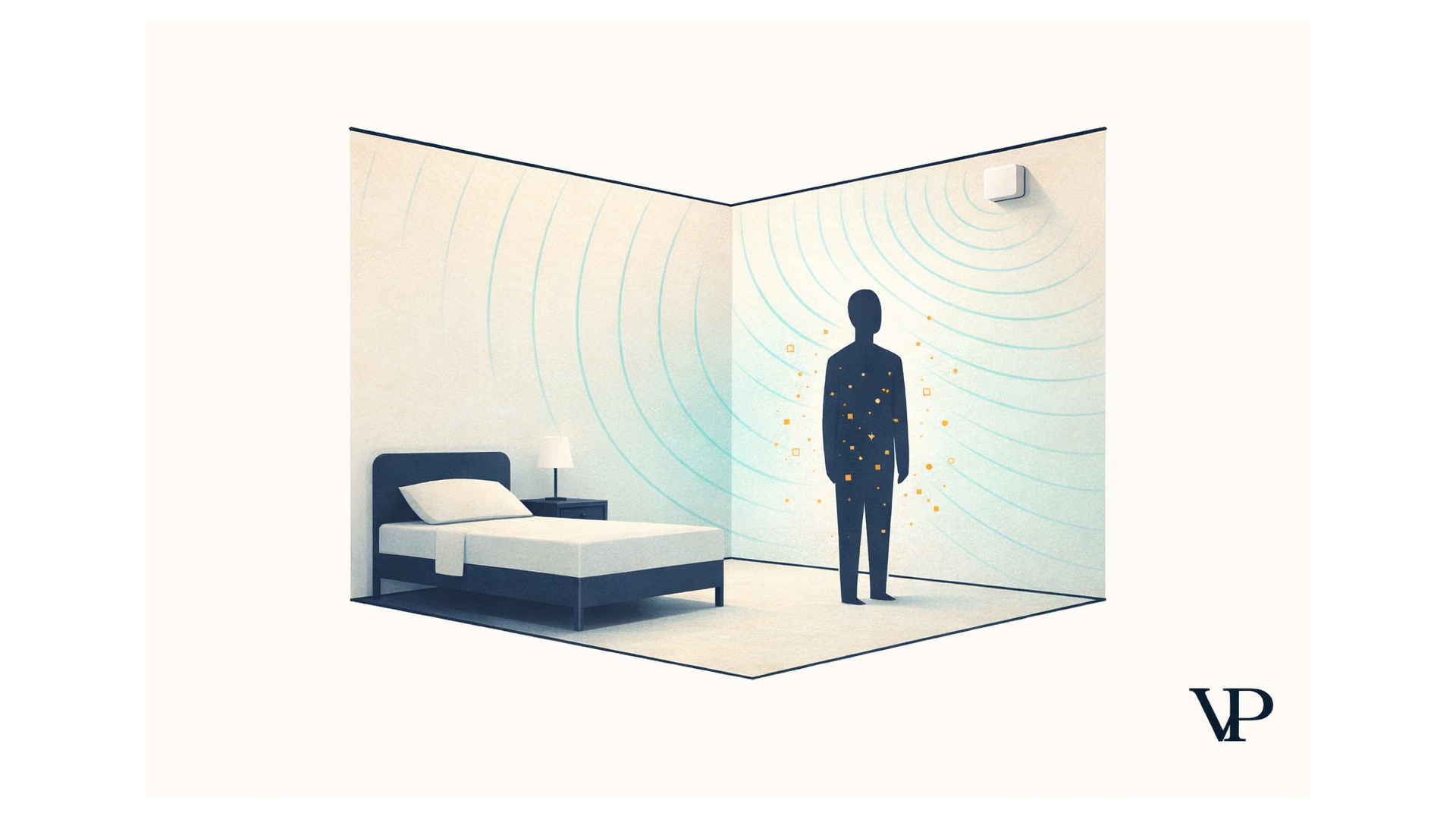
Every year, falls kill more adults over 65 than any other type of injury. The healthcare system's answer has been to put cameras in their bedrooms and bathrooms. I've spent the last two years building a different approach — one that detects falls using radar instead of video, processes everything on the device itself, and is physically incapable of capturing an image of anyone. No cloud. No footage. No compromise on dignity.
The elder care industry has accepted a false choice: safety or privacy. You can watch your residents around the clock with cameras, or you can respect their dignity and hope the wearable pendant they forgot to charge will work when they slip in the shower at 3 AM. At Veriprajna, we rejected that tradeoff entirely. We built a fall detection system using millimeter-wave radar and deep edge AI that keeps people safe without ever "seeing" them.
This is the story of how we got there, what we learned, and why the hardest problems weren't the ones we expected.
The $50 Billion Problem Nobody Wants to Talk About
Falls among seniors cost the U.S. healthcare system approximately $50 billion per year in direct medical expenses. A single fall with injury costs a care facility between $30,000 and $60,000 when you add up medical costs, liability, and increased care needs. But the financial toll isn't even the worst part.
The psychological damage is staggering. Seniors who fall — or who fear falling — withdraw. They stop walking. They stop socializing. They decline faster. The clinical term is "fear of falling," and it triggers a vicious cycle of immobility, isolation, and accelerated physical deterioration.
So the industry responded with surveillance. Cameras in hallways, then in rooms, then — in some facilities — in bathrooms. The logic was straightforward: if we can see them fall, we can respond faster.
We built a system where safety is guaranteed by physics, not by policy. There is no lens. There is no microphone. There is nothing to hack, leak, or subpoena.
But here's what that logic misses: the mere presence of a camera lens destroys something essential. The feeling of solitude. The sense that your room is still yours. I watched my own team struggle with this when we started — we kept defaulting to "just add privacy masking to the video feed." It took an uncomfortable conversation with a geriatric care nurse to snap us out of it. She said: "My patients would rather risk a broken hip than be watched in the shower." That sentence rewired our entire approach.
Why Cameras and Wearables Both Fail
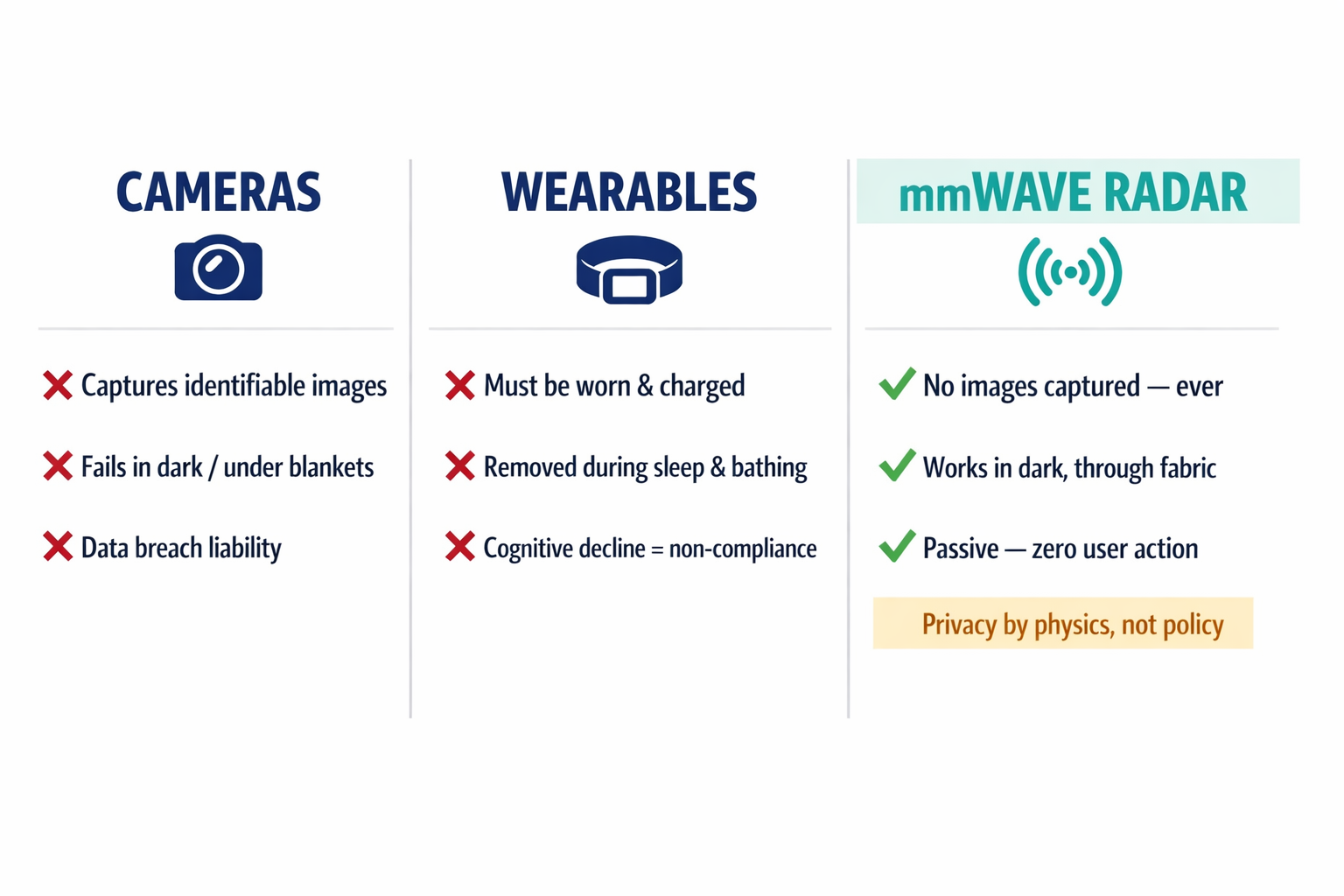
The two dominant technologies in fall detection each have a fatal flaw.
Cameras capture personally identifiable information by default. Even "privacy-enhanced" systems with blurred faces or skeleton overlays still require a lens pointed at a human being in their most vulnerable moments. They fail in the dark. They can't see through shower curtains or blankets. And they create a data liability — footage that can be hacked, leaked, or misused.
Wearable pendants and watches solve the visual privacy problem but introduce what the industry calls the "compliance gap." The device only works if the person remembers to wear it and keep it charged. Cognitive decline, arthritis, simple forgetfulness — all of these break the system. The cruelest irony: most falls happen at night or during bathing, precisely when wearables are removed.
A passive system — one that requires zero interaction from the person it protects — is the only approach that actually works in the real world.
Seeing Without Eyes: How 60 GHz Radar Works
This is where the physics gets interesting, and where I got genuinely excited when my team first showed me the data.
Millimeter-wave radar works by sending out radio waves and analyzing what bounces back. Think of it like echolocation — bats navigate in complete darkness by listening to reflected sound. Our sensor does the same thing with electromagnetic waves, operating at 60 GHz.
Why 60 GHz specifically? Three reasons that matter:
The wavelength at this frequency is roughly 5 millimeters. That's fine enough to detect the sub-millimeter rise and fall of a person's chest as they breathe. An unconscious person lying on the floor after a fall still registers, because their chest is still moving. A camera in a dark room would see nothing.
The 60 GHz band sits within what physicists call the oxygen absorption spectrum — the signals weaken rapidly over distance and don't penetrate thick walls. Your sensor monitors one room and one room only. The data physically cannot leak to the apartment next door.
And critically: radar at this frequency produces a mathematical representation of motion in 3D space. It generates what we call a point cloud — a set of coordinates showing where moving objects are and how fast they're moving. It does not and cannot produce an image. There is no reconstruction path from radar data back to a photograph of a person. Privacy isn't a software setting. It's a property of the physics.
We explored this sensing architecture in depth in our interactive analysis, including the signal processing chain that makes it work.
The Moment I Realized the Real Problem Wasn't Detection
About eight months into development, we had a working prototype. In the lab, it was beautiful. Falls detected with high accuracy. Clean separation between walking, sitting, standing, lying down. My team was celebrating.
Then we installed it in a test apartment. Within 48 hours, the system had flagged 14 false alarms. A ceiling fan. A cat jumping off a couch. Curtains billowing near an air conditioning vent.
The lab is a liar. Every real-world deployment teaches you that the hardest engineering isn't the core algorithm — it's surviving the chaos of an actual living space.
That was the moment I understood: detection accuracy in a controlled environment is table stakes. The real engineering challenge is the "long tail" of false alarms — the thousand weird things that happen in a real home that your training data never anticipated.
We spent the next several months building what I now think of as the immune system around the core AI. A ceiling fan generates a constant, high-frequency radar signature at a fixed location — so the system learns that "fast motion at coordinates X, Y, Z on the ceiling is normal, ignore it." A pet has a different electromagnetic reflectivity than a human and occupies a horizontal shape rather than a vertical one — so the classifier learned to distinguish them. Curtains near windows get flagged as interference zones during installation, with higher confidence thresholds required before an alert fires.
None of this is glamorous work. None of it makes for exciting demos. But it's the difference between a product that works in a conference room and one that works in your grandmother's apartment.
How the AI Actually Tells a Fall from a Hard Sit
This was our trickiest classification problem, and solving it taught me more about AI architecture than anything else in my career.
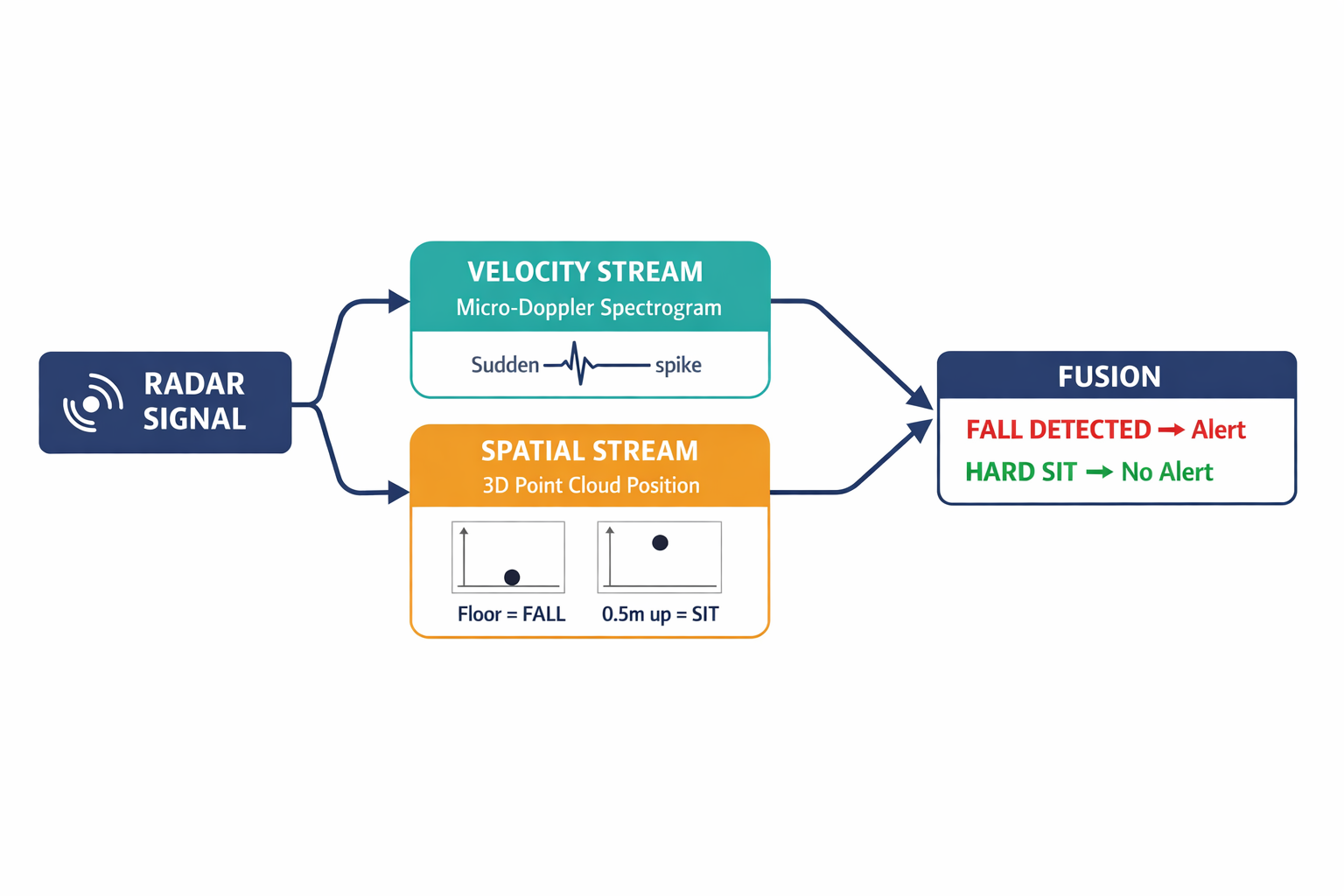
Picture someone collapsing onto a sofa. The radar sees a sudden downward velocity spike — a body moving fast toward a surface. Now picture someone falling to the floor. The radar sees... a sudden downward velocity spike. The motion signatures look nearly identical.
We solved this with what we call a dual-stream approach. One stream analyzes velocity dynamics — how fast is the person moving, and what's the pattern of acceleration? The other stream analyzes spatial trajectory — where does the person end up in 3D space?
A fall ends with the person's center of mass near the floor — roughly ground level. A hard sit onto a couch ends with their center of mass at about half a meter up. The velocity streams look the same. The spatial streams look completely different. By fusing both, the AI correctly distinguishes between the two scenarios.
This fusion architecture — combining what we call micro-Doppler spectrograms (velocity fingerprints) with 3D point cloud analysis (spatial positioning) — consistently outperforms single-stream approaches. Benchmark studies show that deep learning on radar spectrograms beats classical machine learning methods by 7-10% in accuracy, and our dual-stream fusion adds another layer of robustness on top of that.
Why We Refuse to Send Data to the Cloud
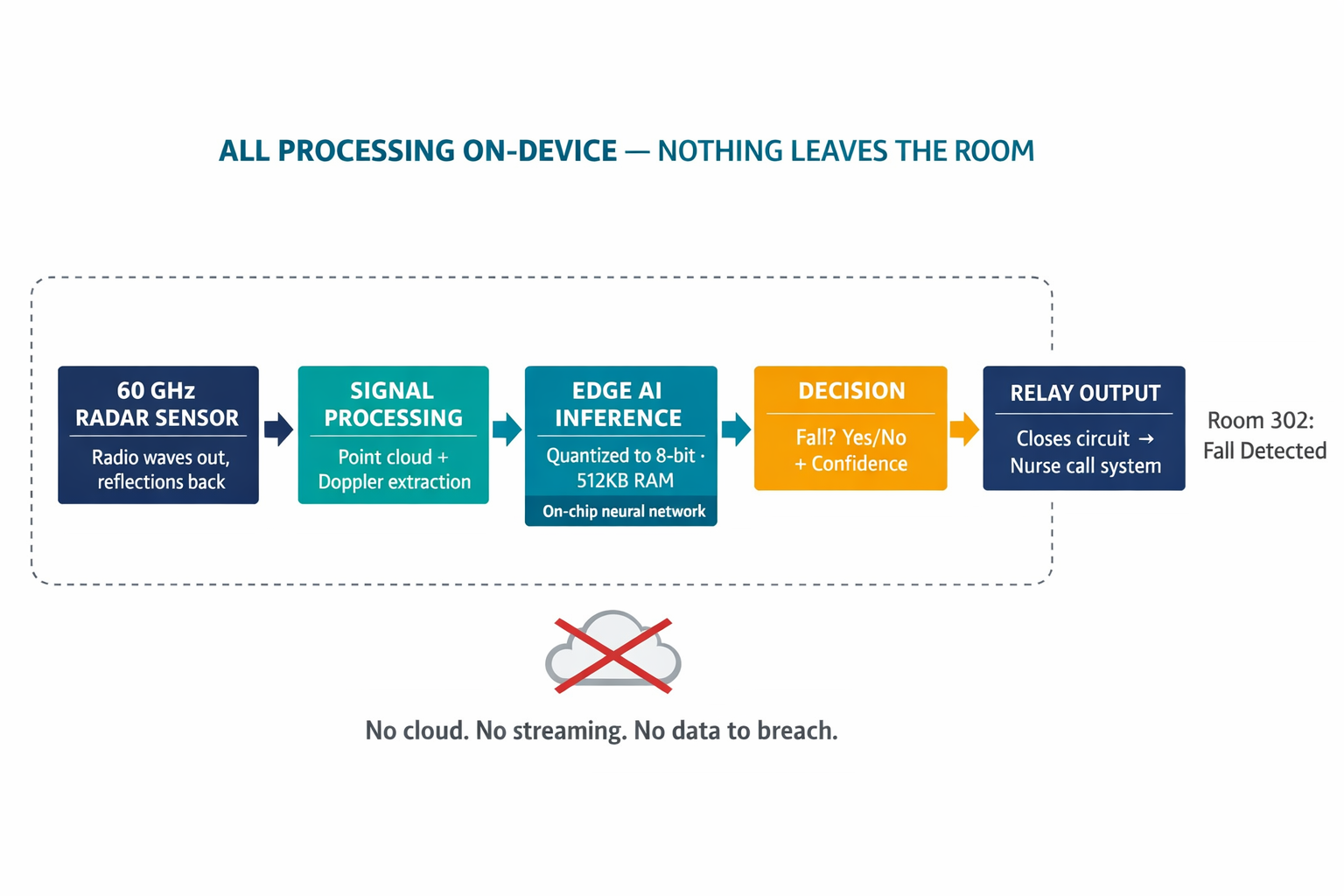
Every byte of radar data our sensor captures is processed on the device itself. Nothing goes to a server. Nothing touches the internet during inference.
This isn't just a privacy stance — though it is that. It's an engineering decision driven by three constraints that cloud-based systems can't solve.
Latency kills. When someone falls, you have seconds, not minutes. A round trip to a cloud server adds delay that a local processor eliminates. Our system runs on embedded chips — Texas Instruments mmWave systems-on-chip that integrate the radar front-end and the AI processor on a single piece of silicon. Inference happens in milliseconds.
Bandwidth costs compound. Streaming dense radar data 24/7 from thousands of rooms would require massive bandwidth infrastructure. Processing locally means the only data that leaves the device is a simple alert: "Room 302: Fall detected, high confidence."
Privacy must be structural. If data never leaves the device, it cannot be intercepted, subpoenaed, or breached. We don't ask facilities to trust our encryption or our cloud security policies. We eliminate the attack surface entirely.
Running deep neural networks on a microcontroller with 512KB of RAM requires brutal optimization. We convert our models from 32-bit floating-point to 8-bit integers — a technique called quantization — which shrinks the model by 4x with less than 1% accuracy loss. We prune redundant connections. We use ARM's hand-optimized computation libraries to squeeze every cycle of performance from the hardware.
Edge AI isn't a feature. It's a trust architecture. If the data never leaves the room, there's nothing to breach.
For the full technical methodology behind our signal processing and edge deployment pipeline, see our detailed research.
Plugging Into the System That Already Exists
A sensor that detects a fall but can't tell anyone about it is useless. The central nervous system of every nursing home is the nurse call system — the button on the wall, the light above the door, the pager on the nurse's hip. These systems are governed by UL 1069, a safety standard that mandates rigorous reliability.
We designed our sensor with a simple solid-state relay output. When a fall is detected, the relay closes. That closure connects to the existing nurse call station's auxiliary input — the same port that a pull cord or bathroom button uses. The nurse sees the light. The pager goes off. No new software. No IT integration project. No training.
For facilities with modern IP-based systems, we also push structured data via standard protocols. Instead of a generic alarm, the nurse's dashboard shows: "Room 302: Fall Detected, High Confidence" or "Room 302: Resident stationary for 4 hours." But the relay output means we work with 90% of existing infrastructure out of the box.
This was a deliberate design choice. The fastest path to saving lives isn't building a beautiful new platform. It's plugging into the ugly, reliable system that's already there.
What About HIPAA? What About GDPR?
This is the question I get in every meeting, and it's where radar has a structural advantage that cameras never will.
Because mmWave radar cannot capture biometric identifiers — no faces, no fingerprints, no recognizable images — it sidesteps the most burdensome provisions of both HIPAA and GDPR. The data it processes is anonymous motion information: coordinates, velocities, signal strength. There's no personally identifiable information to protect because none is ever captured.
That said, we're not naive about the edges. Behavioral patterns — how often someone uses the bathroom, whether their gait is slowing — constitute health information. We encrypt all transmitted data with TLS 1.2+ in transit and AES-256 at rest. We adhere to ISO 31700 for Privacy by Design: no microphone, no lens, highest privacy settings by default, data minimization throughout the lifecycle.
But the fundamental point stands: it's much easier to comply with privacy regulations when your hardware is physically incapable of capturing the data that regulations exist to protect.
Does This Actually Pay for Itself?
The math is surprisingly simple. A single hospitalization-level fall costs a facility $30,000 to $60,000. Published research on evidence-based fall prevention programs shows an ROI exceeding 500% — $5 saved for every $1 invested. Our system pays for itself if it prevents one serious fall every five years.
But the less obvious ROI is in staff efficiency and alarm fatigue. When every alert is a false alarm, nurses stop responding urgently. When the system is accurate, trust goes up, response times go down, and staff can focus on residents who actually need help. Nurses no longer need to perform intrusive room checks just to confirm someone is in bed — the sensor provides real-time presence status passively.
And then there's the long game: predictive analytics. By tracking gait speed and activity levels over weeks, the system can flag the subtle decline that precedes a fall. "Mrs. Jones is walking 20% slower this week" is a leading indicator that allows intervention before the accident. We're not just detecting falls. We're building toward preventing them.
Where This Goes Next
The technology roadmap here is genuinely exciting. Future 6G networks are being designed to integrate sensing and communication — a concept called ISAC. The Wi-Fi router of the future may be the fall detection sensor, using the radio waves already filling our homes.
But I'm most interested in something closer to the present: the shift from "surveillance" to "sensing" as the default paradigm in elder care. We've spent decades accepting that safety requires watching people. It doesn't. It requires understanding motion, context, and change over time — none of which require a single pixel of imagery.
We built a system that is physically incapable of watching someone naked, yet computationally capable of knowing they've fallen and need help. That sentence shouldn't sound revolutionary. But in an industry that has normalized cameras in bedrooms, it is.
If you're working in senior care, health system operations, or AgeTech — I'd genuinely like to hear how you're navigating the privacy-safety tension. The engineering is solvable. The harder question is whether the industry is ready to demand better.