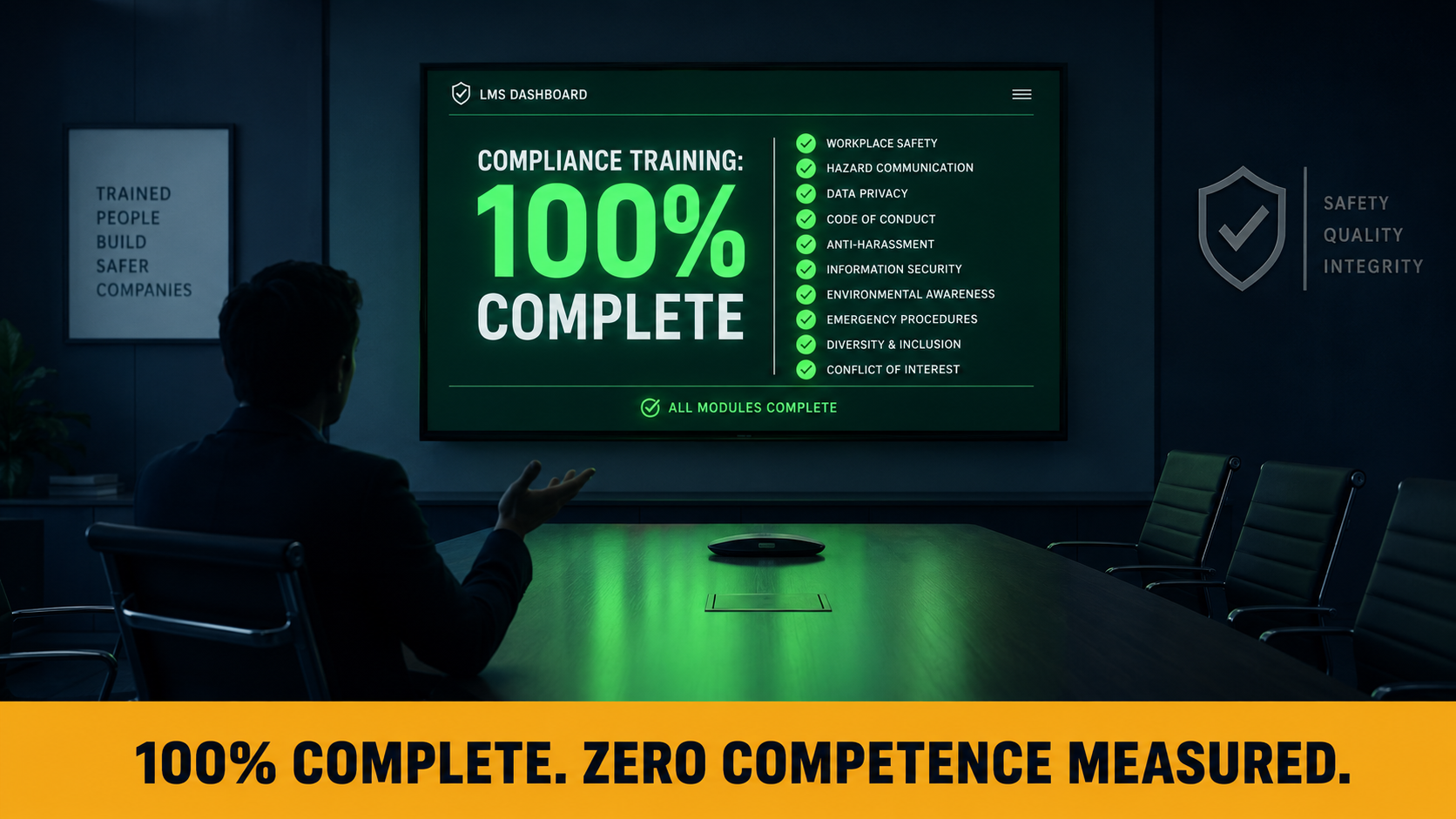
I've been in a lot of compliance training discussions. The one that reframed how I think about the whole problem was with an L&D director at a regulated financial firm who pulled up a dashboard full of green checkmarks — 100% of the compliance function had completed the annual AML module — and I asked whether employees actually knew the material.
The answer, delivered without particular defensiveness as though it were obvious, was that competence wasn't what the system was built to measure.
That answer is about to get harder to defend. EU AI Act Article 4, in effect since February 2025, requires AI literacy training calibrated to each employee's role — not just assigned and logged. National market surveillance authorities begin enforcement in August 2026. TD Bank's $3.1 billion AML penalty included findings about the adequacy of its training program, not just the compliance failures that followed. The standard for "we did the training" is shifting, and a completion dashboard isn't the answer to the question regulators will start asking.
What I Found After Actually Running the Vendor Evaluations
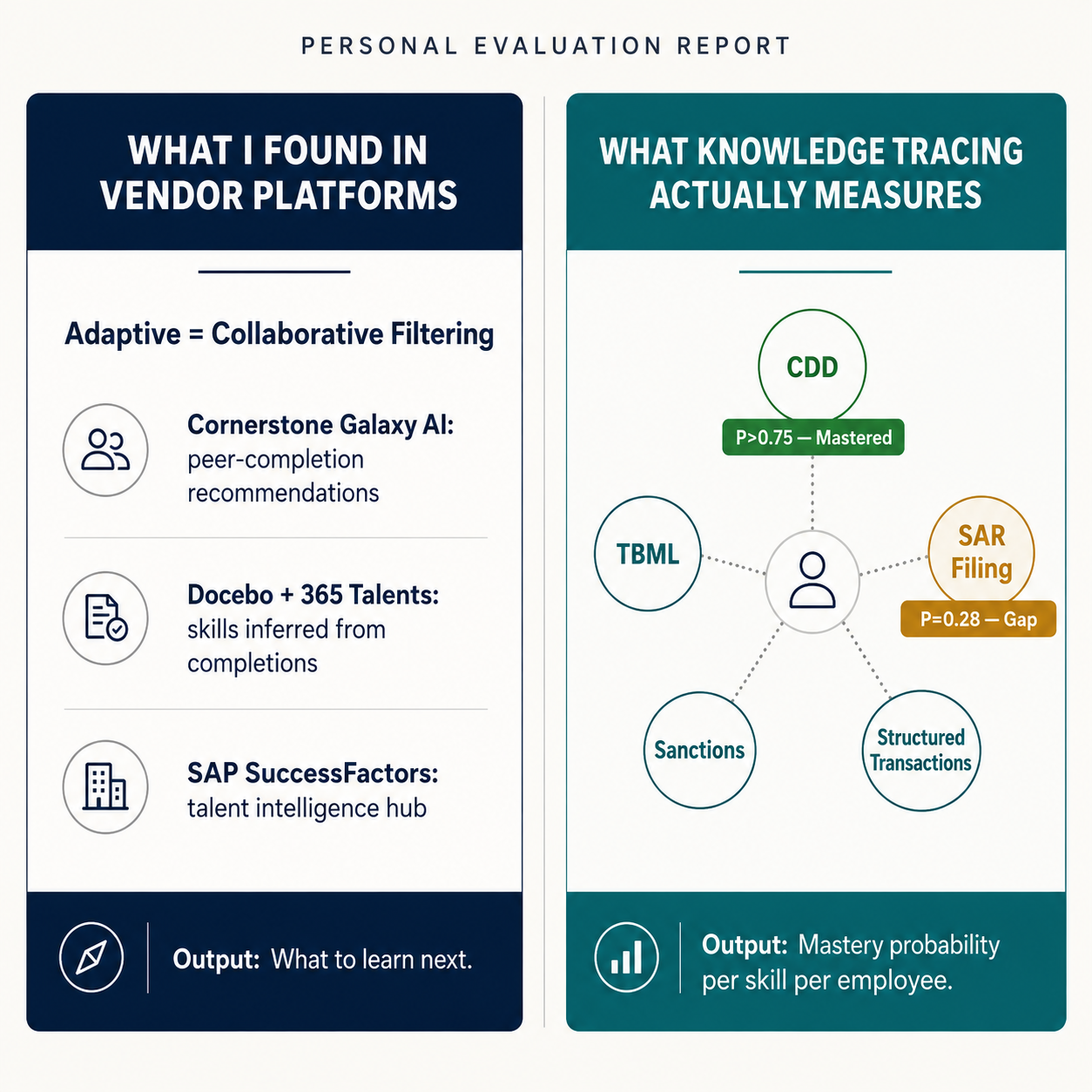
My team spent time evaluating every major LMS platform before committing to building a knowledge tracing layer. What I found was that the word "adaptive" appears in nearly every pitch deck but means very different things in practice.
Cornerstone's Galaxy AI — launched in March 2026 — is the most prominent move. Their Adaptive Learning Agent uses collaborative filtering: it asks what employees in similar roles completed next, then recommends accordingly. That's the Netflix model for training content. Docebo acquired 365 Talents and SAP SuccessFactors extended its talent intelligence hub in the same direction — inferring skills from completions and self-assessments, not from modeling what each employee knows.
What I kept returning to after those evaluations was the distinction between content recommendation and mastery measurement. A knowledge-tracing model — SAKT (Self-Attentive Knowledge Tracing) or AKT (Context-Aware Attentive Knowledge Tracing) — maintains a real-time probability estimate for each learner's mastery of each skill node, updated with every quiz response and hint request. A SAKT mastery probability heatmap shows not "who completed CDD training" but "who has P(correct) above 0.75 on CDD documentation and who is at 0.28 on SAR filing." That's a diagnostic — the kind the L&D director with the green dashboard had never been given. When I explained this to her, she said it was the first metric she'd seen that would actually mean something to an examiner.
Fulcrum Labs is the one platform building genuine mastery-based systems. Their BKM (Behavior and Knowledge Mapping) algorithm is a real adaptive engine, not a recommendation layer. The Allegiant Airlines case study — training time cut from 51 days to 23 days, accidents and equipment damage down 60% — is the best published evidence I've seen of what adaptive compliance training can produce in a regulated environment. The practical constraint for most organizations is that Fulcrum is a platform replacement: content migrates to their system. The enterprises I've worked with aren't positioned to do that migration and aren't willing to rebuild their content library. That's what drove the architecture we settled on.
The Month I Didn't Budget For
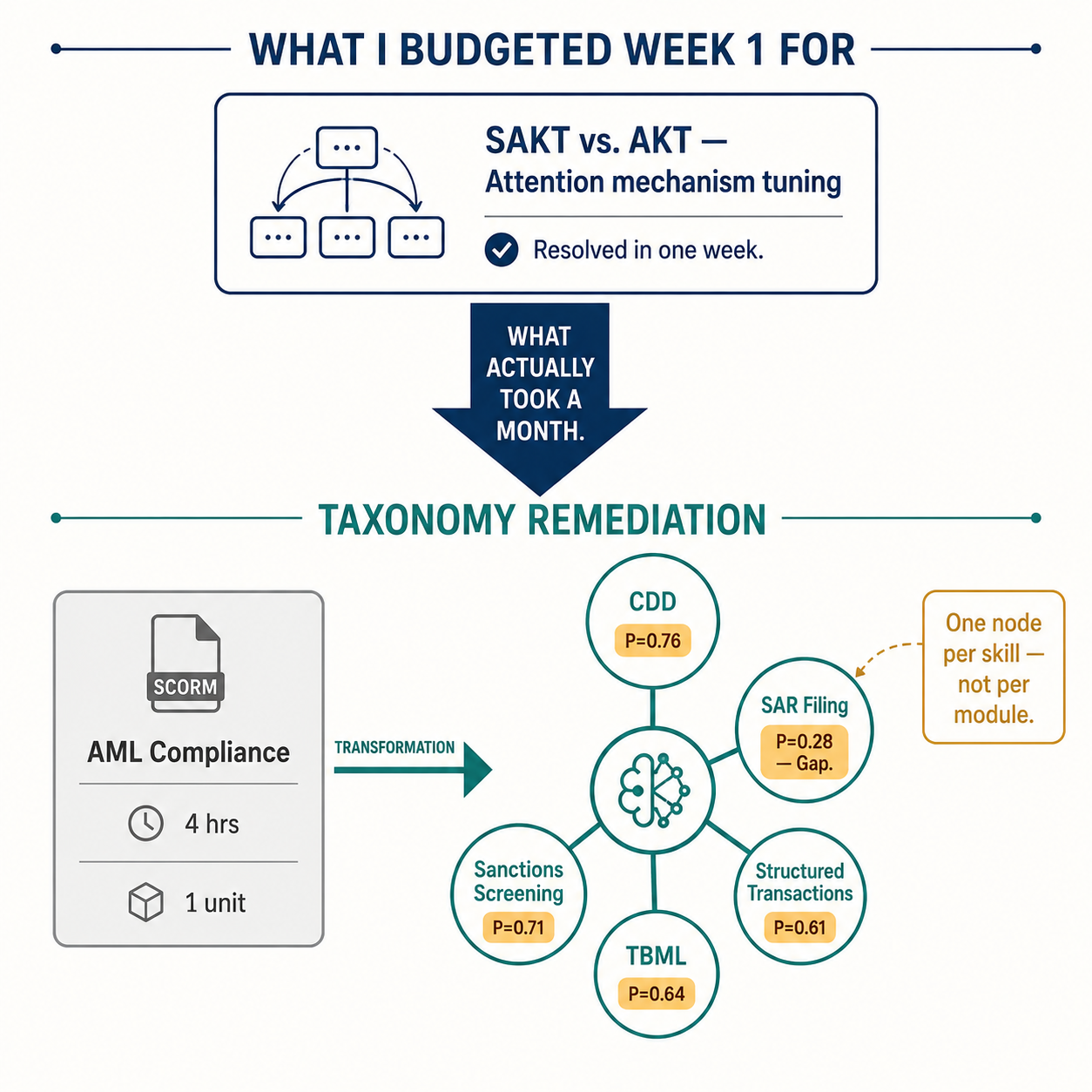
When I started building what became our Adaptive Learning AI system, I thought the hard part would be the model architecture. SAKT vs. AKT, attention mechanisms, how to tune on compliance-specific content. That took about a week to decide.
The concept tagging spreadsheet took a month.
A corporate compliance library built for SCORM doesn't carry the concept-level structure a knowledge tracing model needs. A four-hour AML module might cover customer due diligence, SAR filing, structured transaction detection, trade-based money laundering, and sanctions screening — packaged as a single completion unit. The SCORM-to-xAPI wrapper captures interaction data, but if the content isn't tagged to separate concept nodes, the model learns completion patterns rather than mastery. The senior BSA analyst with eight years of AML experience has very different mastery probabilities across those five domains than the new branch manager six months into the role. Both complete the same module. Without granular concept tagging — one node per skill, not one per module — the model can't tell them apart.
I've talked to L&D directors who built the concept tags at module granularity and wondered why the adaptive system didn't feel different from what they had before. It's the same problem: if the concept tagging spreadsheet isn't granular enough, the model learns who clicked through, not who knows which part. Every other architecture decision depends on this foundation being right. The good news is it's fixable — the remediation is methodical, not technically hard. The frustrating part is that it's not in anyone's initial project plan.
The Enforcement Date That's in My 2026 Planning

August 2 is a date I keep coming back to. That's when national market surveillance authorities begin formal enforcement of EU AI Act Article 4 — the AI literacy obligation. Penalties reach EUR 35 million or 7% of global annual revenue under Article 99. The regulation's extraterritorial reach means it applies if you serve EU customers or process EU citizen data, regardless of where your training program was designed.
The part that concerns me most when I'm in these conversations is the phrase "role-based calibration." The EU AI Office guidance says training needs to match the employee's role — no prescribed format. A software engineer deploying a production model, a compliance officer reviewing AI-assisted credit decisions, and a customer service agent using a chatbot interface have genuinely different AI literacy requirements. A single awareness workshop pushed to the whole organization doesn't meet that standard — and a completion report showing everyone attended won't be the answer an auditor asks for.
My planning assumption is that the organizations that have built role-based concept graphs and mastery evidence infrastructure before enforcement begins will be in a fundamentally different position than the ones scrambling after the first enforcement findings are published. That's not a particularly bold prediction. But the timeline is tighter than most L&D teams realize — August 2026 is the first active enforcement date; building the taxonomy, training the model, and generating initial mastery evidence takes months.
What the xAPI Logs Showed Me That I Wasn't Looking For
I found the AI-gaming pattern during calibration work on an early pilot — and I wasn't looking for it.
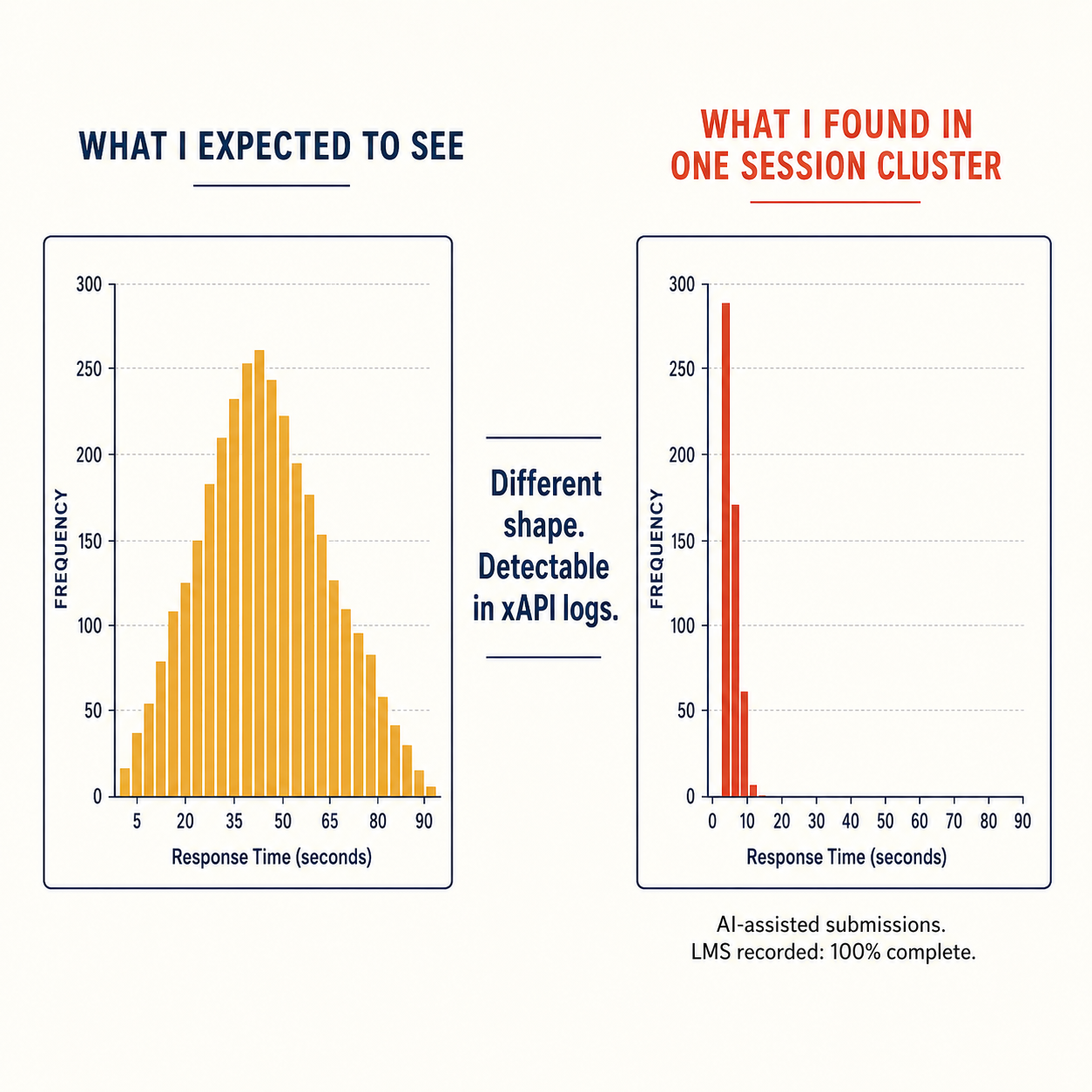
I was reviewing xAPI statement logs to set response-time parameters — working out how long different employees spend on different question types before submitting answers. Most sessions showed the distribution I expected: variable response times, some hints requested, some corrections, answers that correlated with the mastery probability curves we were building. Then I started noticing a cluster with a different signature: near-uniform response times, almost no hint requests, correct answers at rates that didn't fit any other learner profile.
The response-time delta between question display and submission was too consistent to be human decision-making. What I was looking at was AI-assisted submissions — employees pasting compliance quiz questions into a language model and submitting the output. The LMS had recorded every one of them as complete. Every green checkmark remained green.
The latency histogram for a human working through a compliance question and one for a paste-and-submit session have different shapes. That difference is detectable in the xAPI statement log before the next assessment scores — and it points to a competence gap the training system itself created.
Gartner predicted in early 2026 that 50% of organizations will require AI-free skill assessments because of this pattern — concern about critical thinking atrophy from AI-assisted completion becoming indistinguishable from genuine mastery in systems that only measure completion. The organizations building detection and documentation infrastructure for this now are making a compliance bet that I think will look conservative in retrospect.
Where I've Landed on What Actually Matters
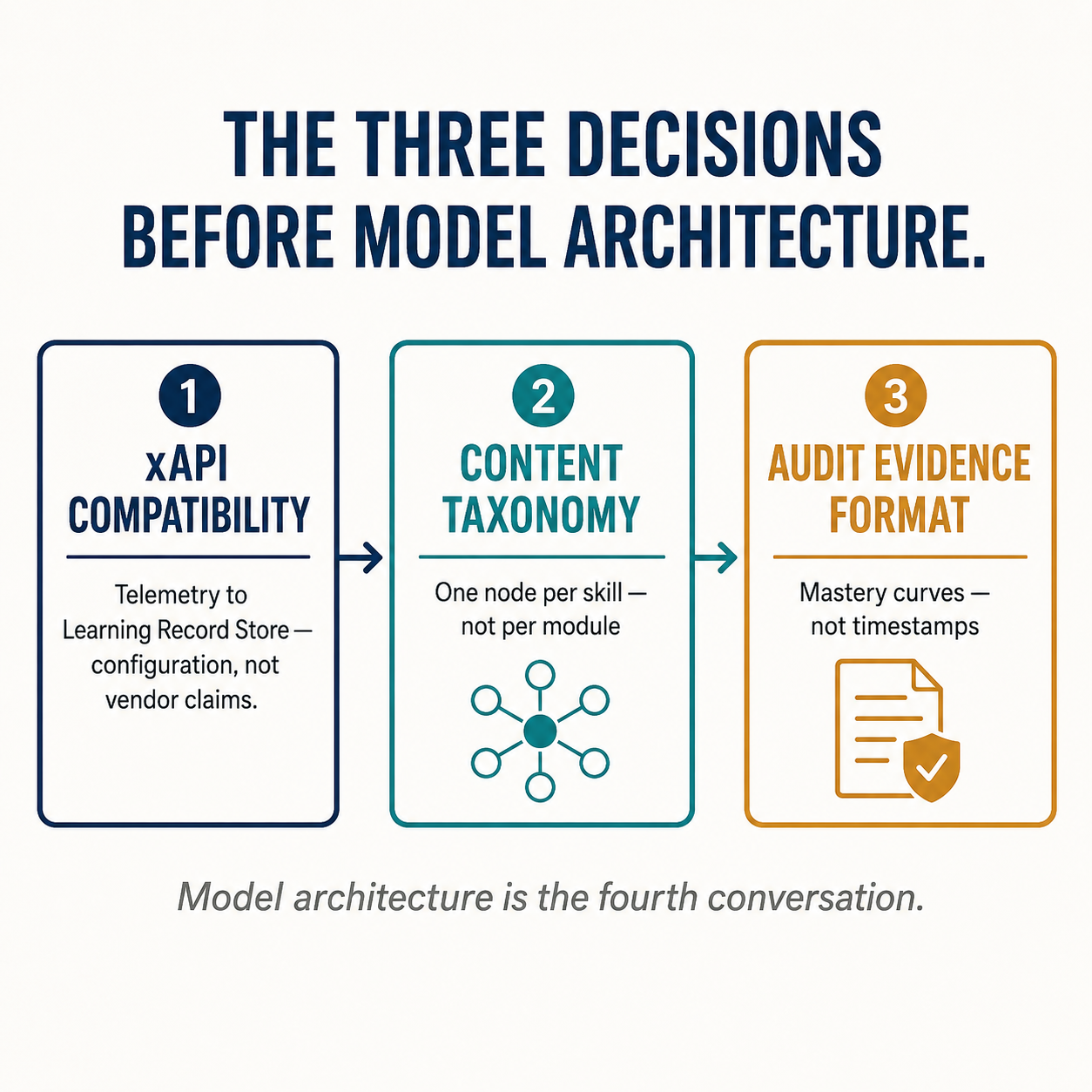
The compliance officer's question — why we needed xAPI telemetry at all if the organization was already passing its annual audit — helped me understand something I hadn't fully separated before. The audit and the competence question are different problems. The annual audit checks whether training happened. The competence question asks whether it worked. For years those have been treated as synonymous because there was no way to measure competence at scale.
The infrastructure decisions that determine whether a knowledge tracing project succeeds aren't the model architecture choices. xAPI compatibility is the first constraint to resolve — not model selection. SCORM-only systems need a wrapper before any interaction data flows to a Learning Record Store. From there, content taxonomy granularity determines model quality more than any architecture decision: concept granularity at the skill level, not the module level, is what produces mastery evidence rather than a fancier completion flag. And audit evidence format is the last question to settle before committing to a data pipeline design, because what regulators will accept as mastery evidence in 2027 is still being defined, and your pipeline architecture determines your flexibility.
At $874 average training cost per learner (Training Magazine, 2025), a 55% seat-time reduction across 500 compliance employees represents $200K–$250K in recovered productivity annually. That math I find straightforward. What I'm still thinking through is the L&D director's original answer — that competence wasn't what the system measured — and how long that answer remains defensible once the first Article 4 enforcement findings are published. I think the window is shorter than most L&D budgets assume.