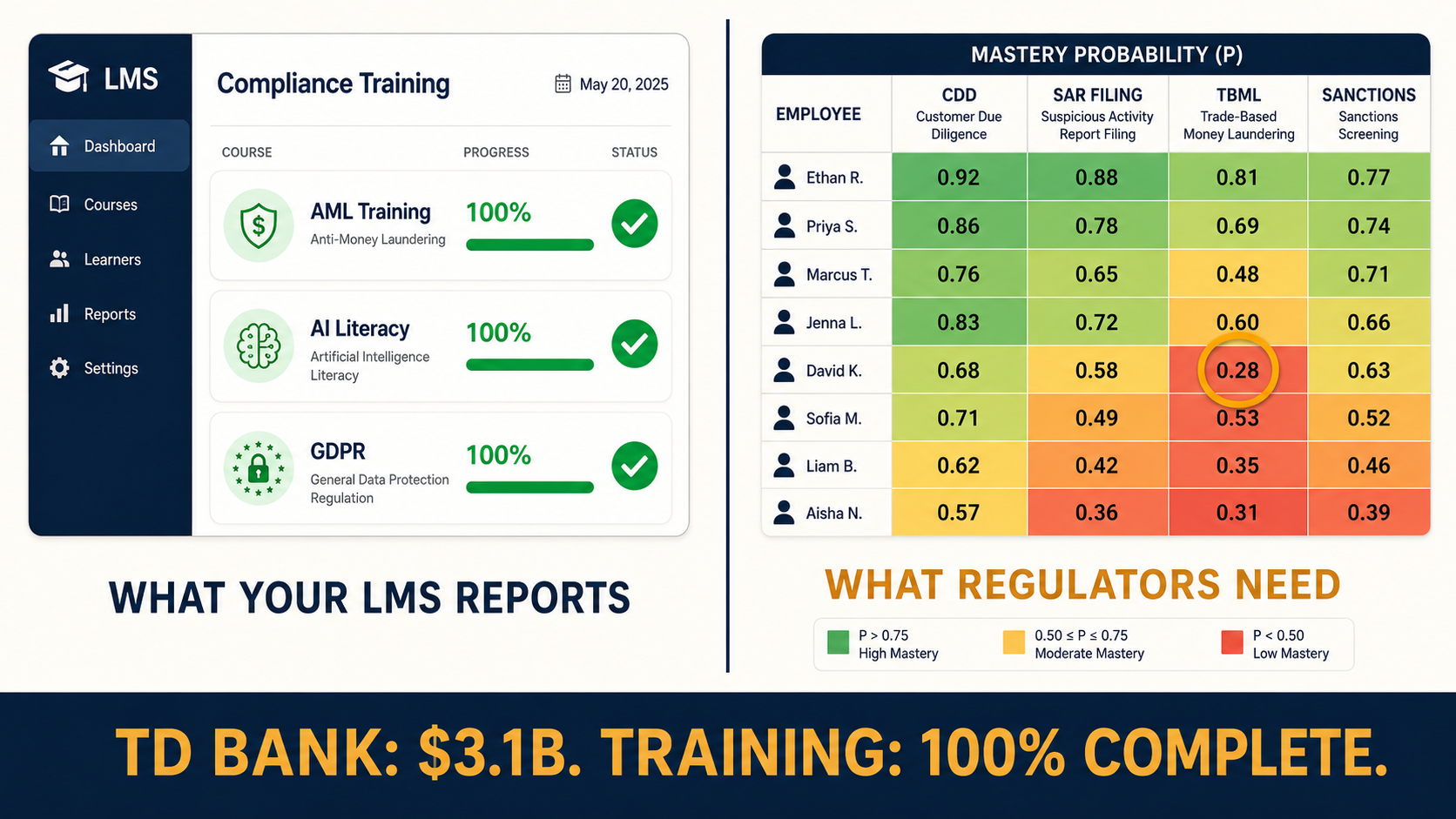
The LMS marks employees complete. SCORM returns a pass/fail. The audit report shows a column of green checkmarks. None of it tells you what employees actually know — and regulators are starting to ask.
EU AI Act Article 4's AI literacy obligation, in effect since February 2025, requires training calibrated to each employee's role, not just assigned and logged. TD Bank's $3.1 billion AML penalty included findings about the adequacy of its compliance training program. And increasingly, employees are using AI agents to complete compliance modules without actually engaging — the checkmark appears, the learning doesn't. National market surveillance authorities begin enforcement in August 2026. A completion screenshot from your LMS won't answer what a regulator will ask: what does this employee actually know, and how do you know they know it?
The gap between completion tracking and competence tracking is the compliance training problem that most regulated enterprises are about to be forced to solve.
What "Adaptive Learning" Actually Means on a Vendor Slide
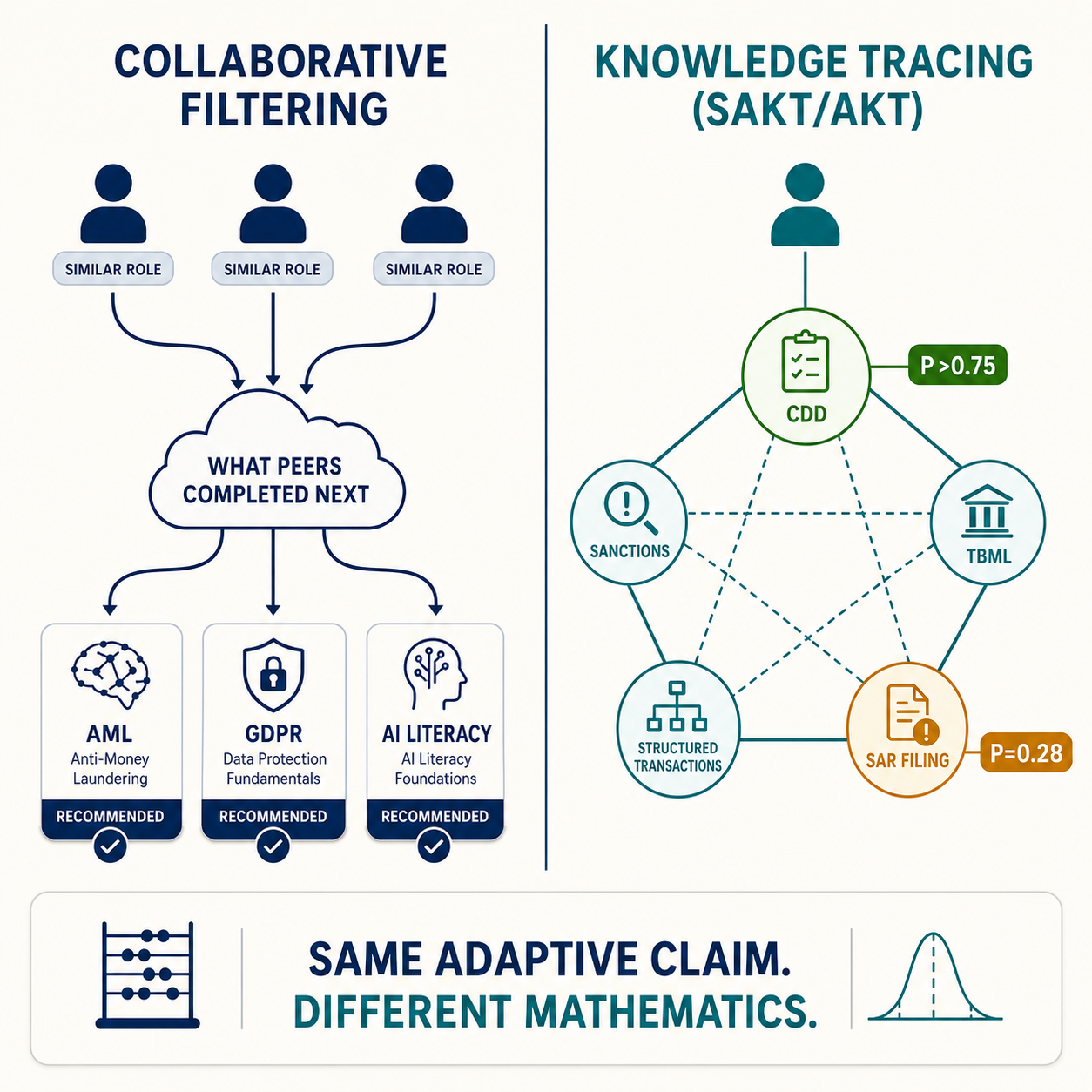
Most LMS platforms added AI features in the past year. Cornerstone's Galaxy AI, launched in March 2026, is the most prominent: an Adaptive Learning Agent and a course assistant with real-time Q&A. SAP SuccessFactors extended its talent intelligence hub with AI-powered recommendations. Docebo acquired 365 Talents to add skills assessment capability.
What these tools share: they use collaborative filtering. The recommendation engine asks what employees in similar roles completed next — the Netflix-for-courses model. It surfaces relevant content. It does not model what any specific employee knows.
Knowledge tracing is different in kind. A knowledge-tracing model maintains a real-time probability estimate of each learner's mastery of each skill node — updated with every quiz response, every hint request, every time-on-task signature. SAKT (Self-Attentive Knowledge Tracing) and AKT (Context-Aware Attentive Knowledge Tracing) are the architectures that perform best in enterprise compliance settings. A SAKT mastery probability heatmap across your compliance function shows not "who completed CDD training" but "who has P(correct) above 0.75 on CDD and who is still at 0.28 on SAR filing" — a diagnostic, not a recommendation. Collaborative filtering produces better content paths. Knowledge tracing produces mastery evidence.
The Real Project Nobody Budgets For
Choosing the right model architecture is straightforward. Building the content taxonomy it runs on is not.
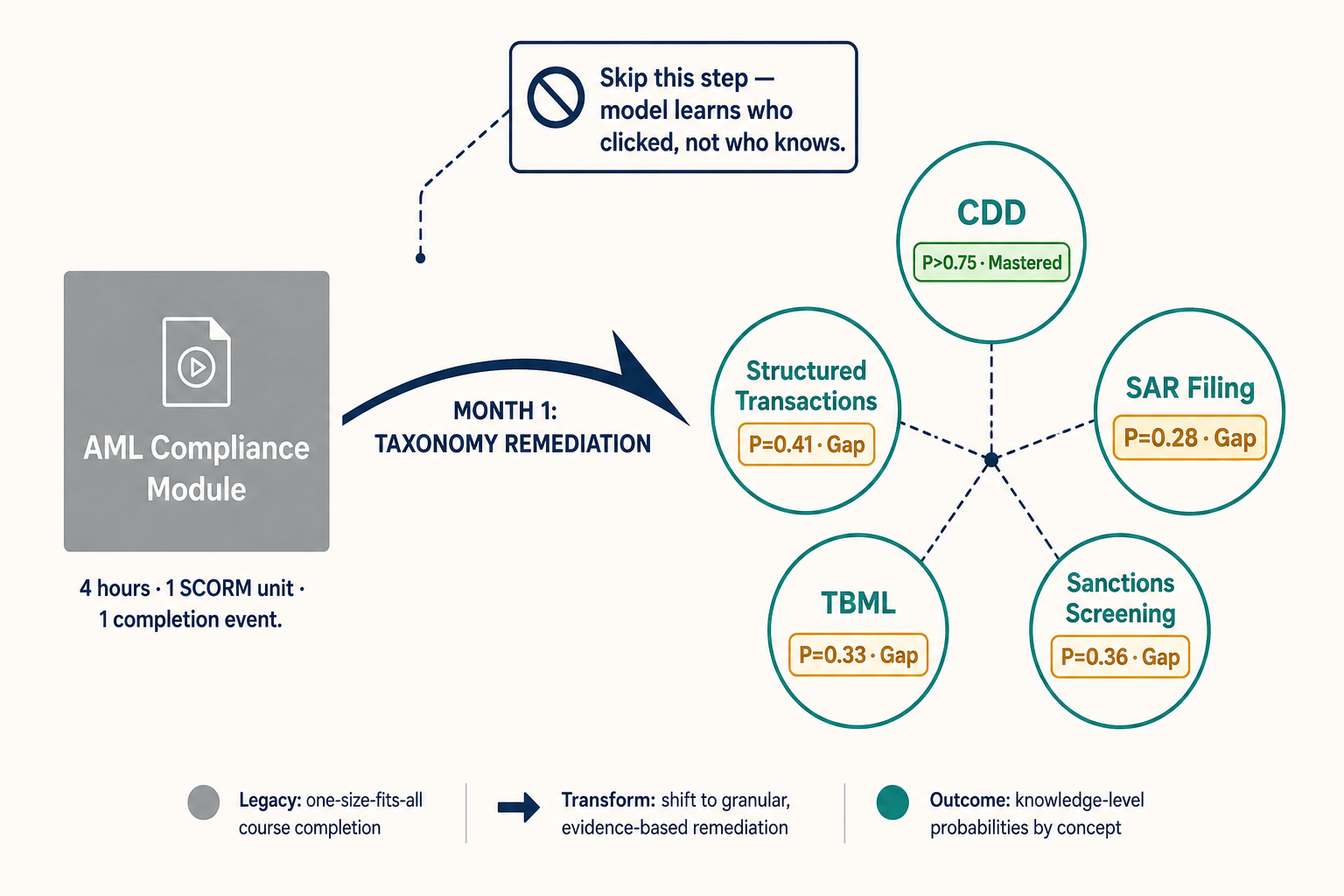
Most corporate compliance content wasn't built to support concept-level tracking. A four-hour AML module might cover customer due diligence, SAR filing, structured transaction detection, trade-based money laundering, and sanctions screening — five distinct skill domains — packaged as a single SCORM completion unit. The SCORM-to-xAPI wrapper can capture interaction-level telemetry, but if the content isn't mapped to a concept tagging spreadsheet that separates these domains into skill nodes, the model learns completion patterns rather than mastery patterns. Those aren't the same thing, and the difference compounds.
This is where most knowledge tracing pilots stall. The first month of implementation is taxonomy remediation — converting an existing content library into a concept graph the model can read. Building that concept tagging spreadsheet too coarsely (one node per module instead of one node per skill) means the model can't distinguish a senior BSA analyst with eight years of AML experience from a new branch manager six months into the role. Both complete the same module. The mastery probabilities behind those completions are entirely different.
That distinction is what we built the Adaptive Learning AI system to capture — a SAKT/AKT intelligence layer that runs on top of existing LMS infrastructure via xAPI and LTI, without requiring content migration or platform replacement. The hard part was always the concept tagging, not the model.
The EU AI Act Created a Training Calibration Problem
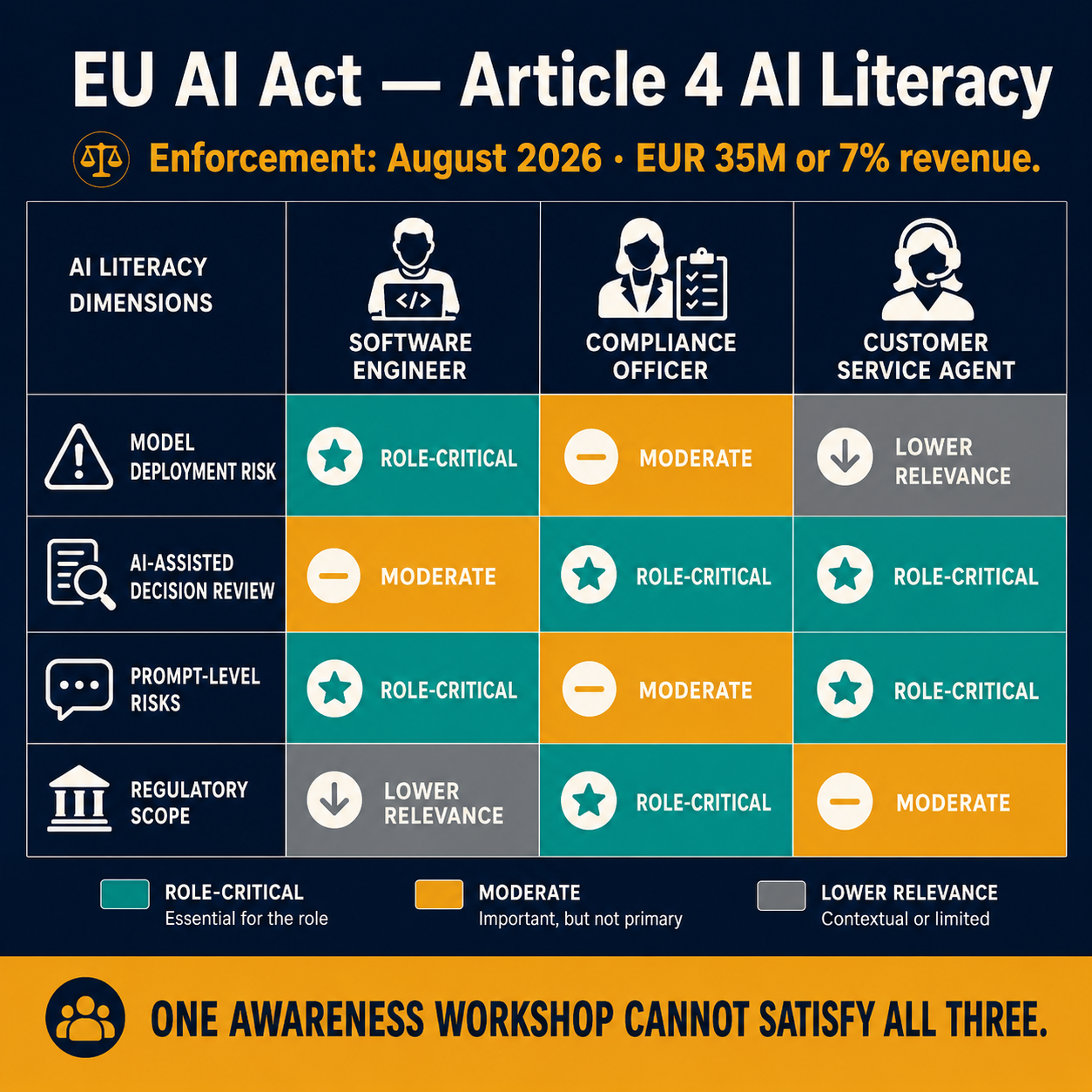
EU AI Act Article 4 created a specific compliance training problem that most L&D teams are still treating as a checkbox exercise. The regulation requires AI literacy training tailored to each employee's role — not a blanket awareness workshop pushed to the whole organization. National market surveillance authorities begin formal enforcement in August 2026, with penalties reaching EUR 35 million or 7% of global annual revenue under Article 99. The regulation's reach is extraterritorial: it applies if you serve EU customers or process EU citizen data, regardless of where your training program was designed.
The generic workshop approach won't survive an enforcement audit because AI literacy isn't one competency. A software engineer deploying a production model needs different AI literacy than a compliance officer reviewing AI-assisted credit decisions, which differs again from a customer service agent using a chatbot interface. That's not a reading of the regulation — it's what the EU AI Office's own guidance says about role-based calibration.
Adaptive learning makes role-based calibration tractable at scale. Instead of building and maintaining a separate curriculum for each function, an organization builds a role-based concept graph and a model that calibrates content delivery to what each employee already knows. The mastery evidence the model produces — concept-level probability curves, knowledge maps, gap reports at the employee level — is precisely the documentation a surveillance authority would ask for. A Learning Record Store data pipeline that preserves interaction-level xAPI telemetry per employee is the audit trail the completion-timestamp system never was.
The AI-Gaming Problem Your LMS Can't See
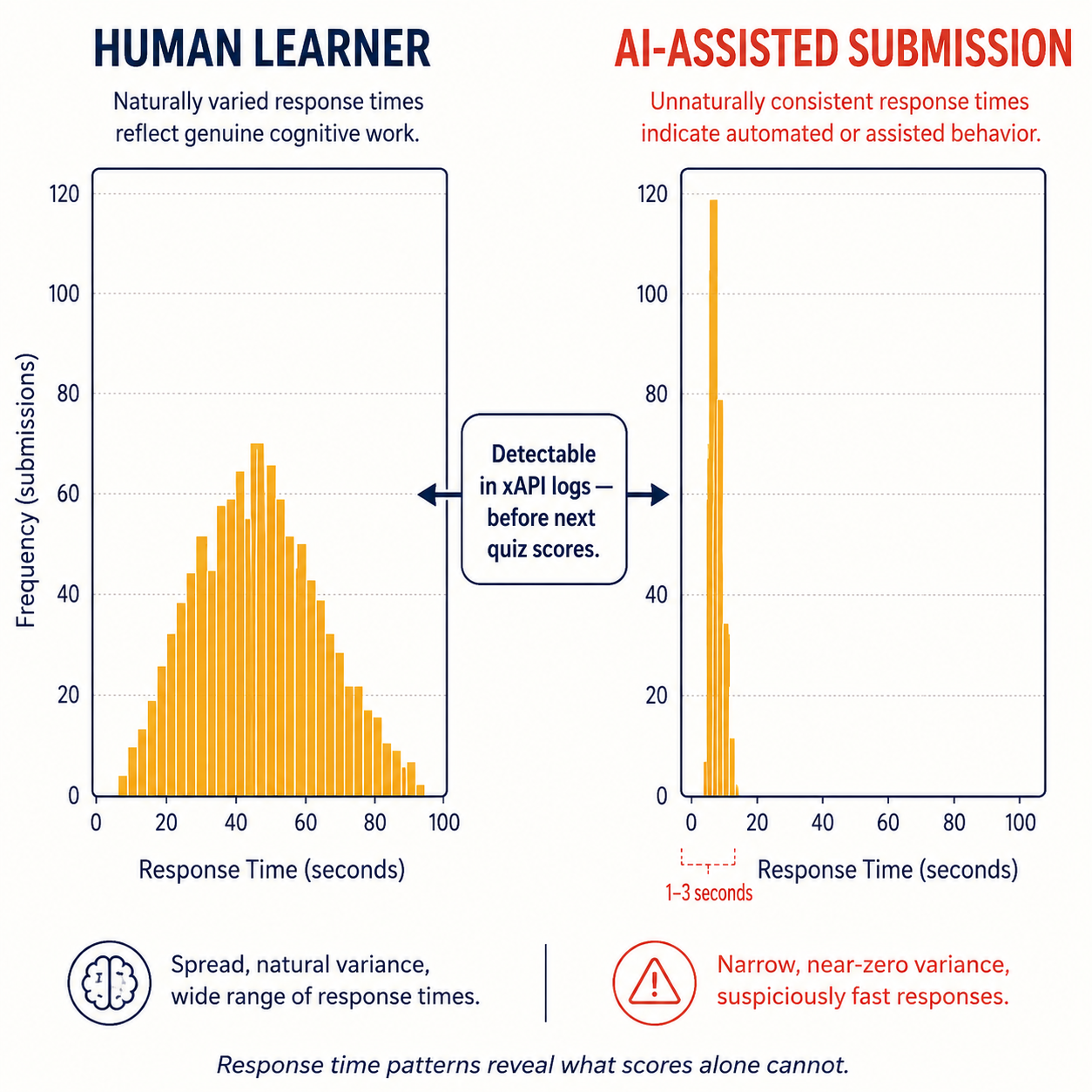
Employees using AI agents to complete compliance training is no longer hypothetical. The pattern is measurable: employees paste quiz questions into a language model, copy the answers, submit. The LMS records completion. The checkmark appears.
xAPI telemetry exposes this in ways SCORM-based systems cannot. Response-time deltas — the time between question display and answer submission — carry a different signature for human learners than for AI-assisted submissions. Hint-request patterns add another signal: a human who's uncertain asks for a hint; an AI-assisted response typically doesn't, because the model already has the correct answer. These patterns are detectable in the xAPI statement log before the next assessment scores, and they surface a fundamentally different kind of mastery gap than the one the training was designed to close.
Completion tracking tells you training happened. Knowledge tracing tells you learning happened. In a regulated industry, those are different evidentiary standards.
This matters because enforcement posture is shifting. Gartner predicted in early 2026 that 50% of organizations will require AI-free skill assessments due to concern about critical thinking atrophy from AI-assisted responses — a direct policy consequence of the gaming pattern. Organizations that detect and document AI-gaming behavior now are building a compliance posture that completion-timestamp systems can't replicate.
Fulcrum Labs, the Platform Question, and the Honest Trade-off
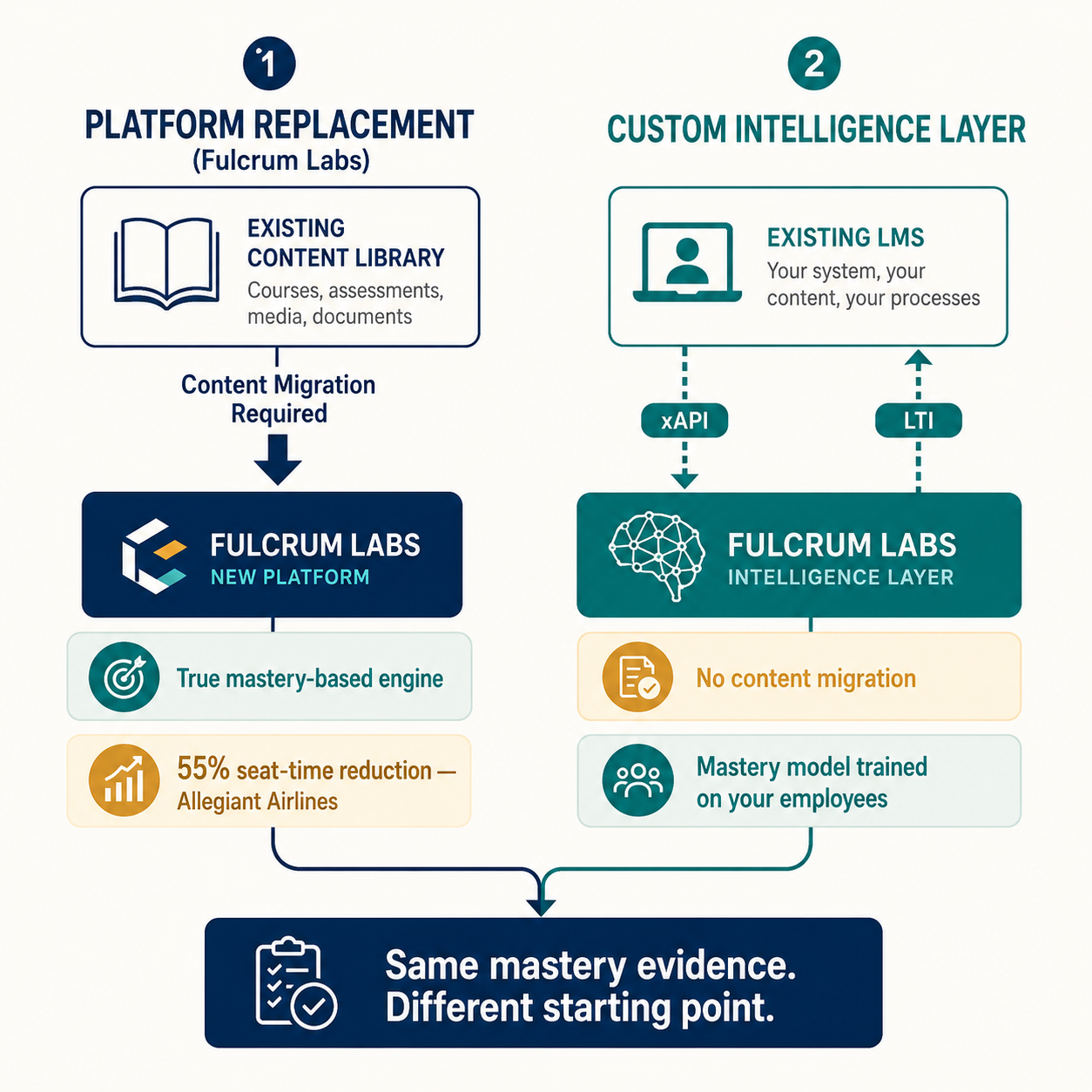
Fulcrum Labs is the most technically rigorous adaptive platform available for compliance use cases. Their BKM (Behavior and Knowledge Mapping) algorithm is a genuine mastery-based engine. The Allegiant Airlines case study — training time cut from 51 days to 23 days, accidents and equipment damage down 60% — is the most credible published evidence of what adaptive compliance training can produce in a regulated environment.
The practical constraint with Fulcrum, and with every purpose-built adaptive platform, is that it's a platform replacement, not an intelligence layer. Content migrates to their system. For organizations that want true knowledge tracing without displacing their LMS, a custom intelligence layer connecting via xAPI and LTI is the other architecture. The advantages are institutional: your content library, your existing LMS contract, and a mastery model trained on your employees and your content rather than a benchmark population. The honest trade-off is higher initial technical investment and a harder dependency on content quality and tagging depth.
At $874 average training cost per learner (Training Magazine, 2025), a 55% seat-time reduction across 500 compliance employees represents $200K–$250K in recovered productivity annually. That math scales with headcount — for organizations with 5,000+ compliance-trained staff, the ROI case doesn't require an elaborate model, just the right architecture.
What to Verify Before You Start
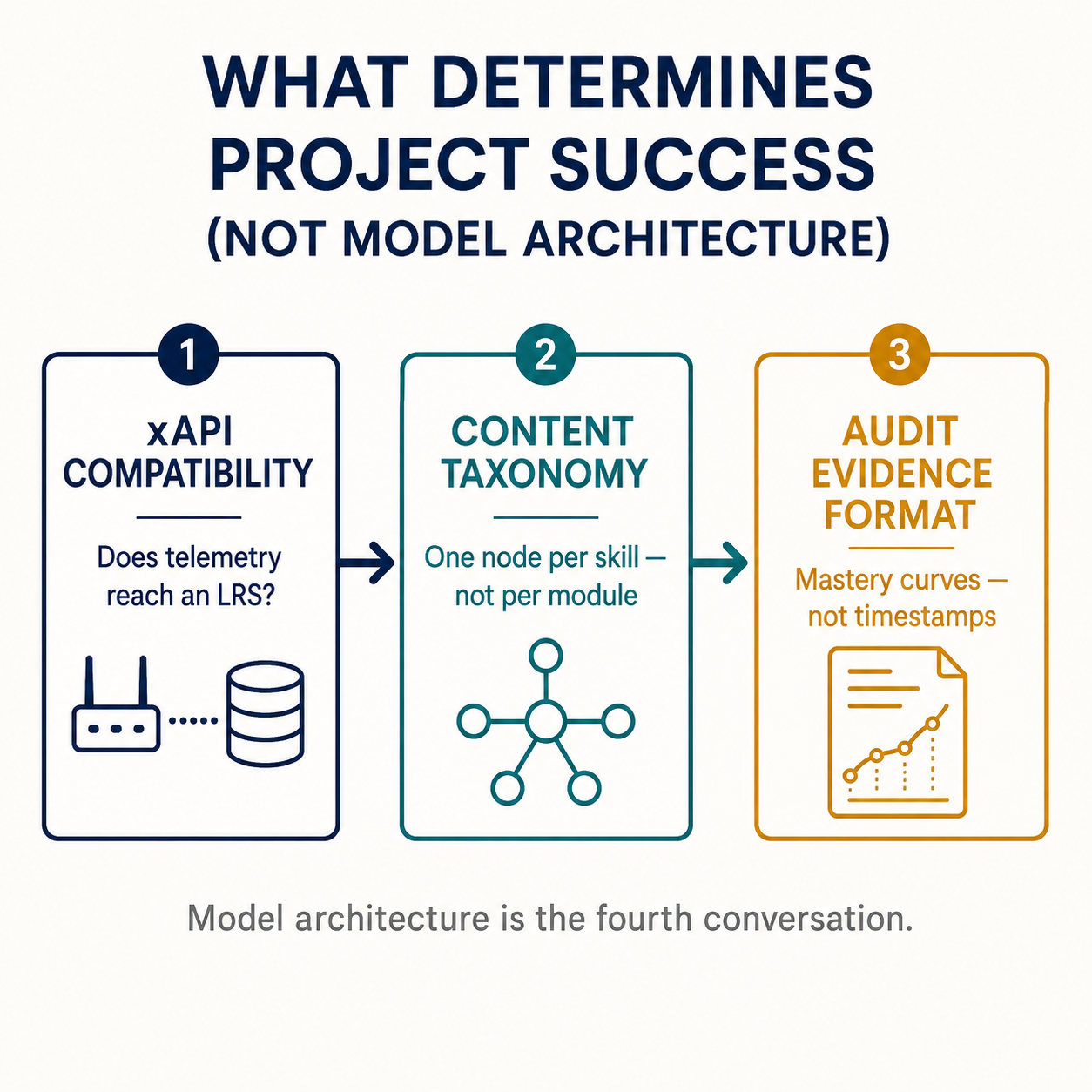
The questions that determine whether a knowledge tracing project succeeds aren't about model architecture — they're about the infrastructure and content you're starting from.
xAPI compatibility is the first constraint to resolve. SCORM-only systems can be wrapped to capture interaction-level data, but that integration adds time the timeline needs to account for. Most enterprises assume their LMS supports xAPI because the vendor documentation says "SCORM/xAPI compatible" — the real question is whether xAPI data flows to a Learning Record Store, and if not, where that LRS sits in the architecture.
What trips most projects before a model is even trained is content taxonomy. SCORM completion units are the wrong unit of analysis for knowledge tracing — the real unit is a concept node with a measurable mastery probability. Auditing your content library for concept granularity before choosing an architecture will save months. Organizations that skip this step typically discover mid-project that their concept tagging needs rebuilding from scratch, at a point where the model architecture is already committed.
Audit evidence format deserves early architecture attention too. If your current compliance documentation is completion timestamps and pass/fail rates, understanding what format your regulators are moving toward before you design the mastery evidence package is an architecture decision, not a retrofit.
If your team is navigating any of these gaps — EU AI Act literacy programs, AML compliance training, healthcare credentialing — we'd welcome comparing notes. The organizations that have gotten this right in 2026 tend to hit the same four infrastructure decisions in the same order; we've worked through each of them at Veriprajna and are happy to share what we've learned about the sequencing.