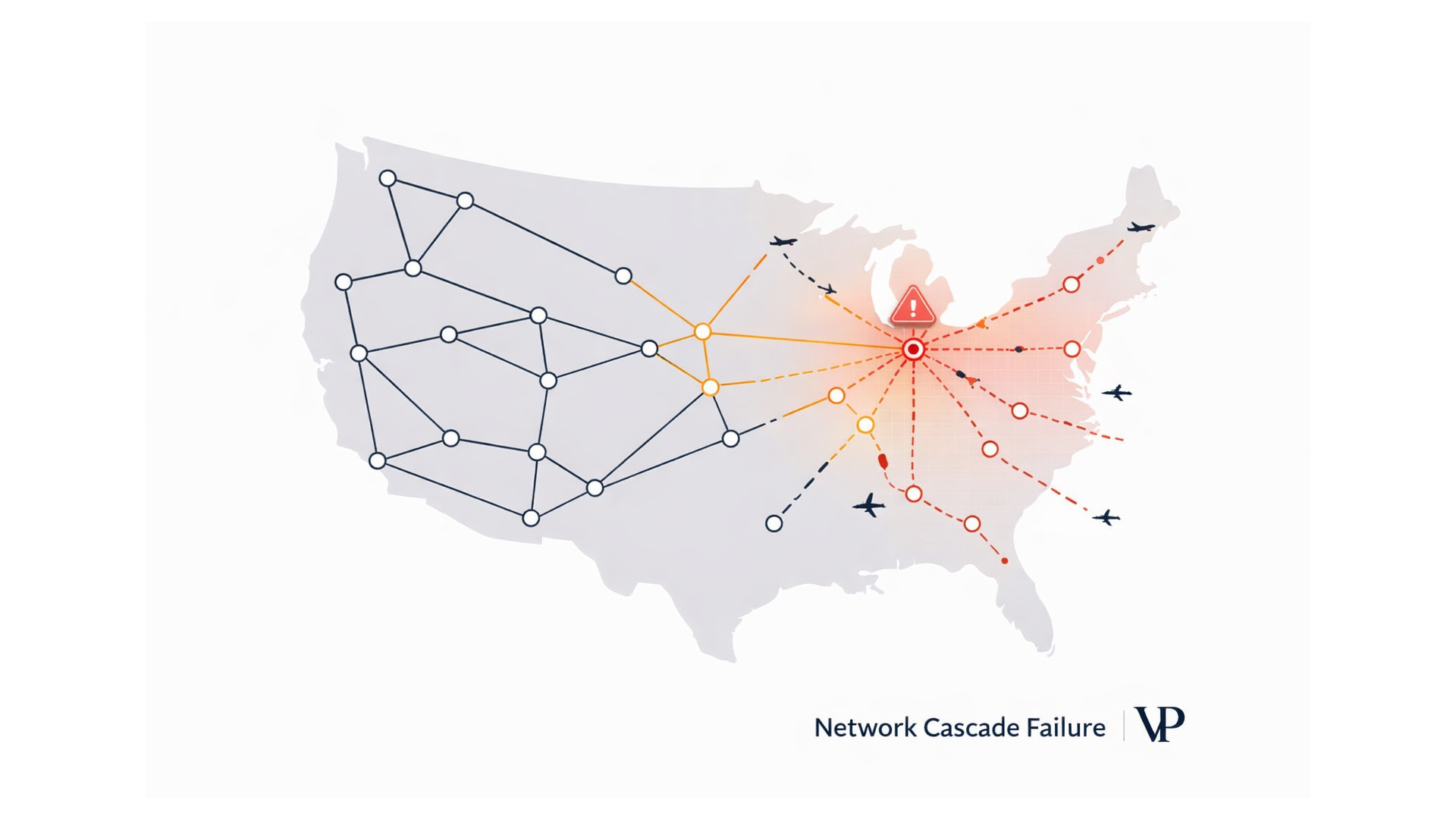
December 2022. Winter Storm Elliott hits the US. Every major airline cancels flights. United, Delta, American — they all recover within 48 hours. Southwest Airlines doesn't recover for a week. Over 16,900 flights cancelled. Two million passengers stranded. More than $1.2 billion gone. The storm didn't cause that meltdown. The storm merely revealed that Southwest's scheduling software — the system trusted to keep the whole operation running — was architecturally incapable of handling chaos. And what worries me is that most of the logistics industry is running on the same kind of software today.
My team at Veriprajna has spent the last year building what we believe is the replacement: Deep AI for logistics — not the chatbot kind, but AI that can actually reason about complex networks under pressure. I want to explain why this distinction matters, because the industry is currently sleepwalking into a trap.
The Real Reason Southwest Broke
The weather was the trigger. The failure was computational.
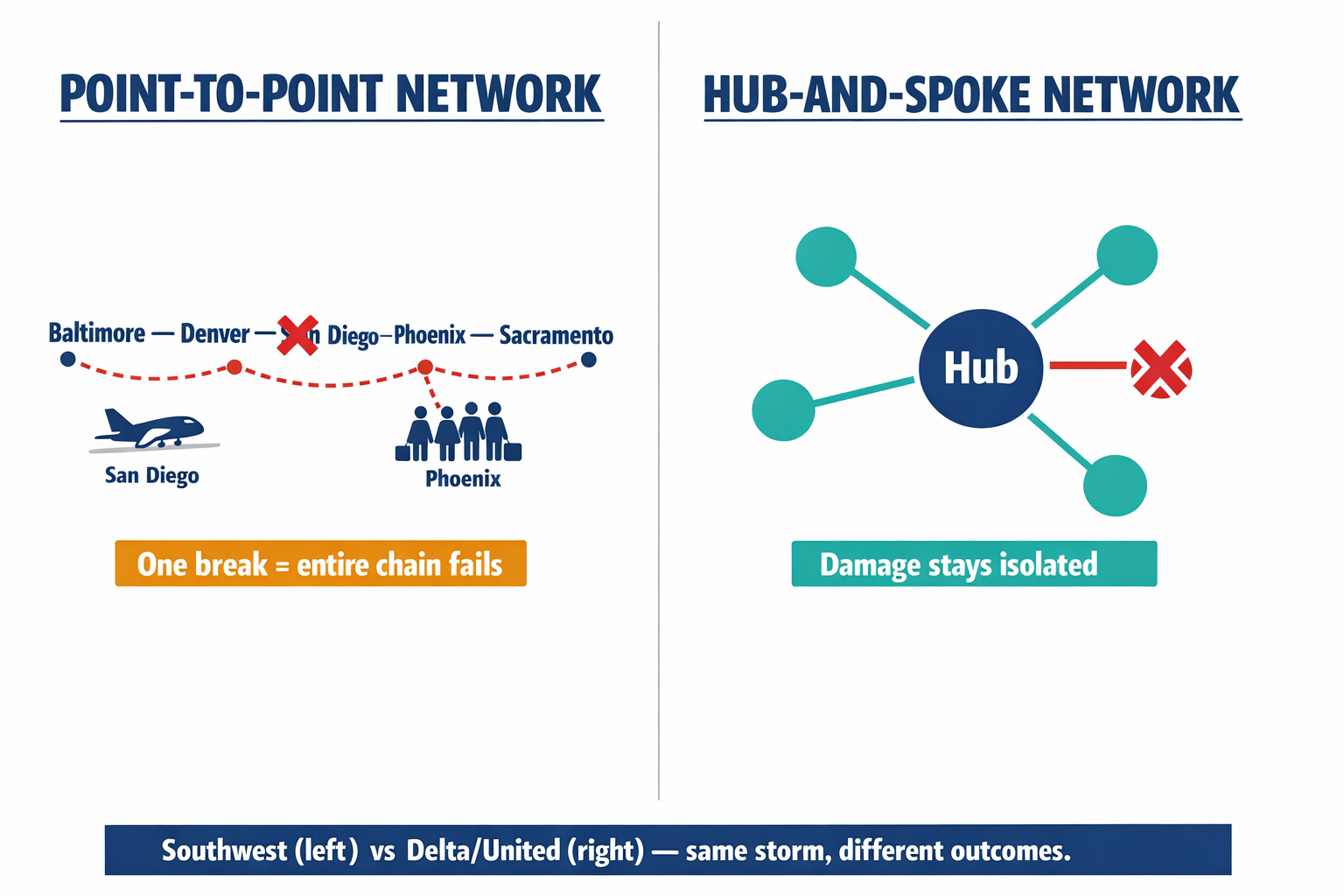
Southwest runs what's called a point-to-point network. Think of it like a chain: a plane and its crew fly Baltimore → Denver → San Diego → Phoenix → Sacramento. Efficient on a clear day. Catastrophic in a storm. When Denver froze, the crew headed there from Baltimore got stuck. The plane they were supposed to meet in San Diego sat empty. The passengers in Phoenix had no flight. One broken link shattered the entire chain.
Delta and United run a different model — hub-and-spoke — where everything flows through central airports. When a storm hits, they can isolate the damage. Shut down Newark for a morning, reset, resume. Southwest's network had no firewall.
But the deeper problem was the software. Southwest's scheduling system, built on 1990s-era optimization math, works by taking a snapshot of the world — where every pilot is, where every plane is — and computing the cheapest schedule. This process takes 30 to 60 minutes. During the meltdown, the world was changing every five minutes. Crews couldn't even call in to report their locations; hold times hit eight hours. The software was optimizing a phantom airline — generating schedules based on crew positions that were hours out of date.
The system didn't degrade gracefully. It optimized confidently for a world that no longer existed.
By December 26, the weather had cleared. Southwest was still cancelling over half its flights — not because of snow, but because they'd literally lost track of their own people.
Why the Math Itself Has a Breaking Point
I need to get slightly technical here, because this isn't just a Southwest problem. It's a math problem that affects every logistics operation using traditional scheduling software.
Assigning crews to flights is what mathematicians call NP-Hard — a class of problems where the number of possible solutions grows so fast that no computer can check them all. For an airline with 4,000 daily flights, the number of valid crew-flight combinations is effectively infinite. The standard approach, called Column Generation, works by iteratively narrowing down the options. It's elegant. It's powerful. And it falls apart when too many things go wrong at once.
During a crisis, the number of broken connections grows exponentially, not linearly. The algorithm hits what I call a computational cliff — the point where finding even one workable schedule (forget the optimal one) takes longer than the decision window allows. You need an answer in five minutes. The solver needs five hours.
When exact methods fail, systems fall back on shortcuts — rules of thumb tuned for normal operations. "A flight into Denver probably turns around to the West Coast." In a once-in-a-decade storm, those assumptions are worthless. The system can't even find a starting point for recovery because the disruption has fragmented the problem into disconnected pieces.
We explored these failure mechanics in depth in our interactive analysis.
The Chatbot Trap
After the Southwest disaster, boards panicked. "We need AI" became the mandate. And vendors showed up with exactly what the market wanted to hear: slap a ChatGPT-style interface on top of your existing systems and call it innovation.
This is what I call the "LLM Wrapper" illusion. A dispatcher types "How do we recover the Denver schedule?" and the chatbot translates that into a query to the same broken scheduling engine underneath. The user experience improves. The computational problem doesn't change at all. It's a fresh coat of paint on a seized engine.
I have enormous respect for what Large Language Models can do. They're extraordinary at language, summarization, coding assistance. But logistics recovery isn't a language problem. It's a reasoning problem. And LLMs are fundamentally the wrong tool.
Think of it this way. LLMs are pattern-matchers — they predict the most likely next word based on training data. That's what cognitive scientists call System 1 thinking: fast, intuitive, associative. Scheduling recovery is System 2 thinking: slow, deliberate, logical. You need to verify hard constraints step by step. Can this pilot legally fly? Has she had eight hours of rest? Is this aircraft certified for this route?
An LLM that generates a schedule where a pilot has seven hours and 59 minutes of rest instead of the required eight has produced something that reads perfectly and is completely illegal. LLMs optimize for linguistic coherence. Logistics demands logical correctness. Those are different things.
A 99% accurate creative essay is excellent. A 99% accurate crew schedule is a regulatory violation.
Benchmarks on classic routing problems confirm this. As the number of stops increases, LLMs start skipping locations, visiting them twice, losing track of where they've been. They can't simulate what happens ten steps downstream from a decision. They're blind to the butterfly effect — the small crew swap today that causes a cascading failure three days later.
What We're Building Instead
If legacy solvers are too slow and LLMs can't reason, what's left?
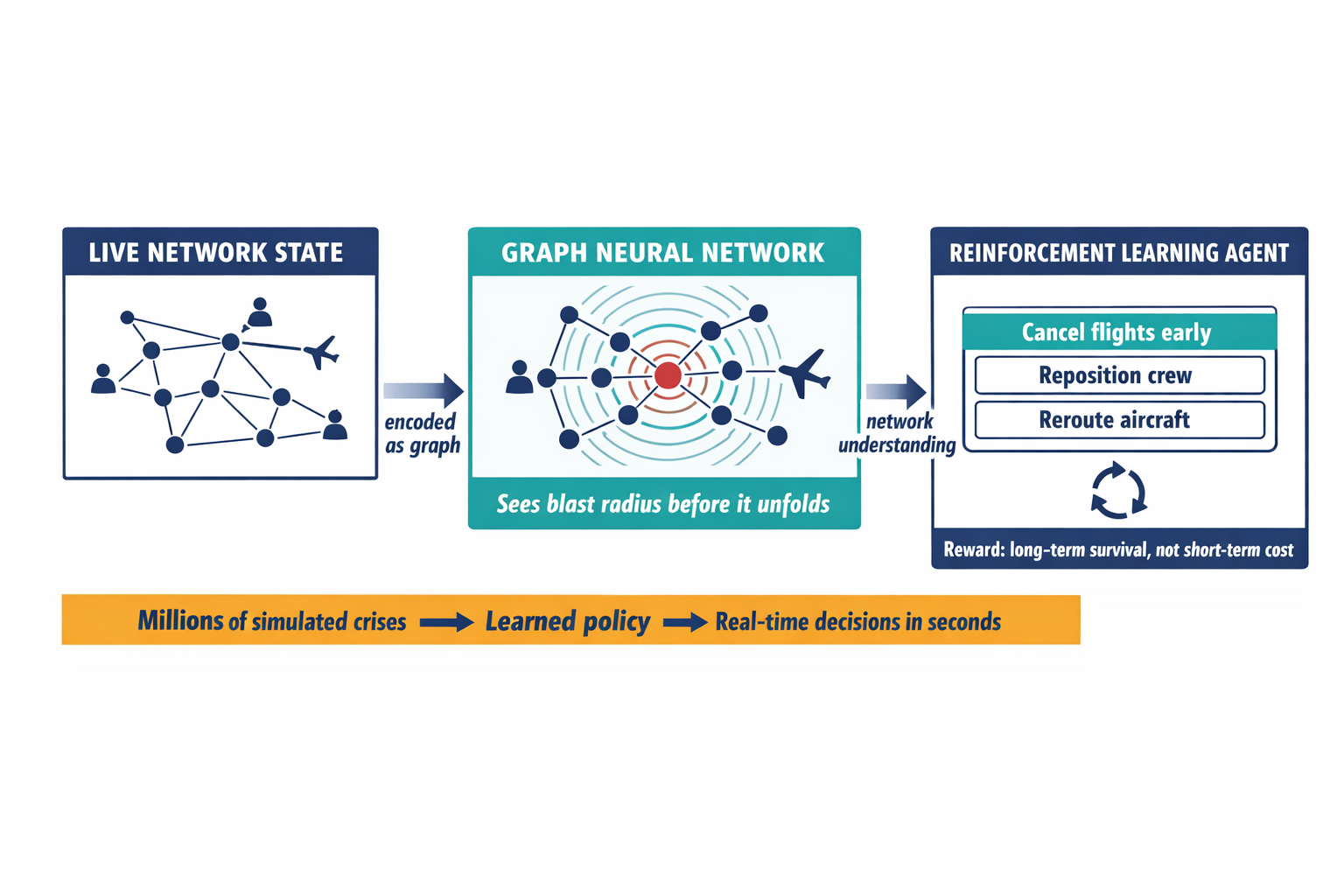
We're building on something called Graph Reinforcement Learning — a combination of two AI techniques that, together, can both understand a logistics network and learn how to manage it under pressure.
The first piece is Graph Neural Networks. A logistics network isn't a spreadsheet. It's a web of relationships — airports connected by flights, warehouses connected by trucks, crews assigned to routes. Graph Neural Networks are designed specifically for this kind of relational data. Every airport, pilot, and aircraft becomes a node. Every flight and assignment becomes an edge. And information flows through the network the way disruptions do in real life.
When a blizzard closes Denver, the model doesn't just flag Denver. It propagates that signal outward — to the crew in Baltimore about to fly there, to the plane waiting in San Diego for that crew, to the passengers in Phoenix counting on that plane. The AI sees the blast radius of a disruption before it fully unfolds. Traditional systems can't do this without expensive, time-consuming database operations.
The second piece is Reinforcement Learning — the same family of techniques that taught AI to beat world champions at Go. Instead of calculating the single "optimal" answer (which is what legacy solvers try and fail to do in a crisis), the AI learns a policy through millions of simulated experiences. It observes the network state, takes an action (swap a crew, cancel a flight, reroute an aircraft), and gets a reward or penalty based on the outcome.
The critical difference: it optimizes for long-term survival, not short-term cost. A traditional system says "don't cancel that flight, it loses revenue." Our agent learns: "If I don't cancel it now, the crew gets stuck in Denver and I lose ten flights tomorrow." It learns strategic sacrifice — giving up something small today to prevent a catastrophe tomorrow.
For a network the size of a major airline, we use multiple agents working together. A global agent monitors overall network health. Local agents at each airport optimize their own resources. They negotiate, cooperate, and sometimes disagree — just like a real operations center, but at machine speed.
You Can't Train on a Live Airline
There's an obvious problem with reinforcement learning: it requires trial and error. You can't experiment on a live airline. "Let's see what happens if we cancel 200 flights" is not a viable training strategy.
This is where Digital Twins come in — and I don't mean dashboards or 3D visualizations. I mean full physics-based simulations that replicate every aircraft (with tail-specific maintenance cycles), every crew member (with individual fatigue counters and contract rules), every gate, every weather pattern. A state-transition engine that enforces FAA regulations, union contracts, and maintenance manuals on every simulated decision.
We use these twins as synthetic experience factories. We simulate 10,000 years of operations in a week. We generate super-storms, mass mechanical failures, labor disruptions — the kind of tail events that happen once a decade in real life but that an AI needs to train on thousands of times. We start the agents on easy days and gradually increase the chaos, a technique called curriculum learning.
By the time our agents face a real crisis, they've already "lived through" more disruptions than any human dispatcher will see in a career.
For the full technical methodology behind our simulation and training architecture, see our detailed research.
The Sheriff That Keeps the AI Honest
I hear the objection constantly: "Neural networks are black boxes. How do you trust an AI with flight safety?"
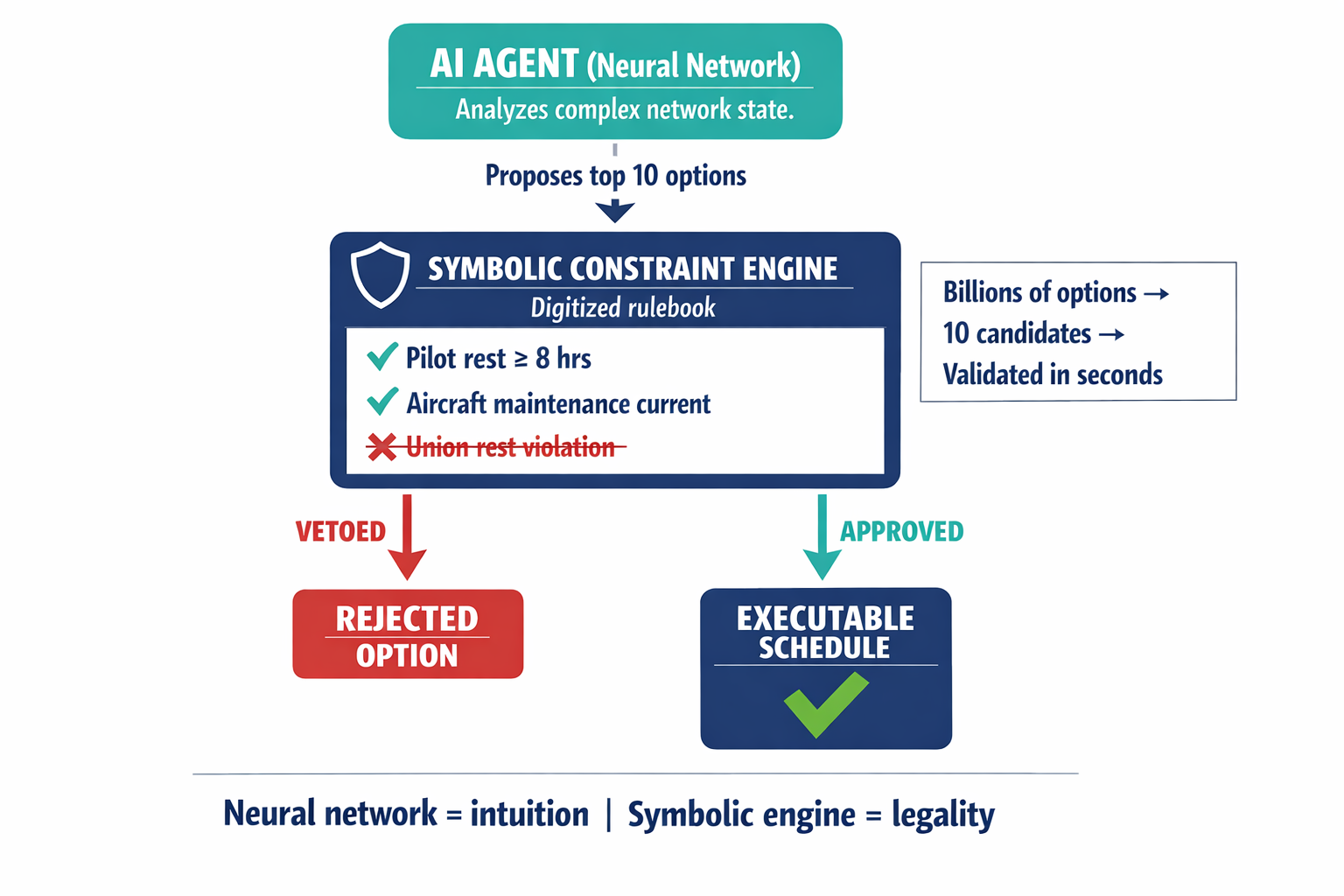
Fair question. We don't trust it blindly. We built what we call a Neuro-Symbolic architecture — a hybrid where the neural network proposes and a deterministic rule engine disposes.
The AI agent analyzes the messy, complex network state and suggests its best moves. Then a symbolic constraint engine — essentially a digitized rulebook — checks every suggestion against hard rules. Can this pilot legally fly this leg? Has this aircraft been maintained? Does this schedule violate union rest requirements? If the AI suggests something illegal, the engine vetoes it. Not sometimes. Every time. Mathematically guaranteed.
This does something elegant for performance, too. Instead of the old solver searching through billions of possibilities, the AI narrows the field to the ten most promising options. The constraint engine only has to validate those ten. Computation that used to take hours drops to seconds.
The neural network provides intuition. The symbolic engine provides legality. Neither works alone. Together, they're fast and safe.
What Happened When We Simulated the Meltdown
We rebuilt the December 2022 Southwest crisis inside our Digital Twin. Same weather data, same network topology, same crew positions. Then we ran two scenarios.
The legacy solver did exactly what SkySolver did in real life — choked on stale data, optimized for a phantom network, produced unusable schedules. Simulated recovery: seven days.
Our Graph Reinforcement Learning agent detected the point-to-point fracture emerging around Denver hours before it became unrecoverable. It executed what we call a pre-emptive firewall: cancelled 20% of flights into Denver early, trapping the disruption locally. It simultaneously repositioned crews to Phoenix to create a backup operational base.
Result: the East Coast network stayed 95% operational. Total cancellations dropped by 66%. The week-long meltdown became a regional disruption.
That moment — watching the simulation diverge from what actually happened — was when I knew we were building something that matters.
This Isn't Just About Airlines
The fragility that broke Southwest exists everywhere complex networks operate under pressure.
Maritime ports face the same combinatorial chaos. A delayed vessel misses its berth slot. Cranes get reassigned. Trucks scheduled for container pickup queue for hours. We're deploying agents that automatically renegotiate slot times and truck appointments in real time when a vessel runs late — smoothing the peaks and valleys that kill port throughput.
Rail networks are rigid graphs with single-track bottlenecks. One delayed train forces a "who waits on the siding?" decision that can gridlock traffic hundreds of miles away. In our simulations of high-density corridors, our agents outperform human dispatchers by 15-20% in delay reduction — often by making counterintuitive moves, like holding a freight train early to clear a path for an express train 50 miles upstream.
The pattern is the same everywhere: networks optimized for efficiency, running on software designed for stability, operating in a world that is neither stable nor predictable.
What About the Cost of Building All This?
Yes, Digital Twins and Graph Reinforcement Learning are expensive to build. I won't pretend otherwise. But consider the alternative.
Southwest's one-week meltdown cost over $1.2 billion — wiping out years of efficiency gains from running a lean network. A blocked Suez Canal costs the global economy billions per day. Over a ten-year horizon, the "tail risk" from these events isn't a rounding error. It's the dominant cost driver.
In normal operations, our agents deliver 2-5% cost savings through smarter buffer management and reduced crew overtime. That alone justifies the investment. But the real value is in the crisis you avoid — the meltdown that never happens, the billion dollars you don't lose, the brand reputation you don't destroy.
We advise a phased approach: build the graph model and Digital Twin first. Run agents in shadow mode alongside human dispatchers. Then graduate to AI-assisted decisions, and eventually autonomous execution for routine, low-risk choices.
The Era of "Good Enough" Math Is Over
We're managing 21st-century complexity with mid-20th-century mathematics. Static solvers that freeze the world, compute an answer, and hope nothing changed. Chatbots that can eloquently describe a schedule but can't repair one.
The logistics industry doesn't need better interfaces. It needs better reasoning. Systems that understand network topology. That learn from simulated catastrophe. That sacrifice optimality for survivability. That are governed by hard rules, not soft probabilities.
The future of logistics belongs to systems that can reason under pressure — not systems that can talk about it.
If you're running operations where a single disruption can cascade across your network, I'd genuinely like to hear how you're thinking about resilience versus efficiency. That tradeoff is the central question of the next decade in logistics, and I don't think anyone has it fully figured out yet.